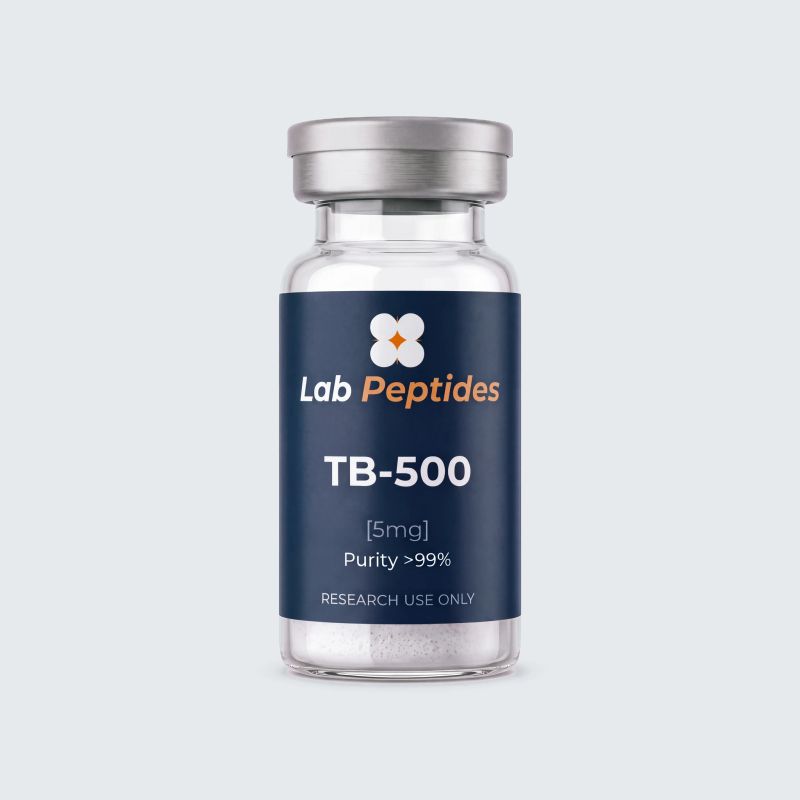
TB-500 5mg Regeneration
BPC-157's perfect partner.
The essential partner to BPC-157. Thymosin Beta-4 fragment — systemic cell migration, angiogenesis. Complementary to BPC-157, which acts locally. The standard combo of advanced recovery protocols.
Research protocols start at: 40 units, i.e. 2 mg per injection (vial prepared with 1 ml of water).
5 mg = what the vial contains, not the dose.See the preparation
- In stock in France
 Ordered with its water: shipped in a magnetic box
10% off every deliveryPause, skip or cancel in 1 clickNo commitment, no hidden fees
No automatic charge: pay for each delivery by card, in Bitcoin (an extra 5% off), or by bank transfer from €100
This product contains TB-500. Published work covers angiogenesis, the formation of new blood vessels. No randomised human clinical trial has characterised contraindications.
The theoretical alerts described in preclinical work concern a history of cancer, particularly vascularised solid tumours, pregnancy and breastfeeding, and proliferative retinopathies.
Your complete kit
The vial alone cannot be used as is. Add what you need to prepare it:
Frequently bought together


Research Use Only (RUO) · Prohibited for human or veterinary use.
Key facts
Our TB-500 5 mg vial is the ideal pilot format to initiate a first regenerative research protocol without committing to extended stock. With 5 mg of lyophilized peptide at HPLC purity ≥98 %, this format covers 2 full loading dose injections (2.5 mg), i.e. 1 to 1.25 weeks at 2 injections per week — perfect for validating a first cycle before moving to the 10 mg flagship format. TB-500 5 mg is intended for independent researchers, experimental sports medicine clinics, and laboratories prioritizing supply flexibility. Why choose 5 mg? Reduced initial investment, simple marks (1 ml = 5 mg/ml, same as the 10 mg), coverage of 2 loading injections. The perfect pilot format to document a first response before committing to more extended research.
Protocol and preparation
| Water added | Concentration | Reading marker |
|---|---|---|
| 1 ml | 5 mg/ml | 40 UI = 2 mg |
| 2 ml | 2,5 mg/ml | 40 UI = 1 mg |
The volume of water does not change the product, only its concentration. Introduce the water slowly along the vial wall, never directly onto the lyophilisate, then swirl without shaking. Markers given on a 1 ml syringe graduated in 100 units.
Asepsis
Disinfect surfaces and stoppers (70% alcohol).
Solvent
Draw the required volume of bacteriostatic water.
Introduction
Inject gently against the vial wall (avoid direct jet on powder).
Solubilization
Roll the vial gently. Do not shake vigorously (degradation risk).
Solution storage Once reconstituted: 2-8°C (refrigerator).
Warning Theoretical tool for chemical handling. Does not constitute medical advice.
Open the dilution calculator- The amount of powder looks tiny. A lyophilisate takes up a few millimetres at the bottom of the vial, sometimes just a translucent film. The stated weight is there.
- The powder is compact, stuck to the wall or to the stopper. Transport moves the freeze-dried cake around. It changes nothing to reconstitution.
- The vial carries no individual label. That is our standard packaging, not a downgraded vial.
- After reconstitution, deposits or filaments appear. This is common, especially with small molecules. Let it settle and roll the vial between your palms, never shake it.
- The parcel is plain. Nothing on the outside indicates the contents or the brand name.
What is not normal: a cracked vial, an uncrimped cap or a stopper that moves, powder that has liquefied or changed colour. In those specific cases, write to us with a photo and we take the vial back.
Recommended reconstitution: 1 ml bacteriostatic water for injection → final concentration 5 mg/ml. This concentration has an operational advantage: 0.5 ml of solution (50 units on 100 IU syringe) corresponds exactly to the standard loading dose (2.5 mg), with the same marks as TB-500 10 mg, simplifying dosing. Procedure: 1) let vial and diluent reach room temperature (15 minutes); 2) disinfect stopper with 70% alcohol; 3) draw bacteriostatic water into sterile syringe; 4) inject slowly along inner wall of vial; 5) gently swirl until dissolution — no vigorous shaking. Dosages reported in preclinical literature: loading phase 2.0-2.5 mg twice weekly, maintenance phase 2.0 mg once weekly. At 5 mg/ml concentration, 2.5 mg corresponds to 0.5 ml (50 units on 100 IU syringe) and 2.0 mg to 0.4 ml (40 units). Autonomy: 5 mg allows 2 injections of 2.5 mg or 2.5 injections of 2 mg, i.e. 1 to 1.25 weeks at 2 injections per week. Ideal pilot format for a short validation cycle. Post-reconstitution storage: refrigerator 2-8 degrees Celsius, 30-day window with bacteriostatic. Over 1 to 1.25 weeks of use, the vial is fully consumed well before the stability limit.
Technical data
- Reconstitution
- 1 ml d'eau → 5 mg/ml. 40 UI = 2 mg ; 50 UI = 2,5 mg.
- Peptide sequence
- Ac-SDKPDMAEIEKFDKSKLKKTETQEKNPLPSKETIEQEKQAGES
- Molecular formula
- C212H350N56O78S
- Molecular weight
- 4963 g/mol
- CAS number
- 77591-33-4
- Physical form
- Poudre lyophilisée
- Recommended solubility
- Eau bactériostatique, NaCl 0,9%
- Storage conditions
- Au réfrigérateur (+2 à +8 °C), à l'abri de la lumière. En poudre, possible au congélateur pour une conservation longue. Une fois préparé : réfrigérateur, jamais au congélateur.
- Use
- Research reagent, in vitro only (RUO)
Storage & handling
Lyophilized unreconstituted TB-500 is stored in the fridge (+2 to +8 °C) in its original sealed packaging, protected from light and humidity; for long-term storage (over 3 months), a -20 °C freezer keeps it for up to 24 months. At refrigerated temperature (2-8 degrees Celsius), documented stability covers at least 12 months. At room temperature (below 25 degrees Celsius), the recommended duration for temporary transport or storage does not exceed 3 weeks. Once reconstituted with bacteriostatic water for injection, TB-500 must imperatively be stored between 2 and 8 degrees Celsius. Post-reconstitution stability is documented for up to 30 days when bacteriostatic water (0.9% benzyl alcohol) is used. With preservative-free sterile water, the usage window narrows to 7-10 days. The peptide is sensitive to repeated freeze-thaw cycles (limit to a maximum of three), direct UV light, thermal shocks, and vigorous agitation that can denature tertiary structure. Prefer aliquots for large-volume formats. TB-500 lyophilised stability is high at -20°C under desiccation: > 24 months with no measurable RP-HPLC purity loss. In reconstituted solution (bacteriostatic water, 1-5 mg/mL), stability is documented 28 days at 2-8°C in amber vial. Optimal pH is neutral (6.5-7.5); avoid alkaline solutions (> pH 8) which favour Gln → Glu deamidation. Strictly protect from UV light. Never refreeze after reconstitution: freeze/thaw cycles generate dimers/trimers detectable by SEC-HPLC. Preferred packaging: type I borosilicate glass vial, siliconised butyl stopper, flip-off aluminium cap.
Mechanism of action
TB-500 (Thymosin Beta-4 peptide, or active fragment of Tbeta-4) is a synthetic peptide derived from Thymosin Beta-4, a 44-amino-acid protein initially identified in the thymus and widely distributed across mammalian tissues. Most research suppliers offer either the full 1-44 sequence (Tbeta-4) or the active 17-23 fragment (LKKTETQ), the latter considered the key functional site responsible for several documented biological effects.
The established primary mechanism of TB-500 is G-actin (monomeric actin) sequestration via a specific binding site, which regulates actin-filamentary dynamics and cellular motility. This fundamental action influences the migration of fibroblasts, corneal keratocytes, endothelial progenitors, and epicardial cardiac progenitors in studied models.
Published work has documented several convergent secondary pathways. First, mobilization of endothelial progenitor cells (EPCs) from bone marrow to injury sites, observed in cardiac and vascular repair models. Second, upregulation of VEGF (Vascular Endothelial Growth Factor) and stimulation of local angiogenesis, critical for post-ischemic tissue revascularization. Finally, anti-inflammatory modulation via the NF-kappaB axis and documented reduction of pro-inflammatory markers (TNF-alpha, IL-1beta) in various murine models.
At the tissue level, the preclinical literature has reported accelerated healing in multiple systems: cornea, skin, Achilles tendon, ligament, post-infarction cardiac muscle, colic mucosa. TB-500 displays plasma stability superior to classical regenerative peptides, with documented systemic diffusion making it a subject of particular interest for repair models distant from the injection site.
As with any research peptide, these data come exclusively from preclinical models (rodent, porcine, in vitro) and limited studies. No marketing authorization exists for human therapeutic use: TB-500 remains strictly a peptide intended for exploratory research.
TB-500 is a synthetic 7-amino-acid fragment (Leu-Lys-Lys-Thr-Glu-Thr-Gln, LKKTETQ, 889.0 Da) corresponding to the active sequence of thymosin β-4 (Tβ4, 43 aa, 4960 Da), a ubiquitously expressed endogenous protein involved in the cytoskeleton. The canonical molecular mechanism of Tβ4 is monomeric G-actin sequestration via its β-thymosin domain (17-35), preventing premature polymerisation into F-actin filaments and freeing actin for rapid cytoskeletal rearrangements during cell migration. The LKKTETQ fragment (TB-500) partially retains this G-actin binding activity. Tβ4 also exerts anti-fibrotic effects via its N-terminal acetylated metabolite Ac-SDKP (N-acetyl-seryl-aspartyl-lysyl-proline, cleaved by prolyl-endopeptidase), which inhibits activated fibroblast proliferation and type I collagen accumulation. Documented signalling pathways include Integrin-Linked Kinase (ILK) activation, NF-κB downregulation, and modulation of several pro-regenerative microRNAs (miR-146a, miR-124).
Studies and references
The scientific corpus on Thymosin Beta-4 and its TB-500 fragment is dense and comes from several independent laboratories, particularly those of Allan Goldstein (GWU Washington), Ron Knutsen, and Hynda Kleinman (NIH). Main publications cover several converging models.
Philp and Kleinman (Annals of the New York Academy of Sciences 2007; DOI 10.1196/annals.1415.026) synthesized the first data on the regenerative properties of Tbeta-4 and its fragments, documenting promotion of endothelial migration, angiogenesis, and cutaneous healing in murine models of complex wounds.
Smart et al. (Nature 2011; DOI 10.1038/nature10188) published a major study showing that Tbeta-4 can reactivate adult epicardial cardiac progenitors in mice, with reduction of infarct size and improvement of left ventricular function post-MI. This work opened the way to several preclinical programs in regenerative cardiology.
In the ophthalmological field, Sosne et al. (Experimental Eye Research 2002; DOI 10.1006/exer.2001.1149) documented accelerated corneal re-epithelialization in rats after chemical injury, with improvement of clinical and histological parameters. These results were extended to dry eye and UV damage models.
On skin repair, Malinda et al. (The Journal of Investigative Dermatology 1999; DOI 10.1046/j.1523-1747.1999.00720.x) reported in rats significant acceleration of excisional wound healing after subcutaneous Tbeta-4 administration. Complementary work in porcine models confirmed these observations closer to human physiology.
Finally, Crockford (Annals of the New York Academy of Sciences 2007) synthesized data on the pharmacological profile, tissue distribution, and pharmacokinetics of TB-500 and Tbeta-4, positioning these peptides as serious research candidates in regenerative medicine. Several phase 2 clinical trials, run on full-length thymosin β4 and not on the TB-500 fragment, were conducted on Stevens-Johnson syndrome, corneal ulcer, and chronic skin lesions, with mixed results published by RegeneRx Biopharmaceuticals.
Corpus limitationsDespite existing phase 2 human data on full-length thymosin β4 (none on the TB-500 fragment), no definitive regulatory approval has been obtained. Reproducibility standards vary across laboratories and formulations. TB-500 remains strictly a preclinical research tool outside validated clinical trial protocols.
Preclinical studies on TB-500 and Tβ4 cover several target organs of regeneration. In experimental cardiology: LAD ligation myocardial infarction model in rats and pigs — partial reconstitution of functional cardiac tissue, improved ejection fraction on echography, reduced fibrosis zone (Bock-Marquette 2004, Nature). In ophthalmology: excimer laser rat/rabbit corneal healing model, alkaline corneal burn — accelerated re-epithelialisation and reduced aberrant neovascularisation. In dermatology: C57BL/6J mouse excisional skin wound, diabetic db/db healing delay, thermal burn model. In neurology: ischaemic stroke MCAO (middle cerebral artery occlusion) rat model — reduced infarct volume, improved neurological scores. In muscle trauma: rat tibialis muscle crush injury model, mdx mouse muscular dystrophy — restoration of sarcomeric histological organisation. In pulmonary fibrosis: bleomycin mouse model — Ac-SDKP-mediated anti-fibrotic action. None of these data transposes directly to human therapeutic use; they remain strictly preclinical (RUO).
- 1Réparation tissulaireThymosin beta4: actin-sequestering protein moonlights to repair injured tissues
- 2
- 3
Similar peptides
TB-500 occupies a central position in the regenerative research peptide class, with a distinctive profile that differentiates it from other candidates in the same category. Compared to BPC-157 (protective pentadecapeptide), TB-500 acts via G-actin sequestration and systemic mobilization of endothelial progenitors, whereas BPC-157 favors an NO-dependent pathway and more local VEGFR2 modulation. Both peptides are often associated in research protocols to explore the synergy of their complementary mechanisms, particularly in tendon and cardiac repair models.
Compared to classical growth factors such as GH (Growth Hormone) or IGF-1, TB-500 presents a significantly more targeted action profile on cell migration and matrix remodeling, without the systemic endocrine anabolic effects characteristic of GH/IGF-1. This specificity makes it a preferred candidate for protocols seeking to stimulate tissue regeneration without disrupting the somatotropic axis.
Compared to full-sequence Tbeta-4 (44 amino acids), the TB-500 fragment (LKKTETQ, residues 17-23) offers more economical synthesis, superior stability, and similar pharmacokinetics in most studied models. Some publications have however suggested that the full sequence might present a slightly different immunomodulatory profile, which remains an open subject of investigation.
Compared to GHK-Cu (copper peptide) or IGF-1 LR3, TB-500 stands out for its systemic mobilization of EPC progenitors from bone marrow, a characteristic relatively unique in this class. In our shop, TB-500 is the second most ordered recovery peptide, just behind BPC-157. Commercialization for human therapeutic use remains prohibited in France, Europe, and the United States.
TB-500 occupies a complementary position to BPC-157 in research healing/regeneration protocols. Where BPC-157 acts primarily via NO/VEGF/Egr-1 on digestive, tendinous and vascular tissues, TB-500 targets actin-cytoskeleton dynamics and the Ac-SDKP anti-fibrotic axis, with documented predominance on cardiac muscle, cornea and diabetic skin. Compared to full-length Tβ4 (4960 Da), TB-500 offers the pharmacological advantage of lower molecular mass (889 Da, better tissue diffusion) but loses the complete anti-apoptotic and angiogenic properties of the native protein. Compared to IGF-1 LR3 (long R3 IGF-1, 9111 Da), TB-500 does not directly stimulate cell proliferation but favours migration and tissue reorganisation. Compared to collagen precursors (bioactive hydrolysed collagen peptides, massive doses required), TB-500 acts at preclinical micromolar doses with a targeted molecular mechanism. The TB-500 + BPC-157 synergy is proposed as a "regenerative stack" in grey literature, validated by several rodent preclinical studies showing additive effects on multi-compartmental tendon injury models.
Frequently asked questions
Is TB-500 5 mg enough to document a loading phase?
How do I reconstitute TB-500 5 mg to simplify dosing?
What is the difference between TB-500 and full Thymosin Beta-4?
Can TB-500 be combined with BPC-157 in research?
Which biological markers are studied in TB-500 protocols?
Is your TB-500 authentic and research-grade?
What is the delivery lead time in Europe?
What is the documented tolerance profile in preclinical studies?
What's the difference between TB-500 and full-length thymosin β-4?
Can TB-500 and BPC-157 be combined in preclinical research?
Should TB-500 HPLC purity exceed 98%?
 The complete guideTB-500 and Thymosin β-4: comprehensive guide to tissue regeneration researchTB-500 is a synthetic thymosin β-4 fragment widely studied for its effects on angiogenesis, cell migration and wound healing. Comprehensive guide: structure, mechanisms, experimental models, pharmacokinetics and research protocols.Read the guide
Also read:Solid-phase peptide synthesis (SPPS): complete guide to Merrifield, Fmoc, Boc, resins, coupling reagents and quality controlBPC-157 vs TB-500: the 2026 research peptide comparison for tissue regeneration and repair