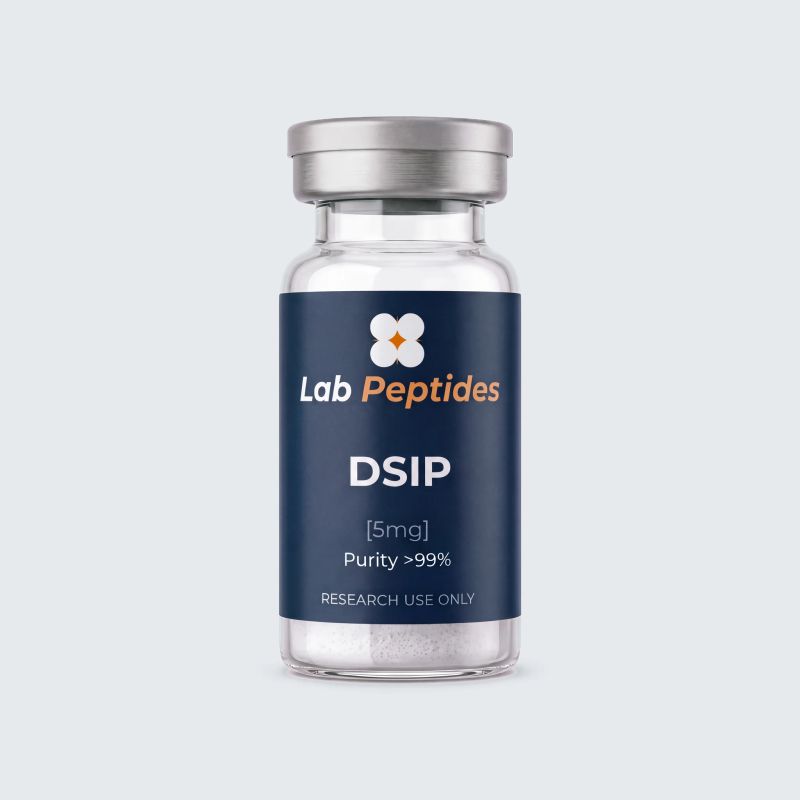
DSIP 5mg Longevity
Deep sleep, restored.
The deep-sleep peptide. Delta Sleep-Inducing Peptide extends slow-wave sleep phases — the ones that truly repair. Restored sleep architecture, erased chronic fatigue. Discovered in 1977 by the University of Basel, backed by 40+ years of research. For those who can't sleep anymore.
- Certificate of analysis
- In stock in France
 Ordered with its water: shipped in a magnetic box
10% off every deliveryPause, skip or cancel in 1 clickNo commitment, no hidden fees
No automatic charge: pay for each delivery by card, in Bitcoin (an extra 5% off), or by bank transfer from €100
Your complete kit
The vial alone cannot be used as is. Add what you need to prepare it:
Frequently bought together


Research Use Only (RUO) · Prohibited for human or veterinary use.
Key facts
DSIP (Delta Sleep-Inducing Peptide) is an endogenous nonapeptide with the sequence Trp-Ala-Gly-Gly-Asp-Ala-Ser-Gly-Glu, molecular mass 848.81 Da, first isolated in 1977 by Guido Schoenenberger and Marcel Monnier at the University of Bern from the cerebral venous blood of rabbits placed in a sleep state via low-frequency thalamic stimulation. This neuroactive peptide holds a singular place in peptide literature: heavily publicized in the 1980s-1990s as the "deep sleep molecule", it is today studied through a much broader lens encompassing neuroendocrine modulation, stress adaptation, thermoregulation, and neuroprotection under deprivation conditions.
In detail
The 5 mg DSIP reference we offer targets laboratories and investigators working on short-chain neuromodulatory peptides, circadian dysregulation models, and exploratory protocols examining delta EEG activity (1-4 Hz). Unlike classical hypnotics (benzodiazepines, Z-drugs, GHB), DSIP acts neither through direct GABAergic facilitation nor through global sedation: animal data suggest a subtle "desynchronization/resynchronization" action on sleep-wake cycles, which differentiates it radically from anesthesia-adjacent hypnotics.
This document synthesizes what forty-seven years of scientific literature allow us today to assert, hypothesize, and question about DSIP: its Bernese historical origin, the never-fully-closed debate about its receptor, preclinical findings on delta sleep, pilot clinical data from the 1980s-1990s (including several Soviet and East-German trials), and the current research positioning of this peptide. Every statement is framed by the Research Use Only (RUO) regulatory framework governing our entire catalog.
Protocol and preparation
| Water added | Concentration | Reading marker |
|---|---|---|
| 1 ml | 5 mg/ml | 40 UI = 2 mg |
| 2 ml | 2,5 mg/ml | 40 UI = 1 mg |
The volume of water does not change the product, only its concentration. Introduce the water slowly along the vial wall, never directly onto the lyophilisate, then swirl without shaking. Markers given on a 1 ml syringe graduated in 100 units.
Asepsis
Disinfect surfaces and stoppers (70% alcohol).
Solvent
Draw the required volume of bacteriostatic water.
Introduction
Inject gently against the vial wall (avoid direct jet on powder).
Solubilization
Roll the vial gently. Do not shake vigorously (degradation risk).
Solution storage Once reconstituted: 2-8°C (refrigerator).
Warning Theoretical tool for chemical handling. Does not constitute medical advice.
Open the dilution calculator- The amount of powder looks tiny. A lyophilisate takes up a few millimetres at the bottom of the vial, sometimes just a translucent film. The stated weight is there.
- The powder is compact, stuck to the wall or to the stopper. Transport moves the freeze-dried cake around. It changes nothing to reconstitution.
- The vial carries no individual label. That is our standard packaging, not a downgraded vial.
- After reconstitution, deposits or filaments appear. This is common, especially with small molecules. Let it settle and roll the vial between your palms, never shake it.
- The parcel is plain. Nothing on the outside indicates the contents or the brand name.
What is not normal: a cracked vial, an uncrimped cap or a stopper that moves, powder that has liquefied or changed colour. In those specific cases, write to us with a photo and we take the vial back.
Exploratory research protocols documented in the DSIP literature show significant dispersion in dosing and schedule, reflecting the absence of consensus on optimal human pharmacokinetics. The 5 mg vial offers flexibility suited to short low-dose schedules (100-200 mcg SC/IM) as well as standard protocols (300-500 mcg SC).
Reconstitution. Add 2 ml of 0.9% bacteriostatic water (benzyl alcohol preserved) to the lyophilized 5 mg vial, allowing the solution to flow slowly against the inner wall rather than directly onto the lyophilized cake. DSIP is less stable in solution than most short peptides: the N-terminal tryptophan motif is sensitive to photo-induced oxidation, and the central Gly-Gly bonds can undergo partial hydrolysis in prolonged aqueous medium. Do not shake vigorously (denaturation risk); gently swirl the vial until complete dissolution (30-60 seconds). Final concentration: 2.5 mg/ml, or 250 mcg per 0.1 ml on a U100 insulin syringe.
Post-reconstitution storage. Refrigerated 2-8 degrees, protected from light (wrap the vial in aluminum or keep in an opaque container). Documented stability 10-14 days maximum in solution, versus 18-24 months for lyophilized powder at -20 degrees. Never freeze/thaw the reconstituted solution (significant degradation after a single cycle).
Schedules documented in the preclinical and pilot clinical literature.
Schedule A - Low exploratory dose100-200 mcg SC (0.04-0.08 ml of reconstituted solution), single injection 30-60 minutes before bedtime, 7-14-day cycle with weekly subjective/polysomnographic assessment.
Schedule B - Standard dose300 mcg SC (0.12 ml) once daily in the evening, 10-21-day cycle. Corresponds to the Scherschlicht 1986 schedule adapted to the SC route.
Schedule C - Occasional high dose (delta-phenotype research only): 500 mcg SC (0.2 ml) single, typically used to characterize EEG dose-response over a single night, followed by a 48-72h wash-out before the next dose.
Schedule D - Russian "deltaran-like" protocol100-150 mcg SC morning AND evening for 14-21 days, targeting adaptogenic/anti-stress positioning rather than pure hypnotic.
Critical timing. Unlike melatonin (DLMO window 30-60 min before bedtime), DSIP appears better documented with a wider administration window (30 min to 2 hours before bedtime). Several Russian works even suggest late-afternoon administration with a delta-sleep peak delayed by several hours, more compatible with the kinetics of a peptide with a brief serum half-life but prolonged central effect.
Routes of administration. Standard subcutaneous route (abdomen, thigh, deltoid) or intramuscular. Oral route is documented as non-functional (rapid gastric degradation). Intranasal route has been explored in Russia with mixed results (estimated 10-20% bioavailability) and is not recommended in the absence of adapted formulation.
Technical data
- Reconstitution
- 2 ml d'eau → 2,5 mg/ml. 4 UI = 100 mcg ; 8 UI = 200 mcg.
- Peptide sequence
- Trp-Ala-Gly-Gly-Asp-Ala-Ser-Gly-Glu
- Molecular formula
- C35H48N10O15
- Molecular weight
- 848.8 g/mol
- CAS number
- 62568-57-4
- Physical form
- Poudre lyophilisée
- Recommended solubility
- Eau bactériostatique, NaCl 0,9%
- Storage conditions
- Au réfrigérateur (+2 à +8 °C), à l'abri de la lumière. En poudre, possible au congélateur pour une conservation longue. Une fois préparé : réfrigérateur, jamais au congélateur.
- Use
- Research reagent, in vitro only (RUO)
Storage & handling
DSIP belongs to the intermediate-stability peptide categoryMore fragile than cyclic cysteine-rich peptides (BPC-157, thymosins), more robust than peptides with highly reactive amide bonds. Three critical factors condition preservation of biological activity: oxidation of the N-terminal tryptophan, hydrolysis of the central Gly-Gly bonds, and global photo-induced degradation.
Unopened lyophilized powder. Storage in the fridge (+2 to +8 °C), in the original unopened packaging, protected from light: documented stability 12 months. For longer storage, a -20 °C freezer remains an option, with documented stability of 24 months. At controlled room temperature (15-25 degrees), stability drops to 3-6 months maximum, with progressive tryptophan-residue degradation observable by HPLC. It is crucial to remove the powder from cold and let it equilibrate 15-30 minutes before opening: any condensation on the powder significantly accelerates hydrolysis and can make the lyophilized cake visually cloudy or sticky.
Reconstituted vial. Refrigerated storage only 2-8 degrees, in an opaque container or wrapped in aluminum. Avoid the refrigerator door (thermal variations). Practical stability 10-14 days, with estimated activity loss of 15-25% at D14 according to accelerated-degradation studies. Beyond 14 days, discard the solution even if visually unchanged: tryptophan oxidation is progressive and invisible to the eye but impacts biological response.
Degradation signs to monitor. Normally clear and colorless solution after reconstitution. Appearance of a slight yellow tint: advanced oxidation, compromised activity. Presence of particles or turbidity: microbial contamination (benzyl alcohol protects but not indefinitely) or peptide precipitation, discard immediately. Abnormal odor: rare but reported in contamination cases, stop signal.
Transport and reception. A DSIP shipment remains viable even after 48-72 hours at room temperature provided the powder has remained dry and protected from direct light. Occasional cold-chain loss (a few hours) has limited impact on lyophilized powder (unlike complex disulfide peptides). Upon receipt of a visibly wet, melted, or decomposed cake, photograph and contact the laboratory before any reconstitution.
Good practice for sensitive short peptides. Prepare small volumes used quickly rather than reconstituting the entire large vial at once. For the 5 mg reference, the 2 ml bacteriostatic water schema is the right compromise between practicality and stability. Note the reconstitution date on the vial with indelible marker.
Mechanism of action
The mechanism of action of DSIP remains, to this day, one of the most intriguing in neuropeptidology. Unlike most modern peptides, no specific high-affinity receptor has been cloned and formally characterized for DSIP, despite four decades of investigation. This absence of a structurally isolated receptor long slowed DSIP's acceptance in the academic neuroscience canon, but has not prevented the reproduction of coherent biological phenotypes across dozens of preclinical models.
The Trp-Ala-Gly-Gly-Asp-Ala-Ser-Gly-Glu sequence is remarkably short and devoid of basic residues. This neutral-to-slightly-acidic chemistry confers high conformational flexibility and a documented ability to cross the blood-brain barrier despite its size, attributable to probable transit through circumventricular organs. The 848.81 Da mass, well above the theoretical passive-diffusion limit (400-500 Da), long puzzled neurophysiologists until radiolabeled-fragment studies confirmed cerebral passage (Banks-Kastin 1984).
Electrophysiologically, the seminal work of Monnier and Schoenenberger (1977, 1984) documented a significant increase in delta-band (1-4 Hz) spectral power on the cortical EEG of rabbits and rats, without a preceding phase of behavioral sedation. This delta increase distinguished DSIP from classical hypnotics: sleep architecture was reorganized rather than forcibly imposed, with preservation of REM cycles and absence of rebound insomnia upon withdrawal.
Modern mechanistic hypotheses favor multi-target indirect modulation rather than a single receptor. Three axes emerge from the post-2000 literature. First, modulation of the somatotropic axis: several works (Graf 1984, Iyer 1988) documented a transient elevation of nocturnal GH and an attenuation of the morning cortisol peak, suggesting upstream hypothalamic action. Second, interaction with the endogenous opioidergic system: DSIP modifies responsiveness to opioid agonists without being opioid itself, interpreted as allosteric or indirect action. Third, a documented antioxidant and neuroprotective effect in ischemia models, attributed to partial ROS scavenging by the N-terminal tryptophan motif.
Finally, recent Russian work (Kovalzon, Sudakov, Mikhaleva) has proposed that DSIP acts as an adaptogenic peptide in the strict sense: it normalizes dysregulated parameters (excess cortisol, delta deficit, sympathetic hyperactivity) without significantly modifying already-balanced parameters in healthy subjects. This "bidirectional" signature remains difficult to validate with modern methodology and must be considered a working hypothesis, not an established fact.
Studies and references
The DSIP literature is uniqueIt combines an initial effervescent phase (1977-1995) with high-quality Western work, an under-exposed Russian discovery phase (1990-2010) with hard-to-access pilot clinical data, and a contemporary phase (post-2010) marked by renewed interest focused on neuroprotective applications.
Founding period 1977-1990. Schoenenberger and Monnier publish in 1977 in Pflugers Archiv the initial isolation of the peptide from the blood dialysates of rabbits in thalamically-induced sleep. The seminal publication documents experimental reproduction of delta increase via intraventricular injection in naive rabbits. Kastin and his New Orleans team confirm in 1978-1984 DSIP's hypnogenic effect in rats with peripheral administration, de facto establishing BBB transit. Graf and Kastin publish in 1984 in Pharmacol Biochem Behav a meta-analysis of 26 preclinical studies documenting a reproducible but moderate-amplitude hypnogenic effect, strongly dependent on experimental parameters (species, injection time, dose).
European clinical studies 1982-1995. Scherschlicht et al. publish in Eur Neurol (1986) the first human data on chronic insomniacs under intravenous DSIP, with documented increase of delta power on polysomnography but mixed subjective results. Schneider-Helmert (Zurich 1985, 1988) conducts several series on opioid and alcohol withdrawal syndrome, documenting reduction of withdrawal dysphoria and insomnia. These works remain pilots (N<30 per study) and have never been the subject of modern double-blind RCTs against active placebo.
Russian and Soviet studies 1985-2010. This literature remains the least known in the West. Mikhaleva, Ivanov et al. at the Shemyakin Institute in Moscow conduct extensive work on DSIP analogs (notably deltaran, Russian formulation) for post-traumatic stress applications, chronic alcoholism, and extreme-condition adaptation (cosmonauts, deep-sea divers). Sudakov publishes in Bull Exp Biol Med (1995-2010) several series on DSIP and emotional stress. Kovalzon of the Russian Academy of Sciences synthesizes this literature in 2003 and 2015: DSIP is positioned there as an adaptogenic peptide more than a pure hypnotic.
Contemporary work 2010-2024. Post-2010 renewed interest has shifted toward three axes. First, neuroprotection under oxidative stress conditions: Mendzheritskii et al. (2014) document hippocampal protection against induced hypoxic crises in rats. Second, HPA axis modulation: Khvatova (2018, 2021) explores DSIP in circadian dysregulation models simulating jet lag. Third, thermoregulation: a few works evoke a role in pharmacological hibernation, which remains speculative.
Methodological limits. It is imperative to emphasize that no modern randomized controlled trial (>100 patients, double-blind, placebo vs. benzodiazepine) has been published on DSIP in humans since 2000. The literature rests mostly on old pilot series, animal models, and Russian work of variable methodological rigor. This reality dictates the strictly RUO positioning of our reference: DSIP remains an exploratory research tool, not a validated therapeutic agent.
- 1
- 2
Similar peptides
Positioning DSIP relative to other tools of sleep and neuroactive stress modulation is crucial to avoid misinterpretation. DSIP is neither a hypnotic nor an anxiolytic in the classical pharmacological sense: it is a neuromodulatory peptide whose profile does not overlap any competing molecule.
DSIP vs melatonin. Melatonin (N-acetyl-5-methoxy-tryptamine) acts on MT1/MT2 receptors to resynchronize the circadian cycle, primarily upstream of the sleep process (sleep-onset timing). DSIP, by contrast, acts on sleep architecture once installed, by increasing delta power of slow waves (N3 stage). The two molecules are complementary rather than competitive: melatonin dictates WHEN to sleep, DSIP modifies HOW one sleeps.
DSIP vs benzodiazepines (BZD). BZDs (diazepam, lorazepam, alprazolam) facilitate GABAergic transmission via an allosteric site on the GABA-A receptor. They induce rapid sedation but fragment sleep architecture: reduction of REM sleep, paradoxical suppression of deep slow waves, pharmacological tolerance in 2-4 weeks, severe withdrawal syndrome. DSIP shows the inverse profile: progressive effect, increase of slow waves, no documented tolerance on short cycles, absence of withdrawal effect. BZDs are effective hypnotics but degrade sleep quality; DSIP theoretically aims at qualitative improvement without direct hypnotic effect.
DSIP vs Z-drugs (zolpidem, zopiclone). Same logic as BZDs, with stronger selectivity for certain GABA-A subtypes. Totally different mechanism from DSIP, risk of dependency and automatic awakening behaviors (induced sleepwalking) documented with Z-drugs, absent with DSIP.
DSIP vs GHB (gamma-hydroxybutyrate). GHB is a partial agonist of GABA-B receptors and of a specific GHB receptor, producing massive augmentation of delta waves and deep sleep at the cost of dose-dependent anesthesia-adjacent sedation and major misuse potential. While the superficial "delta" effect recalls that of DSIP, the mechanisms are unrelated and the safety profile is incomparable. DSIP is not a peptidic GHB.
DSIP vs Selank and Semax. Selank (anxiolytic) and Semax (cognitive nootropic) are the other two Russian neuroactive peptides in our catalog. Selank targets daytime anxiety via the indirect GABA-oxytocin axis, Semax targets attention and working memory via BDNF increase. DSIP targets a third dimension: deep sleep quality and adaptation to chronic stress. The three peptides form a complementary but non-redundant Russian neuropeptide cluster.
DSIP vs endogenous somatotropic peptides. While DSIP indirectly modulates nocturnal GH (Graf 1984, Iyer 1988), this action is a collateral effect of its central action on sleep architecture, not a direct action on somatotropes. GHRHs (Tesamorelin, CJC-1295) or GHRPs (Ipamorelin, Hexarelin) act directly on the pituitary and produce GH elevations 10-100 times larger. These two families are not interchangeable.
Realistic positioning. DSIP is not the "miracle sleep" that some non-scientific marketing sources long described. It is an exploratory research peptide, interesting for laboratories working on delta-sleep architecture, adaptation to chronic stress, or neuroprotection under deprivation conditions. Expectations must be aligned with the reality of a literature that is mostly preclinical with a few old pilot series: coherent but not spectacular phenotypes, variable individual response, need for well-constructed protocols to observe anything.
Frequently asked questions
Will DSIP actually improve my sleep?
What is the difference between DSIP and a classical sleeping pill?
Is there a risk of dependence or tolerance?
Why inject rather than take a capsule?
Can DSIP be combined with other peptides or hormones?
What is the documented adverse-effect profile?
Is DSIP on the WADA prohibited list?
Why so little modern data on DSIP?
 Read before you orderPeptides and sleep in research: DSIP, orexin and hypothalamic axis modulationDSIP, orexin, galanin, MCH: mapping of neuromodulator peptides explored in research on sleep-wake cycles, circadian regulation and NREM/REM architectures.Read the article