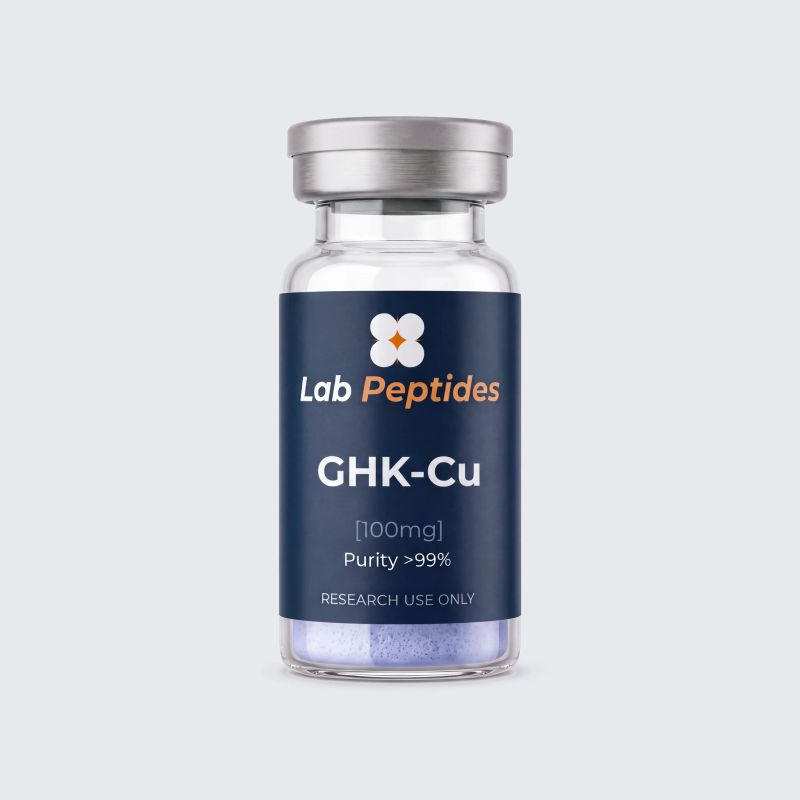
GHK-Cu 100mg Skin Tissues
The copper star, large size.
The anti-aging copper tripeptide par excellence. GHK-Cu modulates 4,000+ genes tied to skin aging — collagen, elastin, regeneration. 50 years of research, 200+ papers. Visibly firmer skin. Science has a name for perfect skin: GHK-Cu.
Research protocols start at: 2 units, i.e. 1 mg per day (vial prepared with 2 ml of water).
100 mg = what the vial contains, not the dose.See the preparation
- Certificate of analysis
- In stock in France
 Ordered with its water: shipped in a magnetic box
10% off every deliveryPause, skip or cancel in 1 clickNo commitment, no hidden fees
No automatic charge: pay for each delivery by card, in Bitcoin (an extra 5% off), or by bank transfer from €100
Your complete kit
The vial alone cannot be used as is. Add what you need to prepare it:
Frequently bought together


Research Use Only (RUO) · Prohibited for human or veterinary use.
Key facts
GHK-Cu (Glycyl-L-Histidyl-L-Lysine, Cu2+ copper complex) is a tripeptide of 340 Da free, 403 Da complexed with copper, discovered by Loren Pickart in 1973 at the University of San Francisco. It appears in human plasma at approximately 200 ng/ml in young subjects, with a drop of more than 60 % between ages 20 and 60, an observation that motivated forty years of research on its role in tissue repair, wound healing, hair growth and cutaneous longevity. Its short sequence Gly-His-Lys binds Cu2+ ions with exceptional affinity through the histidine imidazole ring and the terminal amine, forming the characteristic blue complex.
In detail
GHK-Cu is one of the few peptides to benefit from a rigorous scientific corpus simultaneously covering molecular biology (activation of more than 4000 genes in cutaneous fibroblasts, Pickart 2015 BioMed Research International), clinical dermato-regeneration (healing, anti-ageing, damaged skin) and hair aesthetics (documented trichological protocols). Unlike most peptides sold in research networks, GHK-Cu has been integrated for 40 years in premium cosmeceutical formulations (Procyte Corporation, NeoCutis, Estee Lauder Advanced Night Repair) after showing reproducible structural effects on human skin.
This vial delivers 100 mg of high-purity GHK-Cu (>98 %, HPLC) in lyophilised form, type I borosilicate glass, fluorinated butyl stopper. The dose is deliberately high compared to classical peptides (5-10 mg for GLP-1 analogues, 2-5 mg for short regeneratives) because documented GHK-Cu protocols use larger quantities in trichological and cutaneous research (1-2 mg per injection, concentrated topical applications). Destined exclusively for in vitro research and preclinical studies on non-human models.
Protocol and preparation
| Water added | Concentration | Reading marker |
|---|---|---|
| 2 ml | 50 mg/ml | 10 UI = 5 mg |
| 3 ml | 33,33 mg/ml | 10 UI = 3,33 mg |
The volume of water does not change the product, only its concentration. Introduce the water slowly along the vial wall, never directly onto the lyophilisate, then swirl without shaking. Markers given on a 1 ml syringe graduated in 100 units.
Asepsis
Disinfect surfaces and stoppers (70% alcohol).
Solvent
Draw the required volume of bacteriostatic water.
Introduction
Inject gently against the vial wall (avoid direct jet on powder).
Solubilization
Roll the vial gently. Do not shake vigorously (degradation risk).
Solution storage Once reconstituted: 2-8°C (refrigerator).
Warning Theoretical tool for chemical handling. Does not constitute medical advice.
Open the dilution calculator- The amount of powder looks tiny. A lyophilisate takes up a few millimetres at the bottom of the vial, sometimes just a translucent film. The stated weight is there.
- The powder is compact, stuck to the wall or to the stopper. Transport moves the freeze-dried cake around. It changes nothing to reconstitution.
- The vial carries no individual label. That is our standard packaging, not a downgraded vial.
- After reconstitution, deposits or filaments appear. This is common, especially with small molecules. Let it settle and roll the vial between your palms, never shake it.
- The parcel is plain. Nothing on the outside indicates the contents or the brand name.
What is not normal: a cracked vial, an uncrimped cap or a stopper that moves, powder that has liquefied or changed colour. In those specific cases, write to us with a photo and we take the vial back.
Standard reconstitutionSlowly inject 2 ml of bacteriostatic water into the 100 mg vial, creating a clear turquoise blue solution at 50 mg/ml. The intense blue colour is normal and characteristic of the copper complex: absence of coloration or brown coloration indicates oxidation or an abnormal lot. Do not shake brutally, gently roll between palms.
- Systemic subcutaneous injection: 1-2 mg per injection = 0.02-0.04 ml
- Local intradermal injection (trichological mesotherapy): 0.5-1 mg per zone = 0.01-0.02 ml multiplied over 10-20 points
- Topical application after dilution (in hydroalcoholic or liposomal vehicle): concentrations 0.05-0.2 % (500 mcg/ml to 2 mg/ml)
- Standard systemic protocol: 1-2 mg SC daily in 4-8 week cure
- Intradermal trichological protocol: 10-20 mg total per session, 1-2 sessions per week for 8-12 weeks, then monthly maintenance
- Cosmetic cutaneous protocol: topical application 0.1 % 1-2 times per day continuously
- Post-lesion regeneration protocol: 2-5 mg SC daily for 2-4 weeks around the healing phase
- Bluish urinary excretion: normal, transient, linked to excess copper elimination.
- Slight blue mark at subcutaneous injection site: transient (12-24h), aesthetic, reversible.
- In subjects with Wilson's disease (pathological copper accumulation), absolute theoretical contraindication.
- Never dilute in solutions based on EDTA, citrate or phosphate at high concentration: these chelators compete and dissociate copper from the tripeptide, reducing biological activity.
- Natural pH of the reconstituted solution is around 5.5-6.5, compatible with SC injection.
- Topical minoxidil + topical GHK-Cu: effect addition on androgenetic alopecia (mechanisms are distinct: minoxidil acts on potassium channels, GHK-Cu on dermal papilla and collagen)
- Microneedling + GHK-Cu applied immediately: increased penetration, strengthened regenerative effect
- Fractional laser + GHK-Cu post-procedure: reduction of recovery times
This product is not intended for human use. The protocols described are examples drawn from scientific literature, provided strictly for informational purposes for research work on non-human models.
Technical data
- Reconstitution
- 2 ml d'eau → 50 mg/ml. 2 UI = 1 mg ; 4 UI = 2 mg.
- Peptide sequence
- Gly-His-Lys · Cu²⁺
- Molecular formula
- C14H23CuN6O4
- Molecular weight
- 402.92 g/mol
- CAS number
- 89030-95-5
- Physical form
- Poudre lyophilisée bleutée
- Recommended solubility
- Eau bactériostatique, NaCl 0,9%
- Storage conditions
- Au réfrigérateur (+2 à +8 °C), à l'abri de la lumière. En poudre, possible au congélateur pour une conservation longue. Une fois préparé : réfrigérateur, jamais au congélateur.
- Use
- Research reagent, in vitro only (RUO)
Storage & handling
Sealed unreconstituted vialIn the fridge (+2 to +8 °C); for long-term storage (over 3 months), a -20 °C freezer is an option, stability 36 months (copper complex is particularly stable compared to free peptides thanks to chelation). At 2-8 C, stability 18 months. At room temperature (20-25 C), stability 2-3 months, significantly longer than most peptides.
- 4-8 C (refrigerator): optimal stability 30 days, stable blue colour.
- -20 C: acceptable for aliquots. Only one freeze-thaw cycle tolerated without significant activity loss.
- Light: keep protected from UV light in an opaque box or aluminium. Prolonged UV light can cause photo-induced dissociation of the copper complex.
- pH: solution stable pH 4.5-7.5. Avoid extreme pH which destabilises the complex.
- Handling temperature: avoid repeated refrigerator exits-entries which cause condensation in the vial. Draw the volume needed for 1-2 injections and replace immediately.
- Loss of blue coloration: complex dissociation, free peptide or precipitated copper (non-toxic but loss of activity).
- Brown or green coloration: oxidation of copper to non-complexed Cu2+ or Cu3+ (toxic form).
- Greenish precipitate: reaction with residual phosphates or chlorides, lost chelation.
- Milky veil: peptide aggregation, hydrolytic degradation.
Recommended aliquotingFor extended use beyond 30 days, prepare 5-10 aliquots of 0.2 ml in 0.5 ml microtubes, frozen at -20 C. Thaw one aliquot as needed, store 7-10 days at 4 C after thawing.
Laboratory documentationReconstitution date, lot, storage conditions, aliquot usage must be systematically recorded in a laboratory logbook for experimental result traceability.
Mechanism of action
The mechanism of GHK-Cu articulates around three axesCopper chelation, extracellular matrix remodelling, and massive transcriptional modulation.
First axis, copper chelation and transport. Free Cu2+ is toxic (Fenton reactions, hydroxyl radicals), but the GHK-Cu complex is stable, diffusible and delivers copper in a targeted manner to copper-dependent metalloenzymes: lysyl oxidase (collagen/elastin crosslinking), Cu/Zn superoxide dismutase (SOD1, antioxidant defence), tyrosinase (controlled melanogenesis), dopamine-beta-hydroxylase. This controlled delivery explains why GHK-Cu restores copper-dependent enzymatic functions without metallic toxicity (Pickart & Margolina 2018 Int J Mol Sci).
Second axis, extracellular matrix and tissue regeneration. Maquart 1988 J Clin Invest showed that GHK-Cu at nanomolar concentration stimulates type I collagen synthesis by fibroblasts by 60-200 %, of glycosaminoglycans (hyaluronic acid, heparan sulphate) and proteoglycans. Simeon 2000 Life Sci simultaneously documented the stimulation of matrix repair and the suppression of degradation by MMP-2 and MMP-9 (matrix metalloproteases), a unique profile of constructive rather than destructive remodelling. Pollard 2005 J Biomed Mater Res confirmed the acceleration of cutaneous healing in injured animals and humans.
Third axis, genome-wide transcriptional modulation. Pickart 2015 BioMed Res Int sequenced by Affymetrix chip the effects of 10 nM GHK-Cu on human fibroblasts after 24h: 4192 significantly modulated genes, including activation of DNA repair programmes (NBN, BRCA1), regeneration (collagens, elastin, integrins), antioxidant defence (glutathione peroxidase, SOD, peroxiredoxins) and anti-inflammatory modulation (reduction of TNF-alpha, IL-6, IL-8). It is the peptide with the widest documented genomic modulation spectrum, which explains the apparent diversity of its effects (skin, hair, healing, anti-ageing).
Fourth axis, stem cells and hair growth. Pyo 2007 Biofactors demonstrated that GHK-Cu activates the hair follicle by stimulating dermal papilla stem cells, increases follicle size, prolongs the anagen phase and inhibits early catagen follicle apoptosis. Daily topical applications at 0.05-0.1 % in liposomal vehicle have been validated in several controlled trichology dermatology studies.
PharmacokineticsThe complex is unstable in plasma (apparent half-life <30 min) but copper is rapidly taken up by target tissues where it is incorporated into copper-dependent enzymes. The biological effect thus persists well beyond plasma presence.
Studies and references
The GHK-Cu literature exceeds 300 PubMed-indexed publications since 1973, including several systematic reviews and meta-analyses.
Initial discovery and characterisationPickart 1973 Nature described the effect of young plasma fractions on hepatic restoration, isolating the GHK tripeptide sequence. Pickart & Thaler 1973 Nature New Biology confirmed activity in a purified system. The following 10 years established the exceptional Cu2+ binding (Lau & Sarkar 1981 Biochem J) and tissue distribution.
Cutaneous healing and regenerationMaquart 1988 J Clin Invest (collagen kinetics on fibroblasts), Downey 1985 Surg Forum (human leg ulcers, healing accelerated by 30 %), Mulder 1994 Wound Rep Reg (randomised double-blind trial 120 diabetic ulcer patients, closure time reduction of 50 %). Tredget 1998 J Burn Care Rehabil documented application in burn patients with reduction of hypertrophic fibrosis.
Cutaneous ageing and cosmetic anti-ageingLeyden 2002 J Cosmet Dermatol (randomised double-blind study 67 women aged 45-70, GHK-Cu 0.2 % cream, 12 weeks: significant improvement in dermal density, elasticity, reduction of peri-ocular wrinkles). Finkley 2005 J Am Acad Dermatol (comparison GHK-Cu vs vitamin C vs retinol on photo-ageing, superior GHK-Cu effect on structural markers). Abdulghani 1998 Dis Mon (efficacy in seborrhoeic dermis and actinic lesions).
Hair growthTrachy 1990 (patent with Procyte), followed by Pyo 2007 Biofactors (dermal papilla activation in vitro), Pickart 2017 Cosmetics (clinical synthesis: daily topical 0.1-0.2 % GHK-Cu increases hair density by 15-35 % over 4-6 months in mild to moderate androgenetic alopecia, effect stackable with minoxidil).
Anti-inflammatory and immunomodulatory propertiesMcCormack 2001 Int J Biol Sci (TNF-alpha, IL-1, IL-6 suppression in LPS-stimulated cultures), Hong 2015 Front Pharmacol (neuroprotection preclinical Alzheimer and Parkinson models, cerebral antioxidant action). Cebrian 2005 J Biol Chem (fibrinogen reduction, anti-thrombotic effect).
Bone and tendon regenerationPollard 2005 J Biomed Mater Res (bone healing acceleration through incorporation in grafts), several studies on tendon matrices repaired with GHK-Cu incorporated.
Genomic anti-ageingPickart 2015 BioMed Res Int (genome-wide analysis, 4192 modulated genes, reset of juvenile programmes), Pickart 2018 Int J Mol Sci (review update completing the in vitro senescence-reversing effect).
ToleranceOver 40 years of cosmetic, dermato-regenerative and clinical use, GHK-Cu presents an extremely clean profile. The rare reported side effects (local reactions, transient bluish discoloration) are mild and reversible. No documented systemic toxicity at usual doses (mg/kg).
Critical limitationMost human clinical trials are in topical dermatology. Data on systemic subcutaneous injection in humans remain limited, although the copper complex pharmacology theoretically justifies effective systemic bioavailability.
- 1
- 2Remodelage tissulaireThe human tri-peptide GHK and tissue remodeling
- 3
Similar peptides
GHK-Cu occupies a singular position among regenerative peptides through its copper chelation mechanism, ancient scientific corpus and documented cosmetic use. Versus other regeneratives:
Versus BPC-157 (15 AA, dose 500 mcg-1 mg)BPC-157 is mostly oriented towards gastro-protection, tendon and vascular regeneration (angiogenesis via VEGF, nitric oxide pathway). GHK-Cu is oriented towards structural cutaneous regeneration (collagen, elastin) and trichology. Both are complementary in multi-tissue protocols, with non-redundant mechanisms.
Versus TB-500 / Thymosin beta-4 (43 AA, dose 2-10 mg)TB-500 acts mainly on the cytoskeleton (G-actin sequestration), cell migration and angiogenesis. GHK-Cu acts on extracellular matrix and broad genomic transcription. TB-500 is more oriented towards internal repair (cardiac, tendon), GHK-Cu more oriented towards surface (skin, hair).
Versus retinol and retinoic acid (cosmetic anti-ageing reference): retinol acts via RAR/RXR receptors and transcriptional modulation but with irritating effects (desquamation, solar sensitivity). GHK-Cu acts via copper chelation and massive genomic modulation without irritation: it is the morning (GHK-Cu) + evening (retinol) combination often adopted in premium cosmeceutics.
Versus vitamin C (ascorbic acid) topicalVitamin C is cofactor of prolyl/lysyl hydroxylase (collagen synthesis) and antioxidant. It is unstable, photo-sensitive and irritating at high concentrations. GHK-Cu is stable, non-irritating and acts on a broader genomic spectrum. Frequent combination in cosmeceutical serums: additive effects.
Versus Minoxidil topical (trichology)Minoxidil acts via vasodilation (potassium channels) and anagen prolongation. GHK-Cu acts via dermal papilla stem cells and matrix. Both are complementary: empirical studies document superior hair density with combination than with each alone.
Versus exosomes (cutting-edge cell derivatives in dermato-regeneration): exosomes deliver a complete cocktail of microRNAs, proteins, growth factors. GHK-Cu is a simple, well-characterised, reproducible molecule. Exosomes are more potent but less standardised; GHK-Cu is easier to handle and dose.
Versus biomimetic cosmetic peptides (matrixyl, argireline, acetyl hexapeptide): these peptides are protein fragments with targeted activity (calcium neurotransmission modulation for argireline, matrix stimulation for matrixyl). GHK-Cu is more polyvalent (healing + matrix + genome + hair) and more ancient in the literature.
Unique positioningShort tripeptide, exceptional copper stability, 50-year corpus, commercial cosmetic use integrated since the 1990s, broadest documented genomic modulation for a peptide. GHK-Cu is one of the rare peptides to combine the triple advantage fundamental research / commercial cosmeceutical application / accessible cost.
Frequently asked questions
Why is the reconstituted solution blue?
Can it be applied topically after reconstitution?
What is the difference between free GHK and GHK-Cu?
Is there a risk of copper toxicity?
How long to observe an effect on skin or hair?
Can GHK-Cu be combined with BPC-157 or TB-500?
The 100 mg vial seems high-dosed, is it normal?
Is the transient blue skin coloration at the injection site a problem?
 The complete guideGHK-Cu: complete guide to the copper peptide (genes, skin, healing, dosage)GHK-Cu, the copper tripeptide discovered in 1973: copper chelation, gene-expression data, collagen, wound healing, skin and hair, human studies, published doses, reconstitution and safety. The reference guide for research.Read the guide
Also read:Dermatological peptides in research: GHK-Cu, Matrixyl, Argireline and the science of cosmeceuticalsGHK-Cu: The Copper Peptide Star of Anti-Aging Serums