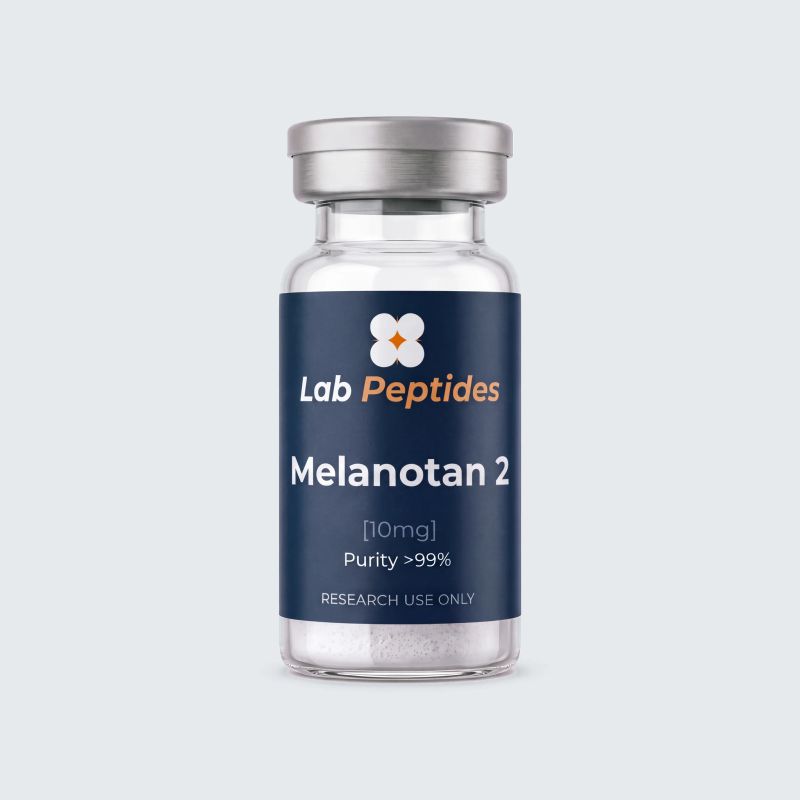
Melanotan 2 10mg Neuromodulation
UV-free tan. Top 3 seller.
The tanning peptide in our top 3 best-selling peptides. Melanocortin MC1R receptor activation — UV-free, lasting, even tan. Libido bonus (MC4R action) observed from the very first clinical trials. Sun without sun, libido as a gift.
Research protocols start at: 5 units, i.e. 250 mcg per day (vial prepared with 2 ml of water).
10 mg = what the vial contains, not the dose.See the preparation
- Certificate of analysis
- In stock in France
 Ordered with its water: shipped in a magnetic box
10% off every deliveryPause, skip or cancel in 1 clickNo commitment, no hidden fees
No automatic charge: pay for each delivery by card, in Bitcoin (an extra 5% off), or by bank transfer from €100
Your complete kit
The vial alone cannot be used as is. Add what you need to prepare it:
Frequently bought together


Research Use Only (RUO) · Prohibited for human or veterinary use.
Key facts
Melanotan-2 10mg (MT-II, MT-2) is a non-selective synthetic analog of alpha-melanocyte stimulating hormone (alpha-MSH) with the sequence Ac-Nle-cyclic[Asp-His-D-Phenylalanine-Arg-Trp-Lys]-NH2. Developed during the 1980s by Victor Hruby and Mac Hadley's teams at the University of Arizona, this 1024 Da cyclic heptapeptide was initially designed to prevent skin cancer by stimulating protective melanin synthesis without requiring prolonged solar exposure. Cyclization between Asp and Lys residues and substitution of natural phenylalanine by its D enantiomer dramatically increase metabolic stability and potency versus endogenous alpha-MSH, with a plasma half-life of approximately 33 hours post-subcutaneous administration.
In detail
Unlike PT-141 (Bremelanotide, Vyleesi FDA 2019), derived from the same melanocortin chemistry but deliberately MC3R/MC4R-central selective to avoid pigmentation, Melanotan-2 is deliberately non-selective and activates the full melanocortin receptor set MC1R, MC3R, MC4R, and MC5R. This unique polypharmacology generates an action profile combining three distinct dimensions: active cutaneous pigmentation via MC1R on epidermal melanocytes, central sexual stimulation via hypothalamic MC3R/MC4R (spontaneous erections in men, libidinal stimulation in both sexes), and appetite modulation via MC4R with transient anorexigenic effect.
MT-2 is not approved as a drug in the United States or Europe; its first-generation cousin Melanotan-1 (Afamelanotide, Clinuvel's Scenesse) has conversely obtained FDA approval in 2019 for treatment of erythropoietic protoporphyria (EPP), validating the MC1R therapeutic activation proof of concept. For MT-2, legal status in Europe is that of a research-use-only (RUO) compound, its over-the-counter sale specifically prohibited in the United Kingdom by MHRA since 2008 and monitored in several EU countries.
The Atlas Lab Melanotan-2 10mg vial ships lyophilized, HPLC specification of at least 98% purity; the certificate of analysis is published on this page. In exploratory research, MT-2 occupies a unique position in the melanocortin space: that of a universal analog enabling simultaneous study of pigmentation, sexual behavior, appetite, and thermoregulation axes, with sufficient potency to generate observable biological effects at low subcutaneous doses of 250 to 500 mcg.
Protocol and preparation
| Water added | Concentration | Reading marker |
|---|---|---|
| 1 ml | 10 mg/ml | 10 UI = 1 mg |
| 2 ml | 5 mg/ml | 40 UI = 2 mg |
The volume of water does not change the product, only its concentration. Introduce the water slowly along the vial wall, never directly onto the lyophilisate, then swirl without shaking. Markers given on a 1 ml syringe graduated in 100 units.
Asepsis
Disinfect surfaces and stoppers (70% alcohol).
Solvent
Draw the required volume of bacteriostatic water.
Introduction
Inject gently against the vial wall (avoid direct jet on powder).
Solubilization
Roll the vial gently. Do not shake vigorously (degradation risk).
Solution storage Once reconstituted: 2-8°C (refrigerator).
Warning Theoretical tool for chemical handling. Does not constitute medical advice.
Open the dilution calculator- The amount of powder looks tiny. A lyophilisate takes up a few millimetres at the bottom of the vial, sometimes just a translucent film. The stated weight is there.
- The powder is compact, stuck to the wall or to the stopper. Transport moves the freeze-dried cake around. It changes nothing to reconstitution.
- The vial carries no individual label. That is our standard packaging, not a downgraded vial.
- After reconstitution, deposits or filaments appear. This is common, especially with small molecules. Let it settle and roll the vial between your palms, never shake it.
- The parcel is plain. Nothing on the outside indicates the contents or the brand name.
What is not normal: a cracked vial, an uncrimped cap or a stopper that moves, powder that has liquefied or changed colour. In those specific cases, write to us with a photo and we take the vial back.
The Atlas Lab Melanotan-2 10mg vial is reconstituted with 2 ml of bacteriostatic water to reach a final concentration of 5 mg/ml, or 5,000 mcg/ml, optimal for precise dosing with 30-31G x 100-unit insulin syringes. Each 0.05 ml (5 units on a U-100 insulin syringe) delivers 250 mcg of MT-2, each 0.1 ml (10 units) delivers 500 mcg.
Loading phaseInitial exploratory dose at 0.25 mg (250 mcg, 5 units) subcutaneously on day one to evaluate individual tolerance, particularly regarding nausea which is the primary limiting adverse effect. Then move to 0.5 mg per day (10 units) if tolerated, maintain this daily dose for 10 to 14 days to achieve target pigmentation. Pigmentary response is dose-dependent and results-dependent: Fitzpatrick phototype I-II subjects require higher doses and greater UV exposure than phototype III-IV.
Maintenance phaseOnce target pigmentation is achieved, reduce to 1-to-2 administrations per week of 0.5 mg each to maintain tan. The 33-hour plasma half-life permits this spaced dosing without significant effect loss. MT-2-induced pigmentation progressively decreases on discontinuation over a 1-to-3-month period depending on individual epidermal renewal rate.
UV exposureContrary to a frequent misconception, MT-2 does not replace solar exposure or UV sessions. MT-2 stimulates melanin production in melanocytes, but melanosome maturation and transfer to keratinocytes require complementary UV stimulation. A typical integrated protocol includes 3 to 5 short UV sessions (5 to 10 minutes in cabin or modest morning solar exposure) per week during loading phase, with adequate photoprotection maintained to avoid sunburn.
Injection sitePreferential subcutaneous abdominal route (lower lateral abdomen near umbilicus), alternatively anterior thigh or triceps. Rotate sites with each administration to avoid local irritation. Use 30G or 31G sterile insulin syringes, never reuse.
TimingEvening administration significantly reduces nausea for most users, these effects being concentrated in the 30 to 120 minutes post-injection. Avoid administration upon waking or on empty stomach: taking a small meal 30 minutes before injection substantially limits nausea.
Essential precautionsMANDATORILY obtain a complete dermatological examination before starting an MT-2 protocol, with nevus mapping and reference photographs. Monitor all nevi during and after protocol, consult a dermatologist immediately in case of size, shape, or color modification or appearance of new nevus. Contraindicated in subjects with melanoma history, numerous atypical nevi (familial atypical nevus syndrome), pregnancy, breastfeeding. Caution in subjects under treatment for hypertension (MT-2 may transiently increase blood pressure). Discontinue immediately in case of severe headaches, chest pain, or focal neurological signs.
Technical data
- Reconstitution
- 2 ml d'eau → 5 mg/ml. 5 UI = 0,25 mg ; 10 UI = 0,5 mg.
- Peptide sequence
- Ac-Nle-cyclo[Asp-His-D-Phe-Arg-Trp-Lys]-NH2
- Molecular formula
- C50H69N15O9
- Molecular weight
- 1024.2 g/mol
- CAS number
- 121062-08-6
- Physical form
- Poudre lyophilisée
- Recommended solubility
- Eau bactériostatique, NaCl 0,9%
- Storage conditions
- Au réfrigérateur (+2 à +8 °C), à l'abri de la lumière. En poudre, possible au congélateur pour une conservation longue. Une fois préparé : réfrigérateur, jamais au congélateur.
- Use
- Research reagent, in vitro only (RUO)
Storage & handling
The lyophilized Melanotan-2 10mg vial stores between 2 and 8 degrees Celsius in its original packaging, protected from direct light and any moisture source. Under these optimal conditions, a lyophilizate generally remains stable for up to 24 months. Intramolecular cyclization between Asp and Lys residues grants MT-2 structural stability superior to most linear peptides, but the lyophilized form remains sensitive to atmospheric humidity: carefully reseal the vial after handling. After reconstitution with 2 ml of bacteriostatic water (0.9% benzyl alcohol), the resulting solution at 5 mg/ml stores between 2 and 8 degrees Celsius for 30 to 45 days with stability exceeding 95%. This duration is consistent with typical usage rhythm of loading + maintenance cycles that generally consume the entire vial in 20 to 40 days. Never freeze the reconstituted vial: freeze-thaw cycles may cause partial aggregation of the cyclic form and 5-to-10% bioactivity loss per cycle. Upon reception, immediately place the vial in refrigeration. Brief exposure to ambient temperature during transport does not significantly alter lyophilized product bioactivity thanks to its inherent structural stability, but prolonging this exposure beyond 96 consecutive hours is inadvisable. Visual check before use: the reconstituted solution must remain perfectly clear, colorless, or very slightly pale yellow. Any appearance of turbidity, precipitate, or significant color change indicates degradation and prohibits vial use. MT-2 may develop a slight amber yellow coloration after several weeks in solution, without impact on bioactivity, but a frankly brown or orange coloration signals oxidation and should lead to replacement. Never dilute MT-2 with non-sterile water, solutions containing highly concentrated divalent metal ions (calcium, magnesium) that may affect cyclic structure, or heavily alkaline (above pH 9) or heavily acidic (below pH 3) buffered solutions. Dilutions in 0.9% NaCl, water for injection, and bacteriostatic water are compatible and recommended. The certificate of analysis is published on this page, viewable before you order.
Mechanism of action
Melanotan-2 mechanism of action articulates four distinct biological pathways corresponding to the four activated melanocortin receptor subtypes, each localized in different tissues and mediating specific physiological effects.
First pathway, cutaneous pigmentation via MC1R on epidermal melanocytes. MC1R activation by MT-2 triggers an adenylate-cyclase-cAMP-PKA-CREB-MITF cascade culminating in transcriptional stimulation of the tyrosinase gene, key enzyme of melanogenesis. The result is differential switching between phaeomelanin (red/yellow pigment, weakly photoprotective) and eumelanin (brown/black pigment, strongly photoprotective), with progressive predominance of eumelanin in melanosomes transferred to keratinocytes. Induced photoprotection represents roughly SPF 3 to 5 equivalent, insufficient to replace classical solar protection but sufficient to reduce actinic erythema and UVB-induced DNA damage. Crucially, MC1R activation by MT-2 does not eliminate the need for UV exposure: final pigmentation results from synergy between MT-2 melanocyte stimulation and UV stimulation activating melanosome maturation and transfer.
Second pathway, sexual behavior via central MC3R and MC4R. MT-2 crosses the blood-brain barrier at therapeutic doses and activates MC3R and MC4R receptors expressed in the hypothalamus (paraventricular nucleus), locus coeruleus, and sacral spinal cord. This central activation triggers oxytocin release, dopamine in mesolimbic reward circuits, and stimulates the sacral parasympathetic system responsible for male erection and female lubrication. Wessells and colleagues (1998, Urology) documented durable spontaneous erections in 80% of men receiving 0.025 mg/kg MT-2 subcutaneously, with onset 30 to 90 minutes post-injection and duration of 2 to 4 hours. Female libidinal stimulation is also documented but less quantified than in men. This central melanocortin action is exactly that exploited by FDA-approved PT-141 Bremelanotide, with the difference that MT-2 combines this effect with pigmentation.
Third pathway, appetite modulation via hypothalamic MC4R. Activation of paraventricular nucleus MC4R neurons inhibits agouti-related peptide (AgRP) orexigenic signals and stimulates proopiomelanocortin (POMC) anorexigenic signals. Users frequently report significant appetite reduction within 1 to 2 hours following injection, with moderate weight loss documented over 2-to-4-week cycles. This anorexigenic effect is not the primary goal of MT-2 but constitutes a predictable side effect of the mechanism of action. MC4R polymorphisms being one of the most documented genetic causes of human obesity, this pathway is subject to active pharmaceutical research with molecules like Setmelanotide (Imcivree FDA 2020).
Fourth pathway, thermoregulation, inflammation, and exocrine functions via MC5R. MC5R is expressed on sweat, sebaceous, and exocrine glands, and in several immune populations. Its activation by MT-2 modulates thermoregulation, sebaceous production (sometimes associated with increased acne), and exerts anti-inflammatory action via cytokine regulation. This pathway is the least well-characterized of the melanocortin quartet but contributes to the overall MT-2 effect profile.
Studies and references
Scientific literature on Melanotan-2 is heterogeneous but solid on fundamental aspects. Founding work from the University of Arizona during the 1980s constitutes the base: Dorr and colleagues (1988) demonstrated directed synthesis of the cyclic peptide, Hadley and Hruby (1988, Experientia) characterized the compound's superpotency versus endogenous alpha-MSH (approximately 1000-fold more potent in vitro), and first human trials addressed skin cancer prevention.
Dorr and colleagues (1996, Life Sciences, 58:20 pages 1777-1784) conducted a phase I clinical trial with dose escalation on 23 healthy volunteers, documenting dose-dependent cutaneous pigmentation measured by colorimetry, with pigmentary effect onset from 0.25 mg/day over 10 days and plateau at 1 mg/day. Main documented adverse effects were nausea (dose-dependent, 80% of subjects at highest doses), facial flushing, and spontaneous erections in men. This study remains the worldwide reference on human MT-2 pharmacology.
Wessells and colleagues (1998, Urology, 52:6 pages 1076-1081) published the seminal study on MT-2 sexual effects in 10 men with psychogenic erectile dysfunction. Doses of 0.025 mg/kg subcutaneously, evaluation by nocturnal penile rigidometer. Results: 8 out of 10 men (80%) obtained durable spontaneous erections within 30 to 90 minutes, with mean duration of 3 hours. This study was the starting point of all subsequent pharmaceutical development around melanocortins and sexuality, culminating in PT-141 Bremelanotide FDA 2019 approval.
Diamond and colleagues (2004, J Sex Med) explored effects in women with HSDD (Hypoactive Sexual Desire Disorder), documenting improvement in sexual desire and satisfaction scores, paving the way for Palatin Technologies' RECONNECT studies leading to Vyleesi approval.
Hadley (1996, Annals NY Acad Sci) and Luger (2002, Am J Clin Dermatol) published integrative reviews on the entire melanocortin field, positioning MT-2 as a reference non-selective pharmacological tool versus more selective analogs like Melanotan-1 (Afamelanotide Clinuvel), PT-141 (Bremelanotide Palatin), and Setmelanotide (Rhythm Pharmaceuticals). Levine and colleagues (1991, Biochemistry) characterized cyclization chemistry and established the structural bases of superpotency.
Human pharmacokineticsUgwu and colleagues (1997) documented a plasma half-life of 33 hours after subcutaneous administration, exceptionally long for a peptide of this size, thanks to cyclization and D-substitution that resist plasma proteases. This unique pharmacokinetics explains why dosing protocols recommend initial daily doses then 1-to-2-times-weekly maintenance doses.
Safety alertsSeveral publications (Cardones 2009 Arch Dermatol, Cousen 2009 Clin Exp Dermatol, Ellis 2009 Br J Dermatol) reported cases of rapid darkening of atypical melanocytic nevi in non-medical MT-2 users, raising concern about a hypothetical promotion of existing undiagnosed melanomas. No prospective trial has confirmed a real increase in melanoma incidence, but caution is warranted in subjects bearing numerous nevi or atypical nevi. UK MHRA prohibited over-the-counter MT-2 sale in 2008 citing these safety signals.
- 1
- 2
Similar peptides
Melanotan-2 positioning in the melanocortin space clarifies through systematic comparison with the four main analogs sharing the same base chemistry but with distinct selectivity profiles.
Versus Melanotan-1 (Afamelanotide, Clinuvel's Scenesse, FDA 2019), MT-2 distinguishes itself by its non-selective profile and capacity to simultaneously activate central MC3R and MC4R receptors. MT-1 is a more MC1R-selective linear decapeptide and generates pure cutaneous pigmentation without MT-2 sexual effects. MT-1 is marketed as a 16 mg sustained-release subcutaneous implant for treatment of erythropoietic protoporphyria (EPP), a rare disease. MT-1 advantages: pharmaceutical approval, absence of disruptive central effects. MT-2 advantages: broadened polypharmacology, classical subcutaneous route, accessible cost, availability for exploratory research.
Versus PT-141 (Bremelanotide, Palatin Technologies' Vyleesi, FDA 2019), MT-2 presents exactly inverse polarity. PT-141 is optimized for central MC3R/MC4R selectivity and eliminates MC1R activity to completely avoid undesirable pigmentation in women with sexual dysfunction. MT-2 conversely retains MC1R activity and adds pigmentation to its sexual action profile. For the user seeking exclusively a sexual effect without pigmentation, PT-141 is the optimal choice. For the user seeking tan + sexual effect, MT-2 is the integrated tool. Both peptides share the same central MC4R hypothalamic activation mechanism with oxytocin and dopamine release.
Versus Setmelanotide (Rhythm Pharmaceuticals' Imcivree, FDA 2020), MT-2 occupies a completely different position. Setmelanotide is a selective MC4R agonist specifically approved for rare monogenic obesities (POMC, LEPR, PCSK1 deficiencies) and focuses exclusively on the hypothalamic MC4R anorexigenic pathway. MT-2 also activates this pathway but anorexigenic effect is not its primary goal and doses used in exploratory research generate modest appetite reduction rather than therapeutic action on obesity.
Versus natural alpha-MSH (endogenous hormone), MT-2 is approximately 1000-fold more potent in vitro thanks to cyclization and D-substitution, and displays a plasma half-life of 33 hours against less than 10 minutes for native alpha-MSH. This major pharmacokinetic difference explains why MT-2 is usable in spaced dosing (1-2 times per week in maintenance) whereas endogenous alpha-MSH is continuously secreted and degraded.
The verdictMelanotan-2 combines tanning and libido in a single molecule. HPLC specification of at least 98%, certificate published on this page. Its profile is broad (nausea, mole changes, effect on desire): have your skin checked before and during the protocol.
Frequently asked questions
What is the difference between Melanotan-1 and Melanotan-2?
Does Melanotan-2 replace UV or solar exposure?
Why is nausea so frequent with MT-2?
Should you consult a dermatologist before using MT-2?
Are MT-2 sexual effects as potent as PT-141?
How long does pigmentation persist after stopping MT-2?
Can MT-2 be used in pregnant or breastfeeding women?
Is MT-2 legal in France and the European Union?
 The complete guideMelanotan 2 (MT-II): complete guide, receptors, studies, side effects, statusMelanotan 2 (MT-II): a cyclic α-MSH analogue born at the University of Arizona. Structure, MC1R to MC5R receptors, the Dorr and Wessells studies, differences from Melanotan 1 and PT-141, doses studied, reconstitution, adverse effects and regulators' warnings.Read the guide
Also read:Melanocortins in research: complete guide to Melanotan II, PT-141 bremelanotide, afamelanotide and MC1R-MC5R receptorsPT-141 (bremelanotide): complete guide, mechanism, studies, side effects, status