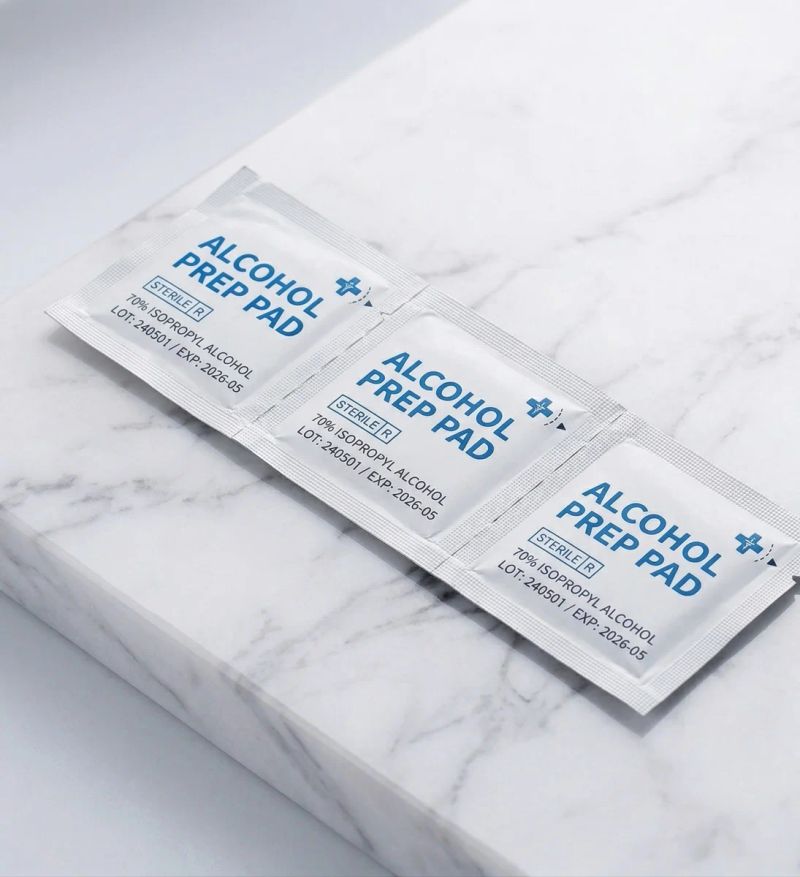
Isopropyl Alcohol Wipes 70% (pack of 10) pack de 10 Accessories
70% isopropyl alcohol disinfectant wipes. Laboratory standard for decontaminating stoppers and work surfaces before manipulation.
Lab standard for injection prep. 70% isopropyl alcohol, individually wrapped. Fast, effective disinfection of the injection site. Essential to any serious protocol. Practical format for daily use.
- In stock in France
Don't forget the essentials
Frequently bought together


Product information
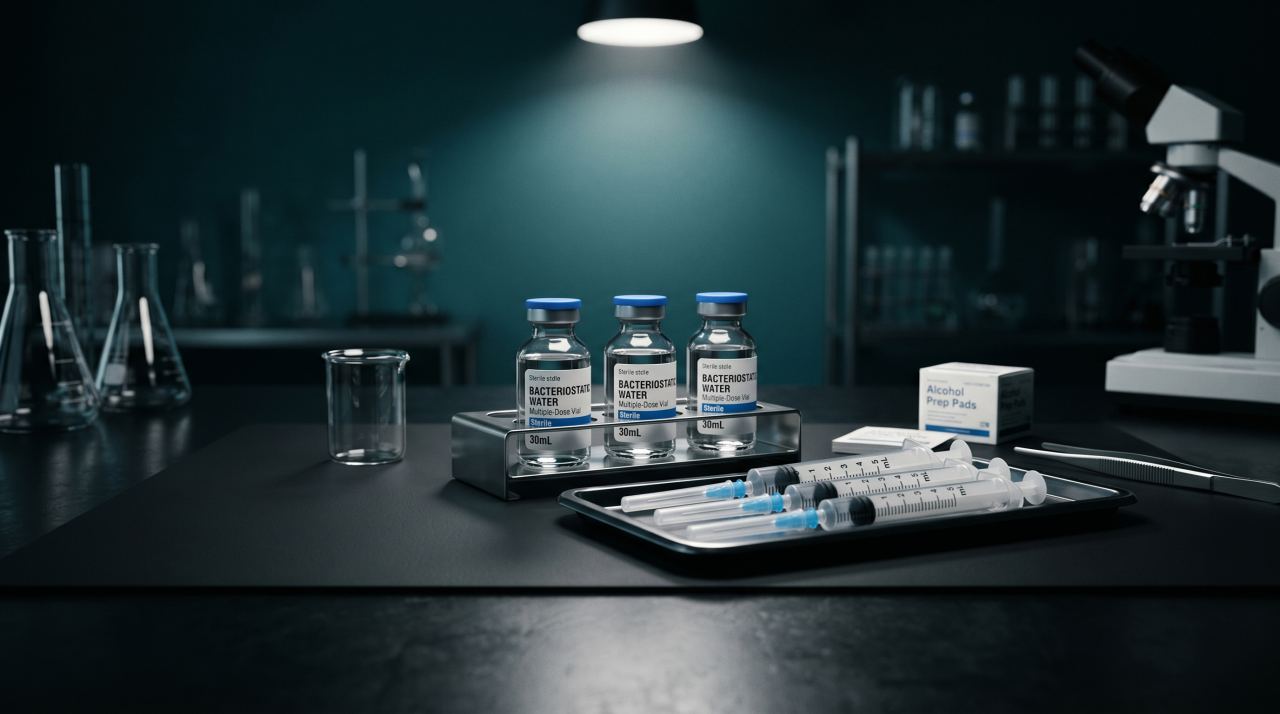
Isopropyl alcohol 70%-impregnated wipes are the most underestimated link in the peptide sterile chain. Researchers focus attention on lyophilised peptide quality, on bacteriostatic diluent traceability, on U100 syringe precision — and often overlook the gesture that conditions the microbiological success of the entire manipulation: systematic septum disinfection before each puncture. A 3ml or 10ml BAC vial and a 5mg or 10mg peptide vial each possess a chlorobutyl rubber septum perfectly clean from the factory, but which becomes a potentially contaminated surface from the first exposure to ambient air, fingers, laboratory environment particles.
The pack of 10 individual wipes is the operational entry format for peptide research. Each wipe is packaged in a sealed aluminium blister, impregnated with 70% v/v isopropanol in aqueous solution. Opening, 2-3 passes application on the septum, wait 15-30 seconds for complete drying, then puncture. Strict single use — one wipe per septum, per puncture, never reused.
For a researcher running a 14-day multi-peptide cycle with two peptide vials + one BAC, each injection session consumes 3 wipes minimum (BAC + peptide A + peptide B + possibly SC injection site). Over 14 days at one injection per day, consumption oscillates between 15 and 30 wipes. The pack of 10 thus covers either a short 3-5 day test cycle, or occasional backup needs in addition to a main stock. It's the starter and backup format, not the intensive production format.
The central question is not "should the septum be disinfected" — it's non-negotiable — but "how to do it correctly". Most frequent errors: application too fast without drying time, use of 90° denatured household alcohol, reuse of a wipe for two consecutive septums, cross-contamination between peptide septum and BAC septum. Each of these errors partially or totally cancels the downstream bacteriostatic system protection.
01Mechanism of action
Isopropyl alcohol (isopropanol, 2-propanol, C3H8O, 60.1 Da) is a rapid broad-spectrum bactericide whose mechanism of action relies on three simultaneous effects: denaturation of membrane proteins, disorganisation of the lipid bilayer, and osmotic desiccation of microbial cells. At 70% v/v in aqueous solution, isopropanol reaches its maximum efficacy — counter-intuitively superior to that of 90% or 95%. This fundamental observation, established as early as the 1950s by Morton and confirmed by all hospital disinfection literature (Larson 1995 Am J Infect Control, Rutala-Weber 2008 CDC Guidelines), rests on a precise physicochemical principle.
Pure alcohol (95%+) fixes bacterial surface proteins too rapidly into external coagulation that forms a protective shell around the cell, paradoxically protecting the cytoplasm. 70% alcohol contains enough water to slow protein fixation and allow progressive isopropanol penetration through the cell wall toward internal structures. The result is complete and homogeneous destruction of the bacterial cell, not just surface sterilisation.
The activity spectrum is broad but calibrated: bactericidal on gram-positives (Staphylococcus aureus, Staphylococcus epidermidis, Streptococcus spp.), bactericidal on gram-negatives (Escherichia coli, Pseudomonas aeruginosa, Klebsiella pneumoniae), fungicidal on Candida albicans and common dermatophytes, virucidal on enveloped viruses (herpes, HIV, influenza, SARS-CoV-2). The classic blind spot concerns bacterial spores (Bacillus, Clostridium): 70% isopropanol is ineffective on sporulated forms, which remain viable after exposure. In the peptide context, this blind spot is negligible because environmental spores are not a realistic contamination vector on a septum kept in a clean domestic environment.
The critical parameter is contact time. Pharmacopoeia literature (USP <1072>, EU Pharmacopoeia 5.1.3) establishes 15 to 30 seconds as the minimum duration to obtain a 3 to 5 log bacterial reduction on smooth non-porous surfaces like chlorobutyl rubber. This time corresponds exactly to the natural drying duration of an impregnated wipe applied to a 6-8mm diameter septum. That's why the universal operational rule is: apply the wipe, wait for visible drying, then puncture. Not before. Puncturing a septum still wet with isopropanol presents three combined risks: (1) liquid isopropanol can be dragged by the needle into the vial, marginally diluting the benzyl alcohol bacteriostatic system; (2) disinfection is incomplete because effective contact time is below the 15-second threshold; (3) rubber particles slightly softened by the alcohol can be torn off by the needle and contaminate the vial.
The non-woven fibre of the wipe also matters. Standard wipes use polypropylene or viscose-polyester substrates of 30-50 g/m² basis weight that release isopropanol in a controlled manner, without lint, without chemical residue. Entry-level "alcohol wipes" from mass retail sometimes use cellulosic substrates that leave microfibres on the septum — a minor defect that compounds problems over repeated manipulations.
Similar peptides
70% Isopropanol vs 70% Ethanol: near-identical spectra on bacteria, fungi and enveloped viruses. Isopropanol is slightly less volatile (boiling point 82.6°C vs 78.4°C for ethanol), extending effective contact time by 10-15% and facilitating correct disinfection. Ethanol remains superior on norovirus and adenovirus (non-enveloped viruses), but this superiority is moot for peptide septum decontamination. For peptide research, 70% isopropanol is the reference.
70% vs 90% Isopropanol: counter-intuitively, 70% is more effective. The mechanism: water slows fixation of bacterial surface proteins, allowing isopropanol to progressively penetrate the cell rather than forming a protective external shell. 90%+ alcohol fixes too rapidly and leaves internal structures intact. Never use pure or 95-99% pharmaceutical alcohol to disinfect septums — reduced efficacy despite counter-intuition.
Impregnated wipes vs 70% isopropanol spray: spray is useful for disinfecting large surfaces (workbench, outside of vial boxes). For precise targeted disinfection of a 6-8mm septum, the wipe is superior: controlled dosing, mechanical contact with the surface, no environmental projection. Spray tends to create a mist that deposits everywhere without guaranteeing effective contact on the target zone. Wipe for the septum, spray for surfaces.
Sealed-sachet 70% isopropanol wipes vs retail "household alcohol" wipes: major difference. A 70% isopropanol wipe in a sealed sachet keeps its concentration until opened and carries an expiry date. Entry-level retail wipes may contain denatured ethanol (sometimes toxic in residue), cellulosic substrates leaving microfibres, and less sealed packaging. For peptide use, choose individually sealed 70% isopropanol wipes.
70% Isopropanol vs 2% Chlorhexidine-alcohol: chlorhexidine offers residual activity of several hours on skin (vs point action of isopropanol that disappears by evaporation). It's reference in surgery and catheter placement. For septum disinfection, chlorhexidine is disproportionate and can leave residue on rubber. For SC injection site, it's theoretically superior but adds little in practice for short daily injection in healthy subjects. Isopropanol remains the right balance.
70% Isopropanol vs Povidone-iodine (Betadine): povidone-iodine offers broad spectrum including spores, but presents several disadvantages for peptide use: orange colouration masking visual inspection of septum and site, longer contact time (2-3 minutes), iodine allergy risk, potential interaction with certain sensitive peptides if residues enter the vial. Reserve for surgical or hospital context, not for domestic peptide research.
70% Isopropanol vs quaternary ammoniums: quaternary derivatives (benzalkonium chloride, cetrimide) are common in disinfectant household products. Narrower spectrum than isopropanol, slow activity (several minutes of contact), leave chemical residue potentially reactive with peptides. Never use on peptide septum.