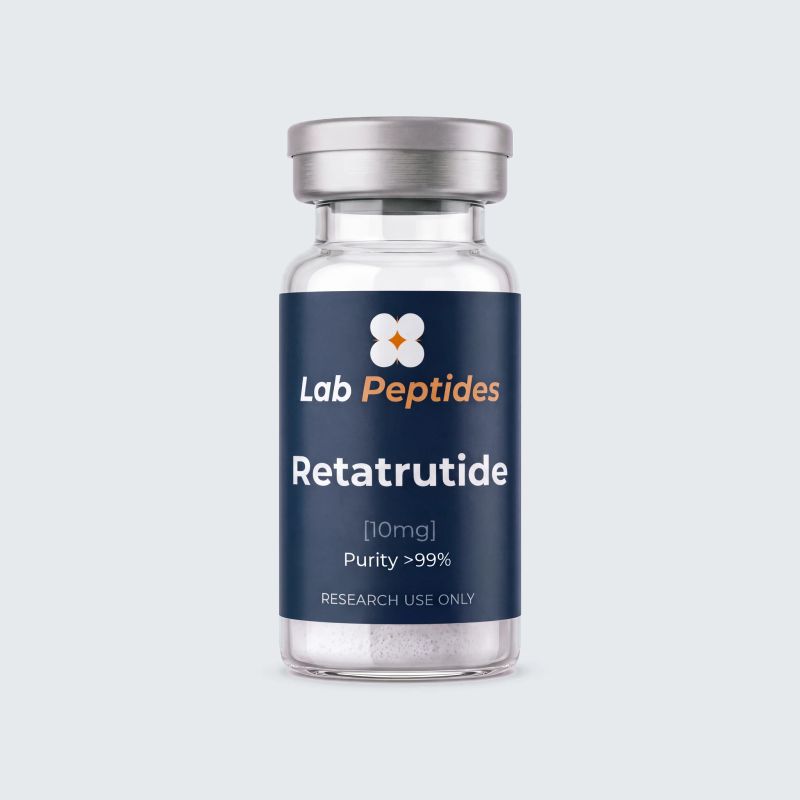
Retatrutide 10mg Metabolism
-25% body weight in 80 weeks.
The absolute heavyweight of weight loss. A triple GLP-1 / GIP / glucagon agonist: three hormonal pathways at once. -25% body weight over 80 weeks in the phase 3 TRIUMPH-1 trial (NEJM 2026). Blind-tested by Janoshik: 99.4 to 99.9% purity. Our No. 1 seller.
Research protocols start at: 5 units, i.e. 0.25 mg per week (vial prepared with 2 ml of water).
10 mg = what the vial contains, not the dose.See the preparation
−5% from 2 vials, −10% from 3Mix strengths: every vial counts. Discount applied in your cart.
- Certificate of analysis
- In stock in France
 Ordered with its water: shipped in a magnetic box
10% off every deliveryPause, skip or cancel in 1 clickNo commitment, no hidden fees
No automatic charge: pay for each delivery by card, in Bitcoin (an extra 5% off), or by bank transfer from €100
Your complete kit
The vial alone cannot be used as is. Add what you need to prepare it:
Frequently bought together


Research Use Only (RUO) · Prohibited for human or veterinary use.
Key facts
Retatrutide 10 mg is the vial for the 1 mg and 2 mg steps, then the start of maintenance. The logical format after a 5 mg vial, once tolerance is confirmed. At the maintenance step of 2 to 4 mg per week, one vial covers 2.5 to 5 weeks. Fewer reconstitutions than two 5 mg vials, exactly the same markings.
PositioningThe 10 mg vial takes over where the 5 mg stops. The 1 mg step over 4 weeks (4 mg used), then the 2 mg step over 4 weeks (8 mg). Both full steps need 12 mg: one vial, then the start of a second. After that, maintenance between 2 and 4 mg per week. One injection per week, 4-week steps, and you move up only if the current step is well tolerated.
In detail
Single reconstitution2 mL of bacteriostatic water, i.e. 5 mg/mL. Same concentration as the 5 mg vial: your IU do not change. 1 mg = 20 IU, 2 mg = 40 IU, 4 mg = 80 IU on a 1 mL syringe (1 IU = 0.01 mL). For the record, the Sanyal 2024 trial (Lancet) tested 10 mg per week in hepatic steatosis and measured -81.4% liver fat at 48 weeks: a study result, not a usage marker. House maintenance sits between 2 and 4 mg per week.
Protocol and preparation
| Water added | Concentration | Reading marker |
|---|---|---|
| 1 ml | 10 mg/ml | 10 UI = 1 mg |
| 2 ml | 5 mg/ml | 40 UI = 2 mg |
The volume of water does not change the product, only its concentration. Introduce the water slowly along the vial wall, never directly onto the lyophilisate, then swirl without shaking. Markers given on a 1 ml syringe graduated in 100 units.
Asepsis
Disinfect surfaces and stoppers (70% alcohol).
Solvent
Draw the required volume of bacteriostatic water.
Introduction
Inject gently against the vial wall (avoid direct jet on powder).
Solubilization
Roll the vial gently. Do not shake vigorously (degradation risk).
Solution storage Once reconstituted: 2-8°C (refrigerator).
Warning Theoretical tool for chemical handling. Does not constitute medical advice.
Open the dilution calculator- The amount of powder looks tiny. A lyophilisate takes up a few millimetres at the bottom of the vial, sometimes just a translucent film. The stated weight is there.
- The powder is compact, stuck to the wall or to the stopper. Transport moves the freeze-dried cake around. It changes nothing to reconstitution.
- The vial carries no individual label. That is our standard packaging, not a downgraded vial.
- After reconstitution, deposits or filaments appear. This is common, especially with small molecules. Let it settle and roll the vial between your palms, never shake it.
- The parcel is plain. Nothing on the outside indicates the contents or the brand name.
What is not normal: a cracked vial, an uncrimped cap or a stopper that moves, powder that has liquefied or changed colour. In those specific cases, write to us with a photo and we take the vial back.
House protocolOne injection per week, start at 0.25 mg, 4-week steps up to 4 mg. Maintenance between 2 and 4 mg per week. Move up only if the current step is well tolerated.
Reconstitution2 mL of bacteriostatic water in the 10 mg vial, i.e. 5 mg/mL. On a 1 mL syringe: 1 IU = 0.01 mL.
- 0.25 mg = 5 IU (weeks 1 to 4)
- 0.5 mg = 10 IU (weeks 5 to 8)
- 1 mg = 20 IU (weeks 9 to 12)
- 2 mg = 40 IU (weeks 13 to 16)
- 4 mg = 80 IU (from week 17, if 2 mg is well tolerated)
These markings are for 2 mL of water. Another volume? Write to us and we send your table.
Role of the 10 mg vialThe 1 mg and 2 mg steps, then maintenance. 1 mg step: 4 mg used over 4 weeks. 2 mg step: 8 mg. At maintenance, one vial covers 5 weeks at 2 mg per week, 2.5 weeks at 4 mg.
Starting on this vialPossible, same IU as the 5 mg vial, 0.25 mg = 5 IU. The 5 mg vial remains the format built for the first 8 to 10 weeks.
Step poorly toleratedDo not move up. Stay on the current step until it is well tolerated.
Injection siteRotate across the 4 abdominal quadrants, at least 2.5 cm from the navel. Angle of 45 to 90 degrees depending on the skin fold. Inject slowly (5 to 10 seconds), hold 10 seconds before withdrawing the needle. Avoid areas that are already hardened.
Research monitoring, liver focusLiver ultrasound and ALT, AST, GGT, ALP at W0, W12, W24 and W48. Liver fat fraction (MRI-PDFF if available) at W0 and W48. Glucose and HbA1c every 3 months. Weekly weigh-in at a fixed time.
Technical data
- Reconstitution
- 2 ml d'eau → 5 mg/ml. 5 UI = 0,25 mg ; 10 UI = 0,5 mg.
- Peptide sequence
- YXQGTFTSDYSILLDKKAQXAFIEYLLEGGPSSGAPPPS-NH2 (X = Aib ; lysine acylée)
- Molecular formula
- C221H342N46O68
- Molecular weight
- 4731.34 g/mol
- CAS number
- 2381089-83-2
- Physical form
- Poudre lyophilisée
- Recommended solubility
- Eau bactériostatique, NaCl 0,9%
- Storage conditions
- Au réfrigérateur (+2 à +8 °C), à l'abri de la lumière. En poudre, possible au congélateur pour une conservation longue. Une fois préparé : réfrigérateur, jamais au congélateur.
- Use
- Research reagent, in vitro only (RUO)
Storage & handling
Lyophilized retatrutide stores up to 24 months between 2 and 8 °C, protected from light, in its original borosilicate vial sealed under inert atmosphere. The peptide is stable in solid form; degradation pathways become operational only after solubilization. Extended stocks can tolerate -20 °C (deep freeze) without documented integrity loss, provided freeze-thaw cycles are avoided as they introduce mechanical stress on tertiary structure.
After reconstitution with bacteriostatic water (0.9% benzyl alcohol), the solution stores for 21-28 days at 2-8 °C, protected from light. The C20 diacid chain is more hydrophobic than semaglutide's (C18) and tirzepatide's, slightly slowing degradation but increasing oligomerization propensity if the solution undergoes agitation or shear. Dominant degradation pathways: methionine oxidation (specifically Met30), asparagine deamidation (Asn25, Asn35) pH-sensitive, aspartate isomerization, and oligomerization/fibrillation via the C20 lipid anchor. After 28 refrigerated days, typically expect 5-10% activity loss, acceptable for most research protocols.
Operational recommendations(1) handle the reconstituted vial with powder-free nitrile gloves to avoid surface contaminants that would catalyze degradation; (2) never vortex or shake, prefer gentle rotation with the vial tilted at 45 degrees until complete dissolution (typically 30-60 seconds); (3) if a precipitate persists after 5 minutes, warm gently to 25 °C (hand, never > 30 °C); (4) post-reconstitution storage must be a constant 2-8 °C, ideally low in the fridge (thermally most stable area), in a peptide-dedicated compartment (no contact with food or other volatile products).
For long protocols, choosing the right format is the first line of defense against degradation. A 12-week cycle at 4 mg per week, the top of house maintenance, requires 48 mg. In 5 mg format that means 10 reconstitutions; in 10 mg, 5; in 15 mg, 4; in 20 mg, 3; in 30 mg as in 40 mg, 2. Each reconstitution saved reduces contamination risk, operator time and consumable costs (bacteriostatic water, sterile syringes, needles, wipes) accordingly.
Mechanism of action
Retatrutide is the first triple incretin-mimetic agonist to reach phase II/III clinical development. Its sequence combines three activities: GLP-1R, GIPR, and GCGR (glucagon receptor), a design that unites in a single molecule the three main metabolic levers of energy regulation. Coskun and Urva (2022, pharmacological description) describe the engineering: modified sequence derived from native GIP, Aib2 and Aib13 substitutions resisting DPP-4, and a C20 diacid fatty-acyl chain grafted to a lysine via a gamma-glutamate linker to extend half-life to approximately 6 days. The affinity profile is calibrated for triple balance: full agonist at GIPR, full agonist at GLP-1R, partial agonist at GCGR, preserving glycemia while exploiting glucagon thermogenic benefits.
The GCGR arm is retatrutide's signature. Hepatic glucagon increases gluconeogenesis and lipolysis via PKA/CREB activation, stimulates brown adipose tissue thermogenesis, and reduces hepatic triglyceride accumulation. This activity partly antagonizes the GIP lipogenic effect and translates clinically into weight loss exceeding tirzepatide's. Tuning the GCGR / GLP-1 + GIP affinity ratio is critical: too much GCGR would trigger hyperglycemia; too little would cancel the thermogenic benefit. Retatrutide was optimized to maximize brown adipose activity without net glycemic disturbance, thanks to the combined glucose-normalizing effect of the GLP-1/GIP incretins.
Additive mechanismsCentral activation of GLP-1R / GIPR hypothalamic satiety circuits, slowed gastric emptying, amplified glucose-dependent insulin secretion, direct adipocyte lipolysis via GCGR, brown thermogenesis via UCP1, and increased hepatic lipid oxidation. Obese mouse models (Coskun 2022) show basal energy expenditure +8-12% vs vehicle, a major contributor to the magnitude of weight loss observed in phase II clinical trials.
PharmacokineticsApproximate terminal half-life 6 days, Cmax at 40-48 hours post-injection, steady-state in 4-5 weeks. Proteolytic clearance (no CYP450), no major pharmacokinetic interactions expected. Subcutaneous bioavailability is nearly complete thanks to albumin binding conferred by the C20 chain. Weekly administration standardizes pharmacokinetics, simplifies protocols, and smooths plasma concentrations — conditions favorable for reproducible cohort studies.
In exploratory research, retatrutide represents the most ambitious incretin agent currently available. Its signaling complexity (triple agonism) imposes heightened methodological vigilance: systematic glycemic monitoring to detect any paradoxical hyperglycemia linked to the glucagon arm, regular hepatic panel given the lipolytic effect, and lean mass tracking to quantify the share of weight loss linked to muscle depletion under severe caloric restriction.
Studies and references
Clinical data on retatrutide are still recent but spectacular. The pivotal phase II obesity trial Jastreboff 2023 NEJM (Retatrutide Phase 2 Obesity Trial) tested 1/4/8/12mg weekly in 338 obese non-diabetic adults over 48 weeks. Mean weight loss: -8.7% (1mg), -17.1% (4mg), -22.8% (8mg), -24.2% (12mg) vs -2.1% placebo. At 12mg, 92% of participants lost >= 5%, 75% >= 15%, 56% >= 20%, and 26% lost >= 25%.
Phase II diabetes study Rosenstock 2023 Lancet281 T2D patients over 36 weeks with doses 0.5/4/8/12mg. HbA1c: -2.02% at 12mg vs -0.01% placebo; weight loss -16.94% vs -3.0% placebo at 12mg. Retatrutide demonstrated an effect equivalent or superior to the best GLP-1 mono-agonists on diabetes while producing markedly stronger weight loss.
Phase II hepatic steatosis study Sanyal 2024 LancetRetatrutide 5-10mg weekly in 98 patients with MASLD and obesity, over 48 weeks. Hepatic fat fraction reduction: -57.0% (5mg), -81.4% (10mg) vs -0.3% placebo. At 10mg, 85% of patients reached hepatic fat fraction < 5% (resolution threshold), 74% had >= 30% reduction. These results exceed those of any other pharmacological agent tested on MASLD, including tirzepatide in SYNERGY-NASH.
Phase III TRIUMPH trials are ongoing. TRIUMPH-1 (adult obesity, n=2250), TRIUMPH-2 (obesity with comorbidities), TRIUMPH-3 (type 2 diabetes + obesity), TRIUMPH-4 (MASH with fibrosis), TRIUMPH-6 (sleep/OSA): results expected 2025-2027. The program was designed to demonstrate broad superiority vs tirzepatide (direct comparator in certain arms) on weight loss, metabolic improvement, hepatic steatosis, and sleep apnea.
Tolerance profileIn phase II trials, gastrointestinal adverse events (nausea, vomiting, diarrhea, constipation) are frequent but mostly mild-to-moderate and concentrated in the early titration weeks. Adverse-event discontinuation rate was 6-16% depending on dose. Two signals deserve vigilance: mean heart rate increase of 3-7 bpm (similar to tirzepatide, likely linked to the GLP-1 arm), and modest ALT elevation in some patients (likely linked to GCGR-induced hepatic lipolysis). Retatrutide did not produce significant hypoglycemia in non-diabetics, confirming that the glucagon arm is properly balanced by the incretin arm.
In research, these trials are references, not instructions for use. The phase II titration was: 2 mg W1-4, 4 mg W5-8, 8 mg W9-12, 12 mg W13+ (4 mg steps every 4 weeks). The trials therefore tested up to 12 mg per week, under medical supervision. The house protocol starts lower and stays lower: 0.25 mg per week at the start, 4-week steps up to 4 mg, maintenance between 2 and 4 mg per week.
- 1
- 2
Similar peptides
Versus tirzepatide (GLP-1/GIP dual agonist): retatrutide surpasses tirzepatide in documented weight efficacy. Phase II Jastreboff 2023 NEJM: -24.2% at 12mg/48w for retatrutide vs SURMOUNT-1 Jastreboff 2022: -20.9% at 15mg/72w for tirzepatide. The absolute 3.3-point weight gap over a shorter window (48 vs 72 weeks) suggests retatrutide reaches maximum plateau faster and further. The GCGR arm adds hepatic thermogenesis and lipolysis that tirzepatide does not generate. Limit: retatrutide is newer, with fewer long-term data (phase III ongoing, not yet published), and the glucagon arm imposes stricter ALT/AST follow-up.
Versus semaglutide (GLP-1 mono-agonist): considerable gap. STEP-1 Wilding 2021 NEJM: -14.9% at 2.4mg/68w for semaglutide vs -24.2% at 12mg/48w for retatrutide. For a researcher seeking maximal metabolic performance, retatrutide is superior by >9 weight points over a shorter window. Semaglutide remains the option when gastrointestinal tolerance is problematic (milder profile) or on tight budget (older molecule, available in more economical formats).
Versus liraglutide 3mg (Saxenda): massive gap (-8% over 56 weeks Pi-Sunyer 2015 NEJM SCALE vs -24.2% over 48 weeks for retatrutide). Liraglutide is outpaced by all modern incretin agents and holds residual interest only for its long-term data (> 5 years) which retatrutide still lacks.
Versus other triple/multi-agonists in development: survodutide (GLP-1/GCGR Boehringer Ingelheim), mazdutide (GLP-1/GCGR Eli Lilly), orforglipron (oral non-peptide GLP-1 Eli Lilly), HRS9531 (GLP-1/GIP Hengrui): each represents a distinct signaling architecture. Retatrutide remains the most advanced triple agonist in phase III and holds the highest published weight efficacy to date.
Versus bupropion-naltrexone, orlistat, phentermine-topiramate: the gap is such that these agents no longer compete. They remain relevant as inexpensive oral alternatives for patients refusing injection or with incretin contraindications.
Research positioning: retatrutide is the most powerful tool currently available to study multi-receptor metabolic regulation. Its triple agonism allows simultaneous study of combined GLP-1 + GIP + glucagon effects, experimental dissections impossible with mono-agonists or dual agonists. Exploratory protocols thus gain unique signaling benefit at the cost of more demanding monitoring complexity.
Frequently asked questions
Why is retatrutide called a "triple agonist" and what does it change in practice?
What volume of bacteriostatic water should be used to reconstitute a retatrutide vial?
How long can reconstituted retatrutide be stored, and what signs indicate degradation?
Why must retatrutide be titrated progressively, and according to what schedule?
What are key drug interactions and contraindications for retatrutide?
Can retatrutide be combined with other research peptides (BPC-157, TB-500, CJC-1295, ipamorelin)?
Which format should I choose for a long protocol (16 weeks or more)?
Why should retatrutide never be mixed with insulin or another peptide in the same syringe?
 The complete guideRetatrutide (LY3437943): complete guide to the triple agonistStructure, triple agonist mechanism, pharmacokinetics, TRIUMPH program (1-4, Obesity, HFpEF, MASH), comparison versus semaglutide and tirzepatide, research-only reconstitution protocols, stability and regulatory outlook. The scientific reference on retatrutide.Read the guide
Also read:Retatrutide: the dedicated pageTirzepatide: complete guide to the GLP-1R / GIPR co-agonist in preclinical researchBacteriostatic water: complete guide for research peptide reconstitution