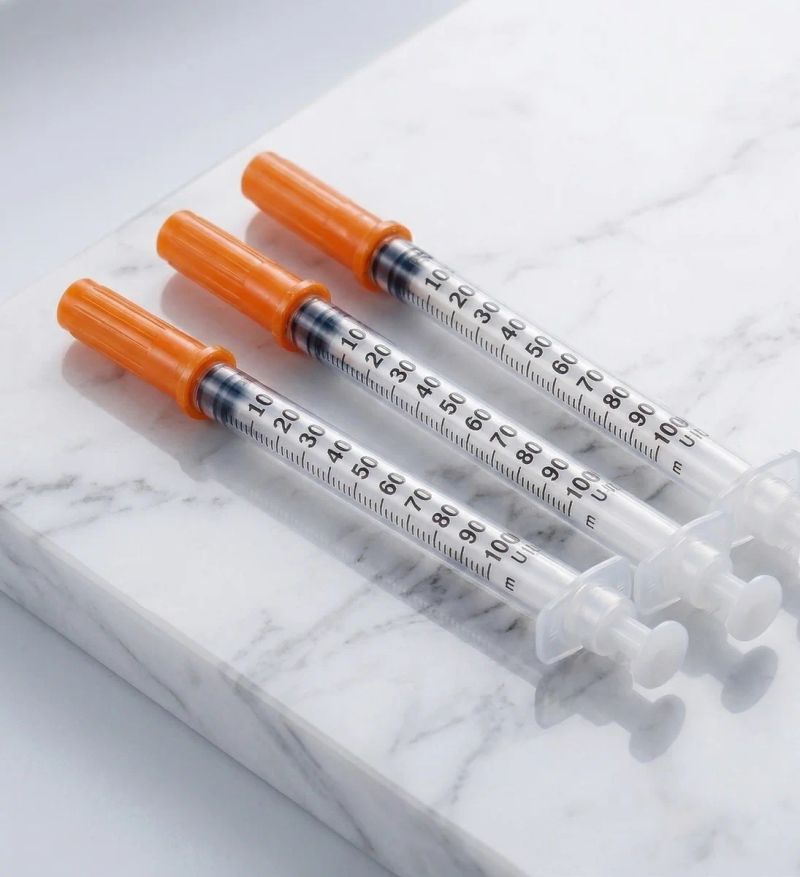
Precision Syringe 1ml 29G (pack of 10) pack de 10 Accessories
1ml precision syringe with fine graduation, 29G needle. Laboratory standard for small-volume manipulation in peptide research.
The precision tool for your micro-injections. 1ml fine graduation, ultra-fine 29G needle to minimize pain and optimize dosing precision. Essential for any peptide dosing. Pharma standard.
- In stock in France
Don't forget the essentials
Frequently bought together


Product information
The U100 1ml insulin syringe with attached 29G needle is the absolute reference dosing tool for peptide research. Without a precise syringe, no peptide protocol is reproducible: a 0.05ml deviation on a 0.2ml dose represents 25% dosimetric error, sufficient to push a therapeutic dose into sub-efficacious territory or, conversely, to accumulate cumulative overload over a 14-28 day cycle. The U100 syringe with its 100 graduations over 1ml, each graduation representing 10 microlitres (10 mcL = 0.01ml), offers the finest reading accessible in domestic practice without specialised lab equipment.
The U100 standard ("100 units per millilitre") has been the global insulin dosing standard since 1992, replacing the older U40 and U80 that coexisted and caused massive dosing errors in hospital settings. This international standardisation (USA, Europe, Japan, Australia) directly benefits peptide research, which exploits the same syringes as insulin-dependent diabetics. The 1U-100U graduation range directly corresponds to volumes 10-1000 mcL, perfectly calibrated for typical post-reconstitution peptide concentrations (1 to 5 mg/ml).
The 29 gauge needle (29G, outer diameter 0.33mm, inner diameter 0.18mm) represents the optimal equilibrium point for peptide manipulation. Finer and it bends when passing the chlorobutyl septum (30G-31G excessive fragility). Bigger and SC injection becomes uncomfortable, perceived as painful by the subject (27G-25G discouraged SC). The 12.7mm (1/2 inch) length corresponds to the adult insulin standard: depth sufficient to reach subcutaneous tissue through the skin fold, without risk of intramuscular penetration in subjects with normal or elevated subcutaneous fat mass.
The 10-syringe pack is the operational entry format. Each syringe is individually sterile-blister packaged, with lot marking and expiry date (typical 5 years), needle protected by rigid cap. Strict single use — one syringe corresponds to one withdrawal puncture AND one injection puncture (the syringe is filled from the peptide vial then immediately injected, never stored filled). For a 14-day mono-peptide cycle with one daily injection, the 10-pack covers about two-thirds of the cycle — to complete with a second pack or refill on a 100-box. The 10 format is the rational choice to test a cycle, cover a stock shortage, or accompany travel without risking transport of large quantities of needle material.
01Mechanism of action
Functional anatomy of the U100 1ml 29G syringe: three mechanically interdependent components.
(1) Barrel in transparent medical polypropylene, calibrated to 1ml nominal volume with 100 black printed graduations at ±0.5 unit tolerance (ISO 8537 standard). Major graduations every 10U (0.1ml), minor graduations every 2U. Transparency allows visual verification of the absence of air bubbles in the liquid column after withdrawal — critical point of peptide withdrawal. Barrel tip without Luer connection: needle attached directly to barrel, impossible to detach, eliminating any risk of disconnection during injection.
(2) Plunger with butyl or dermato-compatible silicone rubber seal, linear travel controlled by graduated rod. The tight seal ensures that withdrawn volume = injected volume without leak loss. Some premium models integrate an end-of-travel plunger stop preventing accidental plunger expulsion from the barrel during abrupt aspiration — important operational detail during withdrawals from a negative-pressure vial.
(3) Attached 29G needle: surgical 304 stainless steel tube or equivalent, short trifacet bevel for progressive cutaneous penetration. Outer diameter 0.33mm, lumen inner diameter 0.18mm — sufficient for fluid flow of aqueous peptide solutions (viscosity close to water), insufficient for oily solutions or thick suspensions. Standard length 12.7mm (1/2 inch) suited to adult SC injection via 2-3 cm skin fold.
Dosimetric calibration: volume/U100 unit correspondence is strictly linear: 1U = 10 mcL = 0.01ml. Printed major graduations (10, 20, 30, 40...) correspond to 0.1, 0.2, 0.3, 0.4ml. This correspondence allows rapid calculations without calculator:
- Peptide reconstituted at 5 mg/ml → 10U withdrawn = 500 mcg peptide.
- Peptide reconstituted at 3.3 mg/ml (10mg + 3ml BAC) → 10U = 330 mcg.
- Peptide reconstituted at 10 mg/ml → 10U = 1 mg = 1000 mcg.
Standard "double puncture" withdrawal technique: (1) disinfect reconstituted peptide vial septum with 70% isopropanol wipe, wait for complete drying; (2) draw into the empty syringe an air volume equivalent to the peptide volume to withdraw (e.g. 20U air to withdraw 20U peptide); (3) pierce the septum, invert vial upward, inject the air to equalise internal pressure; (4) while holding the plunger down, invert vial downward and slowly aspirate the desired volume; (5) verify absence of air bubbles before needle withdrawal, expel any bubbles by tapping barrel with droplet ejection; (6) withdraw needle vertically in a single motion. The syringe is then ready for immediate injection.
This double-puncture protocol avoids partial vacuum formation in the peptide vial which, over successive withdrawals, would make aspiration increasingly difficult and favour non-sterile external air entry during needle withdrawal. It's a classical laboratory gesture taught in nursing training, directly transposable to peptide research.
Cutaneous sensation and injection pain: the 29G needle produces near-painless skin penetration in most adult subjects, particularly if the injection area is relaxed and previously disinfected and dried. The sensation is that of a brief pinch, significantly less intense than an insect bite. 30G and 31G needles are marginally less painful but compensate with increased fragility when passing chlorobutyl septums (bending or breakage risk on insertion). For mixed peptide septum + skin use, 29G remains the best compromise.
Similar peptides
U100 29G syringe vs any U40: never use U40 for peptide research. The U40 scale (40 units = 1ml) presents graduations 2.5x more spaced, imprecise at low volume. Moreover, U40/U100 confusion remains a cause of major dosimetric error (2.5x) if the researcher reads graduations as if they were U100. Global U100 standard = only acceptable.
29G vs 30G-31G (finer): 30G and 31G offer marginally more comfortable skin perception (low perceived difference in adults). Trade-off: significant mechanical fragility when passing thick chlorobutyl septums (bending rate 7x to 24x higher per Hofman 2010). For peptide research where each session involves 2-3 septum passages, 29G guarantees robustness. 29G = optimal comfort/robustness compromise.
29G vs 27G-28G (larger): 27G is the standard needle for multi-use hospital labs. Uncomfortable for daily SC injection (perceptible pain), excessive for simple peptide septum crossing. 28G is an acceptable compromise but without advantage over 29G. 29G remains optimal for SC + septum.
29G vs 25G-26G (large): reserved for deep intramuscular injection and blood sampling. Totally unsuited to SC peptide injection (significant pain, probable haematoma). Categorical rejection for peptide.
U100 insulin syringe vs 1ml tuberculin syringe without insulin graduations: classic tuberculin offers only ml graduations (0.1ml/division), i.e. 10x less fine than U100. Acceptable for calibrated-volume drug dosing (vaccines, paediatric dilutions), but insufficient for peptide research where typical doses are 20-50 mcL order. Always prefer U100 insulin for peptide.
Syringe with attached needle vs syringe + separate Luer needle: Luer (screwed connector) allows needle swapping on the same syringe, useful in hospital context to separate withdrawal and injection. For domestic peptide research, no advantage: attached needle is more sterile (single component, single blister), more practical (no loosening risk), less expensive per unit. Attached needle = peptide reference.
1ml syringe vs 0.5ml (BD Micro-Fine format): 0.5ml syringes offer more spaced graduations for the same U100 resolution, facilitating reading of small volumes (1-50U). For peptide research at sub-50U doses, they may be preferred if available. The standard 1ml format remains versatile (covers 1U to 100U) and sufficiently precise even for 5-10U with careful reading.
Safety retractable-needle syringe vs classic syringe: models with post-injection automatic needle retraction eliminate accidental puncture risk on storage. Mandatory in hospital since 2010 (EU Directive 2010/32/EU). 2-3x higher price than standard format, poorly relevant in individual domestic research where third-party puncture risk is minimal. Non-essential in solo peptide use.
Pre-filled syringe (insulin pen type Ozempic) vs manual syringe: pre-filled pens integrate peptide cartridge + disposable needle, intended for commercial drugs (Ozempic, Trulicity, Saxenda). Not suited to research where peptide is extemporaneously reconstituted. Manual syringe remains research peptide standard.