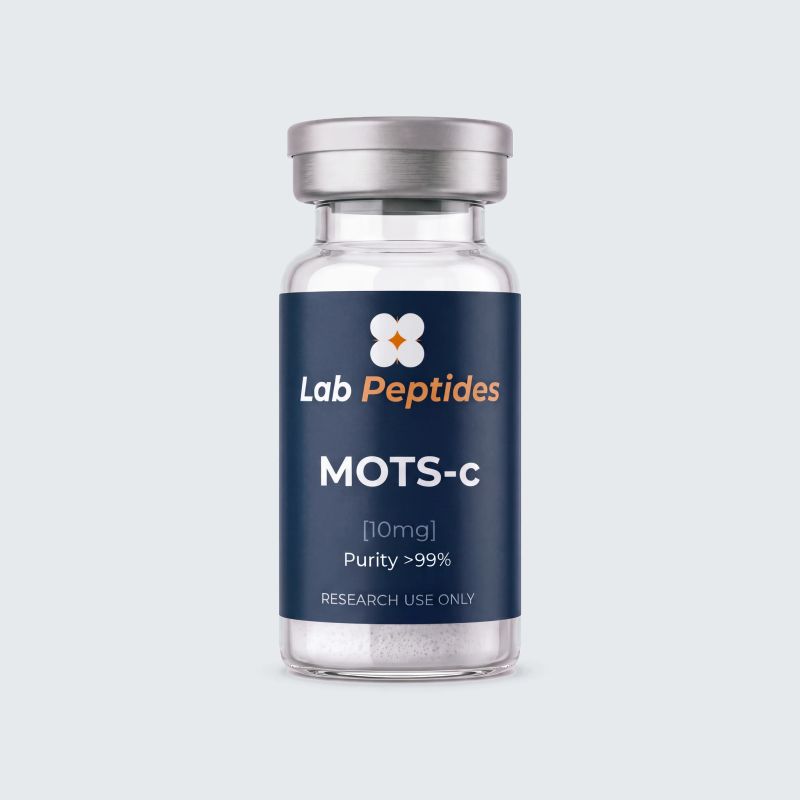
MOTS-c 10mg Longevity
Direct mitochondrial anti-aging.
Direct mitochondrial anti-aging. Peptide encoded by the mitochondrial genome — 2015 discovery, USC. MOTS-c reprograms your cellular metabolism, improves insulin sensitivity and boosts documented longevity in animal models. The future of cellular anti-aging.
- In stock in France
 Ordered with its water: shipped in a magnetic box
10% off every deliveryPause, skip or cancel in 1 clickNo commitment, no hidden fees
No automatic charge: pay for each delivery by card, in Bitcoin (an extra 5% off), or by bank transfer from €100
Your complete kit
The vial alone cannot be used as is. Add what you need to prepare it:
Frequently bought together


Research Use Only (RUO) · Prohibited for human or veterinary use.
Key facts
MOTS-c 10mg represents one of the most innovative peptides identified over the past decade. This acronym designates the Mitochondrial Open Reading frame of the Twelve S rRNA type c, a 16 amino acid peptide unexpectedly encoded in the mitochondrial genome rather than the nuclear genome. This discovery, published by Changhan David Lee and Pinchas Cohen in Cell Metabolism in 2015, revolutionized the understanding of communication between mitochondria and the rest of the cell.
In detail
Mitochondria possess their own genome (mtDNA, approximately 16,569 base pairs in humans) encoding 13 respiratory chain proteins, 2 ribosomal RNAs and 22 transfer RNAs. The discovery that this DNA also contained sequences coding for small secreted bioactive peptides (called mitokines) opened an entirely new field of research. MOTS-c is encoded in the MT-RNR1 gene (12S rRNA) via an alternative reading frame, joining Humanin (identified in 2001) as major mitochondrial-encoded peptide.
Atlas Lab formulates MOTS-c 10mg as high-purity lyophilizate (>98% HPLC) for research applications exclusively. Strict RUO — not intended for human, veterinary, diagnostic or therapeutic use. Circulating levels of endogenous MOTS-c progressively decline with age, an observation that initially positioned the molecule as a tool for studying metabolic aging and sarcopenia.
Protocol and preparation
| Water added | Concentration | Reading marker |
|---|---|---|
| 1 ml | 10 mg/ml | 10 UI = 1 mg |
| 2 ml | 5 mg/ml | 40 UI = 2 mg |
The volume of water does not change the product, only its concentration. Introduce the water slowly along the vial wall, never directly onto the lyophilisate, then swirl without shaking. Markers given on a 1 ml syringe graduated in 100 units.
Asepsis
Disinfect surfaces and stoppers (70% alcohol).
Solvent
Draw the required volume of bacteriostatic water.
Introduction
Inject gently against the vial wall (avoid direct jet on powder).
Solubilization
Roll the vial gently. Do not shake vigorously (degradation risk).
Solution storage Once reconstituted: 2-8°C (refrigerator).
Warning Theoretical tool for chemical handling. Does not constitute medical advice.
Open the dilution calculator- The amount of powder looks tiny. A lyophilisate takes up a few millimetres at the bottom of the vial, sometimes just a translucent film. The stated weight is there.
- The powder is compact, stuck to the wall or to the stopper. Transport moves the freeze-dried cake around. It changes nothing to reconstitution.
- The vial carries no individual label. That is our standard packaging, not a downgraded vial.
- After reconstitution, deposits or filaments appear. This is common, especially with small molecules. Let it settle and roll the vial between your palms, never shake it.
- The parcel is plain. Nothing on the outside indicates the contents or the brand name.
What is not normal: a cracked vial, an uncrimped cap or a stopper that moves, powder that has liquefied or changed colour. In those specific cases, write to us with a photo and we take the vial back.
Reconstitution protocols documented in the research literature recommend adding 1-2 ml of sterile bacteriostatic water (0.9% benzyl alcohol) to a 10 mg MOTS-c vial, producing a solution at 5-10 mg per milliliter. This concentration facilitates standard experimental doses (5-15 mg) with a 29G 1ml insulin syringe. At 10 mg/ml, 1 ml contains 10 mg, allowing easy administration of doses of 5 mg (0.5 ml) or 10 mg (1 ml).
The pharmacokinetics of MOTS-c is characterized by a Tmax of 30-60 minutes after subcutaneous injection, a plasma half-life of approximately 2-3 hours (longer than simple peptides of same size, probably linked to hydrophobic structure and binding with plasma proteins), and a more prolonged biological duration of action reaching via effects on AMPK signaling and induced transcriptional modifications. This duration of action allows administration 2-3 times per week in experimental protocols.
Experimental doses commonly reported in animal models are between 0.5 and 5 mg per kilogram body weight per administration. Reynolds 2021 used 15 mg/kg in aged mice over 8 weeks. Observational non-pharmacological human research protocols do not involve exogenous administration. Documented experimental doses in publications include 5-15 mg per subcutaneous injection in human subjects (approximately 0.07-0.2 mg/kg), 2-3 times per week over periods of 8-12 weeks.
Chronic schemes reported alternate active periods of 8-12 weeks with 2-4 week pauses to allow adaptive transcriptional response without saturation of AMPK pathways and without potential cellular desensitization. The administration window is generally morning due to the synergy observed with the circadian rhythm of the AMPK pathway, itself more active in the morning during post-overnight fasting period.
Association with physical exercise is documented in several preclinical studies as synergistic. MOTS-c administered before or after a resistance or endurance exercise session amplifies the observed metabolic effects, probably via convergence of AMPK, PGC-1alpha and myofibrillar protein synthesis pathways. Experimental protocols often combine MOTS-c plus structured exercise 3-5 times per week.
Combination with other mitochondrial or metabolic peptides is theoretically relevant. MOTS-c plus SS-31 covers two distinct mitochondrial aspects (retrograde signaling for MOTS-c, membrane integrity for SS-31). MOTS-c plus Humanin combines two peptide mitokines with complementary systemic actions (metabolic for MOTS-c, anti-apoptotic for Humanin). These combinations remain experimental without formal clinical validation.
Subcutaneous injection in abdominal fat, thigh or deltoid is the standard route. MOTS-c is not sensitive to food interference and can be injected on empty stomach or after meal without significant difference on biological activity. Preservation of injection site consistency over several weeks facilitates experimental reproducibility.
Technical data
- Reconstitution
- 1 ml d'eau → 10 mg/ml. 50 UI = 5 mg.
- Peptide sequence
- Met-Arg-Trp-Gln-Glu-Met-Gly-Tyr-Ile-Phe-Tyr-Pro-Arg-Lys-Leu-Arg
- Molecular formula
- C101H152N28O22S2
- Molecular weight
- 2174.6 g/mol
- CAS number
- 1627580-64-6
- Physical form
- Poudre lyophilisée
- Recommended solubility
- Eau bactériostatique, NaCl 0,9%
- Storage conditions
- Au réfrigérateur (+2 à +8 °C), à l'abri de la lumière. En poudre, possible au congélateur pour une conservation longue. Une fois préparé : réfrigérateur, jamais au congélateur.
- Use
- Research reagent, in vitro only (RUO)
Storage & handling
Before reconstitution, the lyophilized vial of MOTS-c 10mg must be stored between 2 and 8 degrees Celsius, in its original packaging, away from direct light and any heat source. Under these conditions, the lyophilizate stability is ensured for 24 to 36 months from the manufacturing date. The stability of lyophilized MOTS-c is comparable to that of medium-sized linear peptides, without the presence of residues particularly sensitive to oxidation or photolysis.
Prolonged storage at ambient temperature (>25 degrees Celsius) must remain exceptional and not exceed 72 hours; beyond that, a risk of degradation and potency loss exists. Excessive heat (>40 degrees Celsius) causes accelerated hydrolysis of peptide bonds and irreversibly compromises the molecule's biological activity.
After reconstitution with sterile bacteriostatic water, the aqueous MOTS-c solution remains stable for approximately 30 days at 2-8 degrees Celsius. This duration is in the standard range of research peptides comparable to Ipamorelin, GHRP-6 and Hexarelin. Freezing at -20 degrees Celsius or less extends stability up to 4-6 months under optimal conditions. However, each freeze-thaw cycle partially degrades the molecule and must be avoided.
Best practice is to aliquot the reconstituted solution into portions corresponding to 2-3 weeks of experimental use (i.e. 4-6 doses of 10 mg each), then freeze the aliquots individually in sterile cryotubes. The thawed multi-dose vial is then used for a maximum of 30 days in refrigeration at 2-8 degrees Celsius.
Light protection is recommended but not critical for MOTS-c, sequence less photosensitive than peptides containing multiple tryptophan residues. The original opaque packaging or storage in a closed refrigerator drawer suffices in most configurations. Protection against intense mechanical agitation remains essential: never shake the vial violently during reconstitution. Gentle rotation between palms for 2-3 minutes suffices for complete lyophilizate dissolution.
Any solution presenting a color change (normally colorless and clear), a precipitate, or particles in suspension must be immediately discarded. Visual inspection before each sampling is a mandatory practice in research context. Atlas Lab provides detailed recommendations for rigorous experimental traceability. Traceability is particularly important for MOTS-c due to its relative novelty (discovered in 2015) and the sensitivity of metabolic study models to residual molecular contaminations that could interfere with the studied AMPK or mTOR pathways.
Mechanism of action
The mechanism of action of MOTS-c rests on a distinctive retrograde mitochondrion-to-nucleus hormetic signaling. Unlike classical peptides that act via cell surface receptors, MOTS-c exerts its biological effects primarily via activation of the AMPK pathway (AMP-activated protein kinase), the cellular conductor of energy homeostasis.
AMPK activation by MOTS-c was established by Lee 2015 (Cell Metabolism) in several target tissues including skeletal muscle, liver, adipose tissue and central nervous system. This activation triggers a signaling cascade that inhibits mTOR (mechanistic Target of Rapamycin), activates autophagy and mitophagy, increases mitochondrial biogenesis via PGC-1alpha, promotes fatty acid oxidation and increases insulin-independent muscle glucose uptake via GLUT4 translocation.
The insulin-sensitizing effect of MOTS-c constitutes one of the most documented aspects. In mice obese induced by fat diet, chronic MOTS-c administration restores insulin sensitivity, reduces visceral fat mass, and improves glucose tolerance, without adverse hypoglycemic effect in standard diet animals. This action selectivity in insulin resistance context, and not in normal euglycemic state, is a remarkable pharmacological characteristic.
Exercise-mimetic action was characterized by Reynolds 2021 (Nature Communications), who demonstrated that MOTS-c administration in aged mice partially restored exercise capacity, increased muscle mitochondrial density, and modulated expression of nuclear stress genes such as NRF2 and FOXO. MOTS-c is thus described as an endogenous exercise mimetic, emerging pharmacological concept designating molecules reproducing the metabolic benefits of exercise without physical exercise.
Nuclear translocation of MOTS-c after metabolic stress represents a second distinct mechanism. Kim 2018 (Cell Reports) showed that under conditions of glucidic restriction or metabolic stress, MOTS-c migrated from cytosol to cell nucleus, where it directly modulated transcription of genes regulating stress response, autophagy and fatty acid metabolism. This stress-modulated transcription factor function represents an unprecedented mechanism for a small peptide.
The decline of circulating MOTS-c levels with human age was documented by Lee 2015 and correlated with metabolic aging parameters (HOMA-IR, abdominal circumference, HbA1c). The K14Q polymorphism in the MOTS-c sequence, studied by Fuku 2015 (Aging Cell) in Japanese centenarian cohorts, was associated with increased prevalence of exceptional longevity, suggesting a functional role of this peptide in the human aging trajectory. These observations stimulated research on MOTS-c as potential modulator of metabolic longevity.
Studies and references
The scientific corpus of MOTS-c is relatively young (discovered in 2015) but has rapidly expanded with publications in major journals covering metabolism, aging, exercise and longevity. The founding discovery of Lee and collaborators published in 2015 in Cell Metabolism established the existence of the peptide, its mitochondrial origin, its sequence of 16 amino acids, and its major effects on glucose homeostasis in mice and human subjects. This publication generated more than 1000 citations in less than eight years.
Fuku and collaborators published in 2015 in Aging Cell an important genomic study on 696 Japanese centenarians and 775 young controls, identifying the K14Q polymorphism in the MOTS-c sequence (replacement of a lysine by a glutamine at position 14) with significantly increased prevalence in male Japanese centenarians. This observation positioned MOTS-c as potential modulator of exceptional longevity, even if the precise mechanistic link remains to be deepened.
Reynolds 2021 (Nature Communications) performed a major study on MOTS-c as exercise mimetic in aged mice, with daily subcutaneous administration for 8 weeks. Results documented a significant improvement in endurance capacity (treadmill), an increase in muscle mitochondrial density, and modulation of nuclear gene expression convergent with the effects of physical exercise in the same animals. This study provided the mechanistic basis to position MOTS-c as potential therapeutic strategy against age-related sarcopenia and frailty.
Lu 2019 (Aging) extended observations to accelerated aging models and documented the effects of MOTS-c on average longevity in mice, with a lifespan extension of 8-12% in certain specific genetic cohorts. Kim 2018 (Cell Reports) characterized the nuclear translocation of MOTS-c under metabolic stress and identified its transcriptional targets, clarifying the direct gene regulation mechanism.
Human clinical studies remain limited in number and sample size. Several observational studies have correlated circulating MOTS-c levels with metabolic status: patients with type 2 diabetes present lower levels than healthy controls, inverse correlation with insulin resistance was confirmed in several cohorts, and endurance athletes present higher-than-average levels after effort. These observations suggest that endogenous MOTS-c is a metabolic health biomarker.
No phase 3 clinical trial has been published to date with MOTS-c administered exogenously in humans. Therapeutic development remains primarily academic, with some early-stage biotech initiatives exploring indications type 2 diabetes, sarcopenia and metabolic syndrome. MOTS-c remains at this stage a promising preclinical research tool, with a rapidly expanding scientific corpus and unique positioning as peptide mitokine with systemic metabolic actions.
- 1
- 2
Similar peptides
MOTS-c occupies a distinctive position in the research peptide landscape, being one of the rare peptides encoded in the mitochondrial genome (mitokines) with Humanin. Its comparison to relevant alternatives depends on the experimental context: metabolic research, insulin sensitivity, aging, longevity, or exercise mimetic.
Versus Humanin, the other main peptide mitokine (24 amino acids, discovered in 2001), MOTS-c presents primarily metabolic activity (insulin sensitivity, AMPK, fatty acid oxidation) while Humanin is recognized for its anti-apoptotic and neuroprotective properties (BAX inhibition, Alzheimer neuronal protection). The two peptides are complementary in the study of integral mitochondrial biology and are frequently studied together. The MOTS-c plus Humanin combination therefore covers two distinct aspects of mitochondrion-to-nucleus signaling.
Versus SS-31 (Elamipretide), mitochondrial peptide of synthetic origin targeting cardiolipin of the inner membrane, MOTS-c acts on retrograde signaling rather than mitochondrial structural integrity. SS-31 stabilizes respiratory chain complexes and prevents lipid peroxidation; MOTS-c activates AMPK and modulates nuclear transcription. The two molecules are mechanistically different and pharmacologically complementary. Their combination covers mitochondrial function (SS-31) and communication (MOTS-c).
Versus incretins and GLP-1 analogs (semaglutide, tirzepatide, liraglutide), MOTS-c acts through a completely different mechanism. GLP-1 analogs stimulate glucose-dependent insulin secretion and slow gastric emptying via specific surface receptors; MOTS-c activates AMPK without identified canonical receptor. Experimental indications overlap (insulin resistance, type 2 diabetes) but mechanisms are distinct. A theoretical incretin plus MOTS-c combination could amplify metabolic effects but remains unstudied in clinical use.
Versus GH axis peptides (CJC-1295 DAC, Ipamorelin, Tesamorelin), MOTS-c acts on energy metabolism and insulin sensitivity rather than the somatotropic axis. CJC-1295 DAC plus Ipamorelin increase IGF-1 and favor protein anabolism; MOTS-c activates AMPK and favors lipid oxidation. The two approaches are potentially complementary in protocols combining muscular anabolism (GH axis) and metabolic recomposition (MOTS-c), even if the precise interaction between the two pathways remains complex and partially characterized.
Versus neuroprotective peptides (Semax, Selank, Cerebrolysin), MOTS-c has a global metabolic action rather than CNS-targeted, even if effects on the aging brain are documented (Reynolds 2021 observed transcriptional modulations in the aged murine cortex). Neuroprotective peptides act more directly on neurotransmitters and synaptic plasticity.
The major differentiating characteristic of MOTS-c remains its mitochondrial origin (peptide encoded in mtDNA), its systemic AMPK activation, and its positioning as endogenous exercise mimetic with correlation to exceptional human longevity (Japanese cohorts Fuku 2015). This combination of properties makes it a unique research tool for metabolic, aging and longevity studies.
Frequently asked questions
What is MOTS-c and what makes it unique?
How does MOTS-c improve insulin sensitivity?
Is MOTS-c really an exercise mimetic?
How to reconstitute MOTS-c 10mg?
What dose of MOTS-c is typically used in research?
What is the link between MOTS-c and longevity?
Can MOTS-c be combined with other peptides?
What are the Atlas Lab quality standards for MOTS-c 10mg?
 The complete guideMOTS-c: the complete guide to the mitochondrial peptide in research (2026)MOTS-c, a 16-amino-acid peptide encoded by mitochondrial DNA: AMPK / folate-AICAR mechanism, nuclear translocation, exercise, ageing, human data, the CB4211 and MOTS-MET trials, doses studied and reconstitution.Read the guide
Also read:SS-31 (elamipretide): the peptide that targets the mitochondrion directlyPeptides and longevity in research: epithalon, humanin and cellular senescence mechanisms