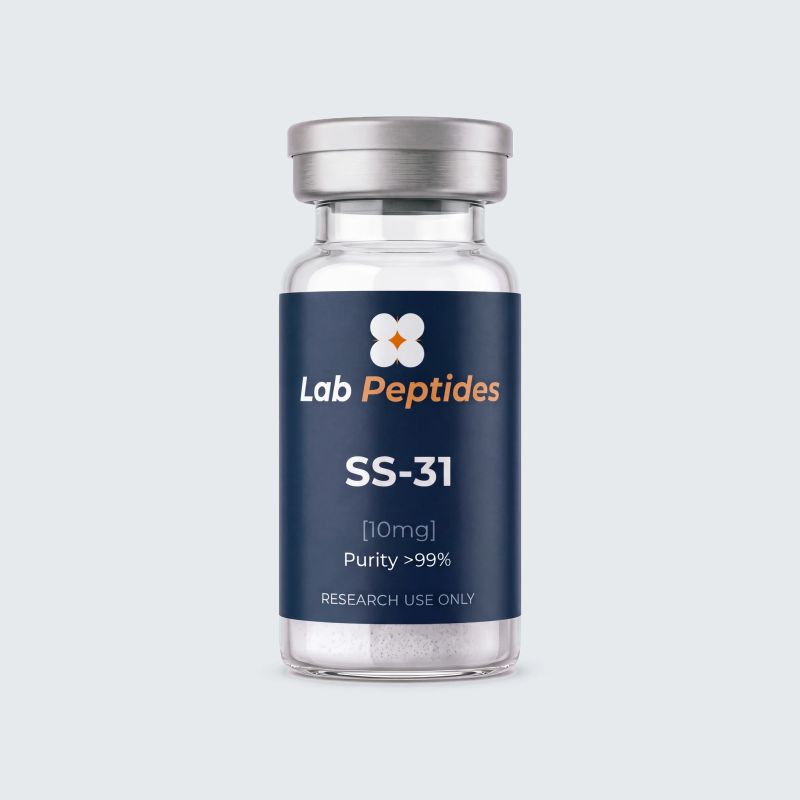
SS-31 10mg Longevity
Targeted mitochondrial shield.
The body's mitochondrial shield. Peptide that penetrates the mitochondrial membrane directly and stabilizes cardiolipin — ROS protection, boosted energy output. The gold standard of cellular anti-aging from Stealth BioTherapeutics.
- Certificate of analysis
- In stock in France
 Ordered with its water: shipped in a magnetic box
10% off every deliveryPause, skip or cancel in 1 clickNo commitment, no hidden fees
No automatic charge: pay for each delivery by card, in Bitcoin (an extra 5% off), or by bank transfer from €100
Your complete kit
The vial alone cannot be used as is. Add what you need to prepare it:
Frequently bought together


Research Use Only (RUO) · Prohibited for human or veterinary use.
Key facts
SS-31 10mg, also known as Elamipretide, MTP-131 or Bendavia, is a mitochondrial tetrapeptide developed in the late 1990s by Hazel Szeto and Peter Schiller at Weill Medical College (Cornell University) as part of the Szeto-Schiller program (hence the SS prefix). The sequence D-Arg-2',6'-dimethylTyr-Lys-Phe-NH2 of 639 Da represents one of the most original pharmacological approaches in mitochondrial research: selectively targeting the inner mitochondrial membrane via affinity for cardiolipin.
In detail
Cardiolipin is a phospholipid quasi-exclusively localized in the inner mitochondrial membrane, where it occupies approximately 20% of membrane lipids. It plays a critical structural role in the assembly of respiratory chain complexes (I, III, IV, V) and in the stabilization of cytochrome c oxidase. The accumulation of SS-31 in this membrane via cardiolipin binding allows a local concentration 1000 to 5000 times superior to plasma concentrations, conferring to the molecule an unprecedented tissue pharmacokinetic profile among peptides.
Atlas Lab formulates SS-31 10mg as high-purity lyophilizate (≥98% HPLC) for research applications exclusively. Strict RUO — not intended for human, veterinary, diagnostic or therapeutic use. SS-31 has been the subject of more than 300 publications and several phase 2 and 3 clinical trials piloted by Stealth BioTherapeutics, without initial FDA approval for the main indications tested (heart failure, MELAS, Barth syndrome), but the accumulated scientific corpus makes it a reference experimental tool for mitochondrial studies.
Protocol and preparation
| Water added | Concentration | Reading marker |
|---|---|---|
| 1 ml | 10 mg/ml | 10 UI = 1 mg |
| 2 ml | 5 mg/ml | 40 UI = 2 mg |
The volume of water does not change the product, only its concentration. Introduce the water slowly along the vial wall, never directly onto the lyophilisate, then swirl without shaking. Markers given on a 1 ml syringe graduated in 100 units.
Asepsis
Disinfect surfaces and stoppers (70% alcohol).
Solvent
Draw the required volume of bacteriostatic water.
Introduction
Inject gently against the vial wall (avoid direct jet on powder).
Solubilization
Roll the vial gently. Do not shake vigorously (degradation risk).
Solution storage Once reconstituted: 2-8°C (refrigerator).
Warning Theoretical tool for chemical handling. Does not constitute medical advice.
Open the dilution calculator- The amount of powder looks tiny. A lyophilisate takes up a few millimetres at the bottom of the vial, sometimes just a translucent film. The stated weight is there.
- The powder is compact, stuck to the wall or to the stopper. Transport moves the freeze-dried cake around. It changes nothing to reconstitution.
- The vial carries no individual label. That is our standard packaging, not a downgraded vial.
- After reconstitution, deposits or filaments appear. This is common, especially with small molecules. Let it settle and roll the vial between your palms, never shake it.
- The parcel is plain. Nothing on the outside indicates the contents or the brand name.
What is not normal: a cracked vial, an uncrimped cap or a stopper that moves, powder that has liquefied or changed colour. In those specific cases, write to us with a photo and we take the vial back.
Reconstitution protocols documented in the research literature recommend adding 2 ml of sterile bacteriostatic water (0.9% benzyl alcohol) to a 10 mg SS-31 vial, producing a solution at 5 mg per milliliter i.e. 5000 mcg/ml. This concentration facilitates higher experimental doses than classical peptides, SS-31 being administered in clinical trials at doses of 40 mg per day subcutaneously (typically 4 ml per day at 10 mg/ml) in adults. An alternative is to reconstitute with 1 ml to obtain 10 mg/ml.
The pharmacokinetics of SS-31 is characterized by a Tmax of 1-2 hours after subcutaneous injection, a plasma half-life of 4-6 hours in humans, and above all mitochondrial tissue accumulation that continues beyond plasma elimination. This dissociation between plasma kinetics and tissue kinetics explains why a single daily administration is sufficient despite a modest plasma half-life. Tissue concentration in target organs (heart, kidney, brain, muscle) remains elevated for 18-24 hours after administration.
Experimental doses reported in animal models are between 1 and 5 mg per kilogram body weight per day, corresponding approximately to human doses of 40 mg per day (0.5-0.6 mg/kg in a 75 kg adult). EMBRACE-STEMI clinical trials used 0.05 mg/kg/hour in continuous IV infusion for 60 minutes around angioplasty. MMPOWER-3 (mitochondriopathy) and TAZPOWER (Barth) trials used 40 mg per day SC. Preclinical studies of renal and muscular aging used 3-5 mg/kg per day in rats over periods of 8-24 weeks.
Chronic schemes reported in the literature vary according to experimental model: continuous daily administration for aging and mitochondriopathy studies (24-48 weeks), short peri-procedural administration for ischemia-reperfusion models (few hours to few days around the ischemic stimulus), monthly pulse administration for certain maintenance studies. The flexibility of the tissue pharmacokinetic profile allows adapting the scheme to the experimental model.
The route of administration can varySubcutaneous for most chronic clinical and animal studies, intravenous in continuous infusion or bolus for acute ischemia-reperfusion studies, intrathecal or intracerebroventricular for certain experimental neurological studies. The oral route is impractical due to digestive peptidase degradation. Subcutaneous injection in abdominal fat or thigh is the most widespread in chronic protocol.
Unlike GH axis peptides, SS-31 does not need to be injected on empty stomach and is not sensitive to food interference. Morning or evening intake depends on the experimental chronotype sought and potential interactions with other treatments. Combined use with classical antioxidants (vitamin E, coenzyme Q10, resveratrol, melatonin) is documented in certain aging and oxidative stress research protocols, without reported negative interactions. SS-31 should not be confused with classical antioxidants: it is not a free radical scavenger but a structural stabilizer of cardiolipin.
Technical data
- Reconstitution
- 2 ml d'eau → 5 mg/ml. 10 UI = 0,5 mg ; 20 UI = 1 mg.
- Peptide sequence
- D-Arg-Dmt-Lys-Phe-NH2
- Molecular formula
- C32H49N9O5
- Molecular weight
- 639.8 g/mol
- CAS number
- 736992-21-5
- Physical form
- Poudre lyophilisée
- Recommended solubility
- Eau bactériostatique, NaCl 0,9%
- Storage conditions
- Au réfrigérateur (+2 à +8 °C), à l'abri de la lumière. En poudre, possible au congélateur pour une conservation longue. Une fois préparé : réfrigérateur, jamais au congélateur.
- Use
- Research reagent, in vitro only (RUO)
Storage & handling
Before reconstitution, the lyophilized vial of SS-31 10mg must be stored between 2 and 8 degrees Celsius, in its original packaging, away from direct light and any heat source. Under these conditions, the lyophilizate stability is ensured for 24 to 36 months from the manufacturing date. The stability of lyophilized SS-31 is comparable to that of short linear peptides, the tetrapeptide sequence with D-Arg and 2',6'-diMethylTyr modifications being naturally resistant to degradation in the solid state.
Prolonged storage at ambient temperature (>25 degrees Celsius) must remain exceptional and not exceed 72 hours; beyond that, a risk of degradation and potency loss exists, particularly for the modified dimethyl-tyrosine group which presents a thermal sensitivity slightly superior to native residues.
After reconstitution with sterile bacteriostatic water, the aqueous SS-31 solution remains stable for approximately 30-45 days at 2-8 degrees Celsius. This duration is in the upper range of research peptides, due to the short length of the sequence and the structural protection conferred by non-native residues (D-Arg and 2',6'-diMethylTyr) which resist residual contaminating peptidases better. Freezing at -20 degrees Celsius or less extends stability up to 6 months under optimal conditions.
However, each freeze-thaw cycle partially degrades the molecule and must be avoided. Best practice is to aliquot the reconstituted solution into portions corresponding to 7-14 days of experimental use (i.e. 1-2 daily doses of 40 mg), then freeze the aliquots individually in sterile cryotubes. The thawed multi-dose vial is then used for a maximum of 30 days in refrigeration at 2-8 degrees Celsius.
Light protection is recommended due to the presence of the dimethyl-tyrosine group which can undergo photo-oxidation under intense UV radiation. The original opaque packaging or storage in a closed refrigerator drawer suffices in most configurations. Protection against intense mechanical agitation is less critical than for large peptides (such as PEG-MGF), the compact tetrapeptide structure being less subject to denaturation by turbulence. Gentle rotation between palms for 2-3 minutes is sufficient for complete dissolution.
Any solution presenting a color change (normally colorless and clear), a precipitate, or particles in suspension must be immediately discarded. Visual inspection before each sampling is a mandatory practice in research context. Atlas Lab provides detailed recommendations for rigorous experimental traceability. Traceability is particularly important for SS-31 due to the required purity (≥98% HPLC) to avoid any contamination by isomers or degradation products that could affect specific mitochondrial activity.
Mechanism of action
The mechanism of action of SS-31 rests on three distinct structural properties that confer to it a unique mitochondrial pharmacodynamic. The net positive charge at physiological pH (D-Arg and Lys residues), combined with membrane permeability conferred by alternation of charged and aromatic residues, allows passive crossing of lipid membranes without requiring an active transporter. This characteristic distinguishes SS-31 from classic CPP (Cell Penetrating Peptide) core peptides by making it specifically tropic for the inner mitochondrial membrane.
Affinity for cardiolipin was demonstrated by Zhao and collaborators in 2004 in the Journal of Biological Chemistry via fluorescence spectroscopy and FRET, establishing a submicromolar dissociation constant. This selective binding concentrates SS-31 in the mitochondrial matrix space according to an electrochemical gradient maintained by the mitochondrial membrane potential (delta Psi m, typically -180 mV). Healthy mitochondria with normal potential accumulate more SS-31, creating a form of self-regulation: depolarized (dysfunctional) organelles capture less molecule.
Stabilization of cardiolipin and associated complexes constitutes the main documented biological effect. Birk 2013 studies (Journal of the American Society of Nephrology) showed that SS-31 preserved cytochrome c oxidase activity (complex IV) in renal ischemia-reperfusion models. Szeto 2014 (British Journal of Pharmacology) synthesized observations on reduction of mitochondrial ROS production (reactive oxygen species) without however acting as a classical antioxidant: SS-31 does not neutralize free radicals directly but prevents their excessive generation by electron transport optimization.
Anti-lipid peroxidation action was specifically characterized by Birk 2014 (Kidney International), with reduction of 4-hydroxynonenal and malondialdehyde formation in mitochondria exposed to oxidative stress. Preservation of mitochondrial cristae crystal structure, essential for electron transport efficiency, was visualized by electron microscopy in several preclinical models (cardiac ischemia, neurodegeneration, nephropathy).
A secondary mechanism would involve modulation of the opening of the mitochondrial permeability transition pore (mPTP), structure involved in cell death by necrosis/apoptosis under severe stress conditions. Prevention of mPTP opening by SS-31 was documented in cardiac ischemia-reperfusion models by Kloner 2012 (JACC). This mechanism could explain cardioprotective effects observed in certain clinical studies, even though results of phase 3 EMBRACE-STEMI (post-infarction) trials did not reach primary endpoints.
Unlike GH secretagogues or growth peptides (BPC-157, PEG-MGF), SS-31 does not act via a cell surface receptor. Its purely intramitochondrial action thus distinguishes itself fundamentally from other research peptides, which influences experimental usage models (metabolic studies, mitochondriopathies, oxidative stress, cellular aging).
Studies and references
The scientific corpus of SS-31 covers twenty-five years of publications since the first works of Szeto and Schiller at Cornell. The founding studies of Zhao 2004 (Journal of Biological Chemistry) established cardiolipin binding and preferential mitochondrial localization, opening the way to an entirely new class of therapeutics targeting intracellular organelles via amphiphilic peptides.
Szeto 2008 (Antioxidants & Redox Signaling) published the first complete synthesis of the pharmacological profile including plasma half-life (approximately 4-6 hours in humans), tissue biodistribution (preferential accumulation heart, kidney, brain, skeletal muscle), and the first animal cardiac ischemia-reperfusion model results documenting infarct size reduction of 40-60% in rat and pig.
Cho 2007 (Journal of Pharmacology and Experimental Therapeutics) and Kloner 2012 (JACC) confirmed cardioprotective effects in large animal ischemia-reperfusion models, preparing clinical trials in humans. The EMBRACE-STEMI trial (2015-2016, Stealth BioTherapeutics) tested SS-31 (Bendavia) in intravenous infusion during primary angioplasty in 297 patients with STEMI, without reaching the primary endpoint of infarct size reduction measured by MRI. Secondary data however suggested beneficial effects on cardiac biomarkers in certain subgroups.
Birk 2013 (Journal of the American Society of Nephrology) and Birk 2014 (Kidney International) characterized protective effects in renal ischemia-reperfusion with preservation of tubular function and reduction of necrosis. Szeto 2011 (American Journal of Physiology) studied renal aging in aged rats, documenting improvement of glomerular filtration and reduction of oxidative stress markers after chronic treatment by SS-31.
In genetic mitochondriopathy, the MMPOWER-3 trial (Karaa 2018-2020, Neurology) tested Elamipretide in 218 patients with primary mitochondrial myopathy over 24 weeks, without reaching the primary endpoint of 6-minute walk distance but with improvement on secondary fatigue endpoints. The TAZPOWER study (Chatfield 2019, Journal of the American Heart Association) tested Elamipretide in Barth syndrome (cardiomyopathy linked to TAZ mutation and abnormal cardiolipin), with mixed results.
Stealth BioTherapeutics filed an FDA approval application for Elamipretide in Barth syndrome, initially rejected in 2020 then accepted for review after additional data. In fundamental research, Dai 2014 (Journal of the American College of Cardiology) documented the protective role of SS-31 in cardiac hypertrophy induced by pressure overload, and Yin 2016 (Journal of Bone and Mineral Research) reported favorable effects on bone density and osteogenesis in accelerated aging models.
More recently, studies on aged skeletal muscle by Campbell 2019 (Journals of Gerontology) and Siegel 2013 (Aging Cell) suggested that SS-31 improved mitochondrial bioenergetics in sarcopenic muscle in mice and rats, opening research perspectives on sarcopenia and age-related frailty. The overall corpus makes SS-31 one of the best-studied peptides for mitochondrial mechanisms, even if commercial therapeutic development remains complex due to specificities of targeted indications (rare mitochondriopathies, restricted populations).
- 1Bioénergétique mitochondrialeFirst-in-class cardiolipin-protective compound as a therapeutic agent to restore mitochondrial bioenergetics
- 2Myopathie mitochondrialeRandomized dose-escalation trial of elamipretide in adults with primary mitochondrial myopathy
- 3
Similar peptides
SS-31 occupies a unique position in the research peptide landscape, being one of the rare peptide molecules specifically targeting the inner mitochondrial membrane via affinity for cardiolipin. Its comparison to relevant alternatives depends on the experimental context sought: fundamental mitochondrial research, oxidative stress models, cellular aging, or ischemia-reperfusion.
Versus classical antioxidants (vitamin E, coenzyme Q10/ubiquinone, resveratrol, N-acetyl-cysteine, alpha-lipoic acid), SS-31 presents a radically different mechanism of action. Classical antioxidants neutralize free radicals by electron transfer after their generation; SS-31 prevents excessive free radical generation by optimizing electron transport efficiency of the mitochondrial respiratory chain. This upstream/downstream difference in the oxidative cascade can lead to complementary effects: SS-31 in prevention, classical antioxidants in residual neutralization. Several studies combining SS-31 with CoQ10 have documented synergistic effects in cellular aging models.
Versus other mitochondrial peptides (MOTS-c, Humanin, Gly-His-Lys coupled to copper), SS-31 specifically targets the inner membrane via cardiolipin, while MOTS-c and Humanin act as mitokine peptides encoded in the mitochondrial genome and secreted to modulate systemic signaling (insulin sensitizer for MOTS-c, anti-apoptotic for Humanin). These peptides are complementary in their overall action on mitochondrial biology but do not substitute for each other. An SS-31 plus MOTS-c combination is theoretically relevant for studies covering both intramitochondrial function and mitochondrial-to-nuclear signaling.
Versus regenerative peptides (BPC-157, TB-500, PEG-MGF), SS-31 acts neither on injured tissues by direct cytoprotective action (BPC-157), nor on cell cytoarchitecture (TB-500), nor on muscle satellite cells (PEG-MGF). The purely intramitochondrial action of SS-31 makes it a complementary rather than competitive tool. In complex post-traumatic recovery models (cardiac ischemia-reperfusion for example), an SS-31 plus BPC-157 plus TB-500 combination has been theorized to cover mitochondria, cytoprotection, and vascular regeneration, even if this combination remains experimental without clinical validation.
Versus mitochondrial gene therapies (mitochondrial replacement therapy, mitochondrial DNA supplementation), SS-31 is not an alternative but a palliative pharmacological tool that acts on biochemical function rather than on the genetic cause. For severe genetic mitochondriopathies (MELAS, Leigh syndrome, Barth syndrome), SS-31 has been tested as symptomatic treatment of mitochondrial dysfunction downstream of the genetic mutation.
The major differentiating characteristic of SS-31 remains its cardiolipin-dependent mechanism, not shared by any other molecule currently available in peptide research. This specificity makes it an irreplaceable tool for studies on mitochondrial membrane integrity, respiratory chain complex assembly, and prevention of lipid peroxidation at cristae level.
Frequently asked questions
What is SS-31 and why does it target mitochondria?
Is SS-31 an antioxidant?
How to reconstitute SS-31 10mg?
What dose of SS-31 is used in clinical studies?
What clinical studies have been conducted on SS-31?
Can SS-31 be combined with other peptides?
How long does the reconstituted SS-31 solution last?
What are the Atlas Lab quality standards for SS-31 10mg?
 Read before you orderSS-31 (elamipretide): the peptide that targets the mitochondrion directlyMost peptides act on surface receptors. SS-31 does something else: it concentrates inside the mitochondrion, on cardiolipin. What this targeting mechanism changes for mitochondrial research.Read the article
Also read:Peptides and longevity in research: epithalon, humanin and cellular senescence mechanisms