Peptides and longevity in research: epithalon, humanin and cellular senescence mechanisms

Cellular aging is no longer an opaque biological fatality. In two decades, research has identified precise molecular pathways orchestrating senescence, telomere shortening, mitochondrial decline and loss of proteostasis. In this landscape, several research peptides have emerged as privileged experimental tools for probing these mechanisms. This guide details the four most studied molecules — epithalon, humanin, FOXO4-DRI and MOTS-c — strictly within their Research Use Only (RUO) scope, specifying structures, biological targets, notable experimental results and methodological limits.
Cellular senescence: the biological basis that peptides probe
Cellular senescence refers to the state where a cell stops dividing but remains metabolically active, secreting a pro-inflammatory cocktail called SASP (Senescence-Associated Secretory Phenotype). This phenotype emerges from telomere erosion, DNA damage accumulation, mitochondrial oxidative stress and chronic activation of signaling pathways such as p16INK4a, p21CIP1 and p53. Senescent cell accumulation in aging tissues correlates with functional loss, chronic inflammation (inflammaging) and progression of degenerative pathologies.
Therapeutic or experimental strategies targeting aging organize around three main axes: senolytics (selective elimination of senescent cells), senomorphics (SASP modulation without killing cells), and geroprotectors (reinforcement of anti-aging mechanisms like autophagy, mitophagy, telomerase activity). Each research peptide explored in this context falls into one of these categories, offering a specific molecular probe to dissect the processes at play.
Epithalon: tetrapeptide and telomere modulation
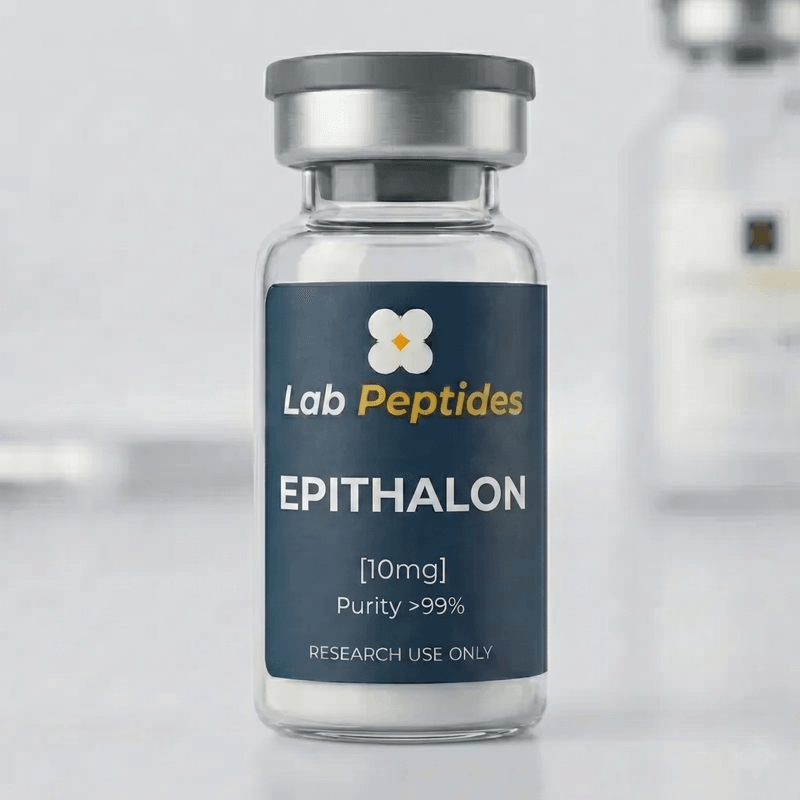
Epithalon (also written epitalon) is a synthetic tetrapeptide of sequence Ala-Glu-Asp-Gly (AEDG), derived from epithalamin peptide isolated from bovine pineal gland in the 1980s by Vladimir Khavinson at the Saint Petersburg Institute of Bioregulation and Gerontology. Its molecular mass is 390 Da, placing it among very short peptides and facilitating its tissue diffusion in in vitro studies.
Studies conducted by Khavinson's team and collaborating groups have suggested epithalon may modulate telomerase activity in human cell lines, with reactivation observed in some senescent fibroblasts and telomere extension measured by Southern blot or qPCR. Mouse models have shown increased median lifespan in some experimental conditions, improved pineal function markers, and modulation of gene expression profiles related to aging. These data remain essentially from a Russian research school with incomplete international reproducibility, justifying strong scientific interest but interpretive caution.
In research protocols, epithalon is typically used at nanomolar concentrations in in vitro replicative senescence studies, and in chronic administration in mouse accelerated aging models (SAMP mice, Klotho knockouts). Its solution stability is limited and reconstitution just before use is recommended.
Humanin: mitochondrial peptide and cytoprotection
Humanin is a 24 amino acid peptide encoded in mitochondrial DNA (overlapping MT-RNR2 gene), identified in 2001 by Hashimoto and colleagues in Alzheimer patient brains. Its primary structure (MAPRGFSCLLLLTSEIDLPVKRRA) includes a central core responsible for its cytoprotective activity. Humanin exemplifies mitochondrial-derived peptides (MDP), an emerging class of endocrine regulators whose biology remains partially mapped.
Experimental studies have suggested humanin acts via several surface receptors (formylpeptide receptor-like 1/FPRL1 complex, gp130-WSX-1-CNTFR) to activate anti-apoptotic signaling pathways, notably Bax inhibition, modulation of STAT3 and ERK1/2. In experimental neuronal injury models, humanin and its synthetic analog HNG (humanin S14G, more stable) have demonstrated protection against toxicities induced by amyloid Aβ peptide, oxidative stress and ischemia-reperfusion. Metabolic studies have also observed improved insulin sensitivity and lipid level modulation in some models.
Humanin illustrates the emergence of active mitochondrial genetics: the mitochondrial genome encodes not only respiratory chain subunits but also diffusible regulatory peptides. This revelation opens an entire research field on mitochondria-nucleus dialogue and its role in cellular aging.
FOXO4-DRI: selective senolytic through rational design
FOXO4-DRI (D-retro-inverso) is a synthetic design peptide published by Peter de Keizer and colleagues in 2017. It is a D-amino acid analog of the FOXO4-p53 interface, designed to disrupt the interaction between these two proteins in senescent cells. The mechanistic logic is elegant: in senescent cells, FOXO4 sequesters p53 and prevents it from exerting its apoptotic function; by breaking this interaction, FOXO4-DRI releases p53, which then induces selective apoptosis of the senescent cell.
Published studies have shown preferential elimination of senescent cells in vitro (IMR90, human fibroblasts) and improved functional markers in aged mice after repeated administration: renal regeneration, fur density, locomotor endurance. This molecule class became a prototype of the senolytic concept, stimulating development of oral small molecules (fisetin, navitoclax, dasatinib-quercetin) targeting the same selective elimination logic.
In research, FOXO4-DRI is used in co-culture and induced senescence protocols (UV irradiation, bleomycin, active oncogene) to evaluate selective senolysis. The D-amino acid configuration protects the peptide from proteolytic degradation and increases its in vivo half-life, making it an operational tool beyond simple in vitro studies.
MOTS-c: mitochondrial peptide and metabolism
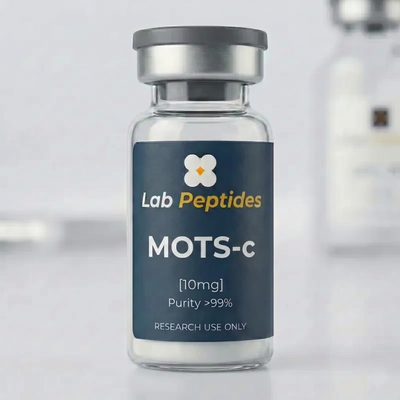
MOTS-c (Mitochondrial Open Reading Frame of the 12S rRNA type-c) is a 16 amino acid peptide discovered in 2015 by Pinchas Cohen and his team at the University of Southern California. Like humanin, it belongs to the mitochondrial-derived peptide family (MDP). Its sequence (MRWQEMGYIFYPRKLR) is encoded by the mitochondrial 12S rRNA gene, illustrating the coding compactness of the human mitochondrial genome.
Mechanistic studies have suggested MOTS-c acts as a metabolic regulator: it activates AMPK (AMP-activated protein kinase), modulates folate and purine metabolism, and improves insulin sensitivity in mouse models of high-fat diet induced insulin resistance. MOTS-c is detected in systemic circulation and its circulating levels decrease with age and with certain metabolic pathologies, suggesting an endocrine mitochondrial hormone role. Physical exercise studies have shown MOTS-c circulating level elevation after effort, establishing a link between metabolic adaptation and mitochondrial signaling.
The experimental interest of MOTS-c lies in its ability to map interactions between mitochondria, skeletal muscle, adipose tissue and liver. Typical protocols include intraperitoneal administration in mice, circulating quantification by ELISA, and evaluation of AMPK/SIRT1/PGC-1α pathways by Western blot and qPCR.
Methodological approaches in senescence research
Senescence markers
Experimental evaluation of cellular senescence relies on a panel of complementary markers. SA-β-galactosidase (β-galactosidase activity at pH 6.0) is the classic histochemical marker, visualized by X-Gal staining. Cell cycle inhibitors p16INK4a, p21CIP1 and ARF are quantified by Western blot and qPCR. DNA damage markers (γ-H2AX, 53BP1) are analyzed by immunofluorescence to visualize persistent foci. SASP is measured by multiplex ELISA or conditioned media analysis on biosensors (IL-6, IL-8, MCP-1, MMP-3).
Cellular models
Reference cell lines include primary human fibroblasts (IMR90, WI-38, BJ) subjected to replicative senescence (serial passages until proliferation arrest) or stress-induced senescence (Ras oncogene, oxidation, irradiation). Human endothelial cells (HUVEC, HAEC) and mesenchymal stem cells (MSC) offer complementary tissue contexts.
Animal models
Standard mouse models include accelerated aging mice (SAMP8, SAMP10), progeria models (LAKI), telomerase knockouts (Terc-/-) and transgenic mice expressing senescent markers (p16-luciferase, p16-3MR for inducible elimination). Invertebrate models (C. elegans, Drosophila) complete the setup for high-throughput lifespan studies.
Experimental limits and precautions
Peptide aging research is punctuated by methodological pitfalls. The first is inter-laboratory variability: epithalon and some MDPs show imperfect reproducibility across teams, possibly linked to differences in lots, purity, reconstitution vehicles or administration protocols. The second pitfall is teleological over-interpretation: a peptide extending median lifespan in a particular mouse strain in a specific context does not prove a generalizable anti-aging effect.
Solution stability is a critical issue: short peptides like epithalon degrade rapidly in solution, requiring reconstitution just before use and storage at -20 °C once dissolved. Analytical purity must be documented by COA (> 98% HPLC, MS-confirmed mass, endotoxins < 1 EU/mg) to avoid artifacts linked to bioactive impurities. Administration route massively influences pharmacokinetics: intraperitoneal versus subcutaneous versus intravenous versus intranasal give completely different profiles in terms of cerebral bioavailability notably.
FAQ longevity peptides in research
Is epithalon approved for human use?
No. Epithalon is an RUO research peptide. It is not approved as a medicine in any country. Studies conducted in Russia in the 1990s-2000s explored its clinical use but these data do not constitute a marketing authorization dossier according to ICH/EMA/FDA standards.
Can FOXO4-DRI-induced senolysis be directly measured?
Yes. Standard protocols include quantification of SA-β-galactosidase positive cells before and after treatment, differential viability senescent versus proliferating (MTT or ATP assay), and measurement of residual SASP after senolysis.
Are mitochondrial-derived peptides (humanin, MOTS-c) actively transported into the cell?
Exact mechanisms remain partially debated. Humanin acts on surface receptors (FPRL1, gp130-WSX-1-CNTFR) without requiring internalization. MOTS-c, in contrast, seems to penetrate cells to modulate AMPK, but precise transporters are not completely characterized.
What is the in vivo half-life of epithalon?
Very short: a few minutes in rodent plasma due to tetrapeptide size and sensitivity to plasma proteases. Chronic protocols compensate with repeated administrations (daily or intermittent).
Are there oral senolytic peptides?
Not to date with demonstrated efficacy. Oral senolytic candidates currently evaluated in clinic (fisetin, quercetin, navitoclax, dasatinib) are small molecules, not peptides. Senolytic peptides remain administered parenterally in research.
How to validate bioactivity of a received epithalon lot?
Through telomerase activity measured by TRAP assay on sensitive cell lines, TERT and TERC expression analysis by qPCR, or proliferation measurement of fibroblasts close to replicative senescence.
Perspectives: toward a pharmacology of aging
Peptide aging research converges with several neighboring fields: mitochondrial biology, epigenetic regulation (sirtuins, Horvath epigenetic clocks), autophagy dynamics and SASP mapping. The emergence of epigenetic clocks as biological age biomarkers offers for the first time an objective standard to evaluate experimental impact of geroprotective peptides, replacing vaguer criteria like mean lifespan or individual phenotypic markers.
The coming years will likely see identification of new mitochondrial-derived peptides (SHLP 1-6, MOTS-c and derivatives), expansion of the peptide senolytic catalog through rational engineering based on p53/Bcl-2/Bcl-xL interactions, and systematic exploration of historical pineal and hypothalamic peptides (epitalon, cortagen, cortexin) with modern analytical tools. This research wave raises the demand level on purity, characterization and reproducibility of experimental lots.
RUO reminder: all peptides mentioned in this article are intended exclusively for research use in vitro or on ethics-committee-validated animal models. No extra-pharmaceutical human use is authorized or recommended.
Epigenetic clocks: modern biological age standard
Epigenetic clocks developed by Steve Horvath and several groups (GrimAge, PhenoAge, Hannum clock, DunedinPACE) measure biological age from methylation of precise CpG sites on DNA. Unlike chronological age which advances invariably, epigenetic age can be accelerated by biological stresses (chronic inflammation, obesity, trauma) or slowed by interventions (caloric restriction, exercise, geroprotective molecules). This objective metric radically transforms experimental evaluation of anti-aging peptides, offering for the first time a continuous indicator measurable in weeks where median lifespan requires years of observation.
In recent peptide studies, teams systematically integrate epigenetic clock measurement on mouse tissues (liver, kidney, blood) before and after administration protocols of epithalon, humanin, MOTS-c. Published results on MOTS-c notably suggested measurable deceleration of the murine Horvath clock in chronically treated mice versus controls, paving the way for quantitative geroprotector characterization. This approach progressively replaces historical phenotypic evaluations (fur density, grip strength, running speed) judged too variable.
Autophagy and mitophagy: underlying therapeutic targets
Autophagy is the cellular process that digests and recycles damaged cytoplasmic components via autophagosome formation fusing with lysosomes. Its decline with age is a robust molecular signature of cellular aging, correlated with accumulation of aggregated proteins, dysfunctional organelles and inflammation markers. Mitophagy, the autophagy subtype specifically targeting damaged mitochondria, is particularly critical for preserving cellular energy function.
Several research peptides explored in longevity converge toward modulation of these pathways. MOTS-c activates AMPK which in turn stimulates the ULK1 complex and autophagy initiation. Humanin and its derivatives protect mitochondrial function and maintain mitochondrial autophagy capacity under oxidative stress. Experimental protocols quantify autophagy via LC3-II/LC3-I analysis by Western blot, LysoTracker staining, confocal imaging of LC3-GFP puncta, or autophagic flux measurement with bafilomycin. For mitophagy, mt-Keima and mito-QC systems enable sensitive visualization of the process in live cells.
Proteostasis and chaperones: peptides involved in folding
Proteostasis (protein homeostasis) encompasses all mechanisms ensuring correct synthesis, folding, trafficking, function and degradation of cellular proteins. Its collapse is an aging hallmark, manifesting as accumulation of misfolded proteins, insoluble aggregates and chronic activation of the endoplasmic reticulum stress response (UPR). Age-related neurodegenerative diseases (Alzheimer, Parkinson, Huntington, ALS) dramatically illustrate the consequences of defective proteostasis.
Research peptides target proteostasis at several levels. Synthetic chaperone peptides (inspired by HSP70/HSP90 motifs) assist folding of stressed client proteins. Some peptide mimetics of chaperone substrate-binding domains inhibit aggregation of amyloidogenic proteins (Aβ, α-synuclein, polyQ huntingtin) in in vitro assays. Experimental evaluation mobilizes thioflavin T aggregation assays, electron microscopy on amyloid fibers, and cellular viability on neuronal lines exposed to toxic proteins.
Peptides and gut microbiota: emerging longevity axis
The role of the gut microbiota in aging emerges as one of the most fertile axes of recent biogerontological research. Age-associated dysbiosis — loss of diversity, reduction of butyrate producers, expansion of pro-inflammatory taxa — feeds systemic inflammaging via intestinal permeability and bacterial translocation. Microbial metabolites (butyrate, propionate, modified tryptophan, indoles) directly influence conserved longevity pathways (AMPK, mTOR, sirtuins, FOXO).
Endogenous antimicrobial peptides (AMP: defensins, cathelicidins, human LL-37) actively shape microbial ecology and their decline with age participates in dysbiosis. Synthetic peptides inspired by AMPs are explored as selective microbiota modulators, capable of reducing pathogenic populations without impacting beneficial ones. In parallel, peptides derived from fermented foods (yogurt bioactives, kefir, aged cheeses) are studied as diet-accessible geroprotectors. This peptide-microbiota convergence opens a rich experimental field, typically evaluated by 16S rRNA sequencing, targeted short-chain fatty acid metabolomics, and intestinal barrier integrity marker analysis (occludin, ZO-1, serum LPS).
Complete analytical review: what a longevity peptide COA must document
Analytical rigor takes particular importance for longevity peptides due to experimental protocol duration (often several months) and the need to compare successive lots without analytical bias. A compliant COA documents eight key parameters: identity by MS mass (± 2 Da of theoretical molecular weight), reverse-phase HPLC purity > 98%, MS/MS fingerprint post-tryptic digestion confirming sequence, water content by Karl Fischer (< 6% typical), counter-ion content (TFA, acetate) by ion chromatography, endotoxins by LAL kinetic chromogenic (< 1 EU/mg), residual solvents per ICH Q3C if applicable, and visual aspect of lyophilized powder.
For D-amino acid peptides like FOXO4-DRI, additional chiral configuration control by circular dichroism or chiral HPLC is highly recommended, since partial chirality inversion during synthesis would totally compromise senolytic activity. For mitochondrial peptides (humanin, MOTS-c), solubility in buffered aqueous media must be verified as these peptides can present aggregation behaviors influencing biodistribution and activity.
Near-term perspectives: AI and rational design of geroprotective peptides
Application of artificial intelligence to peptide design transforms the geroprotective research landscape. Deep learning models trained on peptide-protein interaction databases (BindingDB, PDB, SKEMPI) now predict with increasing accuracy optimal sequences to interfere with specific protein interfaces. AlphaFold and its derivatives open structural mapping of peptide-target complexes hitherto experimentally inaccessible. These tools accelerate design of new senolytics, new synthetic MDPs, and new modulators of p53/Bcl-xL/FOXO interactions.
In parallel, high-throughput peptide synthesis and phenotypic screening platforms on senescence models enable rapid testing of thousand-peptide candidate libraries to identify hits before rational optimization. This industrial approach to peptide screening, once reserved for small molecules, becomes accessible through synthesis cost reduction and cellular phenotyping automation. The coming years will likely see emergence of a new generation of longevity peptides from this AI + screening pipeline, with pharmacological profiles optimized from design rather than discovered serendipitously on natural peptides.