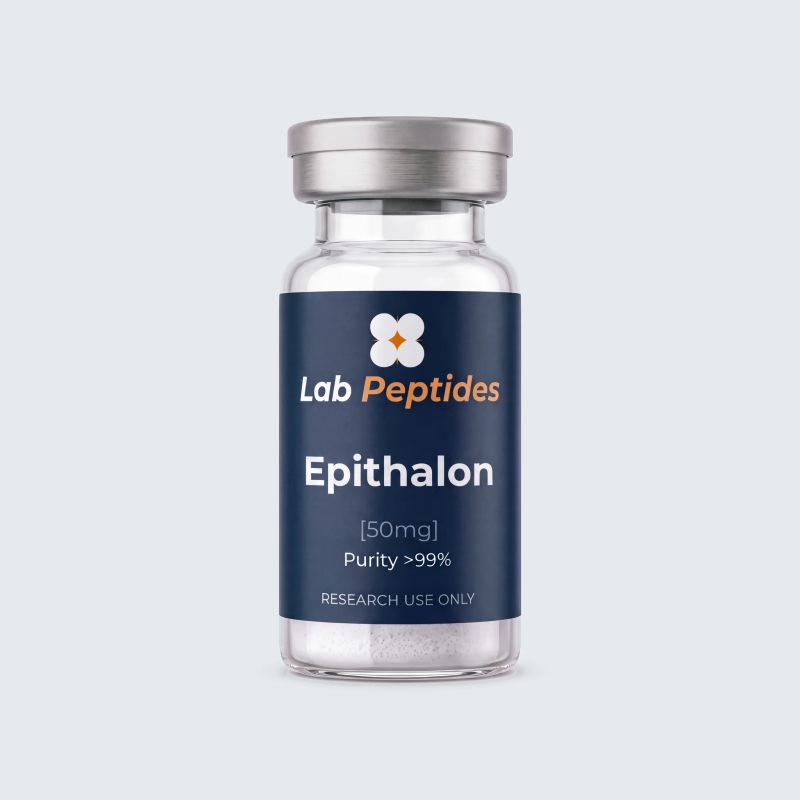
Epithalon 50mg Longevity
Longevity, long-cycle size.
Epithalon 50mg — long-cure format of the most documented longevity tetramer. Telomerase and pineal-axis modulator: cell cycles, deep sleep, circadian rhythm. 5x the material for extended protocols. HPLC ≥ 98 %. Stock in France, zero EU customs.
- In stock in France
 Ordered with its water: shipped in a magnetic box
10% off every deliveryPause, skip or cancel in 1 clickNo commitment, no hidden fees
No automatic charge: pay for each delivery by card, in Bitcoin (an extra 5% off), or by bank transfer from €100
Your complete kit
The vial alone cannot be used as is. Add what you need to prepare it:
Frequently bought together


Research Use Only (RUO) · Prohibited for human or veterinary use.
Key facts
Epithalon 50mg (Epitalon, Epithalone, AEDG) is a synthetic tetrapeptide with the sequence Ala-Glu-Asp-Gly, the short, stabilized version of Epithalamin, the pineal gland extract isolated in the 1980s by Vladimir Khavinson's Russian school of gerontology. With a molecular weight of approximately 390 Da, this tetramer is today the most documented anti-aging peptide in the bioregulation literature, studied continuously for over three decades at the St. Petersburg Institute of Bioregulation and Gerontology.
In detail
This 50mg format is not just a vial: it is the long-cure format. Most Epithalon research protocols rely on short but repeated cycles (10 to 20 days, several times a year). Concentrating 50mg of material in a single HPLC >98% vial covers a full research cycle without multiplying reconstitutions, handling steps and contamination risks. It is the choice of serious, longitudinal protocols where batch consistency matters most.
Its scientific appeal rests on a target unique among peptides: telomerase, the enzyme that rebuilds chromosome ends. On this target, Epithalon has generated in vitro and animal data that few research molecules can claim, placing it at the heart of research on cellular senescence and the biological clock.
Protocol and preparation
| Water added | Concentration | Reading marker |
|---|---|---|
| 2 ml | 25 mg/ml | 10 UI = 2,5 mg |
| 3 ml | 16,67 mg/ml | 10 UI = 1,67 mg |
The volume of water does not change the product, only its concentration. Introduce the water slowly along the vial wall, never directly onto the lyophilisate, then swirl without shaking. Markers given on a 1 ml syringe graduated in 100 units.
Asepsis
Disinfect surfaces and stoppers (70% alcohol).
Solvent
Draw the required volume of bacteriostatic water.
Introduction
Inject gently against the vial wall (avoid direct jet on powder).
Solubilization
Roll the vial gently. Do not shake vigorously (degradation risk).
Solution storage Once reconstituted: 2-8°C (refrigerator).
Warning Theoretical tool for chemical handling. Does not constitute medical advice.
Open the dilution calculator- The amount of powder looks tiny. A lyophilisate takes up a few millimetres at the bottom of the vial, sometimes just a translucent film. The stated weight is there.
- The powder is compact, stuck to the wall or to the stopper. Transport moves the freeze-dried cake around. It changes nothing to reconstitution.
- The vial carries no individual label. That is our standard packaging, not a downgraded vial.
- After reconstitution, deposits or filaments appear. This is common, especially with small molecules. Let it settle and roll the vial between your palms, never shake it.
- The parcel is plain. Nothing on the outside indicates the contents or the brand name.
What is not normal: a cracked vial, an uncrimped cap or a stopper that moves, powder that has liquefied or changed colour. In those specific cases, write to us with a photo and we take the vial back.
The Atlas Lab Epithalon 50mg vial is reconstituted with bacteriostatic water. For a comfortable working concentration, 2 ml of bacteriostatic water yields 25 mg/ml; 5 ml yields 10 mg/ml, a practical ratio for finely fractioning a long cycle. Volume choice depends on the fractioning targeted by the research protocol.
Reference cycle scheme. The Russian literature favors short repeated cycles rather than continuous administration: typically 10 to 20 consecutive days, two to three times a year. The rationale is that the effect on gene expression and telomerase persists after cessation, making continuous dosing unnecessary. The 50mg format is precisely calibrated to cover a full cycle from a single batch, ensuring material homogeneity throughout the experiment.
Handling. Reconstitute by letting the solvent run slowly down the vial wall, without violently shaking the tetramer. Never vortex. Draw under aseptic conditions. Epithalon's short sequence makes it robust, but handling rigor conditions inter-cycle reproducibility.
These parameters are provided for in vitro and model research documentation. For research use only (RUO), no human, diagnostic or therapeutic use.
Technical data
- Reconstitution
- 2 ml d'eau → 25 mg/ml. 10 UI = 2,5 mg ; 20 UI = 5 mg.
- Peptide sequence
- Ala-Glu-Asp-Gly
- Molecular formula
- C14H22N4O9
- Molecular weight
- 390.35 g/mol
- CAS number
- 307297-39-8
- Physical form
- Poudre lyophilisée
- Recommended solubility
- Eau bactériostatique, NaCl 0,9%
- Storage conditions
- Au réfrigérateur (+2 à +8 °C), à l'abri de la lumière. En poudre, possible au congélateur pour une conservation longue. Une fois préparé : réfrigérateur, jamais au congélateur.
- Use
- Research reagent, in vitro only (RUO)
Storage & handling
In lyophilized form, Epithalon 50mg is remarkably stableIt keeps in the fridge (+2 to +8 °C), away from light, and in a -20 °C freezer the tetramer lasts several years without measurable degradation. On receipt, the fridge is enough (freezer optional for storage beyond 3 months); a few days at room temperature during transport does not affect the dry powder, as the short AEDG sequence is little sensitive to heat in solid state.
After reconstitution, keep the solution at +2/+8°C (refrigerator) and use it within the following weeks. Bacteriostatic water (0.9% benzyl alcohol) limits microbial proliferation and allows multiple draws from the same vial, which fits perfectly with the long-cycle use of the 50mg format. Avoid repeated freeze/thaw cycles of the reconstituted solution.
Our peptides are HPLC-tested to over 98% purity and vacuum lyophilized.
Mechanism of action
Epithalon's mechanism of action is organized around three complementary axes that explain its reference status in aging research.
Telomerase activation. With each division, somatic cells lose a fraction of their telomeres, the protective caps at chromosome ends; once they reach the Hayflick limit, they enter senescence. Khavinson's work (2003) showed that Epithalon induces expression of the catalytic subunit of telomerase (hTERT) in human somatic fibroblasts, with measurable telomere elongation and resumption of divisions beyond the expected limit. This founding observation made the tetramer a major study molecule.
Restoration of the pineal axis and melatonin. Epithalon derives from the pineal gland and acts upon it. Russian studies document a normalization of the circadian melatonin rhythm in aged subjects, whose nocturnal secretion collapses with age. This restoration of the nocturnal peak underlies observations on deep sleep and circadian synchronization.
Modulation of gene expression. Khavinson's model proposes that short peptides penetrate the nucleus and interact directly with DNA promoter sequences, modulating the expression of genes linked to the cell cycle, repair and antioxidant defense. This concept of peptide epigenetic regulation remains central in the Russian bioregulation literature.
Studies and references
The Epithalon corpus is dense and longitudinal, a rare feature for a research peptide.
Telomerase and telomeres (Khavinson, 2003). Published in the Bulletin of Experimental Biology and Medicine, the seminal study showed induction of telomerase activity and telomere elongation in human fibroblasts, exceeding the Hayflick limit by more than ten additional divisions.
Animal longevity. Several rodent cohorts (CBA mice, rats) treated with Epithalon cycles show a reduction in spontaneous tumor incidence and an increase in maximum lifespan compared with controls, with normalization of oxidative stress markers. Anisimov and Khavinson published repeatedly on these models.
Longitudinal human study (Korkushko, 2011). A multi-year follow-up of elderly patients treated with Epithalon cycles: the authors report a reduction in mortality in the treated group versus control over a 6 to 12 year window, with restoration of the melatonin profile. It is one of the rare human survival datasets associated with a research peptide.
These results, mostly from the Russian school, remain to be confirmed by large independent randomized trials. Western literature remains cautious in the absence of large-scale replication. Epithalon is, to date, a research tool, not a validated therapeutic.
Similar peptides
Epithalon 50mg vs 10mg. Same molecule, same purity; the difference is strategic. The 10mg suits a one-off test or a mini-cycle. The 50mg is the format for longitudinal protocols: a single batch for a full cycle, hence zero inter-vial variability over the experiment, and a markedly better cost per milligram. For any serious senescence research, the 50mg is the rational choice.
Epithalon vs GHK-Cu. Two anti-aging references with distinct targets: Epithalon acts on telomerase and the pineal axis (biological clock, replicative senescence); GHK-Cu acts on the extracellular matrix and over 4000 tissue regeneration genes (skin, collagen). Complementary rather than competing.
Epithalon vs NAD+. NAD+ targets cellular energy metabolism and sirtuins; Epithalon targets telomere length and circadian rhythm. Two different levers of aging biology.
Epithalon vs non-peptide telomerase activators (TA-65 type). Epithalon is a short synthetic peptide with a defined sequence, verifiable by HPLC, whereas astragalus plant extracts show significant compositional variability. Molecular precision is the tetramer's argument.
Frequently asked questions
Why choose the Epithalon 50mg format over the 10mg?
How much bacteriostatic water to reconstitute the 50mg vial?
Does Epithalon really activate telomerase?
How to store Epithalon?
What is the difference between Epithalon and Epithalamin?
Is Epithalon intended for human use?
 The complete guideEpitalon (Epithalon): complete guide to the telomerase peptide in researchEpitalon (AEDG), a pineal-derived tetrapeptide: telomerase, mouse and fruit fly studies, human data from the Khavinson team, the 2025 independent replication, doses studied, reconstitution and status.Read the guide
Also read:Peptides and longevity in research: epithalon, humanin and cellular senescence mechanisms