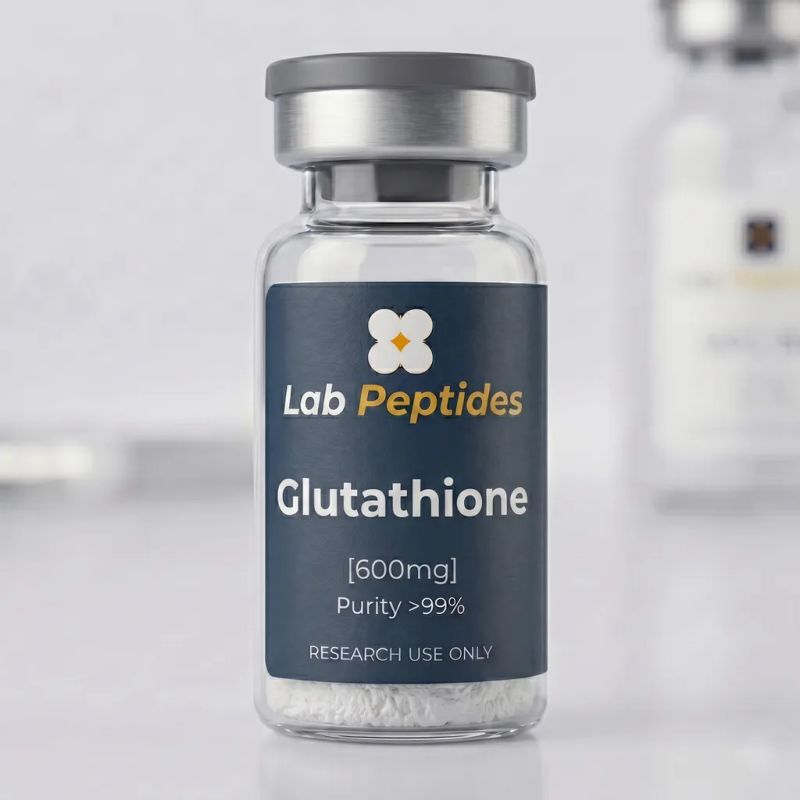
Glutathione 600mg Skin & Beauty
Antioxydant maître. Éclat & détox cellulaire.
Glutathione 600mg — the body's master antioxidant, premium dosing. Cellular detox, skin radiance, oxidative-stress neutralization. The star tripeptide of longevity and skin-beauty research. HPLC ≥ 98 %. EU stock, ships the next day. Research use only (RUO).
- In stock in France
-10 % for life on each cyclePause, skip or cancel in 1 clickNo commitment, no hidden fees
Your complete kit
- 600mg vialIncluded
- Bacteriostatic waterAdd
- 1 ml syringesAdd
The vial alone cannot be used as is. One sealed vial of Glutathione 600mg, lyophilised, without individual labelling.
Don't forget the essentials
Frequently bought together



Product information
Glutathione 600mg (GSH, reduced L-glutathione) is the master antioxidant tripeptide of the living cell, with the sequence gamma-Glu-Cys-Gly. Its structural feature is unique among peptides: the gamma bond, formed via the glutamate side chain, makes it resistant to classical peptidases and explains its biological stability. With a molecular weight of 307 Da and the formula C10H17N3O6S, glutathione is present in every cell at millimolar concentrations, where it forms the first line of defense against oxidative stress.
This 600mg format is a premium dosing, calibrated for high molar-load research protocols (oxidative stress models, hepatic detoxification studies, skin depigmentation research). The high mass per vial avoids multiplying units for consuming protocols, while guaranteeing a single HPLC >98% controlled batch.
At the heart of longevity and skin beauty research, glutathione concentrates three roles: free radical neutralization, cellular detoxification and skin radiance through melanogenesis modulation. It is the reference molecule for studying redox balance and the oxidative protection of tissues.
01Mechanism of action
Glutathione's mechanism of action relies on the sulfur chemistry of its central cysteine, whose thiol group (-SH) is the true active site.
Direct neutralization of reactive species. The cysteine thiol donates an electron to neutralize free radicals (ROS, reactive oxygen species). Two molecules of reduced glutathione (GSH) then oxidize into glutathione disulfide (GSSG). The GSH/GSSG ratio is the reference indicator of cellular redox state in research, subsequently restored by glutathione reductase using NADPH.
Cofactor of glutathione peroxidases. GSH fuels the glutathione peroxidase enzymes that destroy hydrogen peroxide and lipid peroxides, protecting membranes from peroxidation. It is a pillar of enzymatic antioxidant defense.
Phase II detoxification. Via glutathione-S-transferases, GSH conjugates with xenobiotics, heavy metals and electrophilic metabolites, making them water-soluble and eliminable (mercapturic acid pathway). This is the central mechanism of cellular detoxification studied in hepatic models.
Skin radiance and melanogenesis. Glutathione inhibits tyrosinase and shifts melanin synthesis toward light pheomelanin rather than dark eumelanin. This mechanism founds research on skin depigmentation and radiance, the field where glutathione is the most studied candidate.
Similar peptides
Glutathione vs NAD+. Two pillars of cellular metabolism with distinct roles: glutathione manages redox balance and detoxification (thiol chemistry), NAD+ manages energy metabolism and sirtuins (mitochondrial electron transfer). Complementary in any aging-biology approach.
Glutathione vs GHK-Cu. In skin research, glutathione acts on radiance and depigmentation (tyrosinase inhibition, antioxidation); GHK-Cu acts on matrix regeneration (collagen, elastin, over 4000 genes). Two different skin levers, often studied in parallel.
Glutathione vs vitamin C. Classic synergy: vitamin C regenerates oxidized glutathione and vice versa. Glutathione is the master intracellular antioxidant, vitamin C acts more in the extracellular compartment. The antioxidant network works as a relay.
Glutathione vs NAC (N-acetylcysteine). NAC is a precursor that supplies the limiting cysteine so the cell synthesizes its own glutathione; glutathione 600mg directly provides the whole molecule. Direct approach versus precursor approach, depending on the targeted research model.