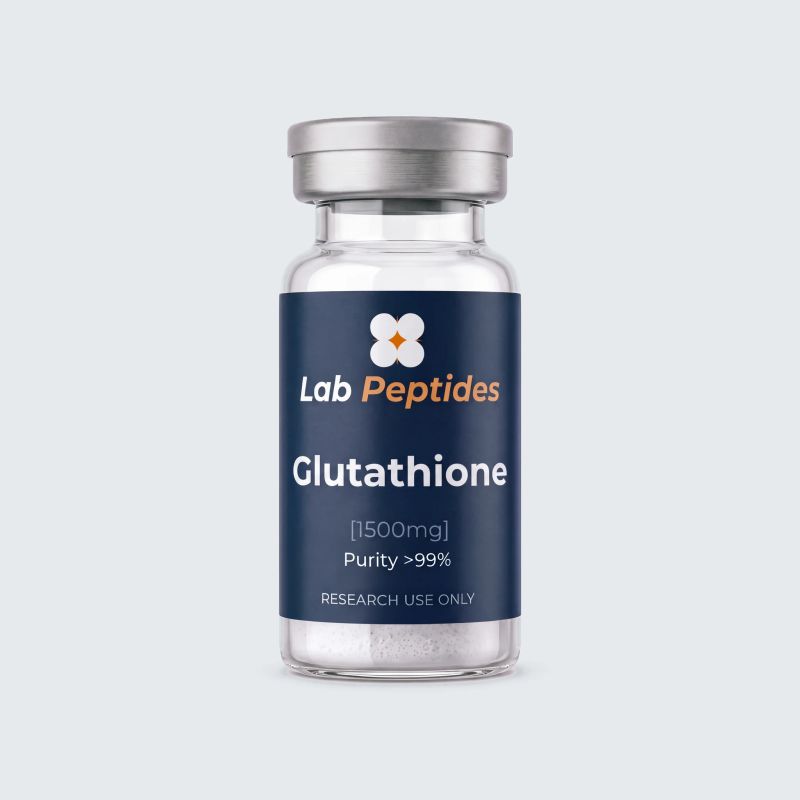
Glutathione 1500mg Skin Tissues
The body's master antioxidant.
Glutathione 1500 mg: the body's master antioxidant, at a premium dose. Cellular detox, skin radiance, neutralisation of oxidative stress. The star tripeptide of longevity and skin research. HPLC ≥ 98%. Stock in France, zero EU customs. Research use only (RUO).
- In stock in France
 Ordered with its water: shipped in a magnetic box
10% off every deliveryPause, skip or cancel in 1 clickNo commitment, no hidden fees
No automatic charge: pay for each delivery by card, in Bitcoin (an extra 5% off), or by bank transfer from €100
Your complete kit
The vial alone cannot be used as is. Add what you need to prepare it:
Frequently bought together


Research Use Only (RUO) · Prohibited for human or veterinary use.
Key facts
Glutathione 1500mg (GSH, reduced L-glutathione) is the master antioxidant tripeptide of the living cell, with the sequence gamma-Glu-Cys-Gly. Its structural feature is unique among peptides: the gamma bond, formed via the glutamate side chain, makes it resistant to classical peptidases and explains its biological stability. With a molecular weight of 307 Da and the formula C10H17N3O6S, glutathione is present in every cell at millimolar concentrations, where it forms the first line of defense against oxidative stress.
In detail
This 1500mg format is a premium dosing, calibrated for high molar-load research protocols (oxidative stress models, hepatic detoxification studies, skin depigmentation research). The high mass per vial avoids multiplying units for consuming protocols.
At the heart of longevity and skin beauty research, glutathione concentrates three roles: free radical neutralization, cellular detoxification and skin radiance through melanogenesis modulation. It is the reference molecule for studying redox balance and the oxidative protection of tissues.
Protocol and preparation
| Water added | Concentration | Reading marker |
|---|---|---|
| 7,5 ml | 200 mg/ml | 10 UI = 20 mg |
The volume of water does not change the product, only its concentration. Introduce the water slowly along the vial wall, never directly onto the lyophilisate, then swirl without shaking. Markers given on a 1 ml syringe graduated in 100 units.
Asepsis
Disinfect surfaces and stoppers (70% alcohol).
Solvent
Draw the required volume of bacteriostatic water.
Introduction
Inject gently against the vial wall (avoid direct jet on powder).
Solubilization
Roll the vial gently. Do not shake vigorously (degradation risk).
Solution storage Once reconstituted: 2-8°C (refrigerator).
Warning Theoretical tool for chemical handling. Does not constitute medical advice.
Open the dilution calculator- The amount of powder looks tiny. A lyophilisate takes up a few millimetres at the bottom of the vial, sometimes just a translucent film. The stated weight is there.
- The powder is compact, stuck to the wall or to the stopper. Transport moves the freeze-dried cake around. It changes nothing to reconstitution.
- The vial carries no individual label. That is our standard packaging, not a downgraded vial.
- After reconstitution, deposits or filaments appear. This is common, especially with small molecules. Let it settle and roll the vial between your palms, never shake it.
- The parcel is plain. Nothing on the outside indicates the contents or the brand name.
What is not normal: a cracked vial, an uncrimped cap or a stopper that moves, powder that has liquefied or changed colour. In those specific cases, write to us with a photo and we take the vial back.
The Atlas Lab Glutathione 1500mg vial is reconstituted with bacteriostatic water or saline. The high mass requires a larger solvent volume than micro-dose peptides: 7.5 ml gives a concentration of 200 mg/ml. A more dilute preparation at 100 mg/ml would require 15 ml, beyond the capacity of a standard vial. Glutathione is highly soluble in aqueous medium; the resulting solution is slightly acidic, which is normal for this tripeptide.
Reference schemes. Subcutaneously, the research baseline is 100 mg per day, i.e. 50 units at 200 mg/ml, in one daily injection. The 600 to 1200 mg per administration cited in the literature refer to the intravenous route and do not transpose to subcutaneous use. Fractioning and frequency depend strictly on the model studied.
Handling and oxidation. Critical point: glutathione's thiol group oxidizes in air. Reconstitute just before use, limit exposure to air and light, do not vortex, draw under aseptic conditions. A solution that yellows or clouds signals advanced oxidation (conversion to GSSG) and must be discarded.
Parameters provided for in vitro and model research documentation. For research use only (RUO), no human, cosmetic, diagnostic or therapeutic use.
Technical data
- Reconstitution
- 7,5 ml d'eau → 200 mg/ml. 25 UI = 50 mg ; 50 UI = 100 mg.
- Peptide sequence
- γ-Glu-Cys-Gly
- Molecular formula
- C10H17N3O6S
- Molecular weight
- 307.33 g/mol
- CAS number
- 70-18-8
- Physical form
- Poudre lyophilisée blanche
- Recommended solubility
- Eau bactériostatique, NaCl 0.9%, acide acétique 0.1%
- Storage conditions
- Au réfrigérateur (+2 à +8 °C), à l'abri de la lumière. En poudre, possible au congélateur pour une conservation longue. Une fois préparé : réfrigérateur, jamais au congélateur.
- Use
- Research reagent, in vitro only (RUO)
Storage & handling
In lyophilized form, Glutathione 1500mg is stable when stored in the fridge (+2 to +8 °C), away from light and air; a -20 °C freezer is an option for long-term storage (over 3 months). The dry powder withstands room-temperature transport over a few days, but since glutathione is oxidation-sensitive, cold storage on receipt is recommended to preserve the maximum reduced form (GSH).
After reconstitution, glutathione is markedly more fragile than most peptides: the solution must be kept at +2/+8°C, away from light, and used quickly (ideally within a few days). Prolonged contact with atmospheric oxygen progressively converts GSH into inactive GSSG. Reseal tightly, minimize the dead air volume in the vial, and avoid any freeze/thaw cycle.
Our peptides are HPLC-tested to over 98% purity and vacuum lyophilized.
Mechanism of action
Glutathione's mechanism of action relies on the sulfur chemistry of its central cysteine, whose thiol group (-SH) is the true active site.
Direct neutralization of reactive species. The cysteine thiol donates an electron to neutralize free radicals (ROS, reactive oxygen species). Two molecules of reduced glutathione (GSH) then oxidize into glutathione disulfide (GSSG). The GSH/GSSG ratio is the reference indicator of cellular redox state in research, subsequently restored by glutathione reductase using NADPH.
Cofactor of glutathione peroxidases. GSH fuels the glutathione peroxidase enzymes that destroy hydrogen peroxide and lipid peroxides, protecting membranes from peroxidation. It is a pillar of enzymatic antioxidant defense.
Phase II detoxification. Via glutathione-S-transferases, GSH conjugates with xenobiotics, heavy metals and electrophilic metabolites, making them water-soluble and eliminable (mercapturic acid pathway). This is the central mechanism of cellular detoxification studied in hepatic models.
Skin radiance and melanogenesis. Glutathione inhibits tyrosinase and shifts melanin synthesis toward light pheomelanin rather than dark eumelanin. This mechanism founds research on skin depigmentation and radiance, the field where glutathione is the most studied candidate.
Studies and references
Glutathione is one of the most studied antioxidants in biology, with a corpus spanning several decades.
Redox balance and oxidative stress. The GSH/GSSG ratio is a validated oxidative-stress marker in countless cellular and animal models. Glutathione depletion sensitizes cells to oxidative apoptosis, a repeated demonstration of its fundamental protective role.
Hepatic detoxification. The liver is the organ richest in glutathione. Toxicity models (notably acetaminophen overdose, where N-acetylcysteine restores glutathione) established GSH's central role in neutralizing reactive metabolites.
Skin depigmentation. Several clinical trials, especially in Asian dermatology, evaluated glutathione (oral, topical and intravenous) on skin radiance and lightness, with positive results but methodological heterogeneity and an ongoing debate on the optimal administration route and effect duration.
Bioavailability and forms. The literature widely documents the poor oral bioavailability of native glutathione (digestive degradation), which steered research toward injectable, liposomal forms and precursors such as NAC. This delivery question remains an active research axis.
These data position glutathione as a leading redox research tool. Atlas Lab Glutathione 1500mg is sold strictly for that purpose, without therapeutic or cosmetic status.
Similar peptides
Glutathione vs NAD+. Two pillars of cellular metabolism with distinct roles: glutathione manages redox balance and detoxification (thiol chemistry), NAD+ manages energy metabolism and sirtuins (mitochondrial electron transfer). Complementary in any aging-biology approach.
Glutathione vs GHK-Cu. In skin research, glutathione acts on radiance and depigmentation (tyrosinase inhibition, antioxidation); GHK-Cu acts on matrix regeneration (collagen, elastin, over 4000 genes). Two different skin levers, often studied in parallel.
Glutathione vs vitamin C. Classic synergy: vitamin C regenerates oxidized glutathione and vice versa. Glutathione is the master intracellular antioxidant, vitamin C acts more in the extracellular compartment. The antioxidant network works as a relay.
Glutathione vs NAC (N-acetylcysteine). NAC is a precursor that supplies the limiting cysteine so the cell synthesizes its own glutathione; glutathione 600mg directly provides the whole molecule. Direct approach versus precursor approach, depending on the targeted research model.
Frequently asked questions
Is glutathione a peptide?
How much solvent to reconstitute the 1500mg vial?
Why does glutathione oxidize so fast once reconstituted?
Why a 1500mg format, higher dosed than classic peptides?
What is the difference between glutathione and NAC?
Can Atlas Lab Glutathione be used in cosmetics or on skin?
 Read before you orderSS-31 (elamipretide): the peptide that targets the mitochondrion directlyMost peptides act on surface receptors. SS-31 does something else: it concentrates inside the mitochondrion, on cardiolipin. What this targeting mechanism changes for mitochondrial research.Read the article