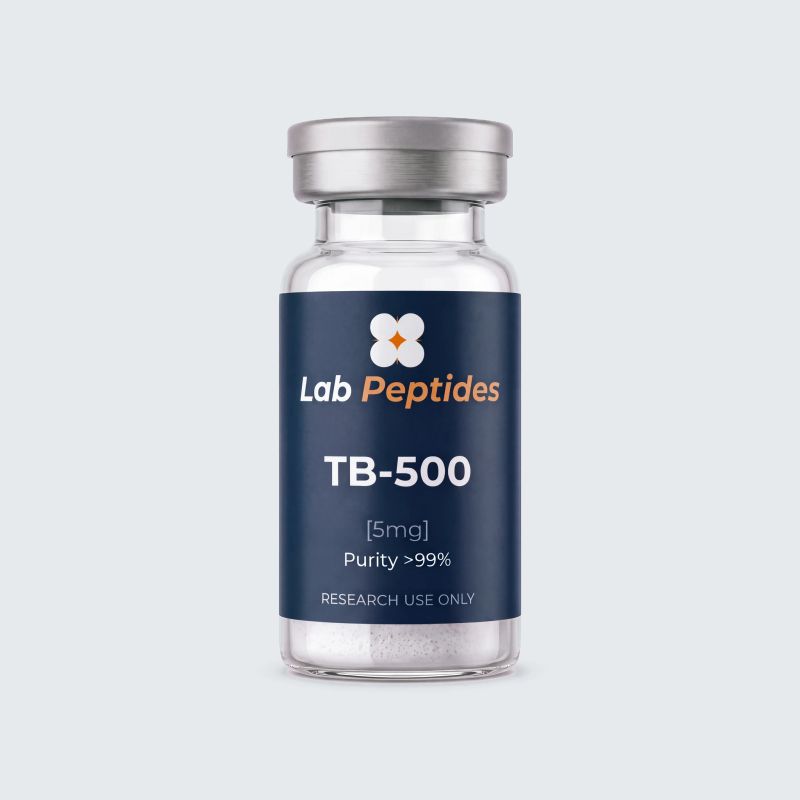
TB-500 5mg Regeneración
El compañero del BPC-157.
El compañero imprescindible del BPC-157. Fragmento de Thymosin Beta-4 — migración celular sistémica, angiogénesis. Acción complementaria al BPC-157 (que actúa en local). Combo estándar de los protocolos de recuperación avanzados.
Inicio de los protocolos de investigación: 40 unidades, es decir 2 mg por inyección (vial preparado con 1 ml de agua).
5 mg = el contenido del vial, no la dosis.Ver la preparación
- Stock en Francia
 Pedido con su agua: enviado en estuche imantado
-10 % en cada envíoPause, salte o cancele en 1 clicSin compromiso, sin gastos ocultos
Sin cargo automático: pague cada envío con tarjeta, en Bitcoin (-5 % adicional) o por transferencia desde 100 €
Este producto contiene TB-500. Los trabajos publicados abordan la angiogénesis, la formación de nuevos vasos sanguíneos. Ningún ensayo clínico humano aleatorizado ha caracterizado las contraindicaciones.
Las alertas teóricas descritas en los trabajos preclínicos afectan a los antecedentes de cáncer, en particular tumores sólidos muy vascularizados, al embarazo y la lactancia, y a las retinopatías proliferativas.
Tu kit completo
El vial por sí solo no puede usarse tal cual. Añada lo necesario para prepararlo:
Se compran juntos a menudo


Uso exclusivo en investigación (RUO) · Prohibido para uso humano o veterinario.
Lo esencial
Our TB-500 5 mg vial is the ideal pilot format to initiate a first regenerative research protocol without committing to extended stock. With 5 mg of lyophilized peptide at HPLC purity ≥98 %, this format covers 2 full loading dose injections (2.5 mg), i.e. 1 to 1.25 weeks at 2 injections per week — perfect for validating a first cycle before moving to the 10 mg flagship format. TB-500 5 mg is intended for independent researchers, experimental sports medicine clinics, and laboratories prioritizing supply flexibility. Why choose 5 mg? Reduced initial investment, simple marks (1 ml = 5 mg/ml, same as the 10 mg), coverage of 2 loading injections. The perfect pilot format to document a first response before committing to more extended research.
Protocolo y preparación
| Agua añadida | Concentración | Marca de lectura |
|---|---|---|
| 1 ml | 5 mg/ml | 40 UI = 2 mg |
| 2 ml | 2,5 mg/ml | 40 UI = 1 mg |
El volumen de agua no cambia el producto, solo su concentración. Introduzca el agua despacio por la pared del vial, nunca directamente sobre el liofilizado, y luego gírelo suavemente sin agitar. Las marcas se dan sobre una jeringa de 1 ml graduada en 100 unidades.
Asepsia
Desinfecte las superficies y los tapones (alcohol al 70%).
Disolvente
Extraiga el volumen necesario de agua bacteriostática.
Introducción
Inyecte suavemente contra la pared del vial (evite el chorro directo sobre el polvo).
Solubilización
Haga rodar el vial suavemente. No lo agite con fuerza (riesgo de degradación).
Conservación de la solución Una vez reconstituido: 2-8°C (nevera).
Advertencia Herramienta teórica para manipulación química. No constituye un consejo médico.
Abrir la calculadora de dilución- La cantidad de polvo parece mínima. Un liofilizado ocupa unos pocos milímetros en el fondo del vial, a veces solo una película translúcida. El peso indicado está ahí.
- El polvo está compacto, pegado a la pared o al tapón. El transporte desplaza la torta liofilizada. No cambia nada en la reconstitución.
- El vial no lleva etiqueta individual. Es nuestro embalaje estándar, no un vial de menor calidad.
- Tras la reconstitución aparecen depósitos o filamentos. Es habitual, sobre todo con moléculas pequeñas. Deje que se asiente y haga rodar el vial entre las palmas, nunca lo agite.
- El paquete es neutro. Nada en el exterior indica el contenido ni el nombre de la marca.
Lo que no es normal: un vial agrietado, una cápsula sin engastar o un tapón que se mueve, polvo que se ha licuado o cambiado de color. En esos casos concretos, escríbanos con una foto y recuperamos el vial.
Recommended reconstitution: 1 ml bacteriostatic water for injection → final concentration 5 mg/ml. This concentration has an operational advantage: 0.5 ml of solution (50 units on 100 IU syringe) corresponds exactly to the standard loading dose (2.5 mg), with the same marks as TB-500 10 mg, simplifying dosing. Procedure: 1) let vial and diluent reach room temperature (15 minutes); 2) disinfect stopper with 70% alcohol; 3) draw bacteriostatic water into sterile syringe; 4) inject slowly along inner wall of vial; 5) gently swirl until dissolution — no vigorous shaking. Dosages reported in preclinical literature: loading phase 2.0-2.5 mg twice weekly, maintenance phase 2.0 mg once weekly. At 5 mg/ml concentration, 2.5 mg corresponds to 0.5 ml (50 units on 100 IU syringe) and 2.0 mg to 0.4 ml (40 units). Autonomy: 5 mg allows 2 injections of 2.5 mg or 2.5 injections of 2 mg, i.e. 1 to 1.25 weeks at 2 injections per week. Ideal pilot format for a short validation cycle. Post-reconstitution storage: refrigerator 2-8 degrees Celsius, 30-day window with bacteriostatic. Over 1 to 1.25 weeks of use, the vial is fully consumed well before the stability limit.
Datos técnicos
- Reconstitución
- 1 ml d'eau → 5 mg/ml. 40 UI = 2 mg ; 50 UI = 2,5 mg.
- Secuencia peptídica
- Ac-SDKPDMAEIEKFDKSKLKKTETQEKNPLPSKETIEQEKQAGES
- Fórmula molecular
- C212H350N56O78S
- Peso molecular
- 4963 g/mol
- Número CAS
- 77591-33-4
- Forma física
- Poudre lyophilisée
- Solubilidad recomendada
- Eau bactériostatique, NaCl 0,9%
- Condiciones de conservación
- Au réfrigérateur (+2 à +8 °C), à l'abri de la lumière. En poudre, possible au congélateur pour une conservation longue. Une fois préparé : réfrigérateur, jamais au congélateur.
- Uso
- Reactivo de investigación, solo in vitro (RUO)
Conservación y manipulación
Lyophilized unreconstituted TB-500 is stored in the fridge (+2 to +8 °C) in its original sealed packaging, protected from light and humidity; for long-term storage (over 3 months), a -20 °C freezer keeps it for up to 24 months. At refrigerated temperature (2-8 degrees Celsius), documented stability covers at least 12 months. At room temperature (below 25 degrees Celsius), the recommended duration for temporary transport or storage does not exceed 3 weeks. Once reconstituted with bacteriostatic water for injection, TB-500 must imperatively be stored between 2 and 8 degrees Celsius. Post-reconstitution stability is documented for up to 30 days when bacteriostatic water (0.9% benzyl alcohol) is used. With preservative-free sterile water, the usage window narrows to 7-10 days. The peptide is sensitive to repeated freeze-thaw cycles (limit to a maximum of three), direct UV light, thermal shocks, and vigorous agitation that can denature tertiary structure. Prefer aliquots for large-volume formats. TB-500 lyophilised stability is high at -20°C under desiccation: > 24 months with no measurable RP-HPLC purity loss. In reconstituted solution (bacteriostatic water, 1-5 mg/mL), stability is documented 28 days at 2-8°C in amber vial. Optimal pH is neutral (6.5-7.5); avoid alkaline solutions (> pH 8) which favour Gln → Glu deamidation. Strictly protect from UV light. Never refreeze after reconstitution: freeze/thaw cycles generate dimers/trimers detectable by SEC-HPLC. Preferred packaging: type I borosilicate glass vial, siliconised butyl stopper, flip-off aluminium cap.
Mecanismo de acción
TB-500 (Thymosin Beta-4 peptide, or active fragment of Tbeta-4) is a synthetic peptide derived from Thymosin Beta-4, a 44-amino-acid protein initially identified in the thymus and widely distributed across mammalian tissues. Most research suppliers offer either the full 1-44 sequence (Tbeta-4) or the active 17-23 fragment (LKKTETQ), the latter considered the key functional site responsible for several documented biological effects.
The established primary mechanism of TB-500 is G-actin (monomeric actin) sequestration via a specific binding site, which regulates actin-filamentary dynamics and cellular motility. This fundamental action influences the migration of fibroblasts, corneal keratocytes, endothelial progenitors, and epicardial cardiac progenitors in studied models.
Published work has documented several convergent secondary pathways. First, mobilization of endothelial progenitor cells (EPCs) from bone marrow to injury sites, observed in cardiac and vascular repair models. Second, upregulation of VEGF (Vascular Endothelial Growth Factor) and stimulation of local angiogenesis, critical for post-ischemic tissue revascularization. Finally, anti-inflammatory modulation via the NF-kappaB axis and documented reduction of pro-inflammatory markers (TNF-alpha, IL-1beta) in various murine models.
At the tissue level, the preclinical literature has reported accelerated healing in multiple systems: cornea, skin, Achilles tendon, ligament, post-infarction cardiac muscle, colic mucosa. TB-500 displays plasma stability superior to classical regenerative peptides, with documented systemic diffusion making it a subject of particular interest for repair models distant from the injection site.
As with any research peptide, these data come exclusively from preclinical models (rodent, porcine, in vitro) and limited studies. No marketing authorization exists for human therapeutic use: TB-500 remains strictly a peptide intended for exploratory research.
TB-500 is a synthetic 7-amino-acid fragment (Leu-Lys-Lys-Thr-Glu-Thr-Gln, LKKTETQ, 889.0 Da) corresponding to the active sequence of thymosin β-4 (Tβ4, 43 aa, 4960 Da), a ubiquitously expressed endogenous protein involved in the cytoskeleton. The canonical molecular mechanism of Tβ4 is monomeric G-actin sequestration via its β-thymosin domain (17-35), preventing premature polymerisation into F-actin filaments and freeing actin for rapid cytoskeletal rearrangements during cell migration. The LKKTETQ fragment (TB-500) partially retains this G-actin binding activity. Tβ4 also exerts anti-fibrotic effects via its N-terminal acetylated metabolite Ac-SDKP (N-acetyl-seryl-aspartyl-lysyl-proline, cleaved by prolyl-endopeptidase), which inhibits activated fibroblast proliferation and type I collagen accumulation. Documented signalling pathways include Integrin-Linked Kinase (ILK) activation, NF-κB downregulation, and modulation of several pro-regenerative microRNAs (miR-146a, miR-124).
Estudios y referencias
The scientific corpus on Thymosin Beta-4 and its TB-500 fragment is dense and comes from several independent laboratories, particularly those of Allan Goldstein (GWU Washington), Ron Knutsen, and Hynda Kleinman (NIH). Main publications cover several converging models.
Philp and Kleinman (Annals of the New York Academy of Sciences 2007; DOI 10.1196/annals.1415.026) synthesized the first data on the regenerative properties of Tbeta-4 and its fragments, documenting promotion of endothelial migration, angiogenesis, and cutaneous healing in murine models of complex wounds.
Smart et al. (Nature 2011; DOI 10.1038/nature10188) published a major study showing that Tbeta-4 can reactivate adult epicardial cardiac progenitors in mice, with reduction of infarct size and improvement of left ventricular function post-MI. This work opened the way to several preclinical programs in regenerative cardiology.
In the ophthalmological field, Sosne et al. (Experimental Eye Research 2002; DOI 10.1006/exer.2001.1149) documented accelerated corneal re-epithelialization in rats after chemical injury, with improvement of clinical and histological parameters. These results were extended to dry eye and UV damage models.
On skin repair, Malinda et al. (The Journal of Investigative Dermatology 1999; DOI 10.1046/j.1523-1747.1999.00720.x) reported in rats significant acceleration of excisional wound healing after subcutaneous Tbeta-4 administration. Complementary work in porcine models confirmed these observations closer to human physiology.
Finally, Crockford (Annals of the New York Academy of Sciences 2007) synthesized data on the pharmacological profile, tissue distribution, and pharmacokinetics of TB-500 and Tbeta-4, positioning these peptides as serious research candidates in regenerative medicine. Several phase 2 clinical trials, run on full-length thymosin β4 and not on the TB-500 fragment, were conducted on Stevens-Johnson syndrome, corneal ulcer, and chronic skin lesions, with mixed results published by RegeneRx Biopharmaceuticals.
Corpus limitationsDespite existing phase 2 human data on full-length thymosin β4 (none on the TB-500 fragment), no definitive regulatory approval has been obtained. Reproducibility standards vary across laboratories and formulations. TB-500 remains strictly a preclinical research tool outside validated clinical trial protocols.
Preclinical studies on TB-500 and Tβ4 cover several target organs of regeneration. In experimental cardiology: LAD ligation myocardial infarction model in rats and pigs — partial reconstitution of functional cardiac tissue, improved ejection fraction on echography, reduced fibrosis zone (Bock-Marquette 2004, Nature). In ophthalmology: excimer laser rat/rabbit corneal healing model, alkaline corneal burn — accelerated re-epithelialisation and reduced aberrant neovascularisation. In dermatology: C57BL/6J mouse excisional skin wound, diabetic db/db healing delay, thermal burn model. In neurology: ischaemic stroke MCAO (middle cerebral artery occlusion) rat model — reduced infarct volume, improved neurological scores. In muscle trauma: rat tibialis muscle crush injury model, mdx mouse muscular dystrophy — restoration of sarcomeric histological organisation. In pulmonary fibrosis: bleomycin mouse model — Ac-SDKP-mediated anti-fibrotic action. None of these data transposes directly to human therapeutic use; they remain strictly preclinical (RUO).
- 1Réparation tissulaireThymosin beta4: actin-sequestering protein moonlights to repair injured tissues
- 2
- 3
Péptidos similares
TB-500 occupies a central position in the regenerative research peptide class, with a distinctive profile that differentiates it from other candidates in the same category. Compared to BPC-157 (protective pentadecapeptide), TB-500 acts via G-actin sequestration and systemic mobilization of endothelial progenitors, whereas BPC-157 favors an NO-dependent pathway and more local VEGFR2 modulation. Both peptides are often associated in research protocols to explore the synergy of their complementary mechanisms, particularly in tendon and cardiac repair models.
Compared to classical growth factors such as GH (Growth Hormone) or IGF-1, TB-500 presents a significantly more targeted action profile on cell migration and matrix remodeling, without the systemic endocrine anabolic effects characteristic of GH/IGF-1. This specificity makes it a preferred candidate for protocols seeking to stimulate tissue regeneration without disrupting the somatotropic axis.
Compared to full-sequence Tbeta-4 (44 amino acids), the TB-500 fragment (LKKTETQ, residues 17-23) offers more economical synthesis, superior stability, and similar pharmacokinetics in most studied models. Some publications have however suggested that the full sequence might present a slightly different immunomodulatory profile, which remains an open subject of investigation.
Compared to GHK-Cu (copper peptide) or IGF-1 LR3, TB-500 stands out for its systemic mobilization of EPC progenitors from bone marrow, a characteristic relatively unique in this class. In our shop, TB-500 is the second most ordered recovery peptide, just behind BPC-157. Commercialization for human therapeutic use remains prohibited in France, Europe, and the United States.
TB-500 occupies a complementary position to BPC-157 in research healing/regeneration protocols. Where BPC-157 acts primarily via NO/VEGF/Egr-1 on digestive, tendinous and vascular tissues, TB-500 targets actin-cytoskeleton dynamics and the Ac-SDKP anti-fibrotic axis, with documented predominance on cardiac muscle, cornea and diabetic skin. Compared to full-length Tβ4 (4960 Da), TB-500 offers the pharmacological advantage of lower molecular mass (889 Da, better tissue diffusion) but loses the complete anti-apoptotic and angiogenic properties of the native protein. Compared to IGF-1 LR3 (long R3 IGF-1, 9111 Da), TB-500 does not directly stimulate cell proliferation but favours migration and tissue reorganisation. Compared to collagen precursors (bioactive hydrolysed collagen peptides, massive doses required), TB-500 acts at preclinical micromolar doses with a targeted molecular mechanism. The TB-500 + BPC-157 synergy is proposed as a "regenerative stack" in grey literature, validated by several rodent preclinical studies showing additive effects on multi-compartmental tendon injury models.
Preguntas frecuentes
Is TB-500 5 mg enough to document a loading phase?
How do I reconstitute TB-500 5 mg to simplify dosing?
What is the difference between TB-500 and full Thymosin Beta-4?
Can TB-500 be combined with BPC-157 in research?
Which biological markers are studied in TB-500 protocols?
Is your TB-500 authentic and research-grade?
What is the delivery lead time in Europe?
What is the documented tolerance profile in preclinical studies?
What's the difference between TB-500 and full-length thymosin β-4?
Can TB-500 and BPC-157 be combined in preclinical research?
Should TB-500 HPLC purity exceed 98%?
 La guía completaTB-500 y timosina β-4: guía completa de la investigación sobre regeneración tisularEl TB-500 es un fragmento sintético de la timosina β-4 ampliamente estudiado por sus efectos sobre la angiogénesis, la migración celular y la cicatrización. Guía completa: estructura, mecanismos, modelos experimentales, farmacocinética y protocolos de investigación.Leer la guía
Lee también:Síntesis de péptidos en fase sólida (SPPS): guía completa de Merrifield, Fmoc, Boc, resinas, reactivos de acoplamiento y control de calidadBPC-157 vs TB-500: la comparativa 2026 de péptidos de investigación para la regeneración y reparación de tejidos