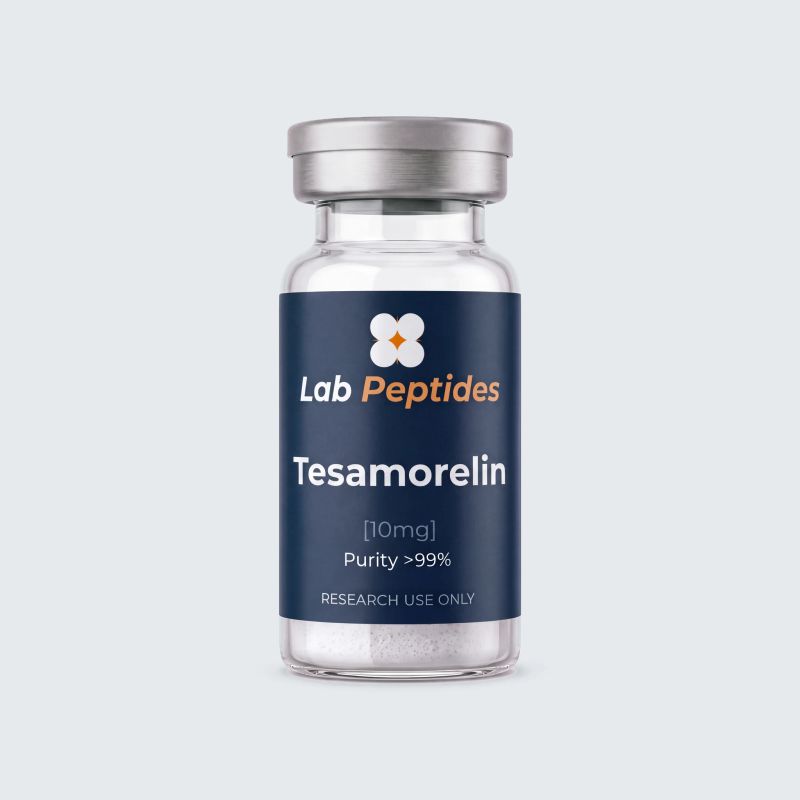
Tesamorelin 10mg Metabolism
The only FDA-approved GHRH.
The only FDA-approved GHRH peptide. Targets abdominal visceral fat exclusively — the kind no cardio touches. -18% visceral fat documented over 26 weeks. The belly-fat burner validated in phase 3.
- Certificate of analysis
- In stock in France
 Ordered with its water: shipped in a magnetic box
10% off every deliveryPause, skip or cancel in 1 clickNo commitment, no hidden fees
No automatic charge: pay for each delivery by card, in Bitcoin (an extra 5% off), or by bank transfer from €100
Your complete kit
The vial alone cannot be used as is. Add what you need to prepare it:
Frequently bought together


Research Use Only (RUO) · Prohibited for human or veterinary use.
Key facts
Our Tesamorelin 10 mg vial is the only currently FDA-approved GHRH analog (2010, commercial name Egrifta, HIV lipodystrophy indication), making it the best-documented peptide in the GHRH class in human clinical use. Developed by Theratechnologies (Montreal), Tesamorelin is a 44-amino-acid analog of native GHRH, stabilized by a trans-3-hexenoic group attached at the N-terminal position.
In detail
With 10 mg of lyophilized peptide per vial at HPLC purity ≥98 %, this format covers approximately 5 days of protocol at the pharmaceutical reference dose (2 mg/day, Falutz 2007/2010 pivotal dose on the original Egrifta formulation); the current Egrifta SV formulation (FDA 2019) reduces the daily dose to 1.4 mg/day SC. The certificate of analysis is published on this page, viewable before you order.
Tesamorelin stands out with a robust clinical corpus including pivotal phase 3 trials on over 800 patients (HIV lipodystrophy indication), with 52-week data documenting a significant reduction in visceral fat (visceral adipose tissue, VAT) and improved lipid parameters. It remains the absolute flagship of the GHRH class for laboratories prioritizing a peptide with tolerance and efficacy profile validated in regulatory human clinical studies.
Protocol and preparation
| Water added | Concentration | Reading marker |
|---|---|---|
| 1 ml | 10 mg/ml | 10 UI = 1 mg |
| 2 ml | 5 mg/ml | 40 UI = 2 mg |
The volume of water does not change the product, only its concentration. Introduce the water slowly along the vial wall, never directly onto the lyophilisate, then swirl without shaking. Markers given on a 1 ml syringe graduated in 100 units.
Asepsis
Disinfect surfaces and stoppers (70% alcohol).
Solvent
Draw the required volume of bacteriostatic water.
Introduction
Inject gently against the vial wall (avoid direct jet on powder).
Solubilization
Roll the vial gently. Do not shake vigorously (degradation risk).
Solution storage Once reconstituted: 2-8°C (refrigerator).
Warning Theoretical tool for chemical handling. Does not constitute medical advice.
Open the dilution calculator- The amount of powder looks tiny. A lyophilisate takes up a few millimetres at the bottom of the vial, sometimes just a translucent film. The stated weight is there.
- The powder is compact, stuck to the wall or to the stopper. Transport moves the freeze-dried cake around. It changes nothing to reconstitution.
- The vial carries no individual label. That is our standard packaging, not a downgraded vial.
- After reconstitution, deposits or filaments appear. This is common, especially with small molecules. Let it settle and roll the vial between your palms, never shake it.
- The parcel is plain. Nothing on the outside indicates the contents or the brand name.
What is not normal: a cracked vial, an uncrimped cap or a stopper that moves, powder that has liquefied or changed colour. In those specific cases, write to us with a photo and we take the vial back.
Recommended reconstitution: 2 ml bacteriostatic water for injection → final concentration 5 mg/ml (1 IU on 100 IU syringe = 50 µg). Procedure: 1) let vial and diluent reach room temperature (15 minutes); 2) disinfect stopper with 70% alcohol; 3) draw bacteriostatic water into sterile syringe; 4) inject slowly along inner wall of vial; 5) gently swirl until complete dissolution — no vigorous shaking. Reconstituted Tesamorelin should present a clear solution without visible particles. Dosages reported in literature: the standard therapeutic dosage established in the Falutz 2007/2010 pivotal trials is 2 mg per day in subcutaneous injection (abdomen, thigh, or arm, with site rotation). Exploratory human research protocols (outside authorized therapeutic framework in Europe) typically respect this reference dosage. At 5 mg/ml concentration, the Falutz 2 mg dose corresponds to 0.4 ml (40 IU on 100 IU syringe). Documented optimal timing: injection is typically performed at bedtime (30 min - 1 h before falling asleep) to synchronize effect with the nocturnal physiological GH peak during deep slow-wave sleep. Alternative: morning fasted. Avoid post-meal injections rich in carbohydrates or lipids that attenuate GH response. Autonomy: at the pharmaceutical reference dose 2 mg/day (Falutz 2007/2010 pivot), 10 mg covers 5 days of daily protocol — a complete 12-26 week cycle documented in literature therefore requires multiple vials. Exploratory research schemes reported in peptide literature classically use 300 µg/day SC on a 5-days-on / 2-days-off cycle: at this regimen, one 10 mg vial covers approximately 6 to 7 weeks of research protocol. Protocol duration: pivotal trials used 26-week cycles (initial phase 3) then 52 weeks (extension). In exploratory research, 12-26 week cycles are typical. Beyond 12 months, tolerance data are limited. Post-reconstitution storage: refrigerator 2-8 degrees Celsius, 14-day usage window (documented stability for commercial Egrifta product reconstituted).
Technical data
- Reconstitution
- 2 ml d'eau → 5 mg/ml. 20 UI = 1 mg ; 40 UI = 2 mg.
- Peptide sequence
- trans-3-hexénoyl-YADAIFTNSYRKVLGQLSARKLLQDIMSRQQGESNQERGARARL-NH2
- Molecular formula
- C221H366N72O67S
- Molecular weight
- 5135.78 g/mol
- CAS number
- 218949-48-5
- Physical form
- Poudre lyophilisée
- Recommended solubility
- Eau bactériostatique, NaCl 0,9%
- Storage conditions
- Au réfrigérateur (+2 à +8 °C), à l'abri de la lumière. En poudre, possible au congélateur pour une conservation longue. Une fois préparé : réfrigérateur, jamais au congélateur.
- Use
- Research reagent, in vitro only (RUO)
Storage & handling
Lyophilized unreconstituted Tesamorelin is stored in the fridge (+2 to +8 °C) in its original sealed packaging, protected from light and humidity; for long-term storage (over 3 months), a -20 °C freezer keeps it for up to 24 months. At refrigerated temperature (2-8 degrees Celsius), stability documented by Theratechnologies covers a minimum of 36 months in the commercial Egrifta form. At room temperature (below 25 degrees Celsius), recommended duration for transport or temporary storage: 3 weeks maximum. Once reconstituted with bacteriostatic water, Tesamorelin must be stored between 2 and 8 degrees Celsius. Documented post-reconstitution stability for commercial Egrifta product: 14 days at 2-8 degrees Celsius. With preservative-free sterile water, the window narrows to 7-10 days. Specific sensitivities: the terminal trans-3-hexenoic group is sensitive to prolonged oxidation — avoid prolonged exposure to atmospheric oxygen and store working vials in aliquots if possible. Limit freeze-thaw cycles to a maximum of three. Avoid direct UV exposure, thermal shocks, and contact with non-inert metallic surfaces. The certificate of analysis is published on this page, viewable before you order.
Mechanism of action
Tesamorelin is a complete synthetic analog of native human GHRH (44 amino acids), modified by adding a trans-3-hexenoic acid group at the N-terminal position. This chemical modification, developed by Theratechnologies, protects the peptide from degradation by dipeptidyl peptidase IV (DPP-IV), the main enzyme responsible for the short half-life of native GHRH. Total molecular weight ~5196 Da, chemical formula C221H366N72O67S.
At the molecular level, Tesamorelin activates the GHRH-R receptor expressed on the surface of somatotropic cells of the anterior pituitary, with affinity and efficacy comparable to native GHRH. Receptor binding triggers a Gs-cAMP-PKA signaling cascade leading to GH synthesis and pulsatile release. The primary mechanism is therefore identical to Sermorelin (GHRH 1-29) and CJC-1295 (tetra-substituted analog), but pharmacokinetics differ: approximately 8-minute plasma half-life for Tesamorelin via SC route (FDA Egrifta SV label) versus 10-15 min for Sermorelin and 6-8 days for CJC-1295 DAC.
The originality of Tesamorelin lies in its efficacy profile specifically documented on VISCERAL FAT REDUCTION (VAT). Pivotal phase 3 trials on HIV lipodystrophy showed an average 15-18% VAT reduction after 26 weeks, with effect maintenance at 52 weeks. This reduction is attributed to the lipolytic effect of amplified endogenous GH and its tissue-specific differential effect: visceral adipose tissue is more sensitive to GH-induced lipolysis than subcutaneous adipose tissue.
The pulsatile GH secretion induced by Tesamorelin remains physiological (preservation of endogenous pulses), distinguishing this approach from exogenous recombinant GH administration producing supra-physiological non-pulsatile levels. IGF-1 increases 80-100% from baseline after 26 weeks, a value comparable to CJC-1295 DAC trials but with daily rather than weekly kinetics.
Tesamorelin is FDA-approved (2010) and Health Canada-approved (2013) for the treatment of lipodystrophy in HIV patients under antiretroviral therapy. EMA refused authorization in 2014 for reasons of benefit-risk ratio deemed insufficient in the European population. Outside HIV indication, Tesamorelin remains strictly an exploratory research peptide.
Studies and references
The Tesamorelin scientific corpus is the most robust in the GHRH analog class, with registered phase 3 clinical trials and documented FDA approval.
Falutz et al. (New England Journal of Medicine 2007; DOI 10.1056/NEJMoa066075) published the pivotal phase 3 study on 412 HIV patients with lipodystrophy. After 26 weeks of Tesamorelin 2 mg/day vs placebo, VAT reduction was 15.4% vs 5.0% (p < 0.001), with significant improvement in triglycerides and total cholesterol. Tolerance profile was acceptable with predominantly local injection site reactions.
Falutz et al. (JCEM 2010; DOI 10.1210/jc.2009-2410) published the 52-week extension confirming maintenance of VAT reduction and absence of tolerance development. This study constituted the basis of the 2010 FDA approval under the commercial name Egrifta (Theratechnologies/EMD Serono).
Stanley et al. (JAMA 2014; DOI 10.1001/jama.2014.15002) conducted a study on the effect of Tesamorelin on non-alcoholic hepatic steatosis (NAFLD) in 61 HIV patients. Results documented significant reduction in hepatic fat measured by MRI, opening research perspectives beyond the lipodystrophy indication.
Adrian et al. (Diabetes Care 2018) published a post-hoc analysis on the metabolic effect of Tesamorelin in insulin-resistant patients, documenting overall glycemic neutrality with improved lipid profile and reduction of inflammatory markers (CRP, IL-6, adiponectin).
More recently, Fourman et al. (The Lancet HIV 2020; DOI 10.1016/S2352-3018(20)30102-9) studied the effect of Tesamorelin on NAFLD in 61 HIV patients in a phase 2b trial, documenting significant reduction in hepatic fat content and improvement in hepatic inflammation biomarkers after 12 months.
On fundamental pharmacology, Dhillo et al. (Endocrinology 2003) had previously characterized the GHRH-R binding profile and pharmacokinetics compared to native GHRH, demonstrating extended duration of action linked to DPP-IV resistance.
Corpus limitationsThe vast majority of clinical data concerns the HIV population with lipodystrophy. Data in healthy subjects or other metabolic indications are more limited. The 2014 EMA refusal reflects uncertainties about long-term benefit-risk in the general population. Tesamorelin remains strictly a research peptide outside the approved HIV indication.
- 1
- 2
Similar peptides
Tesamorelin occupies a unique position in the GHRH analog class: it is the only peptide in this family to have obtained maintained FDA approval (Egrifta, 2010, HIV lipodystrophy indication). Its validated clinical profile distinguishes it from all other molecules in the class.
Compared to CJC-1295 DAC (tetra-substituted GHRH analog with Drug Affinity Complex, 6-8 day half-life), Tesamorelin presents a short plasma half-life of approximately 8 minutes via SC route (FDA Egrifta SV label). Both peptides significantly increase IGF-1 (80-100% for Tesamorelin, similar for CJC-1295 DAC), but with radically different kinetics: daily injection for Tesamorelin vs weekly for CJC-1295 DAC. Tesamorelin benefits from regulatory human phase 3 clinical data, CJC-1295 DAC does not exceed phase 2.
Compared to Sermorelin (truncated native GHRH 1-29, 10-15 minute half-life), Tesamorelin offers significantly superior plasma stability thanks to its DPP-IV resistance. Sermorelin requires 1-2 daily injections, Tesamorelin one daily injection. Tesamorelin also surpasses Sermorelin in clinical corpus (approved phase 3 vs historical phase 2).
Compared to CJC-1295 without DAC (Mod GRF 1-29, tetra-substituted GHRH 1-29 analog without albumin, 30-minute half-life), Tesamorelin covers the complete 1-44 sequence of native GHRH with N-terminal protective group. GH stimulation profiles are comparable, but Tesamorelin benefits from superior regulatory human clinical data.
Compared to GHRPs (Ipamorelin, GHRP-6, Hexarelin), Tesamorelin acts on the GHRH-R pathway (GHRH receptor) while GHRPs activate the GHS-R1a pathway (ghrelin receptor). The two pathways are independent and synergistic — some exploratory protocols associate Tesamorelin + Ipamorelin to amplify GH effect.
Compared to exogenous recombinant GH (somatropin), Tesamorelin preserves the physiological pulsatility of endogenous secretion, maintaining better tissue response, avoiding GH-R desensitization, and presenting a more balanced metabolic profile (glycemic neutrality vs diabetogenic effect often documented with high-dose exogenous GH).
On the research peptide market, Tesamorelin is the GHRH class flagship thanks to its unique clinical corpus. Its commercialization for therapeutic use in France is however prohibited (2014 EMA refusal) — strict research use on European territory.
Frequently asked questions
Why is Tesamorelin the only FDA-approved GHRH analog?
How do I reconstitute Tesamorelin 10 mg?
Does Tesamorelin really reduce visceral fat?
Can Tesamorelin and Ipamorelin be combined?
Which biological markers to track under Tesamorelin?
Is your Tesamorelin authentic?
What is the delivery lead time in Europe?
What is the documented clinical tolerance profile?
 Read before you orderGHRH vs GHRP: the 2026 research peptide comparison for growth hormone secretagoguesTesamorelin, CJC-1295, Sermorelin, Ipamorelin, GHRP-6, Hexarelin: two families, two mechanisms, one GH/IGF-1 axis. The complete guide to choosing and combining in research settings.Read the article
Also read:Tesamorelin: the dedicated pageGH secretagogues in research: CJC-1295, Ipamorelin, GHRP-2/6, hexarelin, MK-677 — mechanisms, synergies and preclinical protocols