GH secretagogues in research: CJC-1295, Ipamorelin, GHRP-2/6, hexarelin, MK-677 — mechanisms, synergies and preclinical protocols
Why target the GH/IGF-1 axis in preclinical research?
The somatotropic axis — hypothalamus → pituitary → liver → target tissues — orchestrates postnatal growth, body composition, tissue regeneration, glucose-lipid metabolism and cellular aging. Growth hormone (GH, 191 aa, 22 kDa) is released in pulsatile bursts under positive control of GHRH (growth hormone-releasing hormone, 44 aa) and ghrelin (28 aa, first endogenous ligand of the GHS-R1a receptor), and negative control of somatostatin (SST-14/28). The research goal of GH secretagogues is to reproduce or amplify this physiological pulsatility rather than administer exogenous recombinant GH, which suppresses pulsatility and negative feedback.
Three major secretagogue classes dominate the preclinical literature: (1) GHRH analogues (sermorelin, CJC-1295, tesamorelin), (2) peptide GHRPs (GHRP-2, GHRP-6, hexarelin, Ipamorelin) and (3) non-peptide agonists of the ghrelin receptor (MK-677 / ibutamoren, anamorelin, capromorelin). Each class displays a distinct pharmacological profile, and their combination reveals well-documented supra-additive synergies.
GHRH analogues: sermorelin, CJC-1295, tesamorelin
Native human GHRH exists as GHRH(1-40) and GHRH(1-44), with biological activity concentrated in the N-terminal GHRH(1-29) fragment. Therapeutic and research analogues are built on this sequence.
- Sermorelin (GRF 1-29, 3358 Da): truncated native form, short plasma half-life (~10-15 min) due to DPP-4 degradation at Ala2.
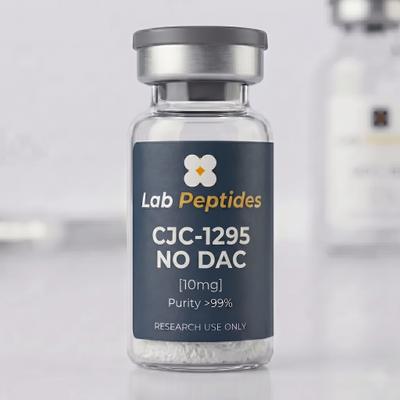
- CJC-1295 without DAC (Modified GRF 1-29): four substitutions (D-Ala2, Gln8, Ala15, Leu27) to resist DPP-4 and trypsin. Half-life ~30 min.
- CJC-1295 with DAC (Drug Affinity Complex): maleimido-propionyl lysine group covalently binding plasma albumin via Cys34. Half-life extended to 6-8 days, with sustained non-pulsatile "GH-bleed".
- Tesamorelin (trans-3-hexenoyl-GHRH(1-44)): used in research on HIV-associated lipodystrophy, half-life ~25-40 min SC.
GHRH analogues activate the GHRHR receptor (class B1 GPCR) coupled to Gαs, raising intracellular cAMP in anterior pituitary somatotrophs, triggering exocytosis of pre-stored GH granules. Release amplitude is capped by tonic somatostatin: in inhibitory phase, even a saturating GHRH dose produces only a modest peak. This dependence explains why GHRH + GHRP co-administration is needed for massive releases.
Peptide GHRPs: GHRP-2, GHRP-6, hexarelin, Ipamorelin
GHRPs (Growth Hormone-Releasing Peptides) are synthetic hexapeptides and pentapeptides mimicking ghrelin, agonists of the GHS-R1a (Growth Hormone Secretagogue Receptor type 1a), class A GPCR coupled to Gαq/PLC-IP3-Ca²⁺ but also Gαs.
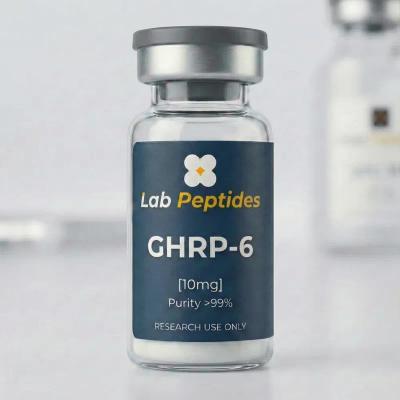
- GHRP-6 (His-D-Trp-Ala-Trp-D-Phe-Lys-NH2, 872.5 Da): first extensively studied GHRP (Bowers 1984). Activates GHS-R1a but also CD36 and MrgprX receptors. Induces appetite via POMC/NPY hypothalamic activation.
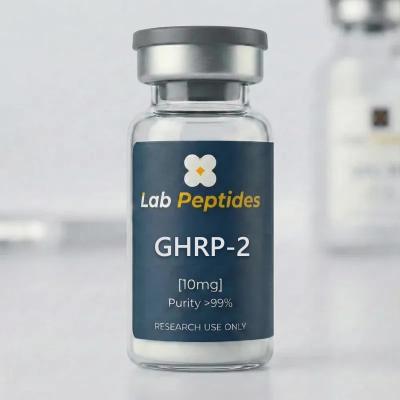
- GHRP-2 (D-Ala-D-β-Nal-Ala-Trp-D-Phe-Lys-NH2, 817.4 Da): more selective for GHS-R1a than GHRP-6, reduced orexigenic effect, more intense GH release.
- Hexarelin (His-D-2-MeTrp-Ala-Trp-D-Phe-Lys-NH2, 887.5 Da): GHRP-6 derivative with 2-methyltryptophan, increased stability, cardiotropic activity mediated by CD36 studied in rodent ischemia models.
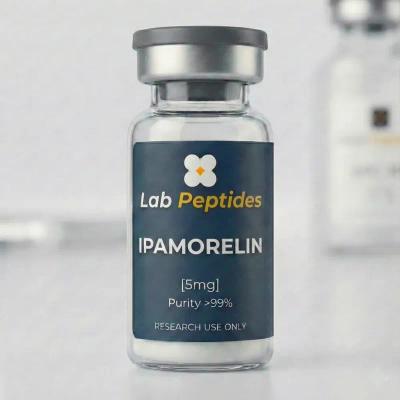
- Ipamorelin (Aib-His-D-2-Nal-D-Phe-Lys-NH2, 711.9 Da): pentapeptide highly selective GHS-R1a, with no detectable effect on cortisolemia, ACTH, prolactin or FSH/LH in classic rodent studies (Raun et al., Eur J Endocrinol 1998). This "clean" profile makes it the reference tool to isolate the ghrelin-like effect on the somatotropic axis.
GHS-R1a signalling activates PLC-β → DAG + IP3 → intracellular Ca²⁺ + PKC, plus Gαs-cAMP-PKA pathways. Crosstalk with the GHRHR pathway is the molecular basis of synergy: concurrent cAMP and intracellular calcium activation produces GH release far greater than the sum of isolated effects.
MK-677 / ibutamoren: non-peptide agonist
MK-677 (Ibutamoren mesylate, 624.8 Da, C27H36N4O5S) is an orally bioavailable spiroindolane designed by Merck in the 1990s as a ghrelin mimetic. It binds GHS-R1a with nanomolar affinity (Ki ~1-5 nM) and shares GHRP pharmacology: stimulation of pulsatile GH and sustained elevation of plasma IGF-1.
Distinctive research features:
- High oral bioavailability (>60% rodents), half-life ~4-6h in humans, ~2-3h in rats.
- Chronic effect: unlike peptide GHRPs requiring multiple injections, a daily PO dose maintains elevated IGF-1 levels 24h/day.
- Modest but reproducible rise in cortisolemia and prolactin at high doses (unlike Ipamorelin).
- Documented effects on appetite, slow-wave sleep (SWS) and lean mass in aged rodent models.
GHRH + GHRP synergy: molecular basis and protocols
Combining a GHRH analogue (CJC-1295 without DAC or sermorelin) with a GHRP (Ipamorelin or GHRP-2) produces GH peaks 3 to 10 times higher than either agent alone, in a pulsatile manner, because co-administration causes transient suppression of tonic somatostatin via GHS-R1a.
Molecular mechanism:
- GHRP ↦ inhibition of somatostatinergic interneurons in periventricular hypothalamic nucleus
- GHRP ↦ activation of arcuate nucleus GHRH neurons
- GHRP ↦ direct GHS-R1a action on anterior pituitary somatotrophs (Ca²⁺ rise)
- GHRH (analogue) ↦ cAMP-PKA rise on somatotrophs
- Ca²⁺ + cAMP convergence ↦ massive exocytosis of GH granules
Typical rodent protocols from the literature:
- CJC-1295 (no DAC) 50-200 µg/kg SC + Ipamorelin 100-500 µg/kg SC, 1 to 3 times/day, 4-6 week windows
- MK-677 3-10 mg/kg PO daily gavage, 4 to 12 week studies
- Sermorelin 10-100 µg/kg SC × 2-3/day
Relevant preclinical rodent models
- Aged rodents: Sprague-Dawley rats 18-24 months, C57BL/6J mice 20-24 months — study of somatopause (age-related decline of pulsatile GH).
- lit/lit mice: dwarfism model from point mutation in Ghrhr (non-functional GHRHR) — allows isolation of the GHS-R1a component.
- GHRHR KO and GHS-R KO mice: genetic tools to dissect pathways.
- Hypophysectomized rats: classic negative control validating pituitary dependence.
- Cachexia models: ApcMin/+ mice, C26 tumor models, post-MI cardiac models — MK-677 and ipamorelin studied for lean mass preservation.
- Bone models: ovariectomized rats (OVX) for post-menopausal osteoporosis, studying bone mass under CJC-1295 + GHRP.
Analytical quality control — minimum requirements
Each peptide secretagogue batch used in research must provide:
- Reverse-phase HPLC (RP-HPLC C18, ACN/H2O/0.1% TFA gradient, UV detection 214 nm): purity ≥ 98%.
- Mass spectrometry (ESI-HRMS or MALDI-TOF): monoisotopic mass within ±1 ppm of theoretical.
- Amino acid analysis (AAA post-hydrolysis 6N HCl, 110°C, 24h): composition matching sequence.
- LAL assay (Limulus amebocyte lysate): endotoxins < 0.25 EU/mg for injectable protocols.
- Water content (Karl Fischer): typically < 8% for peptide lyophilisates.
- Residual acetate content: IC with suppressor, typically 5-15% w/w.
- Certificate of Analysis (COA) provided with each lot, batch-number traceability.
For MK-677 (non-peptide): HPLC, ¹H and ¹³C NMR, LC-MS, purity ≥ 98%, absence of residual solvents (GC headspace per ICH Q3C).
Reconstitution and stability
Lyophilised peptides (CJC-1295, Ipamorelin, GHRP-2, hexarelin) are reconstituted in bacteriostatic water (0.9% benzyl alcohol) or sterile water for injection. Documented recommendations:
- Working concentration: typically 1-5 mg/mL
- Powder storage: -20°C under desiccation, stability >24 months
- Reconstituted solution storage: 2-8°C, documented 28-day stability in bacteriostatic water
- Avoid repeated freeze/thaw cycles
- pH: Ipamorelin stable pH 5-7, CJC-1295 stable pH 6-7
MK-677 comes as powder or capsules; store at room temperature protected from light and humidity.
RUO regulatory framework and critical reminder
All compounds described in this article — sermorelin (except pediatric HGH-deficiency US indication, withdrawn), CJC-1295, Ipamorelin, GHRP-2, GHRP-6, hexarelin, MK-677 / ibutamoren — are distributed in Europe and France exclusively under Research Use Only (RUO) status. They are not EMA- or ANSM-authorised drugs, have no marketing authorisation, and cannot be used for diagnosis, treatment or human administration.
The applicable framework includes Directive 2001/83/EC for medicinal products, Regulation 2017/745 for medical devices, and for animal research Directive 2010/63/EU transposed in France by Decree 2013-118. Any animal protocol must be submitted to the local ethics committee and APAFIS via MESR.
FAQ
What's the difference between CJC-1295 with DAC and without DAC?
CJC-1295 with DAC has a maleimido-propionyl lysine group covalently binding plasma albumin (Cys34), extending half-life to 6-8 days. This produces a chronic non-pulsatile elevation of GH ("GH-bleed"). CJC-1295 without DAC (also called Modified GRF 1-29) keeps the 4 stabilising substitutions but not the albumin linker: half-life ~30 min, preserving physiological pulsatility, which is preferred in most modern research protocols.
Why is Ipamorelin often preferred over GHRP-2 or GHRP-6?
Ipamorelin is the only GHRP documented in the literature (Raun 1998) as not significantly elevating cortisolemia, ACTH, prolactin or FSH/LH at effective doses. This "clean" GHS-R1a selectivity makes it the reference tool for specifically isolating the ghrelin-like effect on the somatotropic axis, without confounding by adreno-gonadotropic effects.
Is MK-677 equivalent to a peptide GHRP?
Pharmacologically yes — same target receptor (GHS-R1a), same signalling. But kinetics differ: MK-677 is orally active with ~4-6h half-life, producing a chronic 24h IGF-1 elevation, while an injected peptide GHRP produces a short acute peak. The two tools address distinct research questions: acute vs chronic.
Can GH response be measured via IGF-1 levels?
Plasma IGF-1 is a 24-48h integrator of hepatic GH secretion. It is more stable than pulsatile GH (which requires catheterisation and sampling every 10-15 min over 6-24h). In preclinical practice: total IGF-1 (ELISA or IRMA) for chronic effect, pulsatile GH profiling by rodent jugular catheterisation for acute effect.
Regulatory reminder: all peptides and compounds discussed in this article are strictly restricted to in vitro and preclinical animal research (Research Use Only). None of the information presented constitutes a human therapeutic indication, medical advice, or clinical usage recommendation.
Discovery history: from Bowers 1976 to MK-677
The secretagogue story begins in 1976 when Cyril Bowers, an endocrinologist at Tulane University, fortuitously discovered that certain met-enkephalin analogues — initially studied for opioid properties — stimulated GH release without activating classical opioid receptors. These compounds, named GHRPs, revealed the existence of a receptor distinct from GHRHR, soon identified as the ghrelin target. GHRP-6 (1984) was the first optimised compound of this lineage.
In the 1990s, Merck launched a high-throughput screening program to identify an orally bioavailable non-peptide agonist of the same receptor. This led to L-692,429 (1993) then MK-677 / ibutamoren (1995). In parallel, Kojima and Kangawa identified the endogenous ligand in 1999: ghrelin, a 28-amino-acid peptide secreted by X/A-like cells of gastric mucosa, bearing a unique octanoyl modification on Ser3 catalysed by ghrelin O-acyltransferase (GOAT).
The receptor was renamed GHS-R1a (Growth Hormone Secretagogue Receptor type 1a), with inactive GHS-R1b variant. This molecular convergence — GHRP discovery before their receptor, then identification of the endogenous ligand — remains a pharmacological textbook case called "reverse pharmacology".
GH pulsatility: chronobiology and feedback
GH secretion follows a pulsatile ultradian dynamic unique among pituitary hormones. In male rats, GH peaks occur every 3-4h with amplitude varying from <1 ng/mL (trough) to 200-300 ng/mL (peak), with marked sexual dimorphism: females show a more continuous pattern of lower amplitude. In humans, most GH peaks occur during slow-wave sleep (N3/SWS stages) linked to tonic somatostatin decline.
This pulsatility results from a hypothalamic neuronal oscillator: arcuate nucleus GHRH neurons and periventricular somatostatinergic neurons oscillate in phase opposition, alternately producing permissive (low SST) and restrictive (high SST) windows for pituitary release. The pulsatile pattern is itself a critical biological signal: it determines differential expression of hepatic target genes (Cyp7b1, Hnf6, Igf-1) via STAT5b temporal activation. Continuous secretion (as caused by CJC-1295 with DAC) reproduces a female pattern, while pulsatile secretion reproduces the male pattern, with documented transcriptomic consequences in murine models.
Feedback mechanisms include:
- Short feedback by GH itself on the hypothalamus (SST stimulation, GHRH inhibition)
- Long feedback by hepatic IGF-1 on hypothalamus and pituitary
- Modulation by free fatty acids (FFA), insulin, glucose, glucocorticoids
- Circadian influence (NREM, age, fasting, exercise)
Chemical synthesis of GHRPs and GHRH analogues
GHRPs and GHRH analogues are produced by solid-phase peptide synthesis (SPPS) using Fmoc chemistry on Rink Amide resin (for C-terminal amidated peptides like Ipamorelin, GHRP-2, GHRP-6, hexarelin) or Wang resin (for CJC-1295 with C-terminal acid). Key steps:
- Fmoc deprotection by 20% piperidine in DMF
- Coupling with HATU/HOBt/DIEA in DMF, 60 min/residue
- Use of protected non-natural amino acids: Aib (Ipamorelin), D-Ala, D-β-naphthyl-Ala (GHRP-2, Ipamorelin), D-2-MeTrp (hexarelin), D-Trp, D-Phe
- Final cleavage with TFA/water/TIS/EDT (94/2/2/2), 2-3h
- Precipitation in cold diethyl ether
- Preparative RP-HPLC purification (C18, ACN/H2O/0.1% TFA gradient)
- Lyophilisation, HPLC + MS + AAA characterisation
CJC-1295 with DAC synthesis adds a post-SPPS acylation step: the maleimido-propionyl group is coupled to the N-terminus via selectively protected Mtt-lysine. Reaction with plasma albumin then occurs in vivo via Michael addition between maleimide and albumin Cys34 free thiol.
Post-synthesis QC: RP-HPLC (2 orthogonal gradients), high-resolution LC-MS, post-hydrolysis AAA, solubility test, pH, LAL endotoxin test, sterility test if applicable.
GHS-R1a 3D structure and biased pharmacology
Cryo-EM studies published from 2020-2023 (Shao et al., Liu et al.) resolved the 3D structure of GHS-R1a in complex with:
- Native ghrelin (octanoyl-Ser3-peptide)
- Peptide GHRPs (Ipamorelin, hexarelin)
- MK-677 and other non-peptide agonists
- Antagonists (e.g., GHS-R1a inverse agonist [D-Arg1, D-Phe5, D-Trp7,9, Leu11]-substance P)
Key insights emerging from these structures:
- Orthosteric pocket common to ghrelin, GHRPs, MK-677, centred on TM3, TM5, TM6, TM7
- ECL2 (extracellular loop 2) and TM6 undergo ~9 Å swing during activation
- Biased signalling: MK-677 slightly favours β-arrestin pathway, Ipamorelin is balanced Gαs/Gαq/β-arrestin, acylated ghrelin strongly activates all pathways
- Critical residues: Glu124³·³³, Phe279⁶·⁵¹, Arg283⁶·⁵⁵ — involved in binding the central tryptophan of GHRPs
These structural data open paths to rational design of tissue-selective biased agonists (e.g., favouring pituitary somatotropy without activating the hypothalamic orexigenic effect).
Documented extra-somatotropic effects
Beyond GH stimulation, several extra-pituitary effects of GHRPs and MK-677 are documented in animal models:
- Cardiac: hexarelin and GHRP-6 also bind CD36 expressed on cardiomyocytes, mediating a cardioprotective effect in rodent ischaemia-reperfusion models (Bisi et al., Broglio et al.). Effect independent of GH/IGF-1.
- Appetite: GHRP-6 and MK-677 increase food intake via hypothalamic GHS-R1a activation (arcuate NPY/AgRP neurons).
- Slow-wave sleep: MK-677 increases SWS and reduces nocturnal awakenings in chronic rodent studies, probably via central GHS-R1a action.
- Bone mass: CJC-1295 + Ipamorelin, in OVX rat models, increase trabecular bone mineral density (µCT) via GH → IGF-1 → osteoblast axis.
- Lean mass/cachexia: MK-677 and ipamorelin preserve lean mass in C26 and ApcMin/+ tumor cachexia models and sarcopenic aged rodents.
- Wound healing: documented acceleration of cutaneous and tendon healing in rat models treated with sermorelin or CJC-1295, attributed to IGF-1 elevation.
Analytical dosing: ELISA, LC-MS/MS, ligand-binding
Secretagogue quantification in preclinical studies uses several techniques depending on analyte and matrix:
- Peptide secretagogues in rodent plasma: LC-MS/MS after SPE extraction, typical detection limits 0.1-1 ng/mL, precision ±10-15%. LC-MS/MS preferred over ELISA for metabolite specificity.
- MK-677 in plasma: LC-MS/MS, liquid-liquid or SPE extraction, LOD ~0.5 ng/mL.
- Rodent GH: ELISA (Millipore rat/mouse GH, sensitivity ~0.1 ng/mL) or Luminex multiplex for pulsatile kinetics on micro-samples.
- Plasma IGF-1: ELISA (Mediagnost, R&D Systems) or IRMA, after acid-ethanol extraction to dissociate IGFBP binding proteins.
- Cortisol / ACTH / prolactin: essential controls to validate selectivity (Ipamorelin expected negative, GHRP-6 positive).
- Ligand-binding competition: [125I]-ghrelin or [125I]-MK-677 on HEK293 cell membranes expressing human or rodent GHS-R1a — reference affinity Ki test.
- Intracellular Ca²⁺: Fluo-4 AM on HEK293-GHS-R1a cells, 96-well plate reading.
- cAMP accumulation: GloSensor or HTRF, HEK293 cells co-expressing GHS-R1a + GHRHR to study synergy.
Experimental pitfalls and common errors
The literature documents several recurring biases in rodent secretagogue studies:
- Handling stress: rodent restraint massively stimulates GH via catecholamines + CRH → cortisol. Preferably sample via chronic jugular catheter to avoid this confounder.
- Sampling time: pulsatile GH requires sampling every 10-15 min over 6-24h. A single time-point is uninterpretable for GH (but acceptable for IGF-1).
- Sexual dimorphism: always report animal sex. GH responses and pulsatile patterns differ massively between male and female rats.
- Anaesthesia: isoflurane, ketamine/xylazine and pentobarbital all modify the somatotropic axis. Prefer awake models with chronic catheter.
- Tachyphylaxis: GHS-R1a desensitisation with repeated high GHRP doses. Documented from 3-4 close injections. Justifies protocols with "breaks" or 6-8h spaced administrations.
- Dietary interference: overnight fast required before acute protocol (elevated FFAs suppress GH response).
- Lot contamination: some historical GHRP-2 and GHRP-6 lots contained >15% acetate impurities biasing pharmacological dosing. Require COA with acetate <15%.