GHRH vs GHRP: the 2026 research peptide comparison for growth hormone secretagogues
GHRH vs GHRP: two levers, one GH/IGF-1 axis
The choice between a GHRH secretagogue (Tesamorelin, CJC-1295, Sermorelin) and a GHRP / ghrelin mimetic (Ipamorelin, GHRP-6, Hexarelin) has divided research teams for twenty years. Both families trigger growth hormone (GH) release from the anterior pituitary, but they activate radically different pathways. Combined, they produce a documented synergy. In isolation, each has strengths and weaknesses on pulsatility, cortisol, prolactin and duration of action.
This 2025 comparison covers the six most-studied molecules on the research peptide RUO side, with preclinical and clinical data. Goal: a clear decision framework for selecting the right candidate for your protocol — and understanding why GHRH + GHRP stacks dominate recent publications.
Two families, two receptors, two signals
Family 1: GHRH and analogs (endogenous secretagogues)
GHRH (Growth Hormone Releasing Hormone) is the natural hormone secreted by the hypothalamus. It binds to the GHRH-R receptor on somatotroph cells of the anterior pituitary and triggers GH release via the cAMP/PKA pathway. Synthetic analogs reproduce this signal with optimized pharmacokinetic profiles:
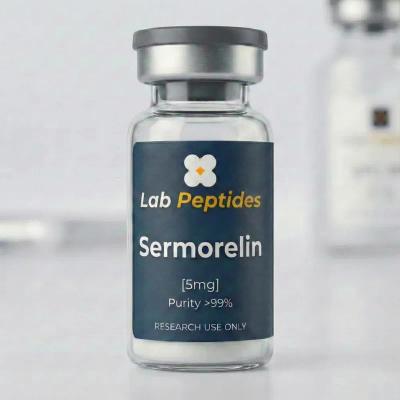
- Sermorelin (GRF 1-29): shortest active fragment, half-life ~10 minutes, signal close to natural
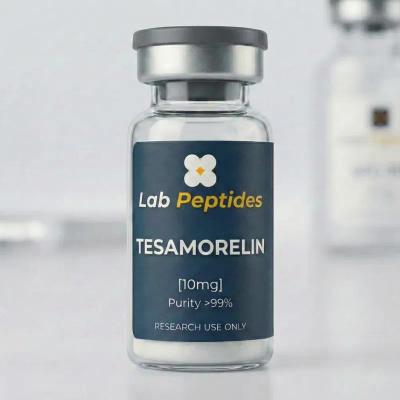
- Tesamorelin: analog stabilized by an N-terminal trans-3-hexenoyl group, half-life ~26 minutes, only molecule of the family with FDA approval (HIV-associated lipodystrophy reduction)
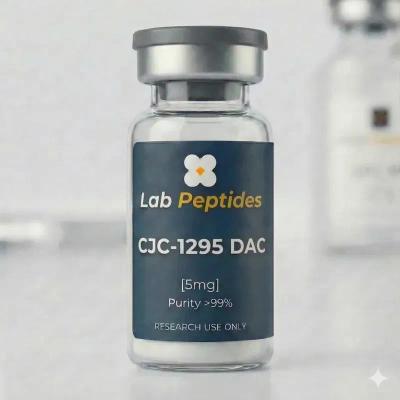
- CJC-1295 with DAC: Drug Affinity Complex modification that binds plasma albumin, extending half-life to ~8 days and creating continuous "GH bleed" rather than a pulse
Key point: GHRH analogs preserve physiological pulsatility. The pituitary remains under somatostatin negative feedback control, which limits desensitization.
Family 2: GHRP and ghrelin mimetics (ghrelin pathway)
GHRPs (Growth Hormone Releasing Peptides) act on a completely separate receptor: GHS-R1a, identical to the endogenous ghrelin receptor. They trigger GH release through a different cascade (phospholipase C, inositol triphosphate, calcium mobilization) while partially suppressing somatostatin. Result: a larger GH pulse than GHRH alone.
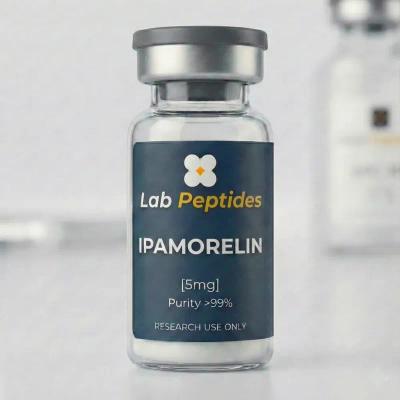
- Ipamorelin: 2nd-generation GHRP, highly selective for GHS-R1a, no significant impact on cortisol or prolactin — the current darling of modern protocols
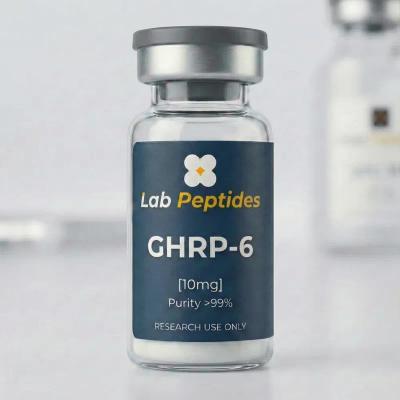
- GHRP-6: first generation, potent but triggers marked hunger (ghrelin-like action on the arcuate nucleus) and slight prolactin/cortisol elevation
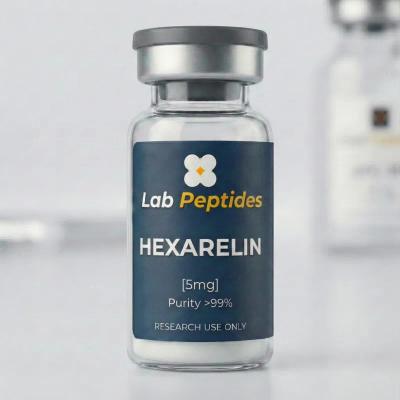
- Hexarelin: most potent on acute GH release, but rapid GHS-R1a desensitization after prolonged use and more pronounced cortisol elevation
Key point: GHRPs add an amplifying signal that potentiates GHRH, but chronic monotherapy triggers receptor down-regulation.
2025 comparison table
| Criterion | Sermorelin | Tesamorelin | CJC-1295 DAC | Ipamorelin | GHRP-6 | Hexarelin |
|---|---|---|---|---|---|---|
| Family | GHRH | GHRH | GHRH | GHRP | GHRP | GHRP |
| Receptor | GHRH-R | GHRH-R | GHRH-R | GHS-R1a | GHS-R1a | GHS-R1a |
| Half-life | ~10 min | ~26 min | ~8 days | ~2 h | ~1 h | ~55 min |
| Preserves pulsatility | Yes | Yes | No (tonic) | Yes | Yes | Partial |
| Cortisol | Neutral | Neutral | Neutral | Neutral | Slight ↑ | ↑ notable |
| Prolactin | Neutral | Neutral | Neutral | Neutral | Slight ↑ | ↑ |
| Appetite | Neutral | Neutral | Neutral | Neutral | ↑↑ | ↑ |
| GH selectivity | High | High | High | Very high | Moderate | Moderate |
| Typical frequency | 1-3x/day | 1x/day | 2x/week | 2-3x/day | 2-3x/day | 1-2x/day |
| Regulatory status | RUO | RUO (FDA EGRIFTA) | RUO | RUO | RUO | RUO |
Detailed profiles of the six molecules
Tesamorelin: the GHRH reference
The only GHRH molecule with an FDA file (EGRIFTA, 2010), Tesamorelin has been studied in hundreds of HIV-positive subjects in randomized trials. Studies have suggested a 15-18% reduction in visceral fat over 26 weeks with moderate IGF-1 elevation. Its safety profile is the most thoroughly documented of the GHRH family. Research usage: daily injection, half-life sufficient for a 60-90 minute GH pulse.
CJC-1295 DAC: the long-acting GHRH
The DAC (Drug Affinity Complex) modification extends the half-life to roughly 8 days, radically changing the paradigm: instead of a daily pulse, CJC-1295 DAC installs a near-continuous GHRH signal. Preclinical publications have reported 2- to 10-fold GH elevation and 1.5- to 3-fold IGF-1 elevation for several days after a single injection. This tonicity is both its strength and its limitation: it dramatically simplifies the protocol (2 injections per week), but abolishes pulsatility.
Sermorelin: the shortest active GHRH form
GRF 1-29 active fragment, Sermorelin is the oldest synthetic analog. Its very short half-life makes it a "natural mimetic" molecule, particularly suited to research protocols on the physiological GH axis. Typical frequency: 1 to 3 injections per day, often at bedtime to amplify the natural nocturnal GH pulse.
Ipamorelin: the clean GHRP
Ipamorelin remains in 2025 the gold standard GHRP for research. Its GHS-R1a selectivity delivers a GH pulse equivalent to GHRP-6 or Hexarelin without the off-target effects (cortisol, prolactin, hunger). Phase I and II trials have suggested efficacy comparable to older GHRPs with a significantly better tolerance profile, making it the natural candidate for prolonged stacks.
GHRP-6: the pioneer
GHRP-6 was the first GHRP to demonstrate the existence of a ghrelinergic receptor separate from GHRH-R. Historically important, it remains used in nutritional research for its ability to strongly stimulate appetite, making it a tool for studying hypothalamic regulation of food intake.
Hexarelin: the strongest acute pulse
Hexarelin produces the largest per-dose GH pulse among research-use GHRPs. Weakness: the GHS-R1a receptor desensitizes rapidly with repeated use (2-3 weeks), which limits long protocols. Documented side effect: more pronounced cortisol elevation than Ipamorelin.
GHRH + GHRP synergy: the combination that changes everything
The most important data point in this comparison fits on one line: the GHRH + GHRP combination is synergistic, not additive. Clinical studies in healthy volunteers have suggested that joint administration of a GHRH (e.g. Sermorelin or Tesamorelin) with a GHRP (e.g. Ipamorelin) produces a GH pulse 2 to 5 times greater than the sum of the separate effects.
The mechanism is twofold: GHRH activates its cAMP pathway while GHRP partially blocks somatostatin and activates the calcium pathway. Somatotroph cells receive two positive signals simultaneously and the physiological brake is released. That is exactly why modern research protocols almost always use a GHRH + GHRP stack rather than an isolated molecule.
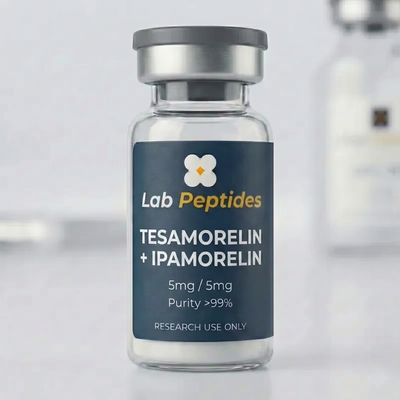
Our Tesamorelin + Ipamorelin 8mg product combines both agents in a pre-mixed vial to simplify reconstitution.
How to choose? Decision framework
Short study (4-8 weeks) on a physiological pulse: Sermorelin + Ipamorelin. Short half-lives, preserved pulsatility, controlled cost.
Long study (12+ weeks) with IGF-1 tracking: Tesamorelin + Ipamorelin. Most robust clinical file on the GHRH side, clean Ipamorelin for the long haul.
Protocol simplicity (2 injections/week): CJC-1295 DAC + Ipamorelin. Caveat: GH tonicity alters the axis and may not suit all experimental designs.
Targeted appetite regulation study: GHRP-6 monotherapy. Its orexigenic effect is an asset in this specific context.
Acute maximal pulse study: Hexarelin acutely (max 2-3 weeks). Beyond that, desensitization is inevitable.
Lab quality: what you can check
Our GHRH and GHRP peptides ship lyophilized, in sealed vials, with an HPLC ≥ 98% specification. Available certificates of analysis are published on the relevant product pages.
Tesamorelin, CJC-1295 DAC and Ipamorelin are in stock and ship the next working day, Monday to Saturday, to France and the EU.
Conclusion: the choice hinges on research objective, not on a "best peptide"
There is no absolute winner between GHRH and GHRP. Both families are complementary, their distinct mechanisms produce a synergy that makes them more effective together. GHRH provides the baseline physiological signal, GHRP adds amplification via the ghrelin pathway and somatostatin release. For the majority of 2025 experimental designs on the GH/IGF-1 axis, a GHRH + Ipamorelin stack is the rational starting point.
See our detailed pages on Tesamorelin, CJC-1295 DAC, Sermorelin, Ipamorelin, GHRP-6 and Hexarelin for reconstitution protocols, referenced studies and certificates of analysis.
All our peptides are intended exclusively for in vitro research or in vivo research on animal models. Not intended for human consumption.