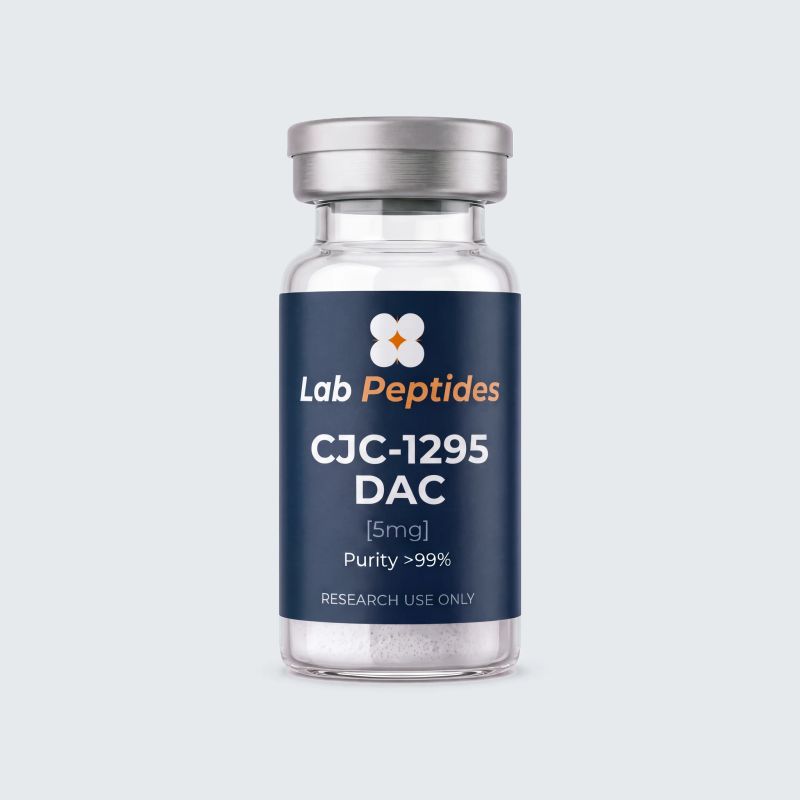
CJC-1295 DAC 5mg Growth Factors
1 shot, days of GH.
GH in long-acting mode. CJC-1295 DAC is the albumin-binding GHRH analog — a single injection releases GH for 6-8 days. Stable peak, no hormonal yo-yo. Multiply your IGF-1 2-3x without daily injections. The standard for long-term protocols.
Research Use Only (RUO) · Prohibited for human or veterinary use.
Key facts
Our CJC-1295 DAC 5 mg vial is the reference format for exploratory research protocols on the somatotropic axis and prolonged stimulation of growth hormone (GH) and IGF-1. CJC-1295 with Drug Affinity Complex (DAC) is a synthetic GHRH (Growth Hormone Releasing Hormone) analog modified for an extended plasma half-life of 6-8 days, a unique characteristic within the secretagogue class. With 5 mg of lyophilized peptide per vial at HPLC purity ≥98 %, this format covers approximately 5 weeks of protocol at the standard weekly dose (1 mg/week). The certificate of analysis is published on this page, viewable before you order.
In detail
CJC-1295 DAC is often associated in research with Ipamorelin (selective GHRP) to explore the GHRH + GHRP synergy documented in literature. The flagship of extended-duration GHRH analogs for serious laboratories.
Protocol and preparation
| Water added | Concentration | Reading marker |
|---|---|---|
| 1 ml | 5 mg/ml | 40 UI = 2 mg |
| 2 ml | 2,5 mg/ml | 40 UI = 1 mg |
The volume of water does not change the product, only its concentration. Introduce the water slowly along the vial wall, never directly onto the lyophilisate, then swirl without shaking. Markers given on a 1 ml syringe graduated in 100 units.
Asepsis
Disinfect surfaces and stoppers (70% alcohol).
Solvent
Draw the required volume of bacteriostatic water.
Introduction
Inject gently against the vial wall (avoid direct jet on powder).
Solubilization
Roll the vial gently. Do not shake vigorously (degradation risk).
Solution storage Once reconstituted: 2-8°C (refrigerator).
Warning Theoretical tool for chemical handling. Does not constitute medical advice.
Open the dilution calculator- The amount of powder looks tiny. A lyophilisate takes up a few millimetres at the bottom of the vial, sometimes just a translucent film. The stated weight is there.
- The powder is compact, stuck to the wall or to the stopper. Transport moves the freeze-dried cake around. It changes nothing to reconstitution.
- The vial carries no individual label. That is our standard packaging, not a downgraded vial.
- After reconstitution, deposits or filaments appear. This is common, especially with small molecules. Let it settle and roll the vial between your palms, never shake it.
- The parcel is plain. Nothing on the outside indicates the contents or the brand name.
What is not normal: a cracked vial, an uncrimped cap or a stopper that moves, powder that has liquefied or changed colour. In those specific cases, write to us with a photo and we take the vial back.
Recommended reconstitution: 2 ml bacteriostatic water for injection → final concentration 2.5 mg/ml. Alternative volume: 1 ml (5 mg/ml, for high doses). Procedure: 1) let vial and diluent reach room temperature (15 minutes); 2) disinfect stopper with 70% alcohol; 3) draw bacteriostatic water into sterile syringe; 4) inject slowly along inner wall of vial; 5) gently swirl until dissolution — no vigorous shaking to preserve peptide structure and DAC interaction. Dosages reported in literature: Teichman 2006 study documents doses of 30 to 250 mcg/kg in single injection. Exploratory human research protocols (outside authorized therapeutic framework) typically mention 1 to 2 mg per week (~15-30 mcg/kg for a 70 kg subject), in subcutaneous weekly or bi-weekly injection. At 2.5 mg/ml concentration, 1 mg corresponds to 0.4 ml (40 units on 100 IU syringe) and 2 mg to 0.8 ml (80 units). Autonomy: 5 mg allows 5 injections of 1 mg (5 weeks of weekly protocol) or 2-3 injections of 2 mg (4-6 weeks bi-weekly). Documented synergy with GHRP: research protocols frequently associate CJC-1295 DAC (long-duration GHRH analog) with Ipamorelin (selective GHRP) to explore the synergy of two independent secretagogue pathways (GHRH-R + GHS-R1a/ghrelin). Dual stimulation would amplify GH pulse amplitude without cross-effects on cortisol or prolactin. Post-reconstitution storage: refrigerator 2-8 degrees Celsius, 30-day usage window with bacteriostatic (0.9% benzyl alcohol).
Technical data
- Reconstitution
- 2 ml d'eau → 2,5 mg/ml. 40 UI = 1 mg ; 80 UI = 2 mg.
- Peptide sequence
- Tyr-D-Ala-Asp-Ala-Ile-Phe-Thr-Gln-Ser-Tyr-Arg-Lys-Val-Leu-Ala-Gln-Leu-Ser-Ala-Arg-Lys-Leu-Leu-Gln-Asp-Ile-Leu-Ser-Arg-Lys(Nε-maléimidopropionyl)-NH2
- Molecular formula
- C165H269N47O46
- Molecular weight
- 3647.2 g/mol
- CAS number
- 446262-90-4
- Physical form
- Poudre lyophilisée
- Recommended solubility
- Eau bactériostatique, NaCl 0,9%
- Storage conditions
- Au réfrigérateur (+2 à +8 °C), à l'abri de la lumière. En poudre, possible au congélateur pour une conservation longue. Une fois préparé : réfrigérateur, jamais au congélateur.
- Use
- Research reagent, in vitro only (RUO)
Storage & handling
Lyophilized unreconstituted CJC-1295 DAC is stored in the fridge (+2 to +8 °C) in its original sealed packaging, protected from light and humidity; for long-term storage (over 3 months), a -20 °C freezer keeps it for up to 24 months. At refrigerated temperature (2-8 degrees Celsius), documented stability covers a minimum of 12 months. At room temperature (below 25 degrees Celsius), recommended duration for transport or temporary storage: 3 weeks maximum. Once reconstituted with bacteriostatic water, CJC-1295 DAC must be stored between 2 and 8 degrees Celsius. Documented post-reconstitution stability: 30 days with bacteriostatic (benzyl alcohol 0.9%), 7-10 days with preservative-free sterile water. CJC-1295 DAC specific sensitivities: the DAC maleimidopropionate complex is particularly sensitive to vigorous shaking that may dissociate the covalent bond before injection, reducing peptide duration of action. Limit freeze-thaw cycles to a maximum of three. Avoid direct UV exposure, thermal shocks, and contact with non-inert metallic surfaces. The certificate of analysis is published on this page, viewable before you order. Lyophilised CJC-1295 DAC shows good stability at -20°C under desiccation (> 24 months with no measurable purity loss). The critical point lies in preserving the C-terminal maleimide group: sensitivity to hydrolysis in aqueous solution at pH > 7.5 (maleimide ring opening → maleamic acid, loss of albumin conjugation capacity). Operational recommendations: reconstitution in bacteriostatic water (0.9% benzyl alcohol) at pH 5.5-6.5, storage at 2-8°C in amber vial, use within 14-21 days to guarantee functional maleimide integrity (vs 28 days standard for peptides without reactive modification). Avoid freeze/thaw cycles (precipitation detectable by SEC-HPLC) and exposure to reducing agents (DTT, β-mercaptoethanol, free glutathione) which can compete with albumin for thiol binding. A research-grade batch COA must specifically document residual maleimide reactivity (Ellman test or titration with reference N-ethylmaleimide) in addition to standard controls (HPLC ≥ 98%, ESI-HRMS, LAL).
Mechanism of action
CJC-1295 is a tetra-substituted analog of GHRH 1-29 (Growth Hormone Releasing Hormone, the active N-terminal 29-amino-acid fragment). The four strategic substitutions — D-Ala2, Gln8, Ala15, Leu27 — confer protease resistance (notably to dipeptidyl peptidase IV, DPP-IV) and increased plasma stability. The major modification is the addition of the Drug Affinity Complex (DAC): a maleimidopropionate chain covalently binding cysteine-34 of human serum albumin, dramatically increasing plasma half-life from 30 minutes to 6-8 days.
At the molecular level, CJC-1295 activates the GHRH receptor (GHRH-R) expressed on somatotropic cells of the anterior pituitary. Receptor binding triggers a Gs-cAMP-PKA cascade leading to synthesis and pulsatile release of GH. Unlike short-acting native GHRH, CJC-1295 DAC maintains sustained plasma concentration and amplifies the amplitude of endogenous physiological GH pulses without suppressing their pulsatile character — a critical point since pulses are essential to tissue response (IGF-1, lipolysis, protein turnover).
Pharmacokinetic studies have documented, after a single 60-250 mcg/kg injection in healthy humans, a sustained increase in mean GH (2-10 times baseline) for at least 6 days, and an IGF-1 increase of 1.5 to 3 times baseline for 7-11 days. This extended kinetics allows weekly or bi-weekly injection frequencies, unlike classical GHRH or GHRP requiring 2-3 daily injections.
The documented route of administration is primarily subcutaneous. The DAC-free version (CJC-1295 "modified GRF 1-29") presents a half-life of only 30 minutes and requires 2-3 daily administration — not to be confused with the DAC version in protocols. As with any research peptide, these data come from preclinical studies and exploratory clinical trials: CJC-1295 DAC is not approved for human therapeutic use and remains an exploratory research tool.
Structurally, CJC-1295 with DAC (Drug Affinity Complex) is a 30-amino-acid analogue derived from the human active GHRH(1-29) fragment, bearing four canonical stabilising substitutions — D-Ala2, Gln8, Ala15, Leu27 — designed to block degradation by dipeptidyl peptidase-4 (DPP-4) and serum trypsin, plus a maleimido-propionyl-lysine group added at the C-terminus after SPPS. This modified lysine forms in vivo a covalent thioether bond with the free Cys34 residue of human serum albumin via Michael addition on the maleimide. Albumin thus becomes a plasma carrier protecting the peptide from renal filtration and proteolysis, conferring CJC-1295 DAC a documented 6-8 day half-life in primates, versus ~30 minutes for the non-DAC version. Pharmacologically, the released peptide remains an agonist of the GHRHR receptor (class B1 GPCR, Gαs coupling) on anterior pituitary somatotrophs, raising intracellular cAMP and triggering exocytosis of pre-stored GH granules. This pattern produces a sustained "GH-bleed" elevation (mildly elevated chronic baseline) rather than classical endogenous pulsatility, with distinct hepatic STAT5b transcriptomic consequences documented in rodent models.
Studies and references
The scientific corpus on CJC-1295 DAC primarily comes from ConjuChem (Montreal), the initial developer of the DAC technology, and from American and Canadian academic endocrinology teams. Main publications cover pharmacokinetics, pharmacodynamics, and first exploratory clinical trials.
Teichman et al. (Journal of Clinical Endocrinology & Metabolism 2006; DOI 10.1210/jc.2005-1536) published the foundational study on CJC-1295 DAC in healthy humans. The dose-response trial on 21 volunteers documented a dose-dependent GH increase (2 to 10 times baseline) and IGF-1 increase (1.5 to 3 times baseline) after single injection of 30 to 250 mcg/kg, with effective half-life of 5.8 to 8.1 days depending on dose. Tolerance profile was favorable with predominant incidence of injection site erythema (28%).
Ionescu and Frohman (JCEM 2006; DOI 10.1210/jc.2006-0581) extended these observations by exploring the GH pulsatile secretion profile under CJC-1295 DAC. Results confirmed that endogenous pulses remain preserved or even amplified, contradicting the initial hypothesis of pulsatile damping by chronic GHRH stimulation.
On the preclinical front, Jetté et al. (Endocrinology 2005) characterized the comparative pharmacokinetics of CJC-1295 DAC and the DAC-free version in rat and dog, demonstrating the major impact of albumin binding on duration of action. Standard preclinical toxicology studies (4 weeks to 6 months, rat and dog) did not reveal major systemic toxicity at extrapolated therapeutic doses.
Registered human clinical trials (ConjuChem phase 1-2 on metabolic and musculoskeletal indications) were suspended in 2008 for strategic reasons and not tolerance issues, leaving CJC-1295 DAC in a regulatory gray zone. No marketing authorization has been filed to date.
Corpus limitationsMost human data come from small-cohort studies (<50 subjects), long-term data (>12 weeks) are limited, and the effect of repeated cycles on pituitary sensitivity remains partially documented. CJC-1295 DAC remains strictly an exploratory research peptide.
CJC-1295 DAC preclinical studies document sustained dose-dependent plasma IGF-1 elevation over several weeks. In young Sprague-Dawley rats, weekly SC administration 30-100 µg/kg: IGF-1 elevation > 2x vs baseline maintained 7-10 days post-injection, confirming albumin-dependent kinetics. In aged C57BL/6J mice (18-24 months): partial restoration of juvenile IGF-1 levels after 4-6 weeks of treatment, with increased lean mass on DEXA body composition and improved trabecular bone mass on µCT. In C26 tumor cachexia and OVX-induced osteoporosis models: preservation of skeletal muscle mass and bone mineral density (Teichman et al., 2006 — seminal primate study). In lit/lit model (non-functional GHRHR): no response, confirming strict dependence on functional GHRHR for CJC-1295 DAC action. Ipamorelin co-administration studies: documented supra-additive synergy with GH peaks 3-5x higher than sum of isolated effects and improved chronic IGF-1. No validated human clinical data is available for therapeutic use: all these studies remain strictly preclinical (RUO).
- 1
- 2
Similar peptides
CJC-1295 DAC occupies a distinctive position in the GH secretagogue class thanks to its 6-8 day plasma half-life, unique among GHRH analogs. Compared to CJC-1295 without DAC (also called "modified GRF 1-29"), the DAC version multiplies duration of action by approximately 300 (30 minutes vs 6-8 days), enabling weekly injections instead of 2-3 per day.
Compared to Sermorelin (historical truncated GHRH 1-29, marketed as Geref), CJC-1295 DAC offers significantly superior stability and duration of action: Sermorelin has only a 10-15 minute half-life and requires daily administration, limiting its use in extended research. Tesamorelin (GHRH analog marketed for HIV lipodystrophy) has an intermediate half-life of 26-38 minutes and remains daily-administered.
Compared to classical GHRPsIpamorelin, GHRP-6, Hexarelin — CJC-1295 DAC acts on a completely different pathway: GHRH-R (GHRH receptor) versus GHS-R1a (ghrelin receptor). The two pathways are independent and synergistic: the CJC-1295 DAC + Ipamorelin combination is the most studied duo in secretagogue research to maximize GH release without cross-side effects (Ipamorelin being the most selective GHRP, without cortisol or prolactin increase).
Compared to exogenous recombinant GH (somatropin), CJC-1295 DAC preserves the physiological pulsatility of endogenous GH secretion, which according to literature maintains better tissue response and avoids GH receptor desensitization. Exogenous GH conversely produces supra-physiological non-pulsatile levels.
On the research peptide market, CJC-1295 DAC is one of the most demanded secretagogues, particularly for combined protocols with Ipamorelin. Its commercialization for human therapeutic use is prohibited in France, Europe, and the United States — strict research use.
CJC-1295 with DAC clearly distinguishes itself from other GHRH analogues by its extended kinetics. Compared to sermorelin (native GRF 1-29, 3358 Da, 10-15 min half-life): 500-700x more persistent, but loses endogenous physiological pulsatility. Compared to CJC-1295 without DAC (aka Modified GRF 1-29, same substitutions without maleimide linker, ~30 min half-life): weekly vs multi-daily kinetics, but chronic "GH-bleed" profile rather than pulsatile. Choice between the two depends on experimental question: hepatic IGF-1 chronicity (CJC-1295 DAC) or physiological pulsatility (sermorelin, Modified GRF). Compared to tesamorelin (trans-3-hexenoyl-GHRH(1-44), SC half-life ~25-40 min): tesamorelin retains full 1-44 human sequence while CJC-1295 DAC is based on 1-29. Compared to peptide GHRPs (Ipamorelin, GHRP-2, hexarelin): different mechanism (GHRHR Gαs vs GHS-R1a Gαq/Gαs), complementary targeting justifying documented CJC-1295 DAC + Ipamorelin co-administrations in rodent protocols. Compared to MK-677 (ibutamoren PO): CJC-1295 DAC acts on GHRHR via weekly injection, MK-677 acts on GHS-R1a orally daily — orthogonal tools for pharmacological dissection of the somatotropic axis.
Frequently asked questions
What is the difference between CJC-1295 DAC and CJC-1295 without DAC (Mod GRF 1-29)?
How do I reconstitute CJC-1295 DAC 5 mg?
Can CJC-1295 DAC be combined with Ipamorelin in research?
Which biological markers are tracked in CJC-1295 DAC protocols?
Is your CJC-1295 DAC authentic?
What is the delivery lead time in Europe?
What is the documented tolerance profile?
How long does a vial cover in research?
What's the difference between CJC-1295 with DAC and without DAC?
Can CJC-1295 DAC be co-administered with Ipamorelin?
How to verify maleimide reactivity of a CJC-1295 DAC batch?