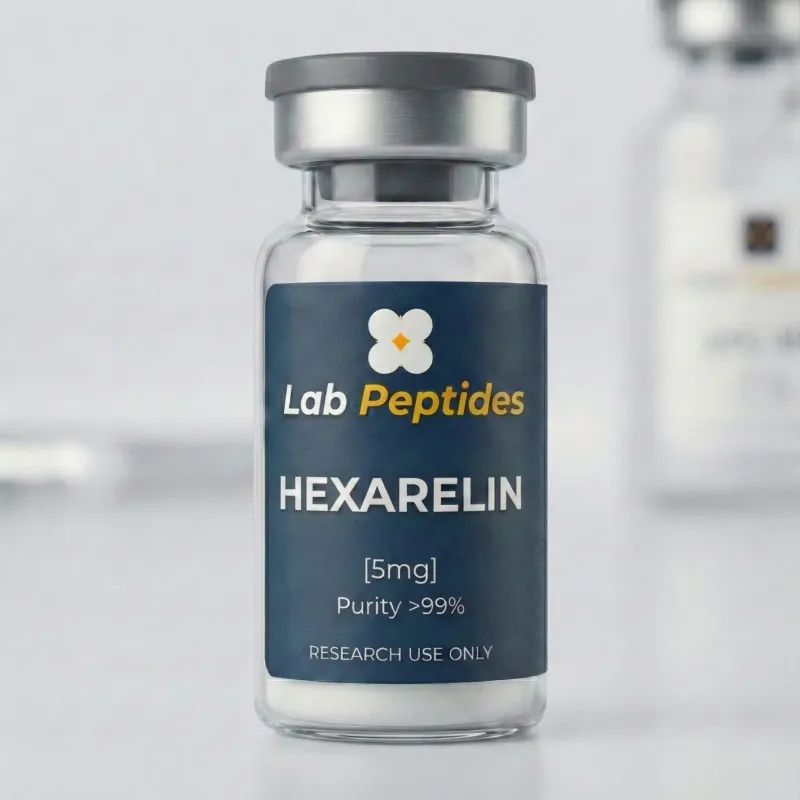
Hexarelin 5mg Muscle Growth
Second-generation GHRP hexapeptide. The molecule with the most potent documented GH secretion peak in the class.
The most potent GH spike in its class. Second-generation secretagogue, Hexarelin triggers a massive GH release, the spike researchers come for. Demonstrated cardioprotective bonus. For those who want the maximum, no compromise.
- In stock in France
-10 % for life on each cyclePause, skip or cancel in 1 clickNo commitment, no hidden fees
Your complete kit
- 5mg vialIncluded
- Bacteriostatic waterAdd
- 1 ml syringesAdd
The vial alone cannot be used as is. One sealed vial of Hexarelin 5mg, lyophilised, without individual labelling.
Don't forget the essentials
Frequently bought together


Product information
Hexarelin 5mg represents the absolute benchmark of synthetic GHRPs through its secretagogue potency. This hexapeptide His-D-2-methyl-Trp-Ala-Trp-D-Phe-Lys-NH2 of 887 Da, developed in the 1990s by the teams of Romano Deghenghi and Ezio Ghigo at Mediolanum Farmaceutici, is classically described in the literature as the most potent growth hormone secretion stimulator ever synthesized for subcutaneous injection.
Beyond its raw potency on the somatotropic axis, Hexarelin stands out through a unique particularity among secretagogues: its affinity for the cardiac scavenger receptor CD36, which makes it a privileged object of study in experimental cardiology. Preclinical studies from 1999-2005 have suggested a cardioprotective potential distinct from the GH action, opening a specific research pathway around ischemia-reperfusion and post-infarction remodeling.
Atlas Lab formulates Hexarelin 5mg as high-purity lyophilizate (≥98% HPLC) for research applications exclusively. Strict RUO — not intended for human, veterinary, diagnostic or therapeutic use. The exceptional potency of this molecule imposes experimental rigor superior to other GHRPs in dose and kinetics management.
01Mechanism of action
Hexarelin belongs to the GHRP (Growth Hormone Releasing Peptides) family and acts primarily as an agonist of the GHS-R1a receptor (Growth Hormone Secretagogue Receptor type 1a), the endogenous ghrelin receptor located in the anterior pituitary, hypothalamus (arcuate nucleus), and some peripheral tissues. This action activates a Gq11-phospholipase C-IP3-calcium cascade that triggers exocytosis of GH-containing granules in somatotroph cells.
The hexapeptide presents two critical structural modifications that explain its potency superior to first-generation GHRPs. The D-methylation of Trp at position 2 protects against enzymatic degradation by serum peptidases, extending plasma half-life to approximately 55 minutes (versus 15-20 minutes for GHRP-6). The D-phenylalanine at position 5 increases GHS-R1a affinity by a factor of 2-3 compared to GHRP-6, explaining the increased potency documented in the studies of Imbimbo 1994 (European Journal of Endocrinology) and Ghigo 1994 (Journal of Clinical Endocrinology and Metabolism).
The most studied particularity of Hexarelin remains its binding to the CD36 receptor, a scavenger receptor member of the class B scavenger receptor family, massively expressed in myocardium, macrophages, adipocytes and platelets. Tivesten and collaborators demonstrated in 2000 (Endocrinology) that Hexarelin binds CD36 with nanomolar affinity, triggering signaling independent of GHS-R1a involving the PI3K-Akt-eNOS pathway and potentially cardioprotective mechanisms. Locatelli 1999 (Circulation) had suggested in ischemia-reperfusion models in rats a reduction of infarct size.
In synergy with GHRH analogs (CJC-1295, Sermorelin, Mod GRF), Hexarelin produces an amplified GH response beyond the arithmetic sum of the two molecules, reflecting the dual mechanism activated. However, its propensity to induce GHS-R1a receptor desensitization is more marked than that of Ipamorelin or GHRP-6, which influences the cycling protocols observed in publications.
Similar peptides
In the GHRP family, Hexarelin occupies a distinct position that should be compared to other secretagogues to inform experimental choices. Versus GHRP-6 (Hexarelin being the improved historical precursor of GHRP-6), Hexarelin offers a potency 2-3 times superior on the GH response at equivalent dose and a prolonged half-life of 55 minutes versus 15-20 minutes. On the other hand, GHRP-6 retains a specific advantage: its marked orexigenic effect via activation of the ghrelin/NPY/AgRP pathway, useful in certain experimental appetite research models. Hexarelin induces a more modest and less constant rise in appetite.
Versus GHRP-2 (pralmorelin), Hexarelin presents equivalent or slightly superior potency, but a longer half-life. GHRP-2 reaches its plasma peak faster (Tmax 10-15 min) with shorter kinetics (half-life 20-30 min), resulting in shorter and more intense GH pulses. GHRP-2 possesses a slight elevation of cortisol and prolactin comparable to Hexarelin, but less than GHRP-6.
Versus Ipamorelin, the contrast is stark. Ipamorelin is the most selective pentapeptide of the class, with GH stimulation comparable to GHRP-6 but without elevation of cortisol, prolactin or ACTH. Hexarelin, more potent on absolute GH response, instead induces a slight rise in cortisol and prolactin (documented by Arvat 1997) and faster receptor desensitization. The choice between the two molecules thus depends on the potency/selectivity compromise sought by the experimental protocol. For long chronic periods, Ipamorelin is preferred; for short windows of maximum stimulation, Hexarelin retains the advantage.
Versus MK-677 (Ibutamoren), non-peptide orally active secretagogue with a half-life of 24 hours, Hexarelin offers a more physiological pulsatile action but requires multiple daily injections. MK-677 maintains chronic elevation of GH/IGF-1 but can induce water retention, insulin resistance and hyperphagia, effects less documented with Hexarelin used in short cycles.
The unique particularity of Hexarelin concerns its affinity for CD36, not shared by Ipamorelin, GHRP-6, GHRP-2 or MK-677. This specific binding opens experimental applications in cardiology that are exclusive to Hexarelin in the peptide GHRP class. Researchers working on ischemia-reperfusion models or post-infarction myocardial remodeling find in Hexarelin a unique tool, even if Ipamorelin remains preferred for exclusively somatotropic studies.
In combination with CJC-1295 DAC (long-acting GHRH analog), Hexarelin generates a synergistic GH response comparable to that of Ipamorelin plus CJC-1295 DAC, but with superior peak intensity. In combination with CJC-1295 without DAC (Mod GRF 1-29, 30 min half-life), the synergy is also documented. However, Hexarelin's propensity for desensitization imposes stricter cycles (4-6 active weeks, 2-4 weeks pause) than the Ipamorelin plus CJC-1295 DAC combination, which better tolerates chronic continuous protocols.