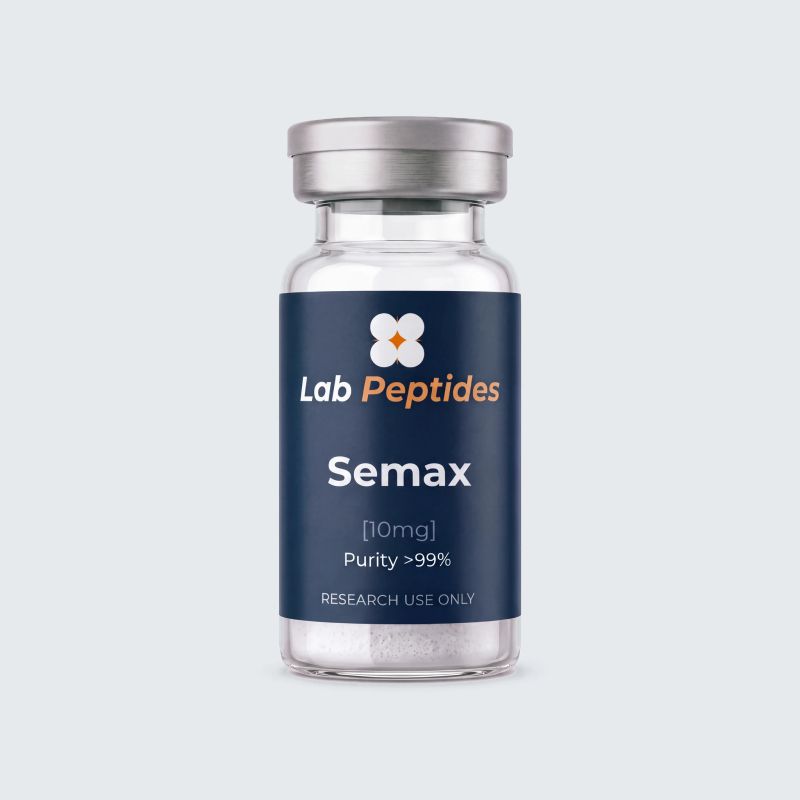
Semax 10mg Cognition
ACTH nootropic. BDNF boosted.
The peptide nootropic born in Russia. A heptapeptide based on ACTH: massive BDNF boost, amplified working memory, maximum cognitive focus. Registered as a medicine in Russia since the 1990s. Your brain, in focus mode.
- Certificate of analysis
- In stock in France
 Ordered with its water: shipped in a magnetic box
10% off every deliveryPause, skip or cancel in 1 clickNo commitment, no hidden fees
No automatic charge: pay for each delivery by card, in Bitcoin (an extra 5% off), or by bank transfer from €100
Your complete kit
The vial alone cannot be used as is. Add what you need to prepare it:
Frequently bought together


Research Use Only (RUO) · Prohibited for human or veterinary use.
Key facts
Semax 10mg is a synthetic heptapeptide with the sequence Met-Glu-His-Phe-Pro-Gly-Pro (MEHFPGP), developed in Moscow by the Institute of Molecular Genetics of the Russian Academy of Sciences during the 1980s. As a structurally truncated analog of the 4-10 fragment of adrenocorticotropic hormone (ACTH 4-10), Semax was specifically engineered to retain the neurotrophic, mnestic, and neuroprotective properties of the parent peptide while completely eliminating its corticotropic hormonal activity.
In detail
Officially approved in Russia in 1994 as an intranasal spray (Semax 0.1% for prevention, Semax 1% for acute stroke), it has since been listed on the Russian government's Vital and Essential Medicines register, used routinely in hospital practice for ischemic stroke, hypoxic encephalopathy, traumatic brain injury, pediatric ADHD, and asthenodepressive syndromes.
With a molecular weight of 813.90 Da, Semax stands apart from most neuroactive peptides through a remarkable feature: the addition of the C-terminal tripeptide Pro-Gly-Pro, derived from natural gliproline, grants it exceptional metabolic stability against plasma and brain proteases. Whereas most neuropeptides display plasma half-lives below one minute, Semax resists degradation significantly better and demonstrates proven blood-brain-barrier penetration following intranasal or subcutaneous administration, with peak central activity occurring between 15 and 60 minutes post-dose.
In exploratory research, Semax occupies a unique nicheThat of a peptide nootropic with multimodal action combining three axes rarely united in a single molecule. First axis: potent upregulation of BDNF (Brain-Derived Neurotrophic Factor) and NGF (Nerve Growth Factor) in the hippocampus and frontal cortex, documented in rodents within 90 minutes after a single dose. Second axis: indirect dopaminergic and serotonergic cortical modulation via enkephalinase inhibition (same mechanism as Selank) and potentiation of monoaminergic systems. Third axis: major anti-ischemic neuroprotective activity with documented reduction of infarct volume in experimental stroke models and, in humans, improvement of NIHSS scores and Barthel index at 21 days in Russian clinical trials.
Protocol and preparation
| Water added | Concentration | Reading marker |
|---|---|---|
| 1 ml | 10 mg/ml | 10 UI = 1 mg |
| 2 ml | 5 mg/ml | 40 UI = 2 mg |
The volume of water does not change the product, only its concentration. Introduce the water slowly along the vial wall, never directly onto the lyophilisate, then swirl without shaking. Markers given on a 1 ml syringe graduated in 100 units.
Asepsis
Disinfect surfaces and stoppers (70% alcohol).
Solvent
Draw the required volume of bacteriostatic water.
Introduction
Inject gently against the vial wall (avoid direct jet on powder).
Solubilization
Roll the vial gently. Do not shake vigorously (degradation risk).
Solution storage Once reconstituted: 2-8°C (refrigerator).
Warning Theoretical tool for chemical handling. Does not constitute medical advice.
Open the dilution calculator- The amount of powder looks tiny. A lyophilisate takes up a few millimetres at the bottom of the vial, sometimes just a translucent film. The stated weight is there.
- The powder is compact, stuck to the wall or to the stopper. Transport moves the freeze-dried cake around. It changes nothing to reconstitution.
- The vial carries no individual label. That is our standard packaging, not a downgraded vial.
- After reconstitution, deposits or filaments appear. This is common, especially with small molecules. Let it settle and roll the vial between your palms, never shake it.
- The parcel is plain. Nothing on the outside indicates the contents or the brand name.
What is not normal: a cracked vial, an uncrimped cap or a stopper that moves, powder that has liquefied or changed colour. In those specific cases, write to us with a photo and we take the vial back.
The Semax 10mg vial from Atlas Lab is reconstituted with 2 ml of bacteriostatic water to reach a final concentration of 5 mg/ml, equivalent to 5,000 mcg/ml. For intranasal administration approximating Russian clinical formulations, prepare a secondary dilution in a 10 ml intranasal spray bottle with 0.9% NaCl from 2 mg of reconstituted peptide, obtaining a concentration of 0.2 mg/ml (approximate equivalent of Russian Semax 0.1%).
The most documented research protocols follow established Russian clinical dosages. For intranasal administration (ref Gusev Stroke 2000, Kaplan 2002), the adult dose ranges between 200 and 2,000 mcg per day distributed across 2 to 3 administrations, equivalent to 1 to 10 sprays depending on the magistral formulation concentration. A typical exploratory nootropic protocol would be 300 to 600 mcg twice daily, morning and midday, over a 10-to-14-day window followed by a 7-to-14-day washout.
For subcutaneous administration, which offers superior bioavailability and longer duration of action, exploratory protocols use 250 to 500 mcg per day in one or two injections (0.05 to 0.1 ml of the solution reconstituted at 5 mg/ml). Injection is preferably performed in the morning and possibly early afternoon, never in the evening to avoid residual noradrenergic stimulation disrupting deep sleep.
Cycles most frequently cited in Russian literature are 10 to 21 consecutive days in active phase, followed by at least 2-to-4-week pauses. Continuous administration beyond 30 days is not documented in clinical trials and provides no established additional benefit on neurotrophic biomarkers. For acute post-stroke hospital settings, Russian protocols use much higher doses (12 to 18 mg/day) over 10 days, but this dosage far exceeds typical exploratory research boundaries.
For combined use with its cousin Selank, favor sequential administration with Semax in the morning (pro-attentional and energizing effect) and Selank in late afternoon or evening (anxiolytic and sleep-promoting effect). Never mix the two in the same syringe or spray bottle: pharmacodynamic ratios balance differently and kinetic profiles must be respected independently.
Essential precautions includeRespecting chronobiology (no evening administration), avoiding association with classical psychostimulants like amphetamines or modafinil to limit risks of tachyarrhythmias, not using in cases of uncontrolled hypertension or known cardiac arrhythmias, and prohibiting any use in pregnant or breastfeeding women (absence of Western clinical research data).
Technical data
- Reconstitution
- 2 ml d'eau → 5 mg/ml. 5 UI = 0,25 mg ; 10 UI = 0,5 mg.
- Peptide sequence
- Met-Glu-His-Phe-Pro-Gly-Pro
- Molecular formula
- C37H51N9O10S
- Molecular weight
- 813.9 g/mol
- CAS number
- 80714-61-0
- Physical form
- Poudre lyophilisée blanche
- Recommended solubility
- Eau bactériostatique, NaCl 0.9%, acide acétique 0.1%
- Storage conditions
- Au réfrigérateur (+2 à +8 °C), à l'abri de la lumière. En poudre, possible au congélateur pour une conservation longue. Une fois préparé : réfrigérateur, jamais au congélateur.
- Use
- Research reagent, in vitro only (RUO)
Storage & handling
The lyophilized Semax 10mg vial is stored between 2 and 8 degrees Celsius in its original packaging, protected from direct light and any moisture source. Under these optimal conditions, a lyophilizate generally remains stable for up to 24 months. The C-terminal Pro-Gly-Pro tripeptide grants Semax structural robustness superior to most neuropeptides, but the lyophilized form remains sensitive to atmospheric humidity: carefully reseal the vial after handling and avoid prolonged openings in humid environments. After reconstitution with 2 ml of bacteriostatic water (0.9% benzyl alcohol), the resulting solution stores between 2 and 8 degrees Celsius for 30 to 60 days with stability exceeding 95%, placing Semax among the most stable peptides in solution available. Avoid freezing the reconstituted vial: freeze-thaw cycles can cause partial aggregation and 5-to-10% bioactivity loss per cycle. For the intranasal formulation diluted in 0.9% NaCl without preservative, shelf life shortens to 7 to 10 days refrigerated due to bacterial contamination risk. Preferably use sterilized spray bottles and renew the preparation regularly. If longer storage is desired, add 0.01% benzalkonium chloride as a preservative, standard practice for Russian magistral formulations. Upon reception, immediately place the vial in refrigeration. Brief exposure to ambient temperature during transport does not significantly alter lyophilized product bioactivity thanks to its inherent structural stability, but prolonging this exposure beyond 96 consecutive hours is inadvisable. Never dilute Semax with non-sterile water, solutions containing highly concentrated divalent metal ions (calcium, magnesium) that may precipitate acidic forms, or heavily alkaline (above pH 9) or heavily acidic (below pH 3) buffered solutions. Dilutions in 0.9% NaCl, water for injection, and bacteriostatic water are compatible and recommended. The certificate of analysis is published on this page, viewable before you order.
Mechanism of action
The mechanism of action of Semax integrates five complementary biological pathways that explain its unique nootropic-neuroprotective-mild anxiolytic profile.
First, massive transcriptional activation of BDNF constitutes the central driver of the pro-cognitive effect. Within 90 minutes after intranasal administration in rodents, Dolotov and colleagues (2006, Peptides) documented a 3-to-5-fold increase in BDNF messenger RNA in the hippocampus and cerebral cortex. This upregulation is paralleled by increases in NGF and the TrkA receptor, establishing a self-sustaining neurotrophic loop favorable to synaptic plasticity, long-term potentiation (LTP), and memory consolidation. The effect is robust, dose-dependent, and persists for several hours post-administration.
Second, Semax modulates monoaminergic neurotransmission through a sophisticated mechanism. Like its cousin Selank, it inhibits enkephalinase (EC 3.4.24.11), a brain metallopeptidase that normally degrades endogenous enkephalins. By prolonging enkephalin action, Semax indirectly increases cortical dopaminergic and serotonergic tone, with consequent improvements in vigilance, motivation, and concentration without rebound effect or withdrawal syndrome. This gentle modulation explains its non-stimulant nootropic profile, radically distinct from classical psychostimulants.
Third, anti-ischemic neuroprotective activity appears to rely on several converging sub-mechanisms: stabilization of mitochondrial membranes in neurons of the peri-infarct zone, inhibition of calcium-dependent apoptosis, reduction of free radical and pro-inflammatory cytokine production (IL-1 beta, TNF-alpha, IL-6), and modulation of the glutamate-mediated excitotoxic cascade. Gusev and Skvortsova (2000, Stroke) documented in humans a significant reduction of final CT-measured infarct volume at day 7 when Semax was administered within 6 hours of stroke onset.
Fourth, Semax exerts direct action on prefrontal attentional and executive circuits. Ponomareva and colleagues (2002, Neurosci Behav Physiol) demonstrated through quantitative EEG an increase in frontal beta waves and reduction of pathological theta waves in patients with encephalopathy, correlated with improvements in selective attention and working memory scores. This electrophysiological signature explains why Semax was successfully investigated in pediatric ADHD by Kaplan's team (2002, Russian Ministry of Health).
Fifth, a mild anxiolytic-antidepressant axis completes the profile. Eremin and colleagues (2005) documented imipramine-type antidepressant effects in the rodent forced swim test, attributable to monoaminergic modulation.
Studies and references
The scientific literature on Semax is almost exclusively Russian and has been subject to limited English-language publication, which explains its relative obscurity in the Western neuropharmacology community despite more than thirty years of official clinical use in Russia. Foundational work traces to Ashmarin and Myasoedov at the Institute of Molecular Genetics in Moscow during the 1980s, with initial demonstrations that truncating ACTH 4-10 to the tetrapeptide MEHF, stabilized by the C-terminal PGP, completely eliminated corticotropic activity while retaining and amplifying neurotrophic effects.
Gusev and Skvortsova (2000, Stroke, 31:1 pages 178-183) published the only major Western prospective multicenter study on Semax in acute ischemic stroke. 110 patients randomized to intranasal Semax 12 to 18 mg/day versus placebo, administered within 6 hours of symptom onset, for 10 days. Results: significant reduction of CT-measured infarct volume at day 7, improvement of NIHSS (National Institutes of Health Stroke Scale) and Barthel index at day 21, remarkable tolerability profile with no serious adverse event attributed to treatment. This study remains the international reference for peptide neuroprotection in acute stroke.
Kaplan and colleagues (2002, Russian Ministry of Health) conducted an open-label pediatric study on 52 children with ADHD (ages 8-12), treated with intranasal Semax 0.1% 1 mg twice daily for 30 days. Results: significant improvement of sustained attention scores, reduction of impulsivity measured by Conners-parent scales, partial normalization of frontal EEG. This study underpinned the pediatric indication for attentional disorders in Russia.
Dolotov and colleagues (2006, Peptides, 27:2 pages 301-307) characterized in detail the neurotrophic mechanism of Semax in rat embryo culture and rodent in vivo models. Dose-dependent increase in BDNF and NGF messenger RNA in the hippocampus, cortex, and striatum, with peak between 60 and 120 minutes post-intranasal administration, persisting up to 12 hours. This foundational study established Semax as a genuine peptide inducer of neuronal growth factors.
Ponomareva and colleagues (2002, Neurosci Behav Physiol, 32:1 pages 61-65) used quantitative EEG in 48 patients with chronic encephalopathy. Increase in frontal beta waves, reduction of pathological theta waves, correlated with objective improvement on neuropsychological tests (Stroop, TMT, Wechsler Memory Scale). This reproducible electrophysiological signature serves as an efficacy biomarker.
Medvedeva and colleagues (2014, BioMed Res Int) documented in hippocampal cultures a CREB- and ERK1/2-dependent increase in BDNF protein synthesis, confirming the central transcriptional mechanism. Kolomin and colleagues (2012, Front Pharmacol) published an English-language integrative review demonstrating that Semax modifies expression of over 1,000 brain genes related to plasticity, inflammation, and energy metabolism.
Eremin and colleagues (2005) and Shadrina and colleagues (2001) respectively documented antidepressant effects in the rat forced swim test and prevention of cognitive deficits after experimental hypoxia, positioning Semax as a broad-spectrum neuroprotector. Limitations of this database remain restricted access to primary Russian literature, absence of Western phase III trials by FDA standards, and heterogeneity of dosing protocols across intranasal, subcutaneous, and intramuscular routes.
Similar peptides
Semax positioning in the nootropic-neuroprotective space clarifies through systematic comparison with four major alternatives: Selank, Cerebrolysin, Noopept, and classical psychostimulants like modafinil or amphetamines.
Versus Selank, its close cousin from the Institute of Molecular Genetics, Semax occupies a complementary rather than competitive position. Selank, derived from tuftsin, is fundamentally anxiolytic and emotionally balancing with secondary nootropic effect. Semax, derived from ACTH 4-10, is fundamentally nootropic and neurotrophic with secondary anxiolytic effect. Sequential administration of both molecules (Semax morning, Selank late day) is a documented practice in Russian literature offering a profile covering the full cognitive-emotional spectrum without negative interaction. Both share the same enkephalinase-inhibition mechanism but diverge on downstream gene expression: Semax favors BDNF/NGF, Selank favors balanced monoaminergic modulation.
Versus Cerebrolysin (porcine neural-tissue peptide cocktail, Ever Pharma, EU/Russia), Semax offers three objective advantages. First, purity and reproducibility: single defined synthetic sequence vs variable biological mixture. Second, administration route: intranasal spray or subcutaneous vs sometimes-daily IM or IV injections. Third, cost and accessibility: industrial-scale synthetic peptide vs expensive biological extract. Cerebrolysin retains an advantage in severe encephalopathy indications and post-major-stroke recovery thanks to its broader neuropeptide spectrum.
Versus Noopept (N-phenylacetyl-L-prolylglycine ethyl ester, Valishev 1996), a Russian synthetic dipeptide popular as a nootropic, Semax offers more direct neurotrophic action (documented BDNF/NGF induction) and a more solid human clinical base (Stroke Gusev 2000). Noopept remains more accessible as oral capsules and offers a faster subjective effect (30-60 minutes) but with shorter half-life and less profound action on long-term neuroplasticity.
Versus classical psychostimulants (modafinil, methylphenidate, amphetamines), Semax differs radically. No tachycardia, no systematic hypertension, no anorexia, no tolerance, no withdrawal, no abuse or dependence risk. In exchange, subjective perceived effect is more subtle: improved mental clarity and motivation rather than artificially elevated alertness. Semax addresses the user seeking a structural, neurotrophic, background nootropic rather than an acute stimulant.
The verdictSemax is the background peptide nootropic, the one that builds (BDNF, NGF) instead of stimulating. Pair it with Selank to cover both cognition and calm, and order the format that fits your protocol. HPLC purity and certificate published on this page: check them before you order.
Frequently asked questions
What is the difference between Semax and Selank?
How to administer Semax: intranasal spray or subcutaneous injection?
Does Semax cause tolerance or dependence?
When to observe the first effects of Semax?
Can Semax be combined with other nootropics like modafinil or racetams?
Is Semax identical to what is marketed in Russia?
Does Semax impact cortisol or the corticotropic axis?
What is the shelf life after reconstitution?
 The complete guideSemax: the complete guide to the cognition peptide in research (2026)Semax, an ACTH 4-10-derived heptapeptide designed in Moscow: structure, nasal route, BDNF and melanocortins, medical use in Russia, the real quality of the studies, N-acetyl Semax amidate, the difference with Selank, studied doses and reconstitution.Read the guide
Also read:Cognitive peptides in research: Semax, Selank, Dihexa and the new generation of peptide nootropics