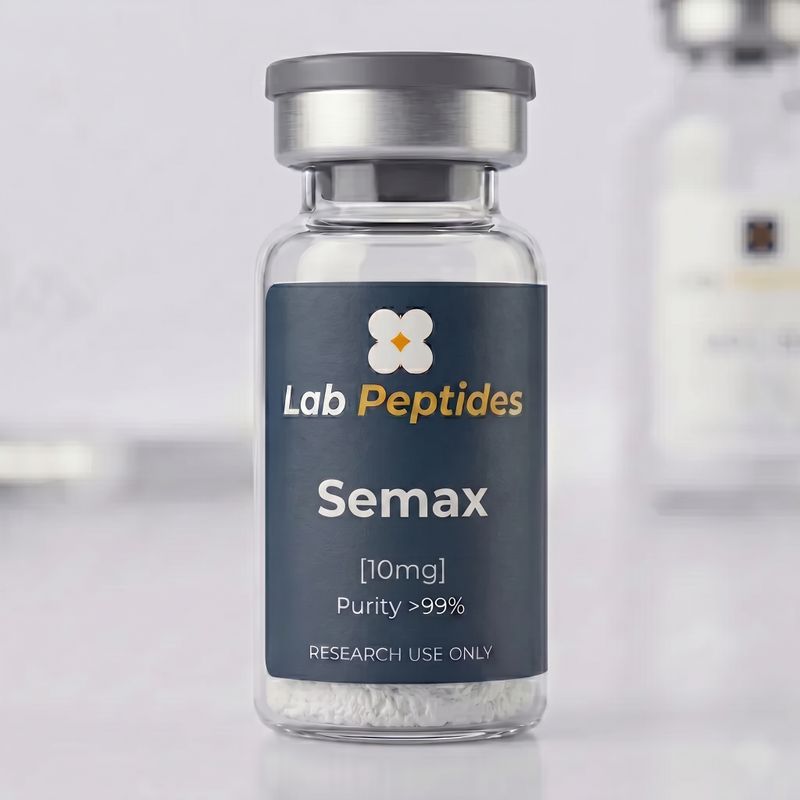
Semax 10mg Enfoque y Cognición
El nootrópico peptídico nacido en Rusia. Heptapéptido ruso basado en la ACTH — impulso masivo del BDNF, memoria de trabajo amplificada, foco cognitivo máximo. Registrado como medicamento en Rusia desde los años noventa. Su cerebro, en modo concentración.
- Certificado de análisis del lote
- Stock en Francia
-10 % de por vida en cada cicloPause, salte o cancele en 1 clicSin compromiso, sin gastos ocultos
Tu kit completo
- Vial 10mgIncluido
- Agua bacteriostáticaAñadir
- Jeringas de 1 mlAñadir
El vial por sí solo no puede usarse tal cual. Un vial sellado de Semax 10mg, liofilizado, sin etiquetado individual.
No olvide lo imprescindible
Se compran juntos a menudo



Información del producto
Semax 10mg is a synthetic heptapeptide with the sequence Met-Glu-His-Phe-Pro-Gly-Pro (MEHFPGP), developed in Moscow by the Institute of Molecular Genetics of the Russian Academy of Sciences during the 1980s. As a structurally truncated analog of the 4-10 fragment of adrenocorticotropic hormone (ACTH 4-10), Semax was specifically engineered to retain the neurotrophic, mnestic, and neuroprotective properties of the parent peptide while completely eliminating its corticotropic hormonal activity. Officially approved in Russia in 1994 as an intranasal spray (Semax 0.1% for prevention, Semax 1% for acute stroke), it has since been listed on the Russian government's Vital and Essential Medicines register, used routinely in hospital practice for ischemic stroke, hypoxic encephalopathy, traumatic brain injury, pediatric ADHD, and asthenodepressive syndromes.
With a molecular weight of 813.90 Da, Semax stands apart from most neuroactive peptides through a remarkable feature: the addition of the C-terminal tripeptide Pro-Gly-Pro, derived from natural gliproline, grants it exceptional metabolic stability against plasma and brain proteases. Whereas most neuropeptides display plasma half-lives below one minute, Semax resists degradation significantly better and demonstrates proven blood-brain-barrier penetration following intranasal or subcutaneous administration, with peak central activity occurring between 15 and 60 minutes post-dose.
In exploratory research, Semax occupies a unique niche: that of a peptide nootropic with multimodal action combining three axes rarely united in a single molecule. First axis: potent upregulation of BDNF (Brain-Derived Neurotrophic Factor) and NGF (Nerve Growth Factor) in the hippocampus and frontal cortex, documented in rodents within 90 minutes after a single dose. Second axis: indirect dopaminergic and serotonergic cortical modulation via enkephalinase inhibition (same mechanism as Selank) and potentiation of monoaminergic systems. Third axis: major anti-ischemic neuroprotective activity with documented reduction of infarct volume in experimental stroke models and, in humans, improvement of NIHSS scores and Barthel index at 21 days in Russian clinical trials.
01Mecanismo de acción
The mechanism of action of Semax integrates five complementary biological pathways that explain its unique nootropic-neuroprotective-mild anxiolytic profile.
First, massive transcriptional activation of BDNF constitutes the central driver of the pro-cognitive effect. Within 90 minutes after intranasal administration in rodents, Dolotov and colleagues (2006, Peptides) documented a 3-to-5-fold increase in BDNF messenger RNA in the hippocampus and cerebral cortex. This upregulation is paralleled by increases in NGF and the TrkA receptor, establishing a self-sustaining neurotrophic loop favorable to synaptic plasticity, long-term potentiation (LTP), and memory consolidation. The effect is robust, dose-dependent, and persists for several hours post-administration.
Second, Semax modulates monoaminergic neurotransmission through a sophisticated mechanism. Like its cousin Selank, it inhibits enkephalinase (EC 3.4.24.11), a brain metallopeptidase that normally degrades endogenous enkephalins. By prolonging enkephalin action, Semax indirectly increases cortical dopaminergic and serotonergic tone, with consequent improvements in vigilance, motivation, and concentration without rebound effect or withdrawal syndrome. This gentle modulation explains its non-stimulant nootropic profile, radically distinct from classical psychostimulants.
Third, anti-ischemic neuroprotective activity appears to rely on several converging sub-mechanisms: stabilization of mitochondrial membranes in neurons of the peri-infarct zone, inhibition of calcium-dependent apoptosis, reduction of free radical and pro-inflammatory cytokine production (IL-1 beta, TNF-alpha, IL-6), and modulation of the glutamate-mediated excitotoxic cascade. Gusev and Skvortsova (2000, Stroke) documented in humans a significant reduction of final CT-measured infarct volume at day 7 when Semax was administered within 6 hours of stroke onset.
Fourth, Semax exerts direct action on prefrontal attentional and executive circuits. Ponomareva and colleagues (2002, Neurosci Behav Physiol) demonstrated through quantitative EEG an increase in frontal beta waves and reduction of pathological theta waves in patients with encephalopathy, correlated with improvements in selective attention and working memory scores. This electrophysiological signature explains why Semax was successfully investigated in pediatric ADHD by Kaplan's team (2002, Russian Ministry of Health).
Fifth, a mild anxiolytic-antidepressant axis completes the profile. Eremin and colleagues (2005) documented imipramine-type antidepressant effects in the rodent forced swim test, attributable to monoaminergic modulation. Clinically, Russian formulations are commonly prescribed for post-stroke asthenodepressive syndromes and mild anxiety disorders, with a benefit-tolerance ratio superior to benzodiazepines.
Péptidos similares
Semax positioning in the nootropic-neuroprotective space clarifies through systematic comparison with four major alternatives: Selank, Cerebrolysin, Noopept, and classical psychostimulants like modafinil or amphetamines.
Versus Selank, its close cousin from the Institute of Molecular Genetics, Semax occupies a complementary rather than competitive position. Selank, derived from tuftsin, is fundamentally anxiolytic and emotionally balancing with secondary nootropic effect. Semax, derived from ACTH 4-10, is fundamentally nootropic and neurotrophic with secondary anxiolytic effect. Sequential administration of both molecules (Semax morning, Selank late day) is a documented practice in Russian literature offering a profile covering the full cognitive-emotional spectrum without negative interaction. Both share the same enkephalinase-inhibition mechanism but diverge on downstream gene expression: Semax favors BDNF/NGF, Selank favors balanced monoaminergic modulation.
Versus Cerebrolysin (porcine neural-tissue peptide cocktail, Ever Pharma, EU/Russia), Semax offers three objective advantages. First, purity and reproducibility: single defined synthetic sequence vs variable biological mixture. Second, administration route: intranasal spray or subcutaneous vs sometimes-daily IM or IV injections. Third, cost and accessibility: industrial-scale synthetic peptide vs expensive biological extract. Cerebrolysin retains an advantage in severe encephalopathy indications and post-major-stroke recovery thanks to its broader neuropeptide spectrum.
Versus Noopept (N-phenylacetyl-L-prolylglycine ethyl ester, Valishev 1996), a Russian synthetic dipeptide popular as a nootropic, Semax offers more direct neurotrophic action (documented BDNF/NGF induction) and a more solid human clinical base (Stroke Gusev 2000). Noopept remains more accessible as oral capsules and offers a faster subjective effect (30-60 minutes) but with shorter half-life and less profound action on long-term neuroplasticity.
Versus classical psychostimulants (modafinil, methylphenidate, amphetamines), Semax differs radically. No tachycardia, no systematic hypertension, no anorexia, no tolerance, no withdrawal, no abuse or dependence risk. In exchange, subjective perceived effect is more subtle: improved mental clarity and motivation rather than artificially elevated alertness. Semax addresses the user seeking a structural, neurotrophic, background nootropic rather than an acute stimulant.
The verdict: Semax is the background peptide nootropic, the one that builds (BDNF, NGF) instead of stimulating. Pair it with Selank to cover both cognition and calm, and order the format that fits your protocol. HPLC purity and certificate published on this page: check them before you order.