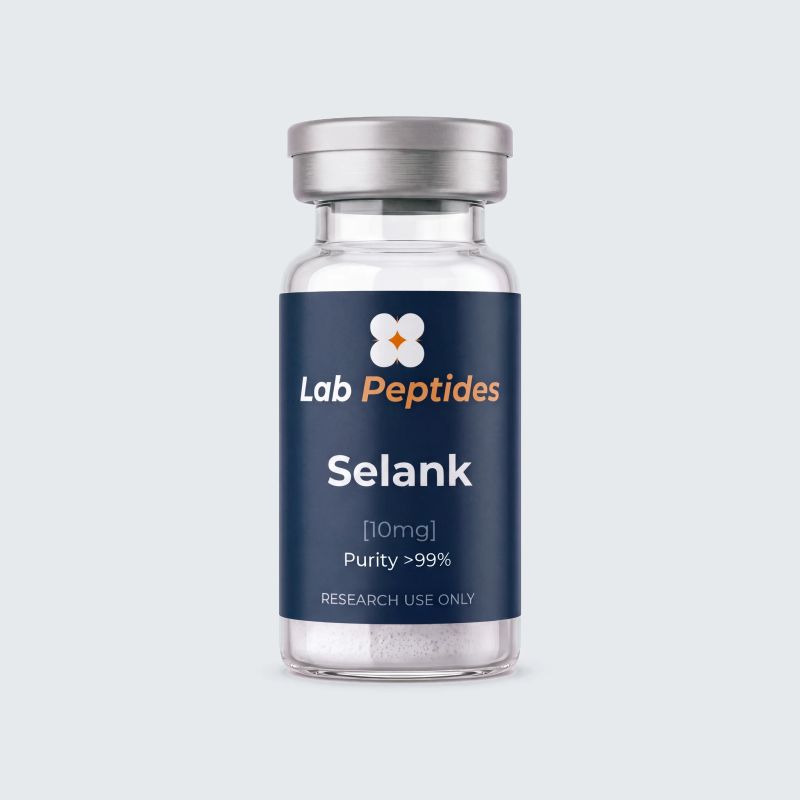
Selank 10mg Cognition
Anti-stress + cognitive boost.
The anti-stress peptide that sharpens the mind. A Russian peptide developed at the Institute of Molecular Genetics of the Russian Academy of Sciences. Anxiolytic without sedation, plus a cognitive boost through BDNF modulation. Laser focus, total calm, without the heaviness of benzos. The next generation of mental performance.
- Certificate of analysis
- In stock in France
 Ordered with its water: shipped in a magnetic box
10% off every deliveryPause, skip or cancel in 1 clickNo commitment, no hidden fees
No automatic charge: pay for each delivery by card, in Bitcoin (an extra 5% off), or by bank transfer from €100
Your complete kit
The vial alone cannot be used as is. Add what you need to prepare it:
Frequently bought together


Research Use Only (RUO) · Prohibited for human or veterinary use.
Key facts
Selank (Thr-Lys-Pro-Arg-Pro-Gly-Pro, 751 Da heptapeptide) is a synthetic stabilised analogue of tuftsin, an endogenous immunomodulatory tetrapeptide produced by the spleen. Developed at the Institute of Molecular Genetics of the Russian Academy of Sciences (Moscow) by the Myasoedov and Ashmarin teams in the 1990s, Selank was approved in Russia as an anxiolytic medication in nasal spray form (commercial name Selanc) for generalised anxiety disorder and adjustment disorders. It represents one of the few anxiolytic peptides to have official regulatory authorisation in a developed country, but remains almost unknown outside the Russian sphere of influence and neuropeptide research.
In detail
This fundamental difference is explained by non-benzodiazepine mechanisms: GABAergic system modulation via tuftsin receptors, enkephalinase inhibition, increased BDNF expression, potentiation of cortical noradrenergic and dopaminergic systems. Selank is thus often characterised in Russian literature as an "atypical anxiolytic" or "regulator of neuropsychic homeostasis".
This vial delivers 10 mg of high-purity Selank (>98 %, HPLC) in lyophilised form, type I borosilicate glass, fluorinated butyl stopper. Destined exclusively for in vitro research and preclinical studies on non-human models, in accordance with European regulations; no human, dietary or medical use. The product is not approved as a medication in the European Union.
Protocol and preparation
| Water added | Concentration | Reading marker |
|---|---|---|
| 1 ml | 10 mg/ml | 10 UI = 1 mg |
| 2 ml | 5 mg/ml | 40 UI = 2 mg |
The volume of water does not change the product, only its concentration. Introduce the water slowly along the vial wall, never directly onto the lyophilisate, then swirl without shaking. Markers given on a 1 ml syringe graduated in 100 units.
Asepsis
Disinfect surfaces and stoppers (70% alcohol).
Solvent
Draw the required volume of bacteriostatic water.
Introduction
Inject gently against the vial wall (avoid direct jet on powder).
Solubilization
Roll the vial gently. Do not shake vigorously (degradation risk).
Solution storage Once reconstituted: 2-8°C (refrigerator).
Warning Theoretical tool for chemical handling. Does not constitute medical advice.
Open the dilution calculator- The amount of powder looks tiny. A lyophilisate takes up a few millimetres at the bottom of the vial, sometimes just a translucent film. The stated weight is there.
- The powder is compact, stuck to the wall or to the stopper. Transport moves the freeze-dried cake around. It changes nothing to reconstitution.
- The vial carries no individual label. That is our standard packaging, not a downgraded vial.
- After reconstitution, deposits or filaments appear. This is common, especially with small molecules. Let it settle and roll the vial between your palms, never shake it.
- The parcel is plain. Nothing on the outside indicates the contents or the brand name.
What is not normal: a cracked vial, an uncrimped cap or a stopper that moves, powder that has liquefied or changed colour. In those specific cases, write to us with a photo and we take the vial back.
Standard reconstitutionSlowly inject 2 ml of bacteriostatic water into the 10 mg vial, creating a 5 mg/ml clear and colourless solution. Gently roll, do not shake.
- Intranasal (Russian reference route Selanc 0.15 % spray): the most documented in Russian clinical literature. Allows direct CNS penetration via olfactory mucosa.
- Subcutaneous: higher systemic bioavailability, probably more marked peripheral effect (immunomodulation).
- Standard Selanc dose: 300 mcg/kg/day = approximately 250-400 mcg per dose for 70 kg, divided into 2-3 doses
- Fractionated intranasal dose: 2-3 drops (at 5 mg/ml, 1 drop = 50 mcl = 250 mcg) per nostril, 2-3 times per day
- SC dose: 250-500 mcg per injection = 0.05-0.1 ml, 1 time per day
- Standard intranasal protocol (anxiolytic): 2-3 doses/day for 14 days, adjustable according to response
- SC protocol (research): 1 injection/day for 2-4 weeks in cures, 1-4 week rest possible
- Withdrawal support protocol: morning SC or intranasal dose for 2-6 weeks
- Onset of anxiolytic effect: from first dose (minutes-hours), maximum after 3-7 days of regular use
- Nootropic/cognition effect: perceptible after 7-14 days of daily regimen
- Neuroimmune effect: after 3-4 weeks
- No sedative effect, no tolerance build-up, no reported withdrawal syndrome on discontinuation
- No major documented drug interaction with antidepressants, anxiolytics, alcohol. However co-administration data with SSRIs and MAOIs are limited; caution.
- In subjects with severe panic disorder or active psychosis, data are insufficient.
- Intranasal route requires clean spray or drops; no reuse of a contaminated device.
- Pregnancy and breastfeeding: theoretical contraindications due to absence of data.
- Semax (other Russian neuropeptide, ACTH 4-10 analogue): frequent combinations in Russian literature, both having complementary nootropic/behavioural profiles. The combined Semax+Selank 10mg product exists in research.
- Cognitive-behavioural psychotherapies: Selank facilitates exposure by reducing anticipatory anxiety without sedation, enabling better therapeutic work.
This product is not intended for human use. The protocols described are examples drawn from Russian scientific literature and documented medication practices in Russia, provided strictly for informational purposes for research work on non-human models.
Technical data
- Reconstitution
- 2 ml d'eau → 5 mg/ml. 5 UI = 0,25 mg ; 6 UI = 0,3 mg.
- Peptide sequence
- Thr-Lys-Pro-Arg-Pro-Gly-Pro
- Molecular formula
- C33H57N11O9
- Molecular weight
- 751.9 g/mol
- CAS number
- 129954-34-3
- Physical form
- Poudre lyophilisée blanche
- Recommended solubility
- Eau bactériostatique, NaCl 0.9%, acide acétique 0.1%
- Storage conditions
- Au réfrigérateur (+2 à +8 °C), à l'abri de la lumière. En poudre, possible au congélateur pour une conservation longue. Une fois préparé : réfrigérateur, jamais au congélateur.
- Use
- Research reagent, in vitro only (RUO)
Storage & handling
Sealed unreconstituted vialIn the fridge (+2 to +8 °C); for long-term storage (over 3 months), a -20 °C freezer is an option, stability 24 months. At 2-8 C, stability 12 months. At room temperature (20-25 C), maximum 30 days stability; beyond, accelerated hydrolysis of peptide bonds.
- 4-8 C (refrigerator): optimal stability 14 days, acceptable up to 21 days.
- -20 C: acceptable for aliquots. One freeze-thaw cycle tolerated.
- Light: keep protected.
- pH: solution stable pH 5.5-7.5.
- Cloudy veil or precipitate.
- Marked yellow coloration: oxidation.
- Abnormal odour: advanced degradation.
For intranasal useSelank can be transferred to a clean nasal spray vial (pharmacy type, 10-30 ml). Dilution possible in sterile physiological saline to reach commercial Selanc concentration (0.15 % = 1.5 mg/ml). Stability 7-14 days refrigerated.
Laboratory documentationReconstitution date, COA lot, storage conditions, administration device used, to be recorded for traceability.
Mechanism of action
Selank's mechanism of action unfolds along at least five axes, documented primarily by the Russian school of neuropeptidology.
First axis, indirect GABAergic modulation. Kozlovskaya 2003 showed that Selank, although it does not bind directly to the GABA-A receptor (unlike benzodiazepines), increases GABA-A expression in rat cortex and hippocampus after intranasal administration. This is downstream transcriptional modulation, without direct activation of the chloride channel. This difference explains why Selank is anxiolytic without sedation, without amnesia and without tolerance.
Second axis, enkephalinase (aminopeptidase N) inhibition. Zolotov 1997 Bull Exp Biol Med demonstrated in vitro that Selank inhibits plasma enkephalinase, the enzyme that degrades endogenous enkephalins. The result is an elevation of circulating enkephalin levels (Met-enkephalin, Leu-enkephalin), endogenous opioid pentapeptides that modulate mood, anxiety and pain. This indirect opioid-mimetic action is probably one of the major substrates of the anxiolytic effect.
Third axis, regulation of BDNF (Brain-Derived Neurotrophic Factor) expression. Inozemtseva 2008 and Volkova 2016 Front Pharmacol showed by RT-PCR that Selank increases BDNF expression in rat hippocampus, an effect shared with SSRI antidepressants (fluoxetine) and tricyclic antidepressants. BDNF modulates neuroplasticity, adult neurogenesis and stress resilience circuits. This axis potentially explains the nootropic and pro-cognitive effects reported by users.
Fourth axis, monoaminergic modulation. Medvedev 2014 BioMed Res Int characterised by in vivo cerebral microdialysis in rats that Selank increases extracellular levels of noradrenaline and dopamine in the prefrontal cortex, without significant effect on serotonin. This monoaminergic signature resembles noradrenaline-dopamine inhibitors (bupropion) rather than SSRIs, and corresponds to the "anxiolytic without sedation" clinical profile: preserved attention, preserved wakefulness, concentration possible.
Fifth axis, immunomodulation. As heir to immunoactive tuftsin, Selank retains moderate immunostimulating activity: increase in macrophage phagocytic activity, Th1/Th2 cytokine modulation. Uchakina 2008 documented that Selank in anxious patients with chronic respiratory infections reduced the number of annual infectious episodes, pointing to a neuroimmunological bridge. This dual neuroimmune action is rare among anxiolytics.
PharmacokineticsExtremely short plasma half-life (<5 minutes), but biological effect persists 12-24 hours thanks to metabolic conversion to tuftsin and other active fragments. By intranasal route, absorption via the olfactory mucosa allows direct CNS uptake with partial bypassing of the blood-brain barrier. By subcutaneous route, superior systemic bioavailability but lower cerebral uptake.
Studies and references
Selank has a scientific corpus primarily Russian of approximately 80 publications, including several controlled Russian clinical trials and half a dozen English-language publications in PubMed-indexed journals.
Initial development and tuftsinFridkin 1970 Biochim Biophys Acta isolated endogenous tuftsin from the spleen. Identification of tuftsin as a neuroimmune regulator motivated the synthesis of stabilised derivatives, culminating in Selank in 1989 (Russian Myasoedov patent). Ashmarin 1997 Patol Fiziol Eksp Ter described the first preclinical data on anxiolytic activity.
Animal anxiety modelsSemenova 2004 Neurosci Behav Physiol tested Selank in elevated plus maze paradigm in rats, showing anxiolytic effect equivalent to diazepam at 300 mcg/kg IP. Vyunova 2008 Stress studied unpredictable chronic stress models, noting normalisation of exploratory behaviour and weight gain under Selank. Kolik 2011 Bull Exp Biol Med compared Selank vs medazepam in Vogel paradigm (licking-electric shock conflict), showing comparable efficacy.
Human clinical studies (Russia)Zozulia 2008 Vopr Pitan reported an open trial of 60 adult patients with generalised anxiety disorder, intranasal Selank 300 mcg/kg/day for 14 days, significant reduction in HAM-A scores (-45 %) and improvement in global functioning. Neznamov 2001 and Filatova 2005 published comparative series Selank vs benzodiazepines (medazepam, diazepam) on cohorts of anxiety and adjustment disorders, concluding similar efficacy with clearly superior tolerance profile (absence of sedation, absence of dependence, absence of alcohol interaction).
Neuromodulation and BDNFVolkova 2016 Front Pharmacol is one of the few quality English-language publications, characterising Selank's effects on neuronal gene expression (BDNF, GABA-A, monoamine enzymes) by RT-PCR and DNA chips in neuronal culture and in rats in vivo.
Nootropic effectsSemenova 2007 and Koroleva 2012 studied Selank in learning and memory paradigms (Morris water maze, passive avoidance). Results: improvement in memory retention in stressed rats, facilitated mnesic consolidation. Users anecdotally report improvement in concentration and cognitive fluidity, but formal human nootropic data are limited.
Clinical immunomodulationUchakina 2008 followed 47 anxious patients with recurrent respiratory infections on Selank for 6 weeks: reduction in the number of infectious episodes, increase in NK and phagocytic activity, normalisation of CD4/CD8 ratios.
Addictions and withdrawalKozlovskaya 2000 tested Selank in opioid and alcohol withdrawal protocols in rats, observing a reduction in seeking behaviours and attenuation of withdrawal symptoms. In humans, observational series suggested utility in supporting tobacco and alcohol withdrawal, but without a conclusive randomised trial.
COVID-19Sluzhaeva 2022 and Blagonravova 2022 published Russian series on the use of Selank in reducing post-COVID anxiety and improving post-infectious cognitive recovery. Observational data, no randomised trial.
Tolerance and safetyOver 20 years of medication use in Russia (since 2004 approval), Selank presents a very clean profile: no sedative effect, no memory alteration, no reported dependence, no major documented drug interactions. Side effects are limited to transient rhinorrhoea after nasal spray (<5 % of subjects).
Critical limitationAlmost all the corpus is Russian, often in journals not indexed in PubMed, with sometimes limited trial designs (cohort size, absence of placebo, evaluation bias). Independent Western replication is minimal. The non-European regulatory status limits formal applications.
Similar peptides
Selank sits at the unique intersection of anxiolysis, neuromodulation and immunomodulation, a rare combination in the therapeutic arsenal.
Versus benzodiazepines (diazepam, alprazolam, lorazepam)BZDs are positive allosteric modulators of GABA-A, with rapid anxiolytic efficacy but heavy side effects (sedation, amnesia, tolerance, dependence, withdrawal syndrome, chronic cognitive deterioration, alcohol interaction). Selank acts downstream without these effects, but the immediate anxiolytic effect of a benzodiazepine in an acute panic attack cannot be equalled. Selank is rather compared to diazepam in chronic treatment of generalised anxiety, not in acute treatment.
Versus SSRIs (fluoxetine, sertraline, paroxetine)SSRIs are the Western reference for generalised anxiety disorder. Established efficacy, but with onset delay 4-6 weeks, side effects (sexual disorders, weight gain, discontinuation syndrome) and less clean tolerance profile. Selank has a faster onset (days) and a profile without sexual effects. Direct SSRI vs Selank comparative data are practically non-existent.
Versus Semax (other Russian neuropeptide, ACTH 4-10 analogue): both are Russian neuropeptides with complementary mechanisms. Semax is more nootropic/dopaminergic, Selank more anxiolytic/GABAergic. Combinations are common and the combined Semax+Selank product exists in Russian research.
Versus pregabalin and gabapentinThese alpha-2-delta ligands are effective anxiolytics without classical benzodiazepine profile, used for generalised anxiety and neuropathic pain. Acceptable tolerance profile but central side effects (drowsiness, dizziness, weight gain) and modest dependence reported. Selank is "cleaner" on these parameters, but more limited clinical corpus outside Russia.
Versus buspirone (5HT1A partial agonist)Another non-benzodiazepine anxiolytic, relatively clean tolerance profile, but clinically modest efficacy. Selank has more robust Russian clinical data on generalised anxiety than buspirone in Western trials.
Versus ashwagandha, passionflower and other phytotherapeutic adaptogens: no direct formal comparison. Adaptogens have a very light profile with modest effects; Selank has more defined and measurable pharmacological activity.
Versus psychotherapies (CBT, mindfulness, EMDR)Selank does not replace the psychotherapeutic approach to anxiety disorders. It can be an adjuvant that reduces anticipatory anxiety and facilitates therapeutic engagement. Integrated approach is superior to each in isolation.
Unique positioningAnxiolytic with remarkably "clean" profile, absence of sedation and dependence, neuroimmune action, established Russian clinical corpus with regulatory approval, but little known in the West. It is one of the few peptides with official medication status in a developed country, which distinguishes its pharmacological credibility.
Frequently asked questions
Why is Selank little known in the West?
Intranasal or subcutaneous, which route to prefer?
Is there a risk of dependence or tolerance build-up?
Can it be combined with antidepressants (SSRIs, SNRIs)?
Does Selank have documented nootropic effects?
How long before anxiolytic effect?
Can a nasal spray be made from the injectable vial?
What is the difference between Selank and Semax?
 The complete guideSelank: complete guide to the Russian anxiolytic peptide in researchSelank, a tuftsin-derived heptapeptide designed in Moscow: Thr-Lys-Pro-Arg-Pro-Gly-Pro structure, nasal route, enkephalinases, GABA, IL-6, Russian trials against benzodiazepines and their limits, doses studied, reconstitution and differences from Semax.Read the guide
Also read:Cognitive peptides in research: Semax, Selank, Dihexa and the new generation of peptide nootropics