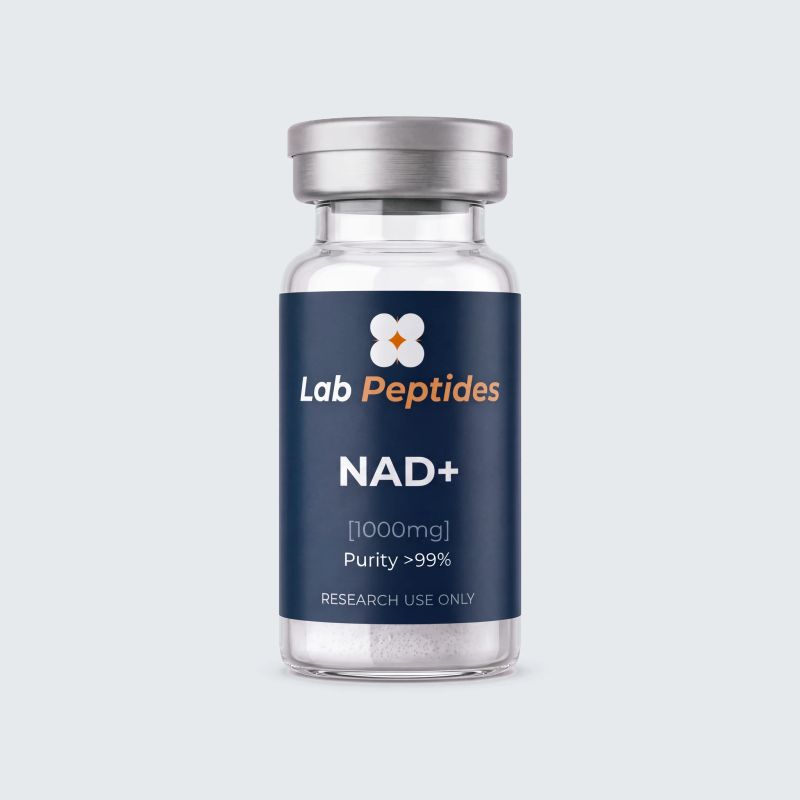
NAD+ 1000mg Longevity
NAD+, the large format.
NAD+ in its large format: 1,000 mg of nicotinamide adenine dinucleotide in a single vial, twice the 500 mg vial. A redox coenzyme found in every cell. Lyophilised powder, to be reconstituted. Stocked in France. For research use only.
- In stock in France
 Ordered with its water: shipped in a magnetic box
Your complete kit
The vial alone cannot be used as is. Add what you need to prepare it:
Frequently bought together


Research Use Only (RUO) · Prohibited for human or veterinary use.
Key facts
NAD+ (nicotinamide adenine dinucleotide, 663.4 g/mol) is not a peptide: it is a dinucleotide, a redox coenzyme found in every living cell. This vial contains 1,000 mg of it, lyophilised, twice the 500 mg format.
The large format meets a simple needFewer vials to prepare for work that consumes NAD+ in large quantities. For laboratory research use only.
Protocol and preparation
| Water added | Concentration | Reading marker |
|---|---|---|
| 5 ml | 200 mg/ml | 10 UI = 20 mg |
The volume of water does not change the product, only its concentration. Introduce the water slowly along the vial wall, never directly onto the lyophilisate, then swirl without shaking. Markers given on a 1 ml syringe graduated in 100 units.
Asepsis
Disinfect surfaces and stoppers (70% alcohol).
Solvent
Draw the required volume of bacteriostatic water.
Introduction
Inject gently against the vial wall (avoid direct jet on powder).
Solubilization
Roll the vial gently. Do not shake vigorously (degradation risk).
Solution storage Once reconstituted: 2-8°C (refrigerator).
Warning Theoretical tool for chemical handling. Does not constitute medical advice.
Open the dilution calculator- The amount of powder looks tiny. A lyophilisate takes up a few millimetres at the bottom of the vial, sometimes just a translucent film. The stated weight is there.
- The powder is compact, stuck to the wall or to the stopper. Transport moves the freeze-dried cake around. It changes nothing to reconstitution.
- The vial carries no individual label. That is our standard packaging, not a downgraded vial.
- After reconstitution, deposits or filaments appear. This is common, especially with small molecules. Let it settle and roll the vial between your palms, never shake it.
- The parcel is plain. Nothing on the outside indicates the contents or the brand name.
What is not normal: a cracked vial, an uncrimped cap or a stopper that moves, powder that has liquefied or changed colour. In those specific cases, write to us with a photo and we take the vial back.
Technical data
- Reconstitution
- 5 ml d'eau → 200 mg/ml. 25 UI = 50 mg.
- Molecular formula
- C21H27N7O14P2
- Molecular weight
- 663.4 g/mol
- CAS number
- 53-84-9
- Physical form
- Poudre lyophilisée
- Recommended solubility
- Eau bactériostatique, NaCl 0,9%
- Storage conditions
- Au réfrigérateur (+2 à +8 °C), à l'abri de la lumière. En poudre, possible au congélateur pour une conservation longue. Une fois préparé : réfrigérateur, jamais au congélateur.
- Use
- Research reagent, in vitro only (RUO)
Storage & handling
Unreconstituted vial. Refrigerated, between +2 and +8 °C, protected from light. A freezer (-20 °C) is suitable for long-term storage.
After reconstitution. Refrigerator only, protected from light, never the freezer. NAD+ in solution is less stable than a peptide: prepare the vial when you are ready to use it.
The 1,000 mg vial is reconstituted with 5 ml of bacteriostatic water, i.e. 200 mg/ml: the same concentration as the 500 mg vial prepared with 2.5 ml.
Mechanism of action
NAD+ cycles between an oxidised form (NAD+) and a reduced form (NADH). This pair carries the electrons of the reactions of energy metabolism: glycolysis, the Krebs cycle, the mitochondrial respiratory chain.
It is also the substrate, consumed in each reaction, of three enzyme families: sirtuins (NAD+-dependent deacetylases), PARPs (poly-ADP-ribose polymerases, mobilised by DNA breaks) and the ectoenzyme CD38. The cell regenerates it continuously, mainly through the salvage pathway from nicotinamide, whose rate-limiting enzyme is NAMPT.
Studies and references
The literature on NAD+ is vast. Two frequently cited milestones: Massudi et al. (PLoS One, 2012), who measured NAD+ in human tissue biopsies according to donor age, and the review by Verdin (Science, 2015), which summarises the role of NAD+ in cell signalling.
Much of the work concerns its precursors (nicotinamide riboside, nicotinamide mononucleotide) in cell and animal models. The product sold here is a laboratory reagent, for research use only.
Frequently asked questions
Is NAD+ a peptide?
How does it differ from the 500 mg vial?