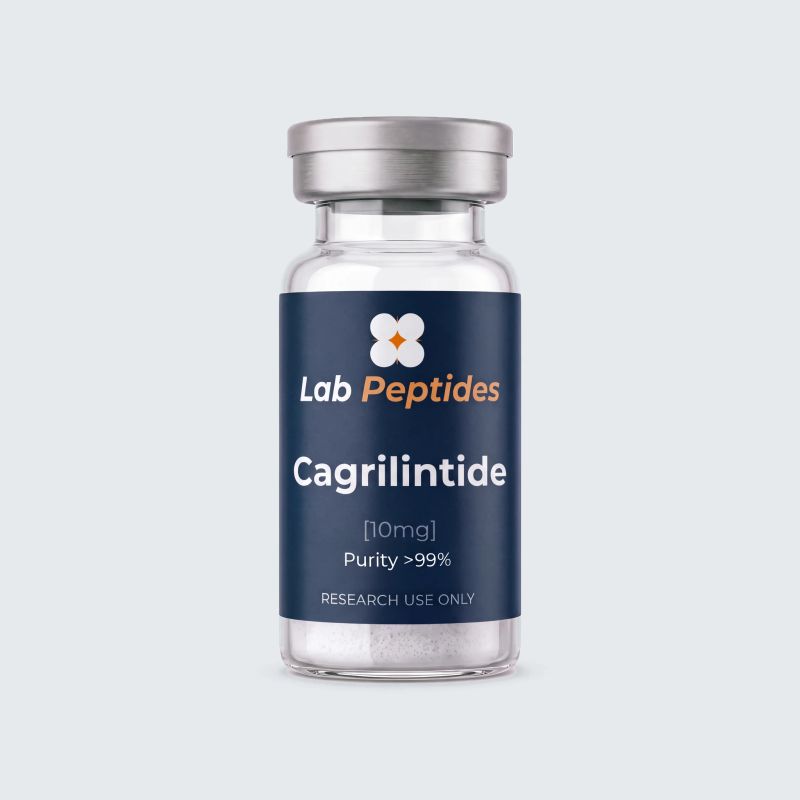
Cagrilintide 10mg Metabolism
Long-lasting appetite control.
The long-acting appetite cutter. An amylin analogue with a half-life extended to 7 days. Cagrilintide slows gastric emptying and switches on central satiety pathways. Paired with Semaglutide (the CagriSema duo, in phase 3), it pushes weight loss beyond Semaglutide alone. The strategic add-on of modern protocols.
Research protocols start at: 5 units, i.e. 0.25 mg per week (vial prepared with 2 ml of water).
10 mg = what the vial contains, not the dose.See the preparation
- Certificate of analysis
- In stock in France
 Ordered with its water: shipped in a magnetic box
10% off every deliveryPause, skip or cancel in 1 clickNo commitment, no hidden fees
No automatic charge: pay for each delivery by card, in Bitcoin (an extra 5% off), or by bank transfer from €100
Your complete kit
The vial alone cannot be used as is. Add what you need to prepare it:
Frequently bought together


Research Use Only (RUO) · Prohibited for human or veterinary use.
Key facts
Cagrilintide 10mg is the research reference for exploring the amylin pathway outside the incretin axis. A long-acting synthetic analog of human amylin designed by Novo Nordisk, it opened in 2021 with the Lau et al. study (Lancet) an entire field of research on satiety modulation through amylin and calcitonin receptors. Its main scientific interest lies in the documented synergy in combination with Semaglutide (CagriSema, phase 3 REDEFINE ongoing) exceeding 20% weight reduction at 68 weeks. The 10mg format is the intermediate standard: it covers 4.2 to 8.3 weeks at the maintenance level of 1.2 to 2.4 mg per week.
In detail
Our Cagrilintide 10mg batch is solid-phase synthesized, HPLC purity of at least 98%, identity confirmed by mass spectrometry, lyophilized under inert atmosphere. The certificate of analysis is published on this page, viewable before you order. Stock in France, discreet shipping from France, 3 to 7 business days in the EU. Reference choice for any exploratory design aiming to dissect the pure contribution of the amylin pathway.
Protocol and preparation
| Water added | Concentration | Reading marker |
|---|---|---|
| 1 ml | 10 mg/ml | 10 UI = 1 mg |
| 2 ml | 5 mg/ml | 40 UI = 2 mg |
The volume of water does not change the product, only its concentration. Introduce the water slowly along the vial wall, never directly onto the lyophilisate, then swirl without shaking. Markers given on a 1 ml syringe graduated in 100 units.
Asepsis
Disinfect surfaces and stoppers (70% alcohol).
Solvent
Draw the required volume of bacteriostatic water.
Introduction
Inject gently against the vial wall (avoid direct jet on powder).
Solubilization
Roll the vial gently. Do not shake vigorously (degradation risk).
Solution storage Once reconstituted: 2-8°C (refrigerator).
Warning Theoretical tool for chemical handling. Does not constitute medical advice.
Open the dilution calculator- The amount of powder looks tiny. A lyophilisate takes up a few millimetres at the bottom of the vial, sometimes just a translucent film. The stated weight is there.
- The powder is compact, stuck to the wall or to the stopper. Transport moves the freeze-dried cake around. It changes nothing to reconstitution.
- The vial carries no individual label. That is our standard packaging, not a downgraded vial.
- After reconstitution, deposits or filaments appear. This is common, especially with small molecules. Let it settle and roll the vial between your palms, never shake it.
- The parcel is plain. Nothing on the outside indicates the contents or the brand name.
What is not normal: a cracked vial, an uncrimped cap or a stopper that moves, powder that has liquefied or changed colour. In those specific cases, write to us with a photo and we take the vial back.
The Cagrilintide 10mg vial is reconstituted with 2 ml of 0.22 µm sterile-filtered bacteriostatic water, giving a final concentration of 5 mg/ml. This concentration enables precise dosing of characteristic doses (0.25mg = 0.05 ml, 1.2mg = 0.24 ml, 2.4mg = 0.48 ml). Precision 1 ml U100 graduated syringe (29G or 30G) required for accurate reading.
Typical titration schedule in exploratory research (4-week steps from the phase 3 trials): 0.25mg, 0.5mg, 1mg, 1.7mg then 2.4mg weekly. The 10mg vial covers 4.2 to 8.3 weeks at the maintenance level of 1.2 to 2.4 mg per week. Study variant (Lau 2021, phase 2): 2-week steps at 0.3mg, 0.6mg then 1.2mg. This progressive escalation minimizes transient gastrointestinal effects and allows mapping of individual dose-response. For a CagriSema combination, fix the Cagrilintide dose at 2.4mg in stabilization then introduce Semaglutide in parallel escalation.
Administration frequencyOnce weekly, same day, subcutaneous route in animal research or as in vitro application depending on experimental design. Classic rotation sites: peri-umbilical abdomen, lateral thigh, posterior triceps.
Stability window after reconstitutionUp to 28 days at 2-8 °C if the vial is reconstituted under sterile conditions and the bacteriostatic water contains a preservative (benzyl alcohol 0.9%). Never freeze after reconstitution at the risk of partial denaturation of the peptide backbone.
Recommended in vitro measurements on a 10mg protocolWeekly weight, fasting glucose and insulin, HOMA-IR, lipid panel, blood pressure, heart rate. For the calcitonin pathway: bone densitometry at entry and exit, quarterly CTX and P1NP. For central designs: validated satiety scales, food craving questionnaires. LC-MS/MS for intact peptide plasma assay.
Technical data
- Reconstitution
- 2 ml d'eau → 5 mg/ml. 5 UI = 0,25 mg ; 10 UI = 0,5 mg.
- Peptide sequence
- C20-diacide-γGlu-KCNTATCATQRLAEFLRHSSNNFGPILPPTNVGSNTP-NH2 (pont disulfure Cys2-Cys7)
- Molecular formula
- C194H312N54O59S2
- Molecular weight
- 4409 g/mol
- CAS number
- 1415456-99-3
- Physical form
- Poudre lyophilisée blanche
- Recommended solubility
- Eau bactériostatique, NaCl 0.9%, acide acétique 0.1%
- Storage conditions
- Au réfrigérateur (+2 à +8 °C), à l'abri de la lumière. En poudre, possible au congélateur pour une conservation longue. Une fois préparé : réfrigérateur, jamais au congélateur.
- Use
- Research reagent, in vitro only (RUO)
Storage & handling
Upon receipt, the lyophilized Cagrilintide vial is stored in the fridge (+2 to +8 °C), hermetically sealed, protected from direct light exposure; for long-term storage (over 3 months), a -20 °C freezer keeps it for up to 24 months. Temporary storage at 2-8 °C for a maximum of 30 days is tolerated with no documented loss of HPLC purity. Avoid repeated freeze-thaw cycles: each cycle marginally degrades tertiary structure and may reduce measurable biological activity. For reconstitution, use exclusively 0.22 µm sterile-filtered bacteriostatic water (benzyl alcohol 0.9% as preservative). Slowly deposit the solvent against the inner wall of the vial to avoid foaming that would damage the peptide chain. Swirl the vial gently — never vortex or shake abruptly. After reconstitution, store refrigerated (2-8 °C) protected from light, and ideally use within 28 days. If a protocol requires extended preservation (rare), aliquot into single-use fractions and freeze at -80 °C: this practice preserves integrity better than extended storage at 4 °C. Cagrilintide lyophilised stability is good at -20°C under desiccation: > 24 months with no measurable RP-HPLC purity loss. The critical stability point of cagrilintide lies in its residual fibrillisation propensity (inherited from native amylin, attenuated but not fully suppressed by Pro substitutions): in aqueous solution at neutral pH and room temperature, β-sheet oligomers may form over 72h+, detectable by ThT (thioflavin T) fluorescence and SEC-HPLC. Operational recommendations: reconstitute just before use or store < 14 days at 2-8°C, avoid mechanical agitation (prolonged vortex), use vials with low glass surface/volume ratio (limits interfacial nucleation), optimal pH 6.0-7.0. UV light and temperatures > 25°C significantly accelerate fibrillisation. LC-MS dosing with SEC-HPLC detection is recommended before any critical pharmacological study to quantify the active monomeric fraction.
Mechanism of action
Cagrilintide is a long-acting synthetic analog of human amylin, designed by Novo Nordisk to overcome the pharmacokinetic limitations of pramlintide (short half-life, multi-daily administration). The molecule is modified by acylation with a C18 fatty acid chain on the Lys22 residue, which maximizes serum albumin binding and extends plasma half-life to approximately 7 days in humans, compatible with weekly administration.
At the receptor level, Cagrilintide simultaneously activates the calcitonin receptor (CTR) and the amylin receptor complexes (AMY1, AMY2, AMY3) formed by association of CTR with receptor activity-modifying proteins (RAMPs). This signaling, distinct from that of GLP-1, produces an anorexigenic effect through complementary neuronal pathways: activation of catecholaminergic neurons in the solitary tract (NTS), modulation of satiety circuits in the hypothalamus, and GLP-1-independent slowing of gastric emptying.
In preclinical DIO (Diet-Induced Obesity) models, animals treated with Cagrilintide alone have shown a 11 to 13% weight reduction over 4 weeks, with preservation of lean mass. The most striking effect documented in the literature remains the synergy observed in co-administration with Semaglutide (CagriSema): full addition of anorexigenic effects, weight reduction exceeding 20% in clinical phase 2 at 32 weeks (Frias et al., Lancet 2023). This synergy has opened an entire field of exploration on amylin + GLP-1 combination that neither molecule alone can achieve.
Cagrilintide also modulates bone markers and calcium metabolism via the calcitonin pathway, which is the subject of parallel studies on bone mineral density and post-menopausal fractures. These avenues remain exploratory but broaden the research scope beyond pure energy metabolism.
Cagrilintide is a synthetic analogue of human amylin (hIAPP, Islet Amyloid Polypeptide, 37 aa, 3904 Da), a peptide hormone co-secreted with insulin by pancreatic β-cells whose sequence is closely conserved with calcitonin. Native human amylin shows amyloidogenic propensity (Aβ-like fibril formation in diabetic pancreatic islets) requiring stabilising modifications: cagrilintide incorporates (1) Pro25, Pro28, Pro29 substitutions (inherited from pramlintide) blocking β-sheet propensity and fibrillisation, (2) an Arg18 substitution improving solubility, and (3) a C20 diacid acylation (eicosanedioic acid) on Lys8 via γ-Glu/OEG linker, conferring reversible plasma albumin binding responsible for its exceptional half-life (~180 hours, compatible with weekly administration). Pharmacologically, cagrilintide activates hybrid receptors AMY1R, AMY2R, AMY3R (calcitonin-receptor + RAMP1/2/3 complexes), the amylin/CGRP receptor family, and more weakly the calcitonin receptor CTR. Signalling pathways include adenylate cyclase activation (cAMP), glucagon suppression, slowed gastric emptying, and central action on arcuate hypothalamic nucleus (POMC/CART neurons) for satiety.
Studies and references
The scientific database on Cagrilintide rapidly took shape between 2020 and 2024 around four reference trials published or presented at major congresses (ADA, EASD, ObesityWeek).
The pivotal phase 2 study by Lau et al., published in The Lancet in 2021 (DOI: 10.1016/S0140-6736(21)00845-X), evaluated Cagrilintide as monotherapy in 706 overweight or obese adults, randomized between placebo, liraglutide 3.0mg and Cagrilintide at escalating doses (0.3, 0.6, 1.2, 2.4, 4.5 mg weekly). At 26 weeks, weight reduction reached 10.8% in the Cagrilintide 4.5mg group, 8.0% at 2.4mg, versus 9.0% for liraglutide 3.0mg and 3.0% for placebo. The tolerance profile proved more favorable than that of liraglutide with fewer transient gastrointestinal effects.
The CagriSema combination study (Frias et al., Lancet 2023, DOI: 10.1016/S0140-6736(23)01163-7) evaluated 92 adults with type 2 diabetes, randomized between Semaglutide 2.4mg, Cagrilintide 2.4mg and the CagriSema 2.4mg/2.4mg combination. At 32 weeks, weight reduction reached 15.6% in the CagriSema group, versus 5.1% for Cagrilintide alone and 5.1% for Semaglutide alone. HbA1c dropped by 2.2% absolute in the combination group. This additive synergy was the trigger for the phase 3 REDEFINE program.
The REDEFINE program (phase 3, initiated late 2023) includes five active trials, including REDEFINE-1 (obesity without diabetes) and REDEFINE-2 (type 2 diabetes). Initial partial readouts presented at ADA 2024 confirm a weight reduction exceeding 20% at 68 weeks for CagriSema, a value unmatched to date in the incretin class outside Retatrutide. Complete results are expected for 2025-2026.
In preclinical research, work by Jensen et al. (Cell Reports Medicine 2022) on C57BL/6J mouse models subjected to a high-fat diet documented a 40% reduction in spontaneous caloric intake under Cagrilintide at 100 µg/kg weekly, with a 23% weight reduction over 8 weeks. c-Fos brain imaging confirmed preferential activation of the solitary tract nuclei and area postrema, corroborating the central amylin mechanism.
On the safety front, cumulative phase 2 and early phase 3 data indicate a gentler gastrointestinal profile than GLP-1 agonists, with no notable signal on cardiovascular, renal or hepatic parameters. The most frequent effects remain transient nausea (dose-dependent) and injection-site reactions. No measurable neoplasia has been reported in extension follow-up beyond 52 weeks.
Cagrilintide preclinical models focus on weight reduction and glycaemic control. In DIO (Diet-Induced Obesity) Sprague-Dawley rat model: SC administration 1-5 nmol/kg weekly over 4-8 weeks, dose-dependent weight loss 8-20% vs control, significant reduction in daily food intake (Lau et al., J Med Chem 2015 — reference paper for preclinical cagrilintide). In ZDF (Zucker Diabetic Fatty) rat model: improved fasting glycaemia, decreased rodent HbA1c, postprandial glucagon suppression. In non-human primate (cynomolgus) model: pharmacokinetics confirming extended ~7-day half-life, SC bioavailability > 80%. The cagrilintide + semaglutide combination (CagriSema co-formulation) produces documented additive effects on body weight and glycaemic profile in DIO rats and primates, justifying current clinical development at Novo Nordisk (REDEFINE and REIMAGINE trials). Additivity mechanisms involve convergence of GLP-1R (semaglutide) and AMY-R/CTR (cagrilintide) pathways on hypothalamic appetite regulation nuclei.
Similar peptides
Against Semaglutide (GLP-1 mono-agonist), Cagrilintide acts through a completely distinct pathway (amylin and calcitonin receptors). In monotherapy, its weight efficacy is slightly inferior (10-11% vs 15% in phase 2 at comparable dose), but its tolerance profile is gentler, its gastrointestinal effects less pronounced, and it modulates complementary neuronal circuits. The main interest of Cagrilintide is not to be better than Semaglutide solo, but to open the possibility of a synergistic combination.
Against Tirzepatide (dual GIP/GLP-1 agonist), Cagrilintide is clearly less powerful in monotherapy (10% vs 22%). The interest lies elsewhere: Cagrilintide engages no incretin receptor, making it an ideal orthogonal tool to dissect the contribution of the amylin pathway independently of the incretin axis. In combination with a GLP-1 or GIP/GLP-1 agonist, Cagrilintide brings an additive effect because it relies on distinct receptors.
Against Retatrutide (triple agonist), same logicCagrilintide is less powerful solo (10% vs 24%) but represents a complementary non-redundant pharmacological lever. Preclinical research programs are actively exploring triple-agonist + amylin combinations.
Strategic conclusionChoose Cagrilintide when the experimental design involves exploring the pure amylin pathway, or when the design incorporates co-administration with an incretin agonist to reproduce the CagriSema synergy documented in phase 2. Cagrilintide in monotherapy is a research tool more than a standalone therapeutic candidate.
Cagrilintide stands out among other amylin agonists by its extended half-life. Compared to pramlintide (Symlin, FDA-authorised amylin analogue for T1D/T2D US, 48 min half-life, 3x/day injectable), cagrilintide extends half-life to ~180h thanks to C20 acylation, allowing weekly administration compatible with chronic obesity model studies. Compared to pure GLP-1R agonists (semaglutide, liraglutide), cagrilintide targets a complementary pathway (amylin/CGRP) with distinct satiety and glucagon suppression mechanisms, justifying CagriSema combination development in clinical research. Compared to GLP-1/GIP co-agonists (tirzepatide) or GLP-1/GIP/GCGR (retatrutide), cagrilintide shares no pathway but may theoretically be additive with these co-agonists (study not yet reported). Compared to davalintide (AC2307, amylin/calcitonin chimera), cagrilintide has a more selective amylin-like profile while preserving residual calcitonin receptor activity (involved in central satiety effects).
Frequently asked questions
What is the difference between Cagrilintide 10mg and other dosages?
What reconstitution protocol for the 10mg?
How does Cagrilintide act at the brain level?
Can Cagrilintide be combined with Semaglutide?
Which biological markers should be tracked under Cagrilintide?
Is your Cagrilintide authentic and research-grade?
How long does shipping take?
What tolerance profile is expected?
What distinguishes cagrilintide from pramlintide?
Can cagrilintide be combined with semaglutide in research?
How to avoid cagrilintide fibrillisation in solution?
 The complete guideCagrilintide (AM-833): complete guide to the long-acting amylin analog in metabolic researchStructure, amylin mechanism, CTR + RAMP1/2/3 receptor, pharmacokinetics, REDEFINE program (CagriSema), comparison versus pramlintide Symlin, GLP-1 synergy, research-only reconstitution protocols, stability and outlook. The scientific reference on cagrilintide.Read the guide