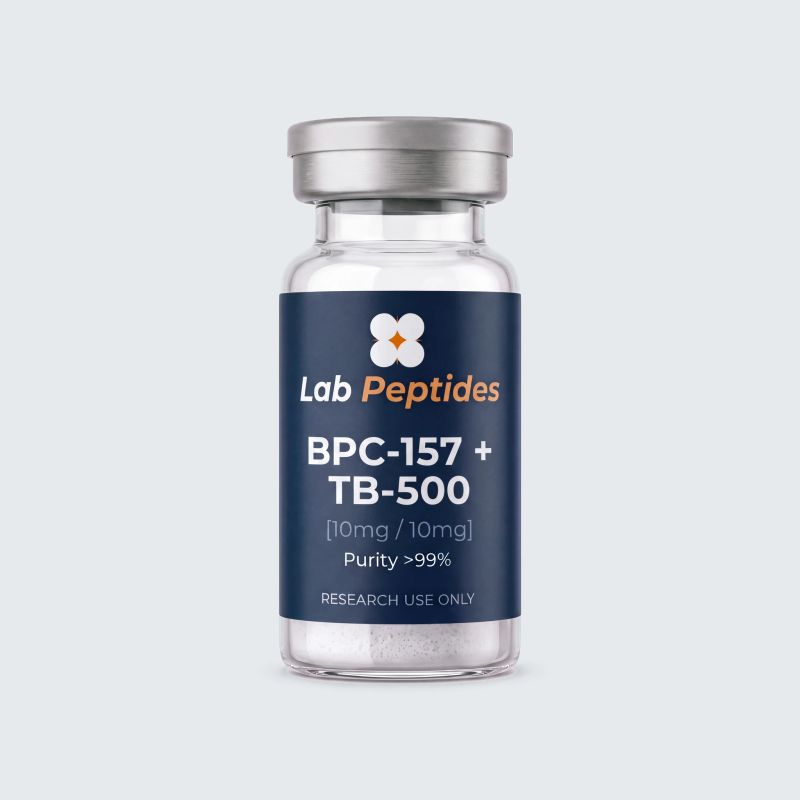
BPC-157 + TB-500 10mg + 10mg Regeneration
2-in-1 recovery combo.
The ultimate recovery combo. BPC-157 (local healing) plus TB-500 (systemic cell migration) in full synergy. Two complementary mechanisms in one formulation. The gold standard of advanced recovery.
Research protocols start at: 5 units, i.e. 250 mcg of each peptide per day (vial prepared with 2 ml of water).
10 mg + 10 mg = what the vial contains, not the dose.See the preparation
- Certificate of analysis
- In stock in France
 Ordered with its water: shipped in a magnetic box
10% off every deliveryPause, skip or cancel in 1 clickNo commitment, no hidden fees
No automatic charge: pay for each delivery by card, in Bitcoin (an extra 5% off), or by bank transfer from €100
This product contains BPC-157 et TB-500. Published work covers angiogenesis, the formation of new blood vessels. No randomised human clinical trial has characterised contraindications.
The theoretical alerts described in preclinical work concern a history of cancer, particularly vascularised solid tumours, pregnancy and breastfeeding, and proliferative retinopathies.
Your complete kit
The vial alone cannot be used as is. Add what you need to prepare it:
Frequently bought together


Research Use Only (RUO) · Prohibited for human or veterinary use.
Key facts
The BPC-157 + TB-500 10mg + 10mg combo delivers in a single vial the two most extensively studied tissue regeneration peptides in musculoskeletal research: 10 mg of BPC-157 (Body Protection Compound-157, a 15-amino-acid pentadecapeptide derived from human gastric juice, isolated by Predrag Sikiric's team at Zagreb from the 1990s) paired with 10 mg of TB-500 (active fragment of thymosin beta-4 described by Allan Goldstein in 1981, 44-residue ubiquitous regeneration peptide). Together these molecules constitute the reference pairing in tendon, ligament, muscle and vascular repair research: two complementary mechanisms of action, one shared angiogenic vector, and dramatically expanded tissue coverage.
In detail
BPC-157 operates locally as an ultra-stable cytoprotectant: it survives gastric milieu, reactivates the VEGF-receptor-2 pathway at the lesion site, modulates the nitric oxide system (NO / eNOS), upregulates growth hormone receptors on tendon fibroblasts (Chang et al. 2011), and orchestrates the FAK-paxillin signaling cascade governing cell migration within tendon tissue. TB-500 operates systemically as a cytoskeleton remodeler: its primary function is G-actin monomer sequestration (active N-terminal Ac-Ser-Asp-Lys-Pro), its cleaved AcSDKP sequence is an autonomous angiogenic factor, it upregulates laminin-5 and matrix metalloproteinases (MMPs), and mobilizes mesenchymal progenitor cells.
The value of the combo lies in mechanistic divergence coupled with vascular convergence: BPC-157 covers local cytoprotection and the gut-tendon axis, TB-500 covers systemic cell migration and stem-cell mobilization, and both converge on the neoangiogenesis required for deep tissue regeneration. This combo is intended exclusively for RUO preclinical research and documented equine veterinary protocols (notably digital flexor tendon regeneration, well characterized in equine sports medicine).
Unique dual-lyophilized vial, two-minute reconstitution, aliquoting supported to extend functional shelf life.
Protocol and preparation
| Water added | Concentration | Reading marker |
|---|---|---|
| 1 ml | 10 mg/ml | 10 UI = 1 mg |
| 2 ml | 5 mg/ml | 40 UI = 2 mg |
The volume of water does not change the product, only its concentration. Introduce the water slowly along the vial wall, never directly onto the lyophilisate, then swirl without shaking. Markers given on a 1 ml syringe graduated in 100 units.
Asepsis
Disinfect surfaces and stoppers (70% alcohol).
Solvent
Draw the required volume of bacteriostatic water.
Introduction
Inject gently against the vial wall (avoid direct jet on powder).
Solubilization
Roll the vial gently. Do not shake vigorously (degradation risk).
Solution storage Once reconstituted: 2-8°C (refrigerator).
Warning Theoretical tool for chemical handling. Does not constitute medical advice.
Open the dilution calculator- The amount of powder looks tiny. A lyophilisate takes up a few millimetres at the bottom of the vial, sometimes just a translucent film. The stated weight is there.
- The powder is compact, stuck to the wall or to the stopper. Transport moves the freeze-dried cake around. It changes nothing to reconstitution.
- The vial carries no individual label. That is our standard packaging, not a downgraded vial.
- After reconstitution, deposits or filaments appear. This is common, especially with small molecules. Let it settle and roll the vial between your palms, never shake it.
- The parcel is plain. Nothing on the outside indicates the contents or the brand name.
What is not normal: a cracked vial, an uncrimped cap or a stopper that moves, powder that has liquefied or changed colour. In those specific cases, write to us with a photo and we take the vial back.
Reconstituting the 10mg + 10mg combo (BPC-157 10mg + TB-500 10mg)
The dual-lyophilized vial contains 20 mg total peptide (10 mg of each). Standard reconstitution:
- Draw 2 ml of bacteriostatic water (benzyl alcohol 0.9% or 1%) into a 3 ml syringe with a 21G needle;
- Disinfect the combo vial septum with an isopropyl wipe, let it dry for 10 seconds;
- Inject the water slowly along the inner wall of the vial (never inject directly onto the lyophilized powder — mechanical impact denaturation risk);
- Withdraw the syringe, roll the vial gently between your palms (never shake vigorously — disulfide bonds and tertiary structure are impact-sensitive);
- Wait 60 to 120 seconds for full dissolution and a clear solution.
- 5 IU = 0.05 ml = 250 mcg BPC-157 + 250 mcg TB-500
- 10 IU = 0.1 ml = 500 mcg BPC-157 + 500 mcg TB-500
- 20 IU = 0.2 ml = 1 mg BPC-157 + 1 mg TB-500
Reference protocols in preclinical research and RUO veterinary use
Two schemes dominate the gray literature and equine veterinary protocols:
- Loading phase — 4 to 6 weeks: 500 mcg BPC-157 + 500 mcg TB-500 per day (10 IU), one subcutaneous injection daily. Injection site adjacent to the lesion for BPC-157 (local cytoprotection rationale), indifferent site for TB-500 (systemic action). Practical option: combined subcutaneous abdominal injection when the lesion is not accessible.
- Maintenance phase — 4 to 8 weeks post-loading: 250 to 500 mcg of each peptide per day (5 to 10 IU); objective is consolidation of matrix remodeling and newly formed vascularization.
Routes of administration
- Subcutaneous (SC) — Standard route, peri-umbilical adipose tissue. Rotate sites every 7 to 10 days to prevent local lipodystrophy.
- Peri-lesional intramuscular (IM) — Documented in equine veterinary practice for tendinopathies (superficial digital flexor tendon); peptide is deposited in immediate proximity to the lesion.
- Topical / intralesional — Rare, reserved for dermatological wound-healing protocols (TB-500).
Cycles and washouts
Typical full cycle duration8 to 14 weeks, followed by a 4 to 8 week washout. Washouts allow reassessment of clinical recovery (veterinary) or histological recovery (preclinical) before any reintroduction. No robust data documents uninterrupted chronic use beyond 6 months.
Technical data
- Reconstitution
- 2 ml d'eau → 5 mg/ml de chaque peptide. 5 UI = 250 mcg de chaque ; 10 UI = 500 mcg de chaque.
- Peptide sequence
- Mélange : BPC-157 (10 mg) + TB-500 (thymosine β4) (10 mg)
- Physical form
- Poudre lyophilisée blanche
- Recommended solubility
- Eau bactériostatique, NaCl 0,9%
- Storage conditions
- Au réfrigérateur (+2 à +8 °C), à l'abri de la lumière. En poudre, possible au congélateur pour une conservation longue. Une fois préparé : réfrigérateur, jamais au congélateur.
- Use
- Research reagent, in vitro only (RUO)
Storage & handling
- Store at -20 C for up to 6 months (preclinical literature documents >90% HPLC recovery post-thaw);
- Thaw one aliquot overnight at 4 C, return to room temperature just before injection;
- Never re-freeze a thawed aliquot. Upon receipt, place immediately in refrigerator. If the package arrives at room temperature after > 72 h transit, contact customer service before use.
Mechanism of action
BPC-157 — Cytoprotective pentadecapeptide (Gly-Glu-Pro-Pro-Pro-Gly-Lys-Pro-Ala-Asp-Asp-Ala-Gly-Leu-Val)
BPC-157 is a 15-amino-acid fragment of a larger 40 kDa protein isolated from human gastric juice. Its exceptional stability (acid-pH resistance, enzymatic resistance outperforming most bioactive peptides) enables partial oral bioavailability and a systemic half-life compatible with once-daily administration. Four mechanisms are established by over 500 peer-reviewed publications from the Zagreb school (Sikiric, Seiwerth, Staresinic, Krivic) and independent laboratories:
- VEGF-R2 axis / local angiogenesis — BPC-157 upregulates VEGF-R2 (KDR) receptor expression on vascular endothelium at the lesion site, triggering early neoangiogenesis required for tendon and ligament repair (Sikiric 2018, successive reviews).
- FAK-paxillin signaling in tendon fibroblasts — Chang et al. (J Appl Physiol 2011) showed BPC-157 accelerates tendon fibroblast migration in vitro via FAK and paxillin phosphorylation, a critical pathway in focal adhesion remodeling.
- NO / eNOS axis modulation — BPC-157 normalizes nitric oxide production, a vascular and mucosal protective effect demonstrated in ischemia-reperfusion and gastroduodenal injury models.
- Growth hormone receptor upregulation — GH-R expression on tendon fibroblasts is increased, potentiating the local anabolic response to circulating IGF-1.
TB-500 — Thymosin beta-4 fragment (44 aa, Ac-SDKPDMAEIEKFDKSKLKKTETQEKNPLPSKETIEQEKQAGES)
Thymosin beta-4 is the most abundant member of the beta-thymosin family in mammalian cell cytoplasm. Its primary function is G-actin sequestration — TB4 binds monomeric actin with nanomolar affinity, regulates the polymerizable actin pool, and indirectly governs cytoskeletal dynamics during cell migration, wound healing and inflammatory response. Five mechanistic axes are documented:
- G-actin sequestration — Primary function, essential for motility of fibroblasts, keratinocytes, endothelial cells and cardiomyocytes.
- Angiogenic AcSDKP generation — Prolyl oligopeptidase cleaves TB4 and releases the tetrapeptide Ac-Ser-Asp-Lys-Pro, an autonomous angiogenic factor layered on top of TB4's direct effect on endothelial migration.
- Laminin-5 and MMP upregulation — TB4 induces expression of matrix metalloproteinases (MMP-2, MMP-9) that remodel extracellular matrix during healing (Malinda 1999 J Invest Dermatol).
- Mesenchymal progenitor cell mobilization — TB4 activates cardiac epicardial progenitors (Smart 2011 Nature) and mobilizes hair follicle cutaneous stem cells.
- Anti-inflammation — NF-kB pathway inhibition and reduced pro-inflammatory mediator production in keratitis and colitis models.
Combo synergy — Vascular convergence, tissue divergence
Complementarity hinges on a single principleBPC-157 initiates local repair, TB-500 amplifies systemic regeneration. On angiogenesis, both peptides converge (VEGF-R2 for BPC-157, AcSDKP for TB-500) and potentiate each other — the shared denominator. On matrix remodeling they diverge: BPC-157 acts specifically on tendon fibroblast signaling, TB-500 acts transversally across all repairing tissues via actin dynamics. On the hormonal axis, BPC-157 potentiates local IGF-1 while TB-500 mobilizes stem cells — two orthogonal anabolic levers.
Studies and references
BPC-157 peer-reviewed corpus — Zagreb school and associated laboratories
The BPC-157 corpus exceeds 500 indexed publications since the 1990s, predominantly from the Pharmacology Laboratory at Zagreb Faculty of Medicine (Predrag Sikiric, Sven Seiwerth, Mario Staresinic, Tomislav Krivic, Rudolf Pevec). Foundational work established gastroduodenal cytoprotection (Sikiric 1993 onward), then extended to intestinal ischemia-reperfusion, tendon, ligament, muscle and cardiac injury models.
- Staresinic et al. (J Orthop Res 2003) — Transverse medial collateral ligament injury in rat; systemically administered BPC-157 accelerated histological repair and biomechanical recovery.
- Krivic et al. (2008) — Achilles tendon rupture in rat; BPC-157 improved tensile failure load and collagen fiber density at 14 days post-injury.
- Pevec et al. (2010) — Crush muscle injury in rat; accelerated muscle regeneration with oral or intraperitoneal BPC-157.
- Chang et al. (J Appl Physiol 2011) — Human tendon fibroblasts in vitro; BPC-157 accelerated migration and upregulated FAK-paxillin signaling.
- Seiwerth et al. (Current Pharm Des 2014) — Review compiling the mechanisms known at that date (VEGF-R2, NO, dopamine, serotonin, GH-R).
- Sikiric et al. (Current Neuropharm 2016, Current Med Chem 2018) — Extended reviews including the gut-brain axis, vascular repair and neuroprotection.
The absence of any large-scale randomized placebo-controlled human trial to date is the major limitation: all evidence is preclinical (rodent) or in vitro. Observational human protocols reported in gray literature reflect uncontrolled RUO or veterinary use.
Thymosin beta-4 / TB-500 corpus
Thymosin beta-4 enjoys an older corpus (Goldstein 1981 PNAS discovery) and human clinical trials in ophthalmology, dermatology and cardiology.
- Goldstein et al. (PNAS 1981) — Initial isolation from bovine thymus, 44-aa sequence determined.
- Malinda et al. (J Invest Dermatol 1999) — Cutaneous wound-healing model in rat; TB4 accelerated wound closure, induced laminin-5 and MMPs, stimulated keratinocyte migration.
- Sosne et al. (Exp Eye Res 2005) — Topical TB4 in keratitis; accelerated corneal re-epithelialization, phase II corneal ulceration trials (RegeneRx).
- Kim et al. (J Mol Cell Cardiol 2003) — Cardiac protection post-ischemia in mouse.
- Smart et al. (Nature 2011) — TB4 activation of cardiac epicardial progenitors post-infarct, myocardial regeneration.
- Crockford et al. (Ann NY Acad Sci 2010) — Phase II clinical trial of TB4 in acute myocardial infarction (RegeneRx).
- Philp and Kleinman (Ann NY Acad Sci 2010) — Review of regenerative applications (cornea, skin, cardiac, cerebral ischemia).
Critical notethe product marketed as "TB-500" in the research peptide supply chain corresponds either to full-length thymosin beta-4 (44 aa) or to an N-terminal fragment concentrated on AcSDKP, depending on supplier. The HPLC certificate of analysis and molecular weight measured by mass spectrometry are the decisive criteria.
Similar peptides
Combo versus BPC-157 alone
BPC-157 alone remains the reference cytoprotective peptide for gastroduodenal protocols, ischemia-reperfusion models and local tendon repair. The combo adds the systemic dimension of thymosin beta-4: progenitor cell mobilization, generalized actin remodeling, AcSDKP angiogenic activity. For deep, multi-tissue tendon or ligament injuries, the combo covers a broader tissue spectrum than BPC-157 in isolation.
Combo versus TB-500 alone
TB-500 alone excels on cutaneous wounds, corneal regeneration and cardiac protection models. The combo adds gastrointestinal cytoprotection, fibroblast-specific FAK-paxillin signaling in tendons, and local IGF-1 / GH-R axis potentiation. On pure tendinopathies, the combo outperforms TB-500 alone in the majority of documented equine veterinary protocols.
Combo versus GHK-Cu
GHK-Cu (copper tripeptide) is oriented toward cutaneous wound healing and cosmetics, with a strong axis on dermal collagen synthesis and anti-glycation. The BPC-157+TB-500 combo is oriented toward deep tendon, ligament and visceral regeneration. The two are complementary and non-redundant: GHK-Cu for dermis and adnexae, BPC-157+TB-500 for deep structures (tendons, ligaments, muscles, gut).
Combo versus conventional pharmacology
NSAIDs (ibuprofen, diclofenac) reduce acute pain and inflammation but delay tissue repair by blocking the constructive inflammatory phase. Infiltrated corticosteroids relieve pain but accelerate long-term tendon degeneration. The BPC-157+TB-500 combo positions itself as a pro-regenerative strategy orthogonal to symptomatic anti-inflammatories, with an opposite mechanistic logic.
Frequently asked questions
What is the reference combo dose in preclinical research?
Are BPC-157 and TB-500 compatible in the same vial?
Should BPC-157 be injected near the lesion and TB-500 distally?
Can the combo be stacked with other peptides (IGF-1, GHK-Cu, CJC/Ipamorelin)?
How long does a full cycle last and what washout should be respected?
What is the difference between TB-500 and full thymosin beta-4?
Is this combo usable in equine veterinary medicine?
What are the known contraindications and warning signs?
 The complete guideTB-500 and Thymosin β-4: comprehensive guide to tissue regeneration researchTB-500 is a synthetic thymosin β-4 fragment widely studied for its effects on angiogenesis, cell migration and wound healing. Comprehensive guide: structure, mechanisms, experimental models, pharmacokinetics and research protocols.Read the guide
Also read:Solid-phase peptide synthesis (SPPS): complete guide to Merrifield, Fmoc, Boc, resins, coupling reagents and quality controlPeptide analytics: high-resolution LC-MS, NMR, HPLC and Edman - Complete research guide