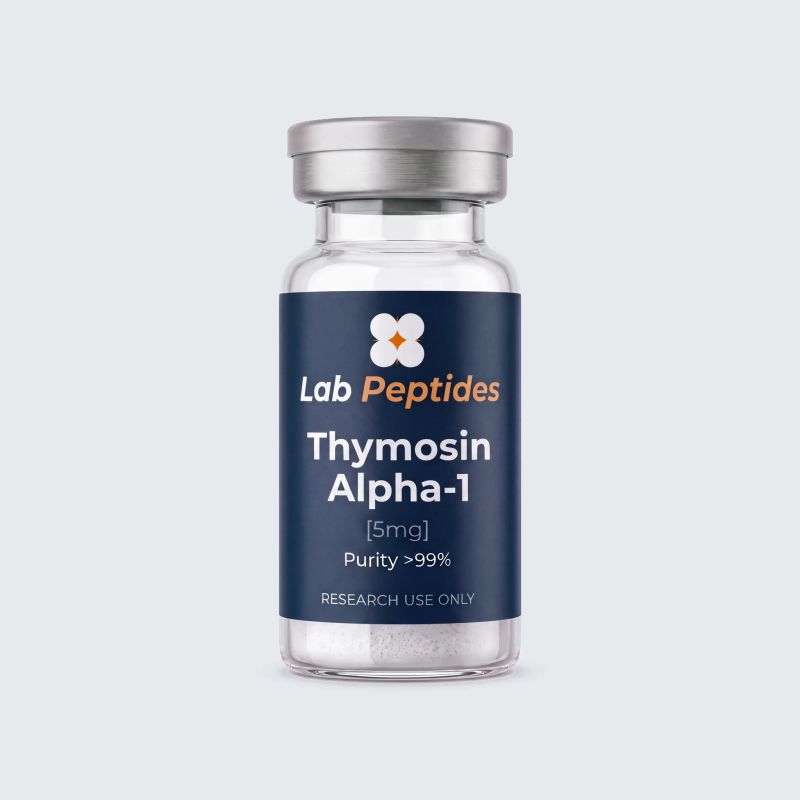
Thymosin Alpha-1 5mg Immunity
Immune shield, 30+ countries.
The immune shield. T-lymphocyte maturation, reinforced innate defenses, complete immunomodulation. Used in 30+ countries as a therapeutic adjuvant. 70+ clinical trials. The must-have for high-risk seasons or immune-stress protocols.
Research protocols start at: 32 units, i.e. 1.6 mg per injection (vial prepared with 1 ml of water).
5 mg = what the vial contains, not the dose.See the preparation
- In stock in France
 Ordered with its water: shipped in a magnetic box
10% off every deliveryPause, skip or cancel in 1 clickNo commitment, no hidden fees
No automatic charge: pay for each delivery by card, in Bitcoin (an extra 5% off), or by bank transfer from €100
Your complete kit
The vial alone cannot be used as is. Add what you need to prepare it:
Frequently bought together


Research Use Only (RUO) · Prohibited for human or veterinary use.
Key facts
Thymosin alpha-1 (Talpha1, Zadaxin in commercial denomination) is a 28-amino-acid peptide N-terminally acetylated (Ac-SDAAVDTSSEITTKDLKEKKEVVEEAEN), molecular weight 3108 Da, isolated by Allan Goldstein in 1977 from fraction 5 of bovine thymus at Albert Einstein College of Medicine. Forty-five years later, it is one of the very few immunomodulatory peptides approved as medication in more than 35 countries (Italy, China, Russia, India, Brazil, Philippines), notably for chronic hepatitis B and C, heavy-chemotherapy cancers, severe immunodeficiencies and certain vaccination protocols in the immunosuppressed.
In detail
Its biological signature is twofoldMaturation and functionalisation of T lymphocytes via TLR2 and TLR9 on dendritic cells, and recalibration of the Th1/Th2/Treg balance in subjects with relative immune deficit. Unlike non-specific immunomodulators (interferons, interleukins), Thymosin alpha-1 does not brutally activate the immune system: it restores a coordinated adaptive response, which explains its remarkably clean tolerance profile over 40 years of pharmacovigilance.
In the research peptide field, Talpha1 occupies an atypical position: long peptide, moderate solid-phase synthesis, robust biological activity, and substantial human clinical corpus (randomised trials in viral hepatitis, observational data on severe COVID-19 in elderly subjects, Costantini 2020). This vial delivers 5 mg of synthetic Thymosin alpha-1, lyophilised. Destined exclusively for in vitro research and preclinical studies on non-human models, in accordance with European regulations; no human, dietary or medical use.
Protocol and preparation
| Water added | Concentration | Reading marker |
|---|---|---|
| 1 ml | 5 mg/ml | 40 UI = 2 mg |
| 2 ml | 2,5 mg/ml | 40 UI = 1 mg |
The volume of water does not change the product, only its concentration. Introduce the water slowly along the vial wall, never directly onto the lyophilisate, then swirl without shaking. Markers given on a 1 ml syringe graduated in 100 units.
Asepsis
Disinfect surfaces and stoppers (70% alcohol).
Solvent
Draw the required volume of bacteriostatic water.
Introduction
Inject gently against the vial wall (avoid direct jet on powder).
Solubilization
Roll the vial gently. Do not shake vigorously (degradation risk).
Solution storage Once reconstituted: 2-8°C (refrigerator).
Warning Theoretical tool for chemical handling. Does not constitute medical advice.
Open the dilution calculator- The amount of powder looks tiny. A lyophilisate takes up a few millimetres at the bottom of the vial, sometimes just a translucent film. The stated weight is there.
- The powder is compact, stuck to the wall or to the stopper. Transport moves the freeze-dried cake around. It changes nothing to reconstitution.
- The vial carries no individual label. That is our standard packaging, not a downgraded vial.
- After reconstitution, deposits or filaments appear. This is common, especially with small molecules. Let it settle and roll the vial between your palms, never shake it.
- The parcel is plain. Nothing on the outside indicates the contents or the brand name.
What is not normal: a cracked vial, an uncrimped cap or a stopper that moves, powder that has liquefied or changed colour. In those specific cases, write to us with a photo and we take the vial back.
Standard reconstitutionSlowly inject 1 ml of bacteriostatic water into the 5 mg vial, creating a 5 mg/ml solution. Gently roll, do not shake (long peptide, shear sensitivity). Clear, colourless solution.
- Standard dose: 1.6 mg = 0.32 ml (32 IU)
- High dose: 3.2 mg = 0.64 ml (oncology or acute COVID protocols)
- Low dose (maintenance/prophylaxis): 0.8 mg = 0.16 ml (16 IU)
- Chronic hepatitis protocol: 1.6 mg SC 2x/week (~3-4 day spacing) for 26-52 weeks
- Cancer/adjuvant chemo protocol: 1.6 mg SC 2x/week during chemotherapy and 4 weeks after
- Severe sepsis/COVID protocol (literature): 1.6 mg SC 2x/day 7 days then 1.6 mg/day
- Longevity/immuno-senescence observational protocol: 1.6 mg SC 2x/week in 3-month cures, 1-3 month pause
Administration routesSubcutaneous exclusively in standard protocol. IV infusion is described in some clinical studies but non-standard. Oral and sublingual have been tried but bioavailability is very low (<5 %) for a long peptide like Talpha1.
- Talpha1 being an immunomodulatory peptide, its association with immunosuppressants (corticosteroids, tacrolimus, cyclosporine) may antagonise their effects. Co-administration data are limited.
- No major documented drug interaction with anti-infectives or chemotherapy (reason for its adjuvant use).
- In acute inflammatory state (cytokine storm), fractionated dose (2x/day) is documented.
- In subjects with active auto-immune reaction, Talpha1 could theoretically worsen the situation by stimulating the T cell response. Empirical data limited.
- Interferon alpha: anti-viral synergy in hepatitis (Ciancio 2004)
- Chemotherapy: reduction of infectious complications (Garaci 2004)
- Vaccination: improvement of seroconversion in immunocompromised (Carraro 2012)
This product is intended exclusively for research and preclinical studies on non-human models.
Technical data
- Reconstitution
- 1 ml d'eau → 5 mg/ml. 32 UI = 1,6 mg. Mêmes repères que le flacon de 10 mg.
- Peptide sequence
- Ac-SDAAVDTSSEITTKDLKEKKEVVEEAEN
- Molecular formula
- C129H215N33O55
- Molecular weight
- 3108.28 g/mol
- CAS number
- 62304-98-7
- Physical form
- Poudre lyophilisée
- Recommended solubility
- Eau bactériostatique, NaCl 0,9%
- Storage conditions
- Au réfrigérateur (+2 à +8 °C), à l'abri de la lumière. En poudre, possible au congélateur pour une conservation longue. Une fois préparé : réfrigérateur, jamais au congélateur.
- Use
- Research reagent, in vitro only (RUO)
Storage & handling
Sealed unreconstituted vialIn the fridge (+2 to +8 °C); for long-term storage (over 3 months), a -20 °C freezer is an option, stability 24 months. At 2-8 C (standard refrigerator), stability 12 months. At room temperature (20-25 C), maximum 30 days stability; beyond, accelerated hydrolytic degradation of peptide bonds.
- 4-8 C (refrigerator): optimal stability 14 days, acceptable up to 21 days.
- -20 C: acceptable for aliquots intended for long-term use (>1 month), but only one freeze-thaw cycle is tolerated without significant activity loss. Plan aliquoting in 200-500 microlitre microtubes to avoid multiple cycles.
- Light: keep protected from light.
- pH: solution stable pH 5.5-7.5. Avoid extreme pH.
- Precipitate or cloudy veil: peptide aggregation, structural degradation.
- Pronounced yellow coloration: probable oxidation.
- Abnormal volume: evaporation or stopper leak.
Recommended aliquotingFor regular use (a 5 mg vial lasts 1.5 weeks at 1.6 mg twice weekly), keep master vial refrigerated; for more spaced use, prepare 0.32 ml (1.6 mg) frozen aliquots.
Laboratory documentationReconstitution date, batch number, storage conditions must be systematically recorded for traceability of experimental results.
Mechanism of action
The mechanism of action of Thymosin alpha-1 has been elucidated in successive layers since its discovery. First level: binding to TLR2 (Toll-Like Receptor 2) and TLR9 on plasmacytoid and myeloid dendritic cells (Romani 2004 Blood, Romani 2006 J Immunol). This binding activates the MyD88 pathway, triggers IL-12 production and favours Th1 polarisation (cellular, anti-viral, anti-tumour response). TLR9 activation synergises with CpG motifs and strengthens antigen presentation by dendritic cells.
Second levelMaturation of T lymphocyte precursors. Talpha1 stimulates thymocyte differentiation into functional CD4+ and CD8+, induces CD28 expression (crucial co-stimulation molecule) and restores IL-2 production in immunosenescence subjects. Knutsen 2014 Ann NY Acad Sci documented in elderly or immunocompromised patients that 4 weeks of Talpha1 significantly increase naive CD4+ T cell counts (compartment collapsed with age and chemotherapy).
Third levelActivation of NK (Natural Killer) cells. Sztein 1988 J Biol Response Mod showed in vitro that Talpha1 increases NK cytotoxicity by 40-60 %, an effect validated in vivo in murine tumour models.
Fourth levelModulation of the Treg response. In chronic inflammatory states (viral hepatitis, cancer), Tregs can excessively brake the anti-pathogen or anti-tumour immune response. Talpha1 partially reduces CD4+CD25+FoxP3+ Treg expansion and restores the effector/regulatory balance (Romani 2006).
Fifth levelEffect on the IL-1/IL-6/TNF-alpha axis in infections. In sepsis and severe viral infections (including COVID-19), hyperactivation of pro-inflammatory cytokines (cytokine storm) coupled with T lymphocyte exhaustion is lethal. Talpha1 reduces pro-inflammatory cytokines while restoring T function, a unique profile that motivated its early use in severe COVID-19 in Italy (Costantini 2020 Int Immunopharmacol).
PharmacokineticsAfter subcutaneous injection of 1.6 mg (Zadaxin standard dose), plasma peak in 1-2 hours, half-life 2 hours, rapid urinary elimination. Biological effect persists well beyond plasma half-life because Talpha1 induces a cellular cascade (T maturation, Th1 polarisation) that sustains for several days.
Studies and references
Thymosin alpha-1 is one of the immunomodulatory peptides with the most robust human clinical base, a corpus that few research peptides can claim. More than 70 clinical trials have been published since 1985.
Chronic hepatitis BSherman 1998 J Hepatol conducted a multicentre randomised trial of 98 HBeAg+ patients, Talpha1 1.6 mg SC 2x/week for 26 weeks: 40 % biochemical (normalised ALT) and virological (HBeAg loss) response vs 12 % placebo. Andreone 2001 J Hepatol and Chien 1998 Hepatology confirmed with meta-analyses (>600 cumulated patients) a sustained response at 12 months post-treatment superior to interferon in certain subgroups.
Chronic hepatitis CTalpha1 alone was moderately effective on HCV, but combination with interferon alpha showed in Rasi 1996 J Interferon Cytokine Res and Ciancio 2004 J Hepatol sustained response rates up to 45 % against 25 % with interferon alone, before the arrival of direct antivirals.
Cancer and chemotherapyGaraci 2004 Ann NY Acad Sci summarised 20 years of studies on non-small cell lung cancer, metastatic melanoma and hepatocellular carcinoma, where adjuvant Talpha1 restored T CD4+/CD8+ compartments collapsed by chemo and reduced opportunistic infections. The Italian study on Talpha1 + dacarbazine + interferon beta melanoma (Talpha1 combination therapy) showed median survival of 30 months versus 9 months with dacarbazine alone.
SepsisWu 2013 Crit Care published a randomised trial of 361 severe sepsis patients, Talpha1 1.6 mg 2x/day 7 days then once/day: 28-day mortality reduction from 35 % (Talpha1) vs 43 % (placebo), improved APACHE II and SOFA scores, T lymphocyte restoration in 7 days.
COVID-19Liu 2020 Cell Death Discov reported an observational series of 76 severe COVID-19 patients treated with Talpha1 in China, significant mortality reduction (11.8 % vs 30 % historical controls) and CD8+ restoration. Costantini 2020 Int Immunopharmacol (Italy) documented similar series in Lombardy at the peak of the first wave. These data are observational and do not replace a randomised trial.
Vaccination in immunocompromisedCarraro 2012 J Gastroenterol Hepatol showed in haemodialysis patients that Talpha1 before hepatitis B vaccination increases seroconversion rate from 55 % to 85 %. Similar effect documented post-bone-marrow transplant.
Longevity/immunosenescenceGoso 1992 and Favalli 1985 showed in aged mice that Talpha1 restores thymic CD4+ populations and post-vaccination antibody production, bringing the aged subject closer to the young. Human longevity trials have not yet been formalised.
ToleranceOver 40 years and millions of doses administered, Talpha1 presents a remarkably clean profile: injection site pain (<5 %), transient fatigue, no hepatic or renal toxicity, no induced auto-immune syndrome reported (unlike interferons). This is one of the strong arguments for its use on fragile ground.
Critical limitationDespite corpus robustness, some trials have modest cohorts, comparator choice (placebo vs active treatment) varies, and regulatory approval concerns specific indications, not global anti-ageing claims.
- 1
- 2ImmunothérapieA Reappraisal of Thymosin Alpha1 in Cancer Therapy
- 3Modulation immunitaireImmune Modulation with Thymosin Alpha 1 Treatment
Similar peptides
Thymosin alpha-1 occupies a unique niche in the peptide immunomodulator landscape. Versus Thymosin beta-4 (Tbeta4, 43 AA): same name family but opposite function. Tbeta4 is a regenerative peptide (healing, cardiac and cutaneous repair, G-actin sequestration) with no direct immune action. Talpha1 is strictly immunomodulatory, not regenerative. Both are complementary in mixed protocols.
Versus interferons (IFN alpha, IFN gamma)Interferons are potent cytokines that induce massive anti-viral response but at the cost of heavy side effects (flu-like syndrome, depression, cytopenias, auto-immune syndromes). Talpha1 has a much superior tolerance profile and acts more upstream (T maturation, TLR2/9) without cytokine flush. This is why IFN + Talpha1 combinations have been studied: Talpha1 sensitises cells to IFN effect while modulating side effects.
Versus TFF peptides (thymulin, thymopentin)Family of smaller thymic peptides, less completely characterised biological activity, very little robust clinical data. Talpha1 is by far the best documented representative of this family.
Versus anti-PD-1/PD-L1 agents (immuno-oncology checkpoint inhibitors): these antibodies unblock exhausted T lymphocyte inhibition in the tumour microenvironment. Talpha1 acts upstream, forming and maturing functional T lymphocytes. Anti-PD-1 + Talpha1 combinations are studied but few published in large randomised trials.
Versus corticosteroids and cyclosporine (immunosuppressants)Diametrically opposite effects. Talpha1 restores immunity, corticosteroids suppress it. Co-prescription must be evaluated case by case; generally avoided except in specific protocols (e.g., transplant patient with severe viral infection).
Versus vaccines and adjuvantsTalpha1 is studied as vaccine adjuvant (increased seroconversion in immunocompromised, Carraro 2012). Its positioning differs from classical adjuvants (aluminium hydroxide, MF59) that act locally at injection site. Talpha1 acts systemically.
Versus BPC-157 and TB-500 (Russian/Croatian regenerative peptides): completely different targets. BPC-157 and TB-500 are tissue regenerative (tendons, mucosa, cardiac). Talpha1 is immunomodulatory. The three can be combined in long experimental protocols but interaction data are essentially anecdotal.
Unique positioningFew peptides simultaneously have (1) a regulatory registration dossier as medication in >35 countries, (2) a corpus of >70 published clinical trials, (3) a remarkable tolerance profile, and (4) a fine immunomodulatory action (restoration versus brutal activation). This quadruple advantage distinguishes Talpha1 from almost all other research-available peptides.
Frequently asked questions
What distinguishes Thymosin alpha-1 from other immunomodulators?
Should Talpha1 be combined with other treatments?
What is the standard research dose?
Is there a risk of induced auto-immunity?
How long before seeing a biological effect?
Is Talpha1 orally active?
Can it be used in longevity/immunosenescence prevention?
Why is the price higher than short peptides?