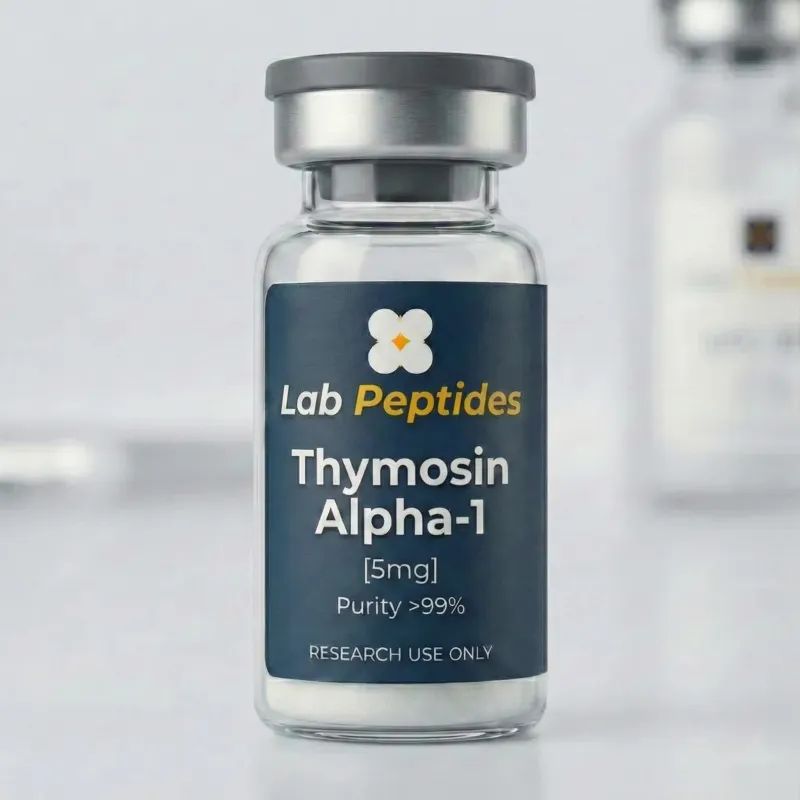
Thymosin Alpha-1 5mg Inmunidad y Salud
Escudo inmunitario, usado en 30+ países.
El escudo inmunitario. Maduración de los linfocitos T, defensas innatas reforzadas, inmunomodulación completa. Usado en 30+ países como adyuvante terapéutico. Más de 70 ensayos clínicos. El imprescindible para las temporadas de riesgo o los protocolos de estrés inmunitario.
- Stock en Francia
-10 % de por vida en cada cicloPause, salte o cancele en 1 clicSin compromiso, sin gastos ocultos
Tu kit completo
- Vial 5mgIncluido
- Agua bacteriostáticaAñadir
- Jeringas de 1 mlAñadir
El vial por sí solo no puede usarse tal cual. Un vial sellado de Thymosin Alpha-1 5mg, liofilizado, sin etiquetado individual.
No olvide lo imprescindible
Se compran juntos a menudo



Información del producto
Thymosin alpha-1 (Talpha1, Zadaxin in commercial denomination) is a 28-amino-acid peptide N-terminally acetylated (Ac-SDAAVDTSSEITTKDLKEKKEVVEEAEN), molecular weight 3108 Da, isolated by Allan Goldstein in 1977 from fraction 5 of bovine thymus at Albert Einstein College of Medicine. Forty-five years later, it is one of the very few immunomodulatory peptides approved as medication in more than 35 countries (Italy, China, Russia, India, Brazil, Philippines), notably for chronic hepatitis B and C, heavy-chemotherapy cancers, severe immunodeficiencies and certain vaccination protocols in the immunosuppressed.
Its biological signature is twofold: maturation and functionalisation of T lymphocytes via TLR2 and TLR9 on dendritic cells, and recalibration of the Th1/Th2/Treg balance in subjects with relative immune deficit. Unlike non-specific immunomodulators (interferons, interleukins), Thymosin alpha-1 does not brutally activate the immune system: it restores a coordinated adaptive response, which explains its remarkably clean tolerance profile over 40 years of pharmacovigilance.
In the research peptide field, Talpha1 occupies an atypical position: long peptide, moderate solid-phase synthesis, robust biological activity, and substantial human clinical corpus (randomised trials in viral hepatitis, observational data on severe COVID-19 in elderly subjects, Costantini 2020). This vial delivers 5 mg of synthetic Thymosin alpha-1, purity above 98 % (HPLC), lyophilisation under argon, type I borosilicate glass, fluorinated butyl stopper. Destined exclusively for in vitro research and preclinical studies on non-human models, in accordance with European regulations; no human, dietary or medical use.
01Mecanismo de acción
The mechanism of action of Thymosin alpha-1 has been elucidated in successive layers since its discovery. First level: binding to TLR2 (Toll-Like Receptor 2) and TLR9 on plasmacytoid and myeloid dendritic cells (Romani 2004 Blood, Romani 2006 J Immunol). This binding activates the MyD88 pathway, triggers IL-12 production and favours Th1 polarisation (cellular, anti-viral, anti-tumour response). TLR9 activation synergises with CpG motifs and strengthens antigen presentation by dendritic cells.
Second level: maturation of T lymphocyte precursors. Talpha1 stimulates thymocyte differentiation into functional CD4+ and CD8+, induces CD28 expression (crucial co-stimulation molecule) and restores IL-2 production in immunosenescence subjects. Knutsen 2014 Ann NY Acad Sci documented in elderly or immunocompromised patients that 4 weeks of Talpha1 significantly increase naive CD4+ T cell counts (compartment collapsed with age and chemotherapy).
Third level: activation of NK (Natural Killer) cells. Sztein 1988 J Biol Response Mod showed in vitro that Talpha1 increases NK cytotoxicity by 40-60 %, an effect validated in vivo in murine tumour models.
Fourth level: modulation of the Treg response. In chronic inflammatory states (viral hepatitis, cancer), Tregs can excessively brake the anti-pathogen or anti-tumour immune response. Talpha1 partially reduces CD4+CD25+FoxP3+ Treg expansion and restores the effector/regulatory balance (Romani 2006).
Fifth level: effect on the IL-1/IL-6/TNF-alpha axis in infections. In sepsis and severe viral infections (including COVID-19), hyperactivation of pro-inflammatory cytokines (cytokine storm) coupled with T lymphocyte exhaustion is lethal. Talpha1 reduces pro-inflammatory cytokines while restoring T function, a unique profile that motivated its early use in severe COVID-19 in Italy (Costantini 2020 Int Immunopharmacol).
Pharmacokinetics: after subcutaneous injection of 1.6 mg (Zadaxin standard dose), plasma peak in 1-2 hours, half-life 2 hours, rapid urinary elimination. Biological effect persists well beyond plasma half-life because Talpha1 induces a cellular cascade (T maturation, Th1 polarisation) that sustains for several days.
Péptidos similares
Thymosin alpha-1 occupies a unique niche in the peptide immunomodulator landscape. Versus Thymosin beta-4 (Tbeta4, 43 AA): same name family but opposite function. Tbeta4 is a regenerative peptide (healing, cardiac and cutaneous repair, G-actin sequestration) with no direct immune action. Talpha1 is strictly immunomodulatory, not regenerative. Both are complementary in mixed protocols.
Versus interferons (IFN alpha, IFN gamma): interferons are potent cytokines that induce massive anti-viral response but at the cost of heavy side effects (flu-like syndrome, depression, cytopenias, auto-immune syndromes). Talpha1 has a much superior tolerance profile and acts more upstream (T maturation, TLR2/9) without cytokine flush. This is why IFN + Talpha1 combinations have been studied: Talpha1 sensitises cells to IFN effect while modulating side effects.
Versus TFF peptides (thymulin, thymopentin): family of smaller thymic peptides, less completely characterised biological activity, very little robust clinical data. Talpha1 is by far the best documented representative of this family.
Versus anti-PD-1/PD-L1 agents (immuno-oncology checkpoint inhibitors): these antibodies unblock exhausted T lymphocyte inhibition in the tumour microenvironment. Talpha1 acts upstream, forming and maturing functional T lymphocytes. Anti-PD-1 + Talpha1 combinations are studied but few published in large randomised trials.
Versus corticosteroids and cyclosporine (immunosuppressants): diametrically opposite effects. Talpha1 restores immunity, corticosteroids suppress it. Co-prescription must be evaluated case by case; generally avoided except in specific protocols (e.g., transplant patient with severe viral infection).
Versus vaccines and adjuvants: Talpha1 is studied as vaccine adjuvant (increased seroconversion in immunocompromised, Carraro 2012). Its positioning differs from classical adjuvants (aluminium hydroxide, MF59) that act locally at injection site. Talpha1 acts systemically.
Versus BPC-157 and TB-500 (Russian/Croatian regenerative peptides): completely different targets. BPC-157 and TB-500 are tissue regenerative (tendons, mucosa, cardiac). Talpha1 is immunomodulatory. The three can be combined in long experimental protocols but interaction data are essentially anecdotal.
Unique positioning: few peptides simultaneously have (1) a regulatory registration dossier as medication in >35 countries, (2) a corpus of >70 published clinical trials, (3) a remarkable tolerance profile, and (4) a fine immunomodulatory action (restoration versus brutal activation). This quadruple advantage distinguishes Talpha1 from almost all other research-available peptides.