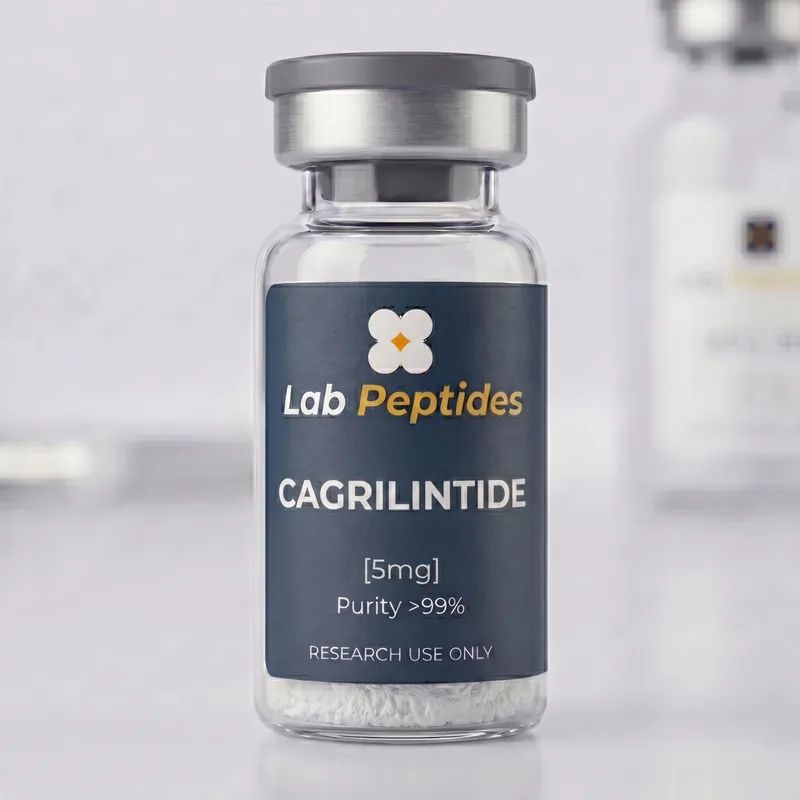
Cagrilintide 5mg Pérdida de Peso
Corta el hambre, larga duración.
El cortahambre de larga duración. Análogo de la amilina con semivida prolongada a 7 días. Cagrilintide ralentiza el vaciado gástrico y activa las vías de saciedad central. Combinado con el Semaglutide (el dúo CagriSema, en fase 3), lleva la pérdida de peso más allá del Semaglutide solo. El complemento estratégico de los protocolos modernos.
- Certificado de análisis del lote
- Stock en Francia
-10 % de por vida en cada cicloPause, salte o cancele en 1 clicSin compromiso, sin gastos ocultos
Tu kit completo
- Vial 5mgIncluido
- Agua bacteriostáticaAñadir
- Jeringas de 1 mlAñadir
El vial por sí solo no puede usarse tal cual. Un vial sellado de Cagrilintide 5mg, liofilizado, sin etiquetado individual.
No olvide lo imprescindible
Se compran juntos a menudo



Información del producto
Cagrilintide 5mg is the pilot format of the long-acting amylin analog that opened the field of CagriSema synergy. The molecule is strictly identical to the 10mg or 20mg versions: only the total lyophilized peptide quantity per vial changes. 5mg fully covers the initiation and early escalation phase modeled on Lau 2021 (0.3mg then 0.6mg then 1.2mg over 6 weeks, 4.2mg consumed) — exactly the critical window to measure tolerance and validate an experimental design. Ideal format to validate individual response before switching to a larger vial. Long-acting synthetic analog of human amylin developed by Novo Nordisk. Our Cagrilintide 5mg batch is solid-phase synthesized, HPLC purity of at least 98%, identity confirmed by mass spectrometry, lyophilized under inert atmosphere. The certificate of analysis is published on this page, viewable before you order. Stock in France, discreet shipping the next day, 3 to 7 business days in the EU. Pragmatic choice for teams wanting to validate amylin pathway engagement before investing in a long protocol.
01Mecanismo de acción
Cagrilintide is a long-acting synthetic analog of human amylin, designed by Novo Nordisk to overcome the pharmacokinetic limitations of pramlintide (short half-life, multi-daily administration). The molecule is modified by acylation with a C18 fatty acid chain on the Lys22 residue, which maximizes serum albumin binding and extends plasma half-life to approximately 7 days in humans, compatible with weekly administration.
At the receptor level, Cagrilintide simultaneously activates the calcitonin receptor (CTR) and the amylin receptor complexes (AMY1, AMY2, AMY3) formed by association of CTR with receptor activity-modifying proteins (RAMPs). This signaling, distinct from that of GLP-1, produces an anorexigenic effect through complementary neuronal pathways: activation of catecholaminergic neurons in the solitary tract (NTS), modulation of satiety circuits in the hypothalamus, and GLP-1-independent slowing of gastric emptying.
In preclinical DIO (Diet-Induced Obesity) models, animals treated with Cagrilintide alone have shown a 11 to 13% weight reduction over 4 weeks, with preservation of lean mass. The most striking effect documented in the literature remains the synergy observed in co-administration with Semaglutide (CagriSema): full addition of anorexigenic effects, weight reduction exceeding 20% in clinical phase 2 at 32 weeks (Frias et al., Lancet 2023). This synergy has opened an entire field of exploration on amylin + GLP-1 combination that neither molecule alone can achieve.
Cagrilintide also modulates bone markers and calcium metabolism via the calcitonin pathway, which is the subject of parallel studies on bone mineral density and post-menopausal fractures. These avenues remain exploratory but broaden the research scope beyond pure energy metabolism.
Cagrilintide is a synthetic analogue of human amylin (hIAPP, Islet Amyloid Polypeptide, 37 aa, 3904 Da), a peptide hormone co-secreted with insulin by pancreatic β-cells whose sequence is closely conserved with calcitonin. Native human amylin shows amyloidogenic propensity (Aβ-like fibril formation in diabetic pancreatic islets) requiring stabilising modifications: cagrilintide incorporates (1) Pro25, Pro28, Pro29 substitutions (inherited from pramlintide) blocking β-sheet propensity and fibrillisation, (2) an Arg18 substitution improving solubility, and (3) a C20 diacid acylation (eicosanedioic acid) on Lys8 via γ-Glu/OEG linker, conferring reversible plasma albumin binding responsible for its exceptional half-life (~180 hours, compatible with weekly administration). Pharmacologically, cagrilintide activates hybrid receptors AMY1R, AMY2R, AMY3R (calcitonin-receptor + RAMP1/2/3 complexes), the amylin/CGRP receptor family, and more weakly the calcitonin receptor CTR. Signalling pathways include adenylate cyclase activation (cAMP), glucagon suppression, slowed gastric emptying, and central action on arcuate hypothalamic nucleus (POMC/CART neurons) for satiety.
Péptidos similares
Against Semaglutide (GLP-1 mono-agonist), Cagrilintide acts through a completely distinct pathway (amylin and calcitonin receptors). In monotherapy, its weight efficacy is slightly inferior (10-11% vs 15% in phase 2 at comparable dose), but its tolerance profile is gentler, its gastrointestinal effects less pronounced, and it modulates complementary neuronal circuits. The main interest of Cagrilintide is not to be better than Semaglutide solo, but to open the possibility of a synergistic combination.
Against Tirzepatide (dual GIP/GLP-1 agonist), Cagrilintide is clearly less powerful in monotherapy (10% vs 22%). The interest lies elsewhere: Cagrilintide engages no incretin receptor, making it an ideal orthogonal tool to dissect the contribution of the amylin pathway independently of the incretin axis. In combination with a GLP-1 or GIP/GLP-1 agonist, Cagrilintide brings an additive effect because it relies on distinct receptors.
Against Retatrutide (triple agonist), same logic: Cagrilintide is less powerful solo (10% vs 24%) but represents a complementary non-redundant pharmacological lever. Preclinical research programs are actively exploring triple-agonist + amylin combinations.
Strategic conclusion: choose Cagrilintide when the experimental design involves exploring the pure amylin pathway, or when the design incorporates co-administration with an incretin agonist to reproduce the CagriSema synergy documented in phase 2. Cagrilintide in monotherapy is a research tool more than a standalone therapeutic candidate.
Cagrilintide stands out among other amylin agonists by its extended half-life. Compared to pramlintide (Symlin, FDA-authorised amylin analogue for T1D/T2D US, 48 min half-life, 3x/day injectable), cagrilintide extends half-life to ~180h thanks to C20 acylation, allowing weekly administration compatible with chronic obesity model studies. Compared to pure GLP-1R agonists (semaglutide, liraglutide), cagrilintide targets a complementary pathway (amylin/CGRP) with distinct satiety and glucagon suppression mechanisms, justifying CagriSema combination development in clinical research. Compared to GLP-1/GIP co-agonists (tirzepatide) or GLP-1/GIP/GCGR (retatrutide), cagrilintide shares no pathway but may theoretically be additive with these co-agonists (study not yet reported). Compared to davalintide (AC2307, amylin/calcitonin chimera), cagrilintide has a more selective amylin-like profile while preserving residual calcitonin receptor activity (involved in central satiety effects).