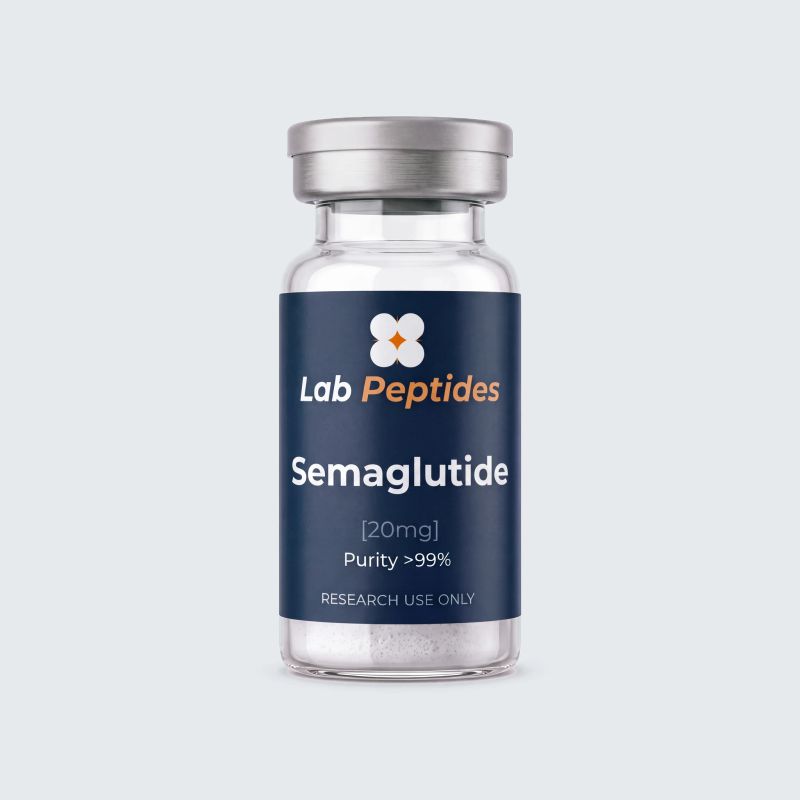
Semaglutide 20mg Metabolism
The most-studied GLP-1.
The GLP-1 that sparked a worldwide revolution. -15 to -20% body weight documented. Triple action: satiety, slower gastric emptying, stable blood sugar. The benchmark of modern weight loss.
Research protocols start at: 0.25 mg per week. On this vial (2 ml of water), that is 2.5 units: between two markings. To start: the 10 mg vial.
20 mg = what the vial contains, not the dose.See the preparation
- In stock in France
 Ordered with its water: shipped in a magnetic box
10% off every deliveryPause, skip or cancel in 1 clickNo commitment, no hidden fees
No automatic charge: pay for each delivery by card, in Bitcoin (an extra 5% off), or by bank transfer from €100
Your complete kit
The vial alone cannot be used as is. Add what you need to prepare it:
Frequently bought together


Research Use Only (RUO) · Prohibited for human or veterinary use.
Key facts
Semaglutide 20mg is the economical long-cycle format of the GLP-1 range. Double dosage of the standard 10mg vial, it optimises mg/euro ratio for researchers conducting extended complete cycles (24-48 weeks) or multiple consecutive cycles without interruption. A single 20mg vial lasts 8.3 to 11.8 weeks at the maintenance level of 1.7 to 2.4 mg per week, or 20 weeks at 1 mg/week (SUSTAIN dose). It's the format of choice for experienced researchers having already validated individual tolerance and optimal scheme.
In detail
Semaglutide remains, in 2025, the founding reference of the modern GLP-1 agonist class. Despite emergence of next-generation molecules (dual GLP-1/GIP tirzepatide, triple GLP-1/GIP/GCGR retatrutide) with superior metabolic amplitudes, semaglutide retains two decisive advantages: a massively superior clinical corpus (30+ phase III trials, 2M+ patient-years of pharmacovigilance) and a perfectly characterised tolerance profile over a decade. For research requiring reproducibility and comparison with existing literature, semaglutide remains unbeatable.
20mg vial use profiles: (1) Integral STEP cycle high doses: complete titration 0.25 -> 2.4 mg/week over 17 weeks + stable phase 8-12 weeks at 2.4 mg, total 30 weeks, cumulative consumption ~44 mg (requires 2 20mg vials). (2) Repeated SUSTAIN cycles at 1 mg/week: 24 weeks consume 24mg, about one 20mg vial + small supplement. (3) Extended maintenance protocols: after attack phase, maintenance at 0.5-1 mg/week for 6-12 months, one 20mg vial covers 20 to 40 weeks depending on dose.
Optimal reconstitution with 2ml bacteriostatic water giving 10 mg/ml: 5U = 0.5 mg, 10U = 1 mg, 24U = 2.4 mg. Caution: this vial is twice as concentrated as the 10mg vial (5 mg/ml), do not reuse its markings. To start at 0.25 mg, use the 5 or 10 mg vial.
Economic advantageThe 20mg vial typically offers a unit price 25-35% lower per mg than the 10mg vial, and 45-55% lower than the 5mg vial. For high-volume research, cost-usage ratio is unbeatable.
Protocol and preparation
| Water added | Concentration | Reading marker |
|---|---|---|
| 2 ml | 10 mg/ml | 10 UI = 1 mg |
| 3 ml | 6,67 mg/ml | 40 UI = 2,67 mg |
The volume of water does not change the product, only its concentration. Introduce the water slowly along the vial wall, never directly onto the lyophilisate, then swirl without shaking. Markers given on a 1 ml syringe graduated in 100 units.
Asepsis
Disinfect surfaces and stoppers (70% alcohol).
Solvent
Draw the required volume of bacteriostatic water.
Introduction
Inject gently against the vial wall (avoid direct jet on powder).
Solubilization
Roll the vial gently. Do not shake vigorously (degradation risk).
Solution storage Once reconstituted: 2-8°C (refrigerator).
Warning Theoretical tool for chemical handling. Does not constitute medical advice.
Open the dilution calculator- The amount of powder looks tiny. A lyophilisate takes up a few millimetres at the bottom of the vial, sometimes just a translucent film. The stated weight is there.
- The powder is compact, stuck to the wall or to the stopper. Transport moves the freeze-dried cake around. It changes nothing to reconstitution.
- The vial carries no individual label. That is our standard packaging, not a downgraded vial.
- After reconstitution, deposits or filaments appear. This is common, especially with small molecules. Let it settle and roll the vial between your palms, never shake it.
- The parcel is plain. Nothing on the outside indicates the contents or the brand name.
What is not normal: a cracked vial, an uncrimped cap or a stopper that moves, powder that has liquefied or changed colour. In those specific cases, write to us with a photo and we take the vial back.
- 1U = 0.01ml = 100 mcg — micro-test, very precise reading required
- 5U = 0.05ml = 500 mcg (0.5 mg)
- 10U = 0.1ml = 1000 mcg (1 mg) — SUSTAIN standard
- 24U = 0.24ml = 2400 mcg (2.4 mg) — Wegovy maximal
- 50U = 0.5ml = 5000 mcg (5 mg) — occasional high dose
- Complete cycle 20mg / 2ml = 200U total aspirable.
- Initial titration at 0.25 mg: use the 5 or 10 mg vial.
- Weeks 1-4: 0.25 mg (5 or 10 mg vial)
- Weeks 5-8: 0.5 mg (5U)
- Weeks 9-12: 1.0 mg (10U)
- Weeks 13-16: 1.7 mg (17U)
- Weeks 17-20: 2.4 mg (24U) — target dose reached
- Weeks 21-40: 2.4 mg (24U) — stable phase
- Cumulative consumption: 0.25×4 + 0.5×4 + 1×4 + 1.7×4 + 2.4×24 = 71.4 mg over 40 weeks — about 70 mg drawn from 20mg vials after the first month: 4 20mg vials (3.5 rounded up).
Repeated SUSTAIN cycle scheme: 24 weeks at 1 mg/week = 24 mg, one 20mg vial + 4 mg supplement (5mg or half a 10mg).
Extended maintenance scheme after initial loss: 0.5 mg/week dose for 6 months = 13 mg, 20mg vial covers 9 months of maintenance without supplement.
Technical 20mg vial opened storage management: with 2ml reconstituted solution, pharmacological shelf-life is 21-28 days at 2-8°C. For long cycles, 2ml reconstitution covers 3-4 weekly injections i.e. about 3 weeks of use. End-of-period residue must be discarded if duration exceeds 28 days, even if remaining volume is substantial.
Economic-fiscal advantage: the 20mg vial is best quality-price ratio on usage range exceeding 10 cycle weeks. Below that, 10mg remains more relevant to avoid wasting expired peptide-solution residue.
Technical data
- Reconstitution
- 2 ml d'eau → 10 mg/ml. 5 UI = 0,5 mg ; 10 UI = 1 mg ; 24 UI = 2,4 mg. Attention : deux fois plus concentré que le flacon de 10 mg (5 mg/ml), ne pas reprendre ses repères. Pour démarrer à 0,25 mg, prendre le flacon de 5 ou 10 mg.
- Peptide sequence
- HXEGTFTSDVSSYLEGQAAKEFIAWLVRGRG (X = Aib ; lysine acylée)
- Molecular formula
- C187H291N45O59
- Molecular weight
- 4113.58 g/mol
- CAS number
- 910463-68-2
- Physical form
- Poudre lyophilisée blanche
- Recommended solubility
- Eau bactériostatique, NaCl 0.9%, acide acétique 0.1%
- Storage conditions
- Au réfrigérateur (+2 à +8 °C), à l'abri de la lumière. En poudre, possible au congélateur pour une conservation longue. Une fois préparé : réfrigérateur, jamais au congélateur.
- Use
- Research reagent, in vitro only (RUO)
Storage & handling
- N-terminal amide bond: sensitive to acid or enzymatic hydrolysis. - Methionine residue Met14: oxidation to methionine sulphoxide under prolonged dissolved oxygen exposure. - Glutamic linker ester bond: possible hydrolysis in acidic solution (pH < 5). - C18 acylated chain: chemically stable but can undergo progressive beta-oxidation over several weeks. Optimal storage conditions:
- Unopened vial: 15-25°C, original cardboard packaging, protected from light, humidity < 60%. - Opened reconstituted vial: strict 2-8°C, vertical position, vial covered or in cardboard box for light protection, do not freeze. Temperatures > 30°C accelerate peptide degradation in solution. Errors to avoid:
- Freeze-thaw: freeze-thaw cycles form ice crystals denaturing peptide tertiary conformation, 20-40% activity loss per cycle. - Direct solar exposure: Met14 methionine and acylated Lys26 are photodegradable, 1-2 hour direct sun exposure can reduce activity by 5-15%. - Vigorous agitation: semaglutide forms reversible oligomers in solution (dimers and trimers via C18), mechanical agitation can favour irreversible insoluble aggregates. - Mixing with other peptides in same vial: unpredictable interactions with pH / ionic strength / other lipophilic residues. One vial = one peptide. Recommended reconstitution with bacteriostatic water 0.9% benzyl alcohol. Typical reconstitution volume depending on nominal dosage (detailed below in Protocols section). Reconstituted peptide presents a clear solution, possibly slightly opalescent after a few hours (reversible C18 micro-oligomer formation), colourless. Any yellow or brown colouration signals oxidation or contamination -> rejection. Alteration visual indicators: solution that remains turbid, appearance of floating particles, formation of deposit at vial bottom, perceptible odour (normally odourless), swollen vial (possible suspect internal pressure). Faced with any of these signs, discard the vial and use a new one.
Mechanism of action
Semaglutide is a complete and selective GLP-1 receptor agonist (Glucagon-Like Peptide-1 Receptor, GLP-1R), resulting from sophisticated molecular engineering carried out by Novo Nordisk on the native scaffold of endogenous human GLP-1. The base peptide is modified at three critical positions to simultaneously resolve the two major limitations of native GLP-1: plasma half-life of 1-2 minutes (rapid degradation by dipeptidyl peptidase-4, DPP-4) and weak albumin affinity compromising duration of action.
- Ala8 to Aib (alpha-aminoisobutyrate) substitution: totally blocks DPP-4 cleavage at the N-terminal site, primary cause of native GLP-1 inactivation.
- Lys34 to Arg34 substitution: removes a potential glycation site and stabilises conformation.
- Lys26 acylation with C18 diacid fatty chain (octadecanedioic acid) via glutamic linker: creates a highly lipophilic covalent anchor that reversibly binds to serum albumin.
This C18 diacid acylation is the heart of semaglutide's pharmacological innovation. Once subcutaneously injected and diffused into the vascular compartment, semaglutide binds mainly to serum albumin (> 99%) through hydrophobic interaction between the C18 chain and the albumin lipid pocket. This reversible binding serves as a plasma reservoir progressively releasing free peptide for action on GLP-1R. Result: plasma half-life of 155-180 hours (about one week), a 10,000-fold increase vs native GLP-1.
- Adenylate cyclase activation via Gs protein -> intracellular cAMP increase.
- PKA and EPAC2 activation -> potentiation of glucose-dependent insulin secretion by pancreatic beta cells (explaining the absence of iatrogenic hypoglycaemia except under concomitant insulin).
- Glucagon secretion inhibition by pancreatic alpha cells under hyperglycaemia (preserved in hypoglycaemia, counter-regulatory mechanism intact).
- Gastric emptying slowing via vagus nerve (central effect on dorsal vagal complex), prolonging satiety and flattening post-prandial glycaemic peaks.
- Central POMC neuron activation in hypothalamus (arcuate nucleus) and AgRP/NPY neuron inhibition -> drastic food intake and appetite reduction.
- Recently identified extra-metabolic effects: inflammatory modulation (CRP, TNF-alpha reduction), direct cardioprotective effects (experimental studies on cardiomyocytes), neuroprotective effects (studies on Alzheimer's and Parkinson's mouse models).
Semaglutide's GLP-1R selectivity distinguishes it from dual agonists (Tirzepatide GLP-1/GIP) or triple agonists (Retatrutide GLP-1/GIP/GCGR). This monospecificity offers a more predictable and better-characterised pharmacological profile (extensive clinical corpus SUSTAIN + STEP + SELECT), but limits metabolic amplitude vs more recent multi-receptor agonists. Semaglutide nevertheless remains the historical reference of the class and the best-documented GLP-1 molecule to date.
Studies and references
Semaglutide's clinical corpus is one of the most extensive of the entire modern peptide class, with more than 30 randomised controlled phase III trials published since 2016 and cumulative pharmacovigilance follow-up exceeding 2 million patient-years.
- SUSTAIN-1 (Sorli et al 2017, Lancet Diabetes Endocrinol): HbA1c reduction -1.45% vs placebo over 30 weeks at 1mg/week dose.
- SUSTAIN-6 (Marso et al 2016, NEJM): major cardiovascular trial on 3297 high CV risk patients, significant reduction in composite CV mortality / non-fatal MI / non-fatal stroke endpoint (-26%, p=0.02), establishing semaglutide's cardiovascular benefit.
- SUSTAIN-7 (Pratley et al 2018, Lancet Diabetes Endocrinol): head-to-head comparison semaglutide 1mg vs dulaglutide 1.5mg, semaglutide superiority on HbA1c (-1.8% vs -1.4%) and weight (-6.5kg vs -3.0kg).
- STEP-1 (Wilding et al 2021, NEJM): flagship trial on 1961 non-diabetic overweight or obese adults, mean weight loss of -14.9% at 68 weeks (vs -2.4% placebo), -15% threshold reached in 50.5% of patients. Marking the greatest pharmacological anti-obesity advance since amphetamine derivatives of the 1970s.
- STEP-4 (Rubino et al 2021, JAMA): treatment cessation effect - mean weight regain of +6.9% over 48 post-cessation weeks, confirming the chronic nature required of treatment.
- STEP-5 (Garvey et al 2022, Nat Med): 2-year weight loss maintenance under continuous treatment, no early plateau, total mean loss -15.2%.
SELECT 2023 (Lincoff et al 2023, NEJM): major cardiovascular trial on 17,604 adults with established cardiovascular disease but without diabetes, randomised semaglutide 2.4mg vs placebo, mean 39.8 month follow-up. -20% reduction in primary composite endpoint (CV mortality, MI, stroke, p<0.001), demonstrating for the first time a GLP-1 cardiovascular benefit in secondary prevention in non-diabetics. Opening the way to a dedicated cardiovascular indication, distinct from the metabolic indication.
- SC bioavailability: 89%
- Tmax: 1-3 days after SC injection
- Distribution volume: 12.5 L
- Plasma protein binding: > 99% (mainly albumin)
- Half-life: 155-180 hours (7-8 days)
- Clearance: 0.05 L/h
- Metabolism: hepatic and renal proteolysis (comparable elimination to native GLP-1 once released from albumin)
- Excretion: 70% urinary, 30% faecal
Tolerance and adverse effects: cumulative SUSTAIN + STEP + SELECT data establish a well-characterised tolerance profile, dominated by digestive effects (nausea 15-44%, vomiting 5-25%, diarrhoea 15-30%, constipation 5-15%), generally transient during titration. Rare but serious effects: acute pancreatitis (< 0.5%), aggravated diabetic retinopathy in poorly controlled patients (SUSTAIN-6 weak signal), theoretical risk of medullary thyroid tumours (rodent signal unconfirmed in humans).
Post-marketing data 2022-2025: emergence of signals on concomitant muscle mass loss (up to 25% of weight loss is lean mass, Heymsfield 2023), persistent gastroparesis post-cessation in a few published cases, and glucagon-mediated peak recovery after abrupt cessation (rebound dumping). These observations reinforce the need for nutritional-muscular support and progressive cessation.
Similar peptides
Semaglutide vs native human GLP-1: native GLP-1 has a half-life of 1-2 minutes, unusable in therapeutic practice. Semaglutide, through its three structural modifications, reaches a half-life of 155-180 hours, a 10,000-fold increase. First synthetic GLP-1s (exenatide 2005, liraglutide 2010) progressed along this gradient without ever approaching semaglutide which remains the current mono-agonist class plateau.
Semaglutide vs Liraglutide (Victoza, Saxenda): liraglutide has a 13-hour half-life requiring daily injection, vs semaglutide once weekly. Comparable weight loss SUSTAIN/STEP (semaglutide -15% vs liraglutide -8% at obesity dose). Liraglutide retains niche utility (sensitive digestive profile patients tolerating lower peaks better). Semaglutide dominates on nearly all clinical criteria: efficacy, convenience (weekly), cardiovascular data, long-term cumulative tolerance.
Semaglutide vs Dulaglutide (Trulicity): direct SUSTAIN-7 comparison (Pratley 2018 Lancet Diabetes Endocrinol) on 1201 patients: semaglutide 1mg superior to dulaglutide 1.5mg on HbA1c (-1.8% vs -1.4%) and weight loss (-6.5kg vs -3.0kg). Same injection frequency (weekly). Dulaglutide retains marginal digestive tolerance advantage. Semaglutide = first choice if main objective is weight + glycaemia.
Semaglutide vs Tirzepatide (Mounjaro, Zepbound): tirzepatide is a GLP-1/GIP dual agonist from the next generation (approved 2022). SURMOUNT-1 trial (Jastreboff 2022 NEJM): mean weight loss at 72 weeks -20.9% at 15mg (vs -14.9% semaglutide STEP-1 at 2.4mg). Direct comparison SURPASS-2 (Frias 2021 NEJM, diabetics) shows tirzepatide 15mg superior to semaglutide 1mg on HbA1c and weight. Tirzepatide is mechanically more powerful thanks to GIP co-activation adding a thermogenic arm. Semaglutide retains the advantage of massive clinical corpus (> 10x longer) and specific SELECT cardiovascular data.
Semaglutide vs Retatrutide: retatrutide is an even more recent GLP-1/GIP/GCGR triple agonist (phase III ongoing late 2024-2025). Published phase II data (Jastreboff 2023 NEJM) suggest -24.2% weight loss at 48 weeks at 12mg - the highest ever observed in a peptide trial. The additional glucagon arm activates thermogenesis and lipid beta-oxidation. Semaglutide will remain relevant for its known profile and lower cost but will probably be surpassed in amplitude by retatrutide.
Semaglutide vs bupropion/naltrexone, orlistat, phentermine: older obesity pharmacological treatments typically reach -3 to -8% weight loss, largely inferior to semaglutide's -15%. Less favourable tolerance profiles (psychiatric bupropion/naltrexone effects, orlistat steatorrhoea, phentermine dependence). GLP-1s have redefined the obesity therapeutic standard starting with STEP-1.
Semaglutide oral (Rybelsus) vs Semaglutide SC (Ozempic, Wegovy): oral version (Rybelsus, approved 2019) available in 3, 7, 14 mg daily with absorption assisted by salcaprozate (SNAC). Oral bioavailability 1%, efficacy inferior to SC (-3 to -5 kg vs -15 kg). Practical interest (needle phobia) but unfavourable cost-efficacy ratio. Weekly SC form remains gold standard for peptide research and real practice.
Frequently asked questions
What is the fundamental difference between semaglutide and natural GLP-1?
Why does semaglutide cause such significant weight loss?
Does semaglutide cause hypoglycaemia?
What's the difference between semaglutide, tirzepatide and retatrutide?
What are the most frequent semaglutide side effects?
How is semaglutide stored?
Should semaglutide be stopped progressively?
Does semaglutide cause muscle mass loss?
 The complete guideSemaglutide in research: complete guide to the GLP-1R mechanism, pharmacokinetics and experimental protocolsReference dossier on semaglutide for research use: molecular structure, GLP-1R mechanism, extended half-life, preclinical models, QC analytics and reconstitution best practices. Mandatory RUO reminder.Read the guide
Also read:Semaglutide: the dedicated page