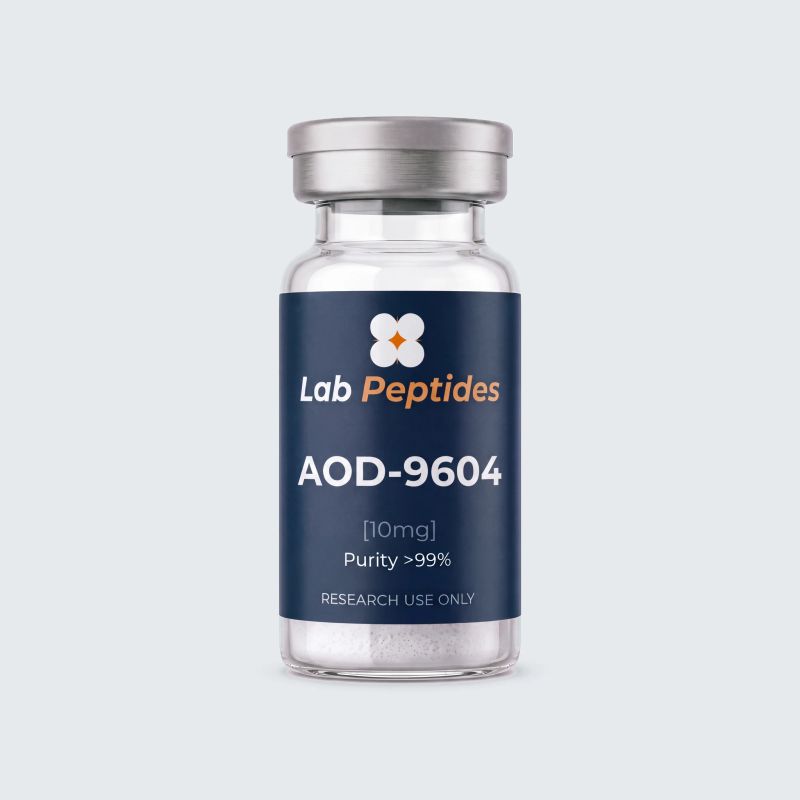
AOD-9604 10mg Metabolism
Burn fat, not muscle.
The lipolytic fragment of growth hormone. AOD-9604 carries sequence 176-191 of human GH, the part that drives lipolysis in laboratory studies, with no IGF-1 and no effect on blood sugar. Tolerance documented in more than 800 volunteers. The reference for lipolysis research protocols.
- Certificate of analysis
- In stock in France
 Ordered with its water: shipped in a magnetic box
10% off every deliveryPause, skip or cancel in 1 clickNo commitment, no hidden fees
No automatic charge: pay for each delivery by card, in Bitcoin (an extra 5% off), or by bank transfer from €100
Your complete kit
The vial alone cannot be used as is. Add what you need to prepare it:
Frequently bought together


Research Use Only (RUO) · Prohibited for human or veterinary use.
Key facts
AOD-9604 (Anti-Obesity Drug 9604) is a synthetic hexadecapeptide of 16 amino acids corresponding to the C-terminal fragment 176-191 of human growth hormone (hGH), with an additional tyrosine added at the N-terminus for improved stability and bioavailability. Its sequence is Tyr-Leu-Arg-Ile-Val-Gln-Cys-Arg-Ser-Val-Glu-Gly-Ser-Cys-Gly-Phe (1817.12 Da), featuring an intrachain disulfide bond Cys7-Cys14.
In detail
Designed in the 1990s by Frank Ng's team at the Howard Florey Institute in Melbourne (Australia), clinically developed by Metabolic Pharmaceuticals through phase IIb in the obesity indication, AOD-9604 represents one of the first successful examples of pharmacological uncoupling between GH's lipolytic effect and its undesirable anabolic / hyperglycemic effects.
The founding principle rests on the hypothesis formulated by Wallis and Heap (1968) and refined by Ng and Borstein (1993): the different biological activities of hGH reside in distinct protein domains. The full 191-residue growth hormone concentrates pure lipolytic activity (storage triglyceride mobilization, fatty acid oxidation) in its C-terminal fragment, while hyperglycemic, anti-insulin and muscle anabolic properties reside in other regions of the molecule. Synthesizing only this lipolytic fragment therefore yields GH's slimming effect without its collateral metabolic and anabolic effects.
Clinical positioningAOD-9604 underwent a complete development program (Metabolic Pharmaceuticals, ASX-listed from 2003 to 2012), with phase II human trials in obesity (N = 300+ patients, 12 weeks) and a US regulatory submission (FDA self-affirmed GRAS status for dietary use, obtained 2014). However, the main program was discontinued after the phase IIb trial without demonstrating clinically significant weight effect (Ng 2008), redirecting the molecule toward secondary applications (osteoarthritis via the chondroprotective pathway suggested by Kwak's later work in 2015).
Use strictly reserved for RUO preclinical research.
Protocol and preparation
| Water added | Concentration | Reading marker |
|---|---|---|
| 1 ml | 10 mg/ml | 10 UI = 1 mg |
| 2 ml | 5 mg/ml | 40 UI = 2 mg |
The volume of water does not change the product, only its concentration. Introduce the water slowly along the vial wall, never directly onto the lyophilisate, then swirl without shaking. Markers given on a 1 ml syringe graduated in 100 units.
Asepsis
Disinfect surfaces and stoppers (70% alcohol).
Solvent
Draw the required volume of bacteriostatic water.
Introduction
Inject gently against the vial wall (avoid direct jet on powder).
Solubilization
Roll the vial gently. Do not shake vigorously (degradation risk).
Solution storage Once reconstituted: 2-8°C (refrigerator).
Warning Theoretical tool for chemical handling. Does not constitute medical advice.
Open the dilution calculator- The amount of powder looks tiny. A lyophilisate takes up a few millimetres at the bottom of the vial, sometimes just a translucent film. The stated weight is there.
- The powder is compact, stuck to the wall or to the stopper. Transport moves the freeze-dried cake around. It changes nothing to reconstitution.
- The vial carries no individual label. That is our standard packaging, not a downgraded vial.
- After reconstitution, deposits or filaments appear. This is common, especially with small molecules. Let it settle and roll the vial between your palms, never shake it.
- The parcel is plain. Nothing on the outside indicates the contents or the brand name.
What is not normal: a cracked vial, an uncrimped cap or a stopper that moves, powder that has liquefied or changed colour. In those specific cases, write to us with a photo and we take the vial back.
Reconstituting the 10mg vial
The lyophilized vial contains 10 mg of pure AOD-9604. Standard reconstitution:
- Draw 2 ml of bacteriostatic water (benzyl alcohol 0.9%) into a 5 ml syringe with 21G needle;
- Disinfect the vial septum with an isopropyl wipe, let it dry for 10 seconds;
- Inject water slowly along the inner wall (never directly onto the powder — impact denaturation risk);
- Gently roll the vial between your palms (never shake vigorously — the Cys7-Cys14 disulfide bond is sensitive);
- Wait 60 to 120 seconds for full dissolution and a clear colorless solution.
- 5 IU = 0.05 ml = 250 mcg AOD-9604
- 10 IU = 0.1 ml = 500 mcg
- 20 IU = 0.2 ml = 1 mg
Reference protocols in preclinical and RUO research
Doses used in gray literature and some extended preclinical research protocols draw on Metabolic Pharmaceuticals phase II doses, adjusted for the subcutaneous route:
- "Single morning fasted dose" scheme — 300 to 500 mcg SC per day (6 to 10 IU on insulin syringe), one morning injection fasted 30 min before breakfast. Most frequently reported protocol.
- "Split morning + pre-exercise" scheme — 250 mcg morning fasted + 250 mcg 30 min before resistance or cardio training. Goal: maximize peri-exercise lipolysis by exploiting synergistic beta-3 activation with endogenous catecholamines.
- "High-dose research" scheme — 1 mg/day SC, maximum dose used in extended preclinical research. Higher doses not validated, no demonstrated benefit.
Timing and administration windows
- Fasted on waking — Optimal window: the adipocyte is metabolically in prolonged nocturnal lipolysis mode, morning catecholamines at physiological peak, absence of post-prandial insulin inhibiting HSL. Injection 30 to 60 min before the first meal.
- Pre-exercise — Second relevant window: 30 min before physical activity to exploit synergy with exercise-induced sympathetic activation.
- Avoid post-prandial administration — Post-prandial insulin inhibits lipolysis and nullifies AOD-9604's lipolytic effect.
Cycle duration and washouts
- Standard cycle: 8 to 12 weeks of daily administration, modeled on the 12-week Metabolic Pharmaceuticals phase II protocols.
- Washout: 4 to 6 weeks between cycles, to prevent any potential beta-3 adrenergic receptor downregulation (theoretical hypothesis, not clinically documented).
- Maximum recommended duration: tolerance data exist up to 12 weeks (phase II). No robust data beyond 6 continuous months.
Route of administration
- Subcutaneous (SC) exclusively — Peri-umbilical adipose tissue, anterior thigh, posterior arm. Rotate sites every 5 to 7 injections. Insulin syringe 29G 12.7 mm, 45-90 degree angle.
- Oral route — Documented low bioavailability (peptide degraded by gastric and intestinal proteases). Metabolic oral phase IIb trials failed. To be avoided in RUO research.
- Topical/transdermal route — Phosphagenics 2014+ cream program, reserved for local osteoarthritis indication. Not relevant for systemic lipolytic indication.
Technical data
- Reconstitution
- 2 ml d'eau → 5 mg/ml. 6 UI = 0,3 mg ; 10 UI = 0,5 mg.
- Peptide sequence
- YLRIVQCRSVEGSCGF
- Molecular formula
- C78H123N23O23S2
- Molecular weight
- 1815.1 g/mol
- CAS number
- 221231-10-3
- Physical form
- Poudre lyophilisée blanche
- Recommended solubility
- Eau bactériostatique, NaCl 0.9%, acide acétique 0.1%
- Storage conditions
- Au réfrigérateur (+2 à +8 °C), à l'abri de la lumière. En poudre, possible au congélateur pour une conservation longue. Une fois préparé : réfrigérateur, jamais au congélateur.
- Use
- Research reagent, in vitro only (RUO)
Storage & handling
- Draw 0.25 ml aliquots (5 injections of 250 mcg = about 1.5 days of standard protocol) into sterile Eppendorf tubes;
- Store at -20 C for up to 90 days (preclinical data, stability > 90% by HPLC post-thaw);
- Thaw an aliquot at +4 C overnight, return to room temperature 15 min before injection;
- Never re-freeze a thawed aliquot. Critical precautions — Disulfide bond AOD-9604 contains an intrachain disulfide bond (Cys7-Cys14) essential to its active conformation. Precautions: - Avoid heat (> 37 C causes rapid bond denaturation);
- Avoid reducing agents (DTT, beta-mercaptoethanol) which would cleave the bond;
- Avoid extreme pH (<4 or >9) which denature tertiary structure;
- Vigorous mechanical agitation can cause insoluble aggregate formation via disulfide bond denaturation; always roll the vial gently. Upon receipt, place immediately in refrigerator. If the package arrives warm after > 72 h transit, contact customer service before use.
Mechanism of action
Functional uncoupling of growth hormone
Full human growth hormone (hGH, 191 aa, 22 kDa) exerts a diversified spectrum of biological activities including:
- Anabolic effects mediated by hepatic IGF-1 synthesis (skeletal growth, muscle protein synthesis);
- Anti-insulin and hyperglycemic effects on adipose tissue and liver (plasma glucose elevation, decreased insulin sensitivity);
- Direct lipolytic effects on adipocytes (hormone-sensitive lipase activation, free fatty acid mobilization);
- Water retention effects (documented peripheral edema);
- Mitogenic effects on various cell lines.
Foundational work by Ng and Borstein (Horm Res 1978; Biochem J 1989; Diabetes 1990) experimentally demonstrated that the hGH 177-191 fragment (15 aa) fully retains lipolytic activity of the whole hormone in isolated adipocyte models.while losing IGF-1-dependent anabolic activities and hyperglycemic effects. Adding an N-terminal tyrosine (tyrosylated 176-191 fragment, i.e. AOD-9604) improves peptide stability and subcutaneous bioavailability without altering the selective lipolytic activity profile.
Documented lipolytic mechanisms
Three mechanistic pathways are established in rodents and on isolated adipocytes:
- Beta-3 adrenergic receptor activation (ADRB3) — AOD-9604 increases beta-3 receptor expression on adipocytes (Heffernan 2001 Endocrinology), sensitizing the adipose cell to endogenous catecholamines and hormone-sensitive lipase (HSL) activation.
- Mitochondrial beta-oxidation stimulation — AOD-9604 increases expression of beta-oxidation enzymes (CPT-1, acyl-CoA oxidase) in liver and adipocytes, directing released fatty acids toward energy combustion rather than re-storage (Heffernan 2001 Biochim Biophys Acta).
- Hepatic lipogenesis inhibition — Via the AMPK / ACC pathway, AOD-9604 decreases hepatic acetyl-CoA carboxylase activity, reducing de novo triglyceride synthesis (demonstrated in obese ob/ob mice, Ng 2000).
Selectivity vs full GH: absence of anabolic and metabolic effects
The critical and scientifically remarkable point of AOD-9604 is the absence of undesirable collateral effects of full GH:
- No plasma IGF-1 elevation — no effect on hepatic GHR/JAK2/STAT5 axis generating IGF-1. Verified by plasma measurement in Metabolic Pharmaceuticals clinical trials (Ng 2008).
- No glycemic elevation — no anti-insulin activity, no fasting glucose or HbA1c rise over 12 weeks.
- No water retention — no peripheral edema reported at tested doses (0.25 to 1 mg/day).
- No carpal tunnel syndrome — classical adverse effect of exogenous GH, absent with AOD-9604.
- No mitogenic cell proliferation — favorable safety profile on murine tumor models.
This pure lipolytic selectivity explains why AOD-9604 obtained self-affirmed GRAS status in the US for dietary use in 2014 — a status inaccessible to recombinant GH.
Secondary chondroprotective activity (later discovery)
Work subsequent to the obesity program's discontinuation revealed anti-inflammatory and chondroprotective activity of AOD-9604 in osteoarthritis models (Kwak 2015 Tissue Eng Regen Med; Kim 2020). The peptide appears to stimulate proteoglycan synthesis by articular chondrocytes and reduce pro-inflammatory cytokine expression (IL-1beta, TNF-alpha) in degenerative cartilage. This pathway has revived pharmaceutical interest in AOD-9604 for a second indication (knee osteoarthritis), with Australian and Korean preclinical trials underway.
Studies and references
Foundational preclinical work — Melbourne and Howard Florey Institute
The AOD-9604 scientific corpus begins in the 1970s with Michael Wallis and Ronald Heap (Biochem J 1968) on proteolytic fractionation of hGH and the demonstration that peptide fragments retain differential biological activities. Frank Ng's team at the Howard Florey Institute (Melbourne, Australia) systematically refined this hypothesis:
- Ng and Borstein (Horm Res 1978) — First identification of the 177-191 fragment as carrier of hGH lipolytic activity, on isolated rat adipocytes.
- Ng et al. (Biochem J 1989) — Chemical synthesis of the fragment and demonstration of pure lipolytic activity (FFA release > 3x control on isolated adipocytes).
- Ng et al. (Diabetes 1990) — Demonstration of the absence of diabetogenic effect of the fragment, contrasting with full GH.
- Heffernan et al. (Endocrinology 2001, 142:11) — Mechanism elucidation via the beta-3 adrenergic receptor in obese ob/ob mice. 80 to 200% ADRB3 upregulation depending on dose.
- Heffernan et al. (Biochim Biophys Acta 2001, 1533:3) — Demonstration of increased mitochondrial beta-oxidation and CPT-1 expression in adipose and hepatic tissue.
Human clinical trials — Metabolic Pharmaceuticals program
Metabolic Pharmaceuticals, an ASX-listed Australian biotech startup, conducted clinical development of AOD-9604 between 2001 and 2008. Key stages:
- Phase I (Ng et al. 2003) — Tolerability and pharmacokinetics in healthy subjects, dose escalation 0.1 to 1 mg SC. Excellent tolerance profile, plasma half-life approximately 30 min, no IGF-1 elevation, no prolactin rise.
- Phase IIa (2005) — 12 weeks, N = 50 obese patients (BMI > 30), doses 0.5 and 1 mg/day SC. Modest reduction of total fat mass by DXA (2-3% vs placebo), confirmed lipolytic signal.
- Phase IIb (Ng et al. 2008) — Randomized placebo-controlled pivotal trial.N = 300 obese patients, 12 weeks, oral doses 1, 5, 10, 15, 30 mg/day. Primary result: absence of statistically significant difference on body weight vs placebo at all tested doses. Modest reduction of abdominal fat mass at the highest dose. Excellent tolerance maintained, no significant toxicity.
- Consequence — Metabolic Pharmaceuticals discontinued the obesity program in 2008. The molecule was licensed in 2014 to Phosphagenics (transdermal cream based on AOD-9604, osteoarthritis indication).
Subsequent work — Osteoarthritis indication
- Kwak et al. (Tissue Eng Regen Med 2015, 12:6) — AOD-9604 stimulates glycosaminoglycan synthesis by human chondrocytes in culture. Reduction of IL-1beta-induced MMP-13 expression.
- Kim et al. (2020 Korean publications) — Murine models of knee osteoarthritis induced by MIA (mono-iodoacetate). Histological reduction of cartilage lesions with local AOD-9604.
- FDA GRAS status (2014) — Self-affirmed GRAS status granted for dietary use in the US, based on phase II tolerance data. AOD-9604 may appear as a dietary supplement ingredient in some US jurisdictions.
Limitations and controversies
The main limitation of the AOD-9604 corpus is the phase IIb trial failure (Ng 2008) to demonstrate a clinically significant weight effect in humans, contrasting with encouraging preclinical results in mice. Discussed explanatory hypotheses: (1) limited oral bioavailability at tested doses, (2) poorly calibrated non-linear dose-response, (3) human pharmacokinetics different from rodent, (4) lipolytic effect present but insufficient to overcome homeostatic compensation of energy expenditure. No human randomized clinical trial in subcutaneous administration at adequate doses has been conducted to date.
Similar peptides
AOD-9604 versus recombinant GH (somatropin)
Full recombinant GH (Saizen, Genotropin, Humatrope) delivers the entire spectrum of hGH biological activities: lipolytic + anabolic + hyperglycemic + mitogenic. Advantages: powerful lipolytic effect, increased lean mass. Major drawbacks: water retention, glucose intolerance, carpal tunnel syndrome, arthralgias, theoretical mitogenic risk, need for frequent SC/IM injections, high cost. AOD-9604 extracts only the lipolytic component by eliminating all collateral effects: smaller effect size but considerably superior tolerance profile. For a research protocol targeting visceral lipolysis without muscle hypertrophy, AOD-9604 is the clean option; for complete GHD substitution, recombinant GH remains indispensable.
AOD-9604 versus Tesamorelin + Ipamorelin
Tesamorelin + Ipamorelin stimulates endogenous physiological pulsatile GH secretion (GHRH + GHRP axis), with IGF-1 amplification.Egrifta-documented visceral lipolytic effect, and secondary anabolic effects (muscle proteosynthesis via IGF-1). AOD-9604 acts downstream of GH via an ADRB3/beta-oxidation mechanism, without activating the GH-IGF-1 axis. Positioning: Tesamorelin + Ipamorelin for a comprehensive anti-somatopause effect (lipolysis + muscle + immune function), AOD-9604 for a strictly lipolytic effect without anabolic activation.
AOD-9604 versus cagrilintide / tirzepatide (GLP-1 co-agonists)
GLP-1 analogues (semaglutide, tirzepatide, cagrilintide) constitute the major pharmacological class for obesity in 2024-2025, with clinically documented weight reductions of 15 to 25% over 68 weeks (STEP, SURMOUNT trials). Their mechanism is indirect: central satiety + gastric emptying slowdown + amplified insulin effect. AOD-9604 acts directly on the adipocyte via ADRB3, a complementary mechanism. In clinical comparison, GLP-1 analogues largely outperform AOD-9604 in weight effect magnitude. AOD-9604's position is that of a targeted adipocyte lipolytic agent relevant in research, not a competing GLP-1-based obesity treatment.
AOD-9604 versus 5-amino-1MQ or other exercise mimetics
5-amino-1MQ (NNMT inhibitor) and SLU-PP-332 (ERR agonist) represent the new generation of exercise mimetics acting on peripheral tissue metabolic signaling. AOD-9604 is older (1990s), more clinically established (completed phase IIb), but with a more restricted mechanism (ADRB3 + beta-oxidation only vs broad metabolic reprogramming for SLU-PP-332). Both approaches are complementary: AOD-9604 for adipocyte FFA mobilization, SLU-PP-332 for muscle oxidative and thermogenic capacity.
AOD-9604 versus cardarine (GW501516) or stenabolic (SR9009)
GW501516 (PPARdelta agonist) and SR9009 (REV-ERB agonist) are non-peptidic metabolic modulators used in gray literature for their effects on endurance and fatty acid oxidation. They share with AOD-9604 a lipolysis / beta-oxidation target but without adipocyte selectivity. Important differences: GW501516 was clinically abandoned due to a rodent carcinogenic signal (hepatocarcinomas at high chronic dose), SR9009 remains exploratory. AOD-9604 benefits from a tolerance profile validated in human phase II over 12 weeks, a substantial advantage in RUO research context.
Frequently asked questions
Why is AOD-9604 described as "GH without the side effects"?
The phase IIb trial failed: does that mean AOD-9604 doesn't work?
Does AOD-9604 raise IGF-1 like recombinant GH or Tesamorelin?
Can AOD-9604 be combined with a GH secretagogue (CJC-1295 + Ipamorelin)?
Can AOD-9604 be taken orally?
Is the chondroprotective effect on osteoarthritis real?
What are the contraindications and precautions?
How long does it take to see an effect on body composition?
 The complete guideAOD-9604: complete guide to the hGH 177-191 fragment in researchAOD-9604, the growth hormone 177-191 fragment from Monash University: fat-burning mechanism without IGF-1, six clinical trials including the 2007 failure, cartilage data, GRAS and FDA status, studied dosages and reconstitution.Read the guide