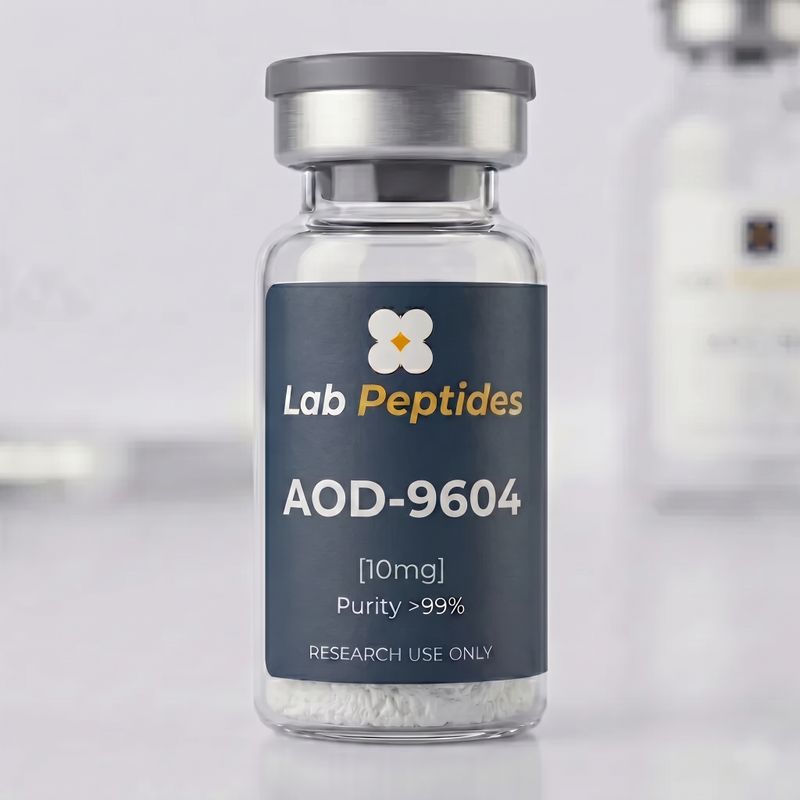
AOD-9604 10mg Pérdida de Peso
El antigrasa quirúrgico. Fragmento 176-191 de la GH humana, AOD-9604 ataca exclusivamente la lipólisis — sin tocar la masa magra, sin IGF-1, sin efecto sobre la glucemia. Queme grasa pura. El bisturí antiadiposo, probado en humanos en varios ensayos clínicos.
- Stock en Francia
-10 % de por vida en cada cicloPause, salte o cancele en 1 clicSin compromiso, sin gastos ocultos
Tu kit completo
- Vial 10mgIncluido
- Agua bacteriostáticaAñadir
- Jeringas de 1 mlAñadir
El vial por sí solo no puede usarse tal cual. Un vial sellado de AOD-9604 10mg, liofilizado, sin etiquetado individual.
No olvide lo imprescindible
Se compran juntos a menudo



Información del producto
AOD-9604 (Anti-Obesity Drug 9604) is a synthetic hexadecapeptide of 16 amino acids corresponding to the C-terminal fragment 176-191 of human growth hormone (hGH), with an additional tyrosine added at the N-terminus for improved stability and bioavailability. Its sequence is Tyr-Leu-Arg-Ile-Val-Gln-Cys-Arg-Ser-Val-Glu-Gly-Ser-Cys-Gly-Phe (1817.12 Da), featuring an intrachain disulfide bond Cys7-Cys14. Designed in the 1990s by Frank Ng's team at the Howard Florey Institute in Melbourne (Australia), clinically developed by Metabolic Pharmaceuticals through phase IIb in the obesity indication, AOD-9604 represents one of the first successful examples of pharmacological uncoupling between GH's lipolytic effect and its undesirable anabolic / hyperglycemic effects.
The founding principle rests on the hypothesis formulated by Wallis and Heap (1968) and refined by Ng and Borstein (1993): the different biological activities of hGH reside in distinct protein domains. The full 191-residue growth hormone concentrates pure lipolytic activity (storage triglyceride mobilization, fatty acid oxidation) in its C-terminal fragment, while hyperglycemic, anti-insulin and muscle anabolic properties reside in other regions of the molecule. Synthesizing only this lipolytic fragment therefore yields GH's slimming effect without its collateral metabolic and anabolic effects.
Clinical positioning: AOD-9604 underwent a complete development program (Metabolic Pharmaceuticals, ASX-listed from 2003 to 2012), with phase II human trials in obesity (N = 300+ patients, 12 weeks) and a US regulatory submission (FDA self-affirmed GRAS status for dietary use, obtained 2014). However, the main program was discontinued after the phase IIb trial without demonstrating clinically significant weight effect (Ng 2008), redirecting the molecule toward secondary applications (osteoarthritis via the chondroprotective pathway suggested by Kwak's later work in 2015).
Use strictly reserved for RUO preclinical research.
01Mecanismo de acción
Functional uncoupling of growth hormone
Full human growth hormone (hGH, 191 aa, 22 kDa) exerts a diversified spectrum of biological activities including:
1. Anabolic effects mediated by hepatic IGF-1 synthesis (skeletal growth, muscle protein synthesis);
2. Anti-insulin and hyperglycemic effects on adipose tissue and liver (plasma glucose elevation, decreased insulin sensitivity);
3. Direct lipolytic effects on adipocytes (hormone-sensitive lipase activation, free fatty acid mobilization);
4. Water retention effects (documented peripheral edema);
5. Mitogenic effects on various cell lines.
Foundational work by Ng and Borstein (Horm Res 1978; Biochem J 1989; Diabetes 1990) experimentally demonstrated that the hGH 177-191 fragment (15 aa) fully retains lipolytic activity of the whole hormone in isolated adipocyte models.while losing IGF-1-dependent anabolic activities and hyperglycemic effects. Adding an N-terminal tyrosine (tyrosylated 176-191 fragment, i.e. AOD-9604) improves peptide stability and subcutaneous bioavailability without altering the selective lipolytic activity profile.
Documented lipolytic mechanisms
Three mechanistic pathways are established in rodents and on isolated adipocytes:
1. Beta-3 adrenergic receptor activation (ADRB3) — AOD-9604 increases beta-3 receptor expression on adipocytes (Heffernan 2001 Endocrinology), sensitizing the adipose cell to endogenous catecholamines and hormone-sensitive lipase (HSL) activation.
2. Mitochondrial beta-oxidation stimulation — AOD-9604 increases expression of beta-oxidation enzymes (CPT-1, acyl-CoA oxidase) in liver and adipocytes, directing released fatty acids toward energy combustion rather than re-storage (Heffernan 2001 Biochim Biophys Acta).
3. Hepatic lipogenesis inhibition — Via the AMPK / ACC pathway, AOD-9604 decreases hepatic acetyl-CoA carboxylase activity, reducing de novo triglyceride synthesis (demonstrated in obese ob/ob mice, Ng 2000).
Selectivity vs full GH: absence of anabolic and metabolic effects
The critical and scientifically remarkable point of AOD-9604 is the absence of undesirable collateral effects of full GH:
- No plasma IGF-1 elevation — no effect on hepatic GHR/JAK2/STAT5 axis generating IGF-1. Verified by plasma measurement in Metabolic Pharmaceuticals clinical trials (Ng 2008).
- No glycemic elevation — no anti-insulin activity, no fasting glucose or HbA1c rise over 12 weeks.
- No water retention — no peripheral edema reported at tested doses (0.25 to 1 mg/day).
- No carpal tunnel syndrome — classical adverse effect of exogenous GH, absent with AOD-9604.
- No mitogenic cell proliferation — favorable safety profile on murine tumor models.
This pure lipolytic selectivity explains why AOD-9604 obtained self-affirmed GRAS status in the US for dietary use in 2014 — a status inaccessible to recombinant GH.
Secondary chondroprotective activity (later discovery)
Work subsequent to the obesity program's discontinuation revealed anti-inflammatory and chondroprotective activity of AOD-9604 in osteoarthritis models (Kwak 2015 Tissue Eng Regen Med; Kim 2020). The peptide appears to stimulate proteoglycan synthesis by articular chondrocytes and reduce pro-inflammatory cytokine expression (IL-1beta, TNF-alpha) in degenerative cartilage. This pathway has revived pharmaceutical interest in AOD-9604 for a second indication (knee osteoarthritis), with Australian and Korean preclinical trials underway.
Péptidos similares
AOD-9604 versus recombinant GH (somatropin)
Full recombinant GH (Saizen, Genotropin, Humatrope) delivers the entire spectrum of hGH biological activities: lipolytic + anabolic + hyperglycemic + mitogenic. Advantages: powerful lipolytic effect, increased lean mass. Major drawbacks: water retention, glucose intolerance, carpal tunnel syndrome, arthralgias, theoretical mitogenic risk, need for frequent SC/IM injections, high cost. AOD-9604 extracts only the lipolytic component by eliminating all collateral effects: smaller effect size but considerably superior tolerance profile. For a research protocol targeting visceral lipolysis without muscle hypertrophy, AOD-9604 is the clean option; for complete GHD substitution, recombinant GH remains indispensable.
AOD-9604 versus Tesamorelin + Ipamorelin
Tesamorelin + Ipamorelin stimulates endogenous physiological pulsatile GH secretion (GHRH + GHRP axis), with IGF-1 amplification.Egrifta-documented visceral lipolytic effect, and secondary anabolic effects (muscle proteosynthesis via IGF-1). AOD-9604 acts downstream of GH via an ADRB3/beta-oxidation mechanism, without activating the GH-IGF-1 axis. Positioning: Tesamorelin + Ipamorelin for a comprehensive anti-somatopause effect (lipolysis + muscle + immune function), AOD-9604 for a strictly lipolytic effect without anabolic activation.
AOD-9604 versus cagrilintide / tirzepatide (GLP-1 co-agonists)
GLP-1 analogues (semaglutide, tirzepatide, cagrilintide) constitute the major pharmacological class for obesity in 2024-2025, with clinically documented weight reductions of 15 to 25% over 68 weeks (STEP, SURMOUNT trials). Their mechanism is indirect: central satiety + gastric emptying slowdown + amplified insulin effect. AOD-9604 acts directly on the adipocyte via ADRB3, a complementary mechanism. In clinical comparison, GLP-1 analogues largely outperform AOD-9604 in weight effect magnitude. AOD-9604's position is that of a targeted adipocyte lipolytic agent relevant in research, not a competing GLP-1-based obesity treatment.
AOD-9604 versus 5-amino-1MQ or other exercise mimetics
5-amino-1MQ (NNMT inhibitor) and SLU-PP-332 (ERR agonist) represent the new generation of exercise mimetics acting on peripheral tissue metabolic signaling. AOD-9604 is older (1990s), more clinically established (completed phase IIb), but with a more restricted mechanism (ADRB3 + beta-oxidation only vs broad metabolic reprogramming for SLU-PP-332). Both approaches are complementary: AOD-9604 for adipocyte FFA mobilization, SLU-PP-332 for muscle oxidative and thermogenic capacity.
AOD-9604 versus cardarine (GW501516) or stenabolic (SR9009)
GW501516 (PPARdelta agonist) and SR9009 (REV-ERB agonist) are non-peptidic metabolic modulators used in gray literature for their effects on endurance and fatty acid oxidation. They share with AOD-9604 a lipolysis / beta-oxidation target but without adipocyte selectivity. Important differences: GW501516 was clinically abandoned due to a rodent carcinogenic signal (hepatocarcinomas at high chronic dose), SR9009 remains exploratory. AOD-9604 benefits from a tolerance profile validated in human phase II over 12 weeks, a substantial advantage in RUO research context.