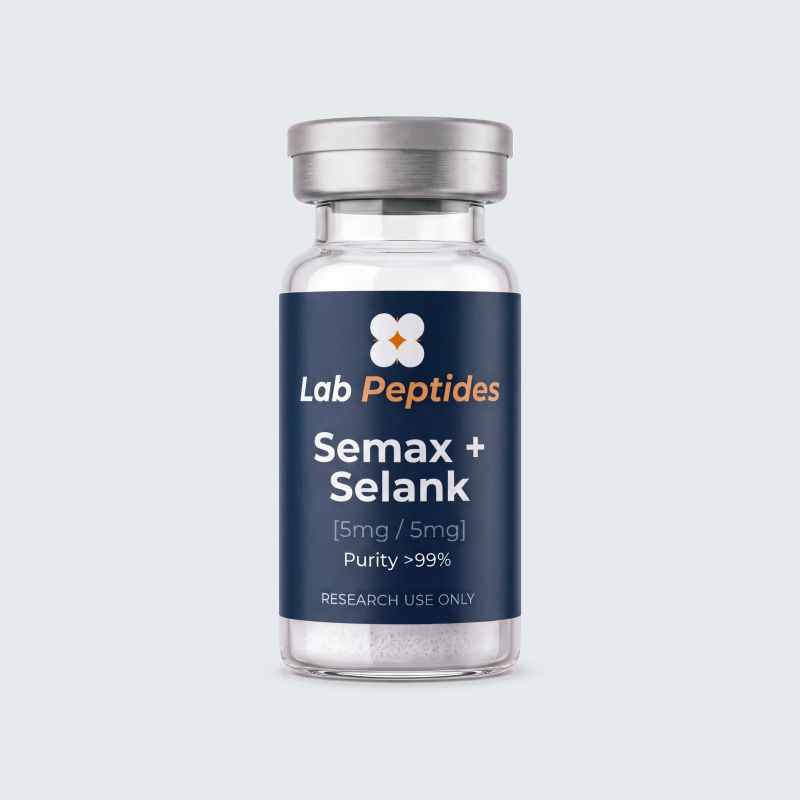
Semax + Selank 10mg Cognition
The ultimate nootropic duo.
The ultimate nootropic duo. Semax (focus + memory) + Selank (anti-stress + concentration) — two Russian best-sellers in full synergy. Maximum cognitive performance plus perfect calm. The signature combo of mental athletes.
- In stock in France
 Ordered with its water: shipped in a magnetic box
10% off every deliveryPause, skip or cancel in 1 clickNo commitment, no hidden fees
No automatic charge: pay for each delivery by card, in Bitcoin (an extra 5% off), or by bank transfer from €100
Your complete kit
The vial alone cannot be used as is. Add what you need to prepare it:
Frequently bought together

Research Use Only (RUO) · Prohibited for human or veterinary use.
Key facts
The Semax+Selank 10mg combo pairs in a single vial the two most emblematic neuroactive heptapeptides of Russian neuropharmacological research: Semax 5mg (MEHFPGP, ACTH 4-10 analog) and Selank 5mg (TKPRPGP, stabilized tuftsin analog). Both developed at the Institute of Molecular Genetics of the Russian Academy of Sciences in Moscow, under the direction of Ashmarin and Myasoedov laboratories during the 1980s, these two molecules share a common structural architecture (heptapeptides stabilized by the C-terminal Pro-Gly-Pro tripeptide), the same baseline pharmacological mechanism (brain enkephalinase inhibition), and officially approved clinical indications in Russia.
In detail
The combo rationale rests on a fundamental observation from thirty years of Russian clinical practice: Semax and Selank cover two complementary dimensions of the cognitive-emotional axis. Semax, derived from adrenocorticotropic hormone, is fundamentally nootropic and neurotrophic: potent BDNF and NGF induction, stimulation of selective attention, working memory consolidation, anti-ischemic neuroprotection documented in stroke trials. Selank, derived from endogenous tuftsin, is fundamentally anxiolytic and emotionally balancing: indirect GABAergic modulation without dependence or sedation, generalized anxiety relief, deep sleep regulation, immune modulation inherited from the parent peptide.
The Atlas Lab vial contains 5mg of each peptide, totaling 10mg of active neuropeptide principles, shipped lyophilized to guarantee maximum stability during transport and storage. Combo formulation optimizes the cost-efficiency ratio for research users wanting to explore the complete cognitive-emotional spectrum without multiplying separate vials.
In exploratory research, this sequential combination occupies a unique niche in the neuropeptide space: a "complete Russian stack" allowing simultaneous exploration of attentional, mnestic, anxiolytic, and emotional dimensions, with remarkable tolerance profile, no documented pharmacological tolerance, and no withdrawal syndrome. Russian clinical practice has established for over twenty years that sequential administration of Semax in the morning and Selank in late day generates an integrated action profile superior to isolated use of each molecule.
Protocol and preparation
| Water added | Concentration | Reading marker |
|---|---|---|
| 1 ml | 10 mg/ml | 10 UI = 1 mg |
| 2 ml | 5 mg/ml | 40 UI = 2 mg |
The volume of water does not change the product, only its concentration. Introduce the water slowly along the vial wall, never directly onto the lyophilisate, then swirl without shaking. Markers given on a 1 ml syringe graduated in 100 units.
Asepsis
Disinfect surfaces and stoppers (70% alcohol).
Solvent
Draw the required volume of bacteriostatic water.
Introduction
Inject gently against the vial wall (avoid direct jet on powder).
Solubilization
Roll the vial gently. Do not shake vigorously (degradation risk).
Solution storage Once reconstituted: 2-8°C (refrigerator).
Warning Theoretical tool for chemical handling. Does not constitute medical advice.
Open the dilution calculator- The amount of powder looks tiny. A lyophilisate takes up a few millimetres at the bottom of the vial, sometimes just a translucent film. The stated weight is there.
- The powder is compact, stuck to the wall or to the stopper. Transport moves the freeze-dried cake around. It changes nothing to reconstitution.
- The vial carries no individual label. That is our standard packaging, not a downgraded vial.
- After reconstitution, deposits or filaments appear. This is common, especially with small molecules. Let it settle and roll the vial between your palms, never shake it.
- The parcel is plain. Nothing on the outside indicates the contents or the brand name.
What is not normal: a cracked vial, an uncrimped cap or a stopper that moves, powder that has liquefied or changed colour. In those specific cases, write to us with a photo and we take the vial back.
The Atlas Lab Semax+Selank 10mg combo vial contains 5mg of each peptide in a single lyophilized vial. Reconstitution uses 1 ml of bacteriostatic water to obtain a final concentration of 5 mg/ml of each peptide, totaling 10 mg/ml of total peptide. This "all-in-one" approach simplifies handling and reduces cost versus purchasing two separate vials, while guaranteeing perfectly coordinated simultaneous or sequential administration.
Sequential subcutaneous protocol (recommended)Administer 0.05 to 0.1 ml in the morning between 7h and 10h (250 to 500 mcg of each peptide) to benefit from the Semax nootropic peak across the morning, then a second similar injection in late afternoon between 17h and 19h to benefit from the Selank anxiolytic peak in transition to sleep. Alternatively, a single morning injection 0.1 to 0.2 ml (500 to 1000 mcg of each peptide) may suffice for short exploration cycles.
Intranasal protocolDilute 2 mg of reconstituted combo (0.4 ml of the 5 mg/ml solution) in a 10 ml intranasal spray bottle with 0.9% NaCl, obtaining a formulation at 0.2 mg/ml of each peptide (0.4 mg/ml total). 3 to 6 sprays (100 mcl each) morning and late day provide 60 to 120 mcg of each peptide per administration, dose equivalent to Russian Semax 0.1% and Selanc 0.15% formulations in sequential use.
Research cyclesMost documented protocols are 10 to 21 consecutive days in active phase, followed by 2-to-4-week pause. Continuous administration beyond 30 days has not been studied in clinical trials and provides no demonstrated additional benefit on neurotrophic and behavioral biomarkers. For longitudinal evaluation, alternating 3 active weeks and 2 pause weeks over a 3-month horizon enables observation of cumulative structural effects while respecting neurotrophic pharmacology.
Essential chronobiologyImperatively respect the morning/evening gap between the two peaks to leverage complementary synergy. Administering both peptides simultaneously in the evening cancels much of the sequential benefit: Semax then needlessly stimulates noradrenergic tone when the organism prepares for sleep onset, and Selank arrives too early to cover the night. The most frequent user mistake is administering everything in the morning to simplify protocol: in that case, prefer purchasing peptides in separate vials.
Essential precautionsDo not associate with classical psychostimulants (amphetamines, modafinil, methylphenidate) nor short-half-life benzodiazepines (Selank may theoretically potentiate sedation). Contraindicated in pregnant or breastfeeding women (no data). Caution in patients with history of vaso-vagal syncope (Selank may slightly increase vagal tone). Always start with a low dose on day one to evaluate individual sensitivity.
Technical data
- Reconstitution
- 1 ml d'eau → 5 mg/ml de chaque peptide. 10 UI = 500 mcg de Semax + 500 mcg de Selank ; 20 UI = 1 mg de chaque.
- Peptide sequence
- Mélange : Semax + Selank
- Physical form
- Poudre lyophilisée blanche
- Recommended solubility
- Eau bactériostatique, NaCl 0,9%
- Storage conditions
- Au réfrigérateur (+2 à +8 °C), à l'abri de la lumière. En poudre, possible au congélateur pour une conservation longue. Une fois préparé : réfrigérateur, jamais au congélateur.
- Use
- Research reagent, in vitro only (RUO)
Storage & handling
The Semax+Selank 10mg combo vial stores between 2 and 8 degrees Celsius in its original packaging, protected from direct light and any moisture source. Under these optimal conditions, a lyophilizate generally remains stable for up to 24 months. The C-terminal Pro-Gly-Pro tripeptide shared by both molecules grants the combo structural robustness superior to most research peptides, but the lyophilized form remains sensitive to atmospheric humidity: carefully reseal after handling and avoid prolonged openings in humid environments. After reconstitution with 1 ml of bacteriostatic water (0.9% benzyl alcohol), the resulting solution at 10 mg/ml total (5 mg/ml of each peptide) stores between 2 and 8 degrees Celsius for 30 to 60 days with stability exceeding 95% for each component. This exceptional duration reflects the intrinsic stability of both heptapeptides, among the most robust in research peptide chemistry. Never freeze the reconstituted vial: freeze-thaw cycles generate partial aggregation and 5-to-10% bioactivity loss per cycle, without distinction between the two peptides. For the intranasal formulation diluted in 0.9% NaCl without preservative, shelf life shortens to 7 to 10 days refrigerated due to bacterial contamination risk. Preferably use sterilized spray bottles and renew the preparation regularly. For longer storage, add 0.01% benzalkonium chloride as preservative, standard practice for Russian magistral formulations. Upon reception, immediately place the vial in refrigeration. Brief exposure to ambient temperature during transport does not significantly alter lyophilized product bioactivity thanks to its inherent structural stability, but prolonging this exposure beyond 96 consecutive hours is inadvisable. Never dilute the combo with non-sterile water, solutions containing highly concentrated divalent metal ions (calcium, magnesium) that may affect peptide conformation, or heavily alkaline (above pH 9) or heavily acidic (below pH 3) buffered solutions. Dilutions in 0.9% NaCl, water for injection, and bacteriostatic water are compatible and recommended.
Mechanism of action
Semax+Selank pharmacological synergy rests on the fine articulation of four converging and diverging mechanisms that explain why the combination generates a more complete profile than the simple sum of the two isolated molecules.
First axis, convergentShared enkephalinase inhibition (EC 3.4.24.11). Both peptides block this brain metallopeptidase that normally degrades endogenous enkephalins. This common mechanism prolongs enkephalin action in synaptic clefts and indirectly potentiates cortical dopaminergic and serotonergic systems. Administered separately, each molecule exerts this modest effect; administered sequentially across the day, they maintain continuous enkephalinase inhibition that stabilizes monoaminergic tone over 24 hours.
Second axis, divergentSemax activates the BDNF/NGF pathway via dose-dependent transcriptional induction documented by Dolotov 2006 (Peptides), with peak at 60-120 minutes post-intranasal administration and persistence up to 12 hours. This neurotrophic pathway favors synaptic plasticity, hippocampal long-term potentiation, and memory consolidation. Selank, conversely, acts predominantly on indirect GABAergic modulation and enkephalinase inhibition with a more emotionally balancing than directly neurotrophic profile. Both pathways combine to create a neurobiological signature covering both structural growth (Semax) and functional regulation (Selank).
Third axis, divergentAutonomic system regulation. Semax slightly potentiates cortical noradrenergic activity, resulting in improved morning vigilance and possible transient blood pressure elevation in sensitive subjects. Selank conversely exerts vagotonic and GABAergic effect with modest decrease in blood pressure and heart rate. Administered in morning/evening sequence, this active/calm alternation respects natural circadian physiology and optimizes both daytime alertness and nighttime deep sleep.
Fourth axis, convergentNeuroinflammation and cytokines. Both peptides share documented brain anti-inflammatory action with reduction of pro-inflammatory cytokines IL-1 beta, TNF-alpha, and IL-6 in experimental models. This common property, inherited from their original neuroimmune dimension (ACTH for Semax, tuftsin for Selank), creates synergy in chronic neuroprotection against subclinical inflammatory aggressions linked to stress, aging, and incipient neurodegenerative pathologies.
The sequential administration pattern recommended in Russian literature exploits these four axes optimally. Semax in the morning initiates the day with neurotrophic and attentional stimulation without cortisol. Selank in late afternoon or early evening prepares the transition to relaxation by soothing residual noradrenergic tone, facilitating sleep onset and allowing Semax-induced BDNF to consolidate memory traces during deep slow-wave sleep. This chronobiological logic explains why Russian clinical practice adopted this sequential scheme as informal standard.
Studies and references
Scientific literature on combined Semax+Selank use is principally derived from Russian publications, with some integrative reviews accessible in English. Individual studies on each peptide are solid (Stroke 2000 for Semax, Front Pharmacol 2016 for Selank), while the combination has been subject of clinical protocols in several Moscow institutes without these results being systematically translated or published in high-impact international journals.
Foundational work comes from Ashmarin and Myasoedov and their successive teams at the Institute of Molecular Genetics, with Russian publications inventorying documented clinical scenarios since the 1990s: Semax in the morning as nootropic and Selank in late day as anxiolytic, in patients with post-chronic-stress asthenodepressive syndromes, sleep disorders secondary to generalized anxiety, and post-stroke cognitive-emotional syndromes. Accumulated clinical observations report perceived synergy superior to isolated use of each molecule, without documented negative interaction or excessive potentiation of adverse effects.
Gusev and Skvortsova (2000, Stroke, 31:1 pages 178-183) remain the Western reference on Semax alone in acute ischemic stroke. Volkova and colleagues (2016, Front Pharmacol) constitute the Western reference on Selank in generalized anxiety. Synthesis of these two clinical databases suggests the combination should exert individual benefits of both peptides without unfavorable pharmacodynamic interaction, the common enkephalinase-inhibition mechanism being moderate and divergent mechanisms (BDNF for Semax, GABAergic for Selank) not generating direct interaction.
Kolomin and colleagues (2012, Front Pharmacol, 3:42) published an English-language integrative review on both peptides and their molecular pathways, demonstrating each modifies expression of over 1,000 distinct brain genes, with significant overlap on synaptic plasticity and anti-inflammation pathways, and marked divergences on growth factor (Semax predominance) and GABAergic signaling (Selank predominance) pathways.
Dolotov and colleagues (2006, Peptides, 27:2 pages 301-307) characterized Semax neurotrophic mechanism, while Medvedev and colleagues (2014, BioMed Res Int) detailed Selank hippocampal BDNF mechanisms and Volkova 2016 confirmed Selank anxiolytic efficacy in double-blind on 62 patients with generalized anxiety disorder. Convergence of these two evidence bases suggests the combination should generate amplification of BDNF signal via double induction, phenomenon not formally proven but biologically plausible.
Zozulia and colleagues (2008, Vopr Pitan) included some subjects in a Semax+Selank combination arm in an open-label study on 60 patients with asthenodepressive syndromes, reporting efficacy superior to the mono-peptide arm on HAM-A and HAM-D scales at 14 days, but this observation remains preliminary and warrants confirmation by randomized placebo-controlled trials. Limitations of this combined literature are real: restricted access to primary Russian publications, absence of Western clinical trials on the specific combination, and variable clinical protocols across institutes. The evidence base remains solid on each individual component, and Russian clinical practice has been documented for over twenty years without unfavorable safety signal.
Similar peptides
Semax+Selank combo positioning versus neuropeptide and nootropic alternatives clarifies through systematic comparison with three major strategies: separate purchase of the two individual peptides, use of a single nootropic, or combination with classical racetams and stimulants.
Versus separate purchase of Semax 5mg and Selank 5mg vials, the 10mg combo offers three objective advantages. First, direct economy: unit price is lower than the sum of both individual peptides, reflecting mutualization of packaging and quality analysis costs. Second, logistical simplicity: a single vial to store, a single reconstitution to manage, a single cold chain to maintain. Third, consistency: both peptides share the same vial, so there is no gap between two vials bought separately. Separate purchase remains preferable if the user wants to use each peptide at very distinct time intervals or with strongly asymmetric dosages.
Versus a single nootropic like Noopept (oral Russian synthetic dipeptide), Racetam (piracetam, aniracetam, oxiracetam), or Modafinil (Western eugeroic), the Semax+Selank combo adds a sophisticated neuropeptide dimension absent from these alternatives. Classical nootropics primarily target cholinergic (racetams) or direct monoaminergic (modafinil via DAT and NET) neurotransmission, without direct action on neuronal growth factors or neuroimmunity. The combo conversely integrates BDNF/NGF transcriptional action (via Semax), sophisticated GABAergic modulation without dependence (via Selank), and mild cerebral anti-inflammation (both). In exchange, classical nootropics offer a faster and more massive perceived effect, making them attractive for acute occasional use rather than a background protocol.
Versus Cerebrolysin (porcine multi-component peptide extract, Ever Pharma, Eastern Europe), the Semax+Selank combo offers superior purity and reproducibility (defined single synthetic sequences vs variable biological mixture), simpler administration route (home intranasal or subcutaneous vs often-daily IM/IV injections), and accessible cost. Cerebrolysin retains advantage in severe post-stroke rehabilitation or advanced dementia indications where its broader spectrum of complete neurotrophic peptides is theoretically better suited to extensive lesions.
Versus the BPC-157 + TB-500 combination (systemic tissue regeneration), the Semax+Selank combo addresses a completely different neurological target and both stacks are complementary rather than competitive. A user in global research could combine both stacks: BPC-157/TB-500 for peripheral tissue regeneration and Semax+Selank for the cognitive-emotional axis, without documented unfavorable interaction.
The verdictThe Semax + Selank combo is the complete Russian stack in a single vial. Semax for cognition, Selank for calm, one reconstitution, and a lower price than the two vials bought separately. HPLC specification of at least 98%.
Frequently asked questions
Why choose the Semax+Selank combo over two separate vials?
How to administer the combo: both peptides simultaneously or sequentially?
What is the final concentration after reconstitution?
Do the two peptides interact negatively or potentiate each other?
Can this combo be used with antidepressant or anxiolytic treatment?
What cycle duration and how many cures per year?
Which peptide is felt first: Semax or Selank?
Is a certificate of analysis published for this combo?
 Read before you orderCognitive peptides in research: Semax, Selank, Dihexa and the new generation of peptide nootropicsScientific overview of cognitive peptides in preclinical research: Semax (ACTH4-10), Selank (tuftsin), Dihexa (angiotensin IV), BDNF/NGF mechanisms and rodent behavioural models. Strict RUO framework, no human use.Read the article