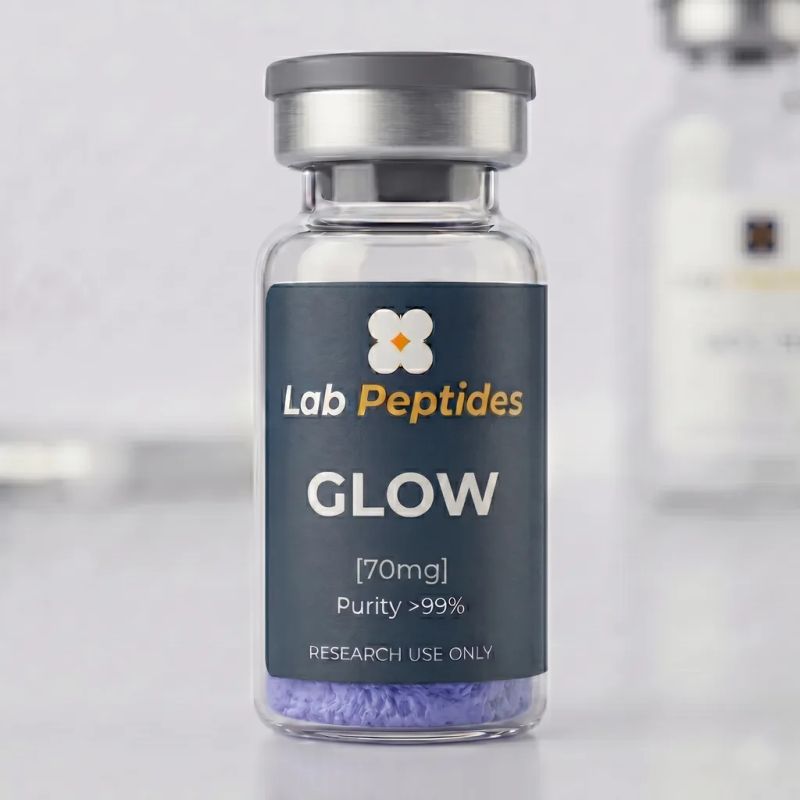
Glow 70mg Skin & Beauty
The reference cosmetic combo. GHK-Cu, BPC-157 and TB-500 in a formulation designed for cutaneous and follicular remodeling research.
Beauty in one all-in-one shot. GHK-Cu + BPC-157 + TB-500 in a single injection. Three synergistic peptides for skin regeneration, hair growth and tissue quality. One product, multiplied results. The ultimate beauty shortcut.
- Batch certificate of analysis
- In stock in France
-10 % for life on each cyclePause, skip or cancel in 1 clickNo commitment, no hidden fees
Your complete kit
- 70mg vialIncluded
- Bacteriostatic waterAdd
- 1 ml syringesAdd
The vial alone cannot be used as is. One sealed vial of Glow 70mg, lyophilised, without individual labelling.
This product contains BPC-157 et TB-500. Published work covers angiogenesis, the formation of new blood vessels. No randomised human clinical trial has characterised contraindications.
The theoretical alerts described in preclinical work concern a history of cancer, particularly vascularised solid tumours, pregnancy and breastfeeding, and proliferative retinopathies.
Don't forget the essentials
Frequently bought together



Product information
GLOW 70 mg is a lyophilized combination formulation bringing together the three peptides most documented in cosmetic and regenerative research applied to skin and hair: GHK-Cu (50 mg), BPC-157 (10 mg), and TB-500 (10 mg). Each component targets a distinct biological lever of cutaneous tissue remodeling, and their combination covers the full cascade observed in preclinical dermal regeneration: extracellular matrix remodeling, local microvascular perfusion, and migration of resolving cell populations.
The logic behind this blend is not cosmetic marketing: it rests on an observation reproduced across more than forty years of peptide literature. Cutaneous renewal of injured, aged, or stressed tissue never mobilizes a single mechanism but an ordered sequence — controlled degradation of the old ECM, vascular recruitment to deliver nutrients and cells, repopulation by competent keratinocytes and fibroblasts, and synthesis of well-organized new collagen and elastin. No isolated peptide covers this complete sequence. GHK-Cu dominates matrix remodeling and transcriptomic modulation; BPC-157 specifically targets angiogenesis via the VEGF-R2/eNOS axis; TB-500 mobilizes migration of fibroblasts, keratinocytes, and endothelial cells toward remodeling zones. These three axes are additive, documented, and non-redundant.
Our 70 mg reference is co-lyophilized in controlled proportion; its certificate of analysis is published on this page. The format targets laboratories and researchers working on exploratory cosmetic research (experimental dermatology protocols, hair studies on follicular cycles, post-inflammatory cicatrization models in rodents), induced cutaneous aging models (UV, glycation, chronic oxidative stress), and tissue kinetics protocols over 4 to 8 weeks. Positioning is strictly Research Use Only (RUO): no therapeutic claim, no medical use, no human diagnostic or preventive use is implied or validated.
01Mechanism of action
The mechanistic basis of GLOW rests on the convergence of three complementary modes of action, each rigorously documented in peptide and dermato-cosmetological literature.
GHK-Cu: cutaneous transcriptome and matrix remodeling (50 mg). The tripeptide Gly-His-Lys (GHK) was isolated in 1973 by Loren Pickart at the University of California San Francisco, initially identified as an albumin-fraction tissue regeneration factor in human plasma. The physiologically active form is the copper-peptide complex GHK-Cu (Gly-His-Lys-Cu2+), in which the cupric ion is chelated by the central histidine residue and the terminal amine/carboxyl functions. This copper coordination is indispensable: it enables selective copper transport to target cells (fibroblasts, keratinocytes) and activates copper-dependent transcriptional programs. The Pickart-Margolina 2015 publication (Biomed Res Int) documented via microarray analysis the modulation of more than 4,192 human genes under GHK-Cu exposure, including upregulation of collagen I and III, elastin, proteoglycans, copper-dependent SOD, and downregulation of senescent and inflammatory markers. This transcriptomic signature simultaneously covers matrix synthesis, antioxidant action, mitochondrial restoration, and immune modulation — making GHK-Cu probably the most versatile peptide in the cosmetic repertoire.
BPC-157: controlled angiogenesis and cytoprotection (10 mg). The pentadecapeptide BPC-157, derived from the human gastric protective protein, was characterized by Predrag Sikirić's team in Zagreb from the 1990s onward with more than 500 accumulated publications. In the cutaneous context, its dominant action is induction of localized angiogenesis via VEGF-R2 activation (Chang 2011, Journal of Applied Physiology) and the eNOS/endothelial NO synthase pathway. This targeted angiogenesis is qualitatively different from that induced by recombinant VEGF: more structured, less leaky, with formation of functional capillary networks rather than chaotic neo-vessels. In a cosmetic blend, BPC-157 ensures the perfusion necessary for nutrient, oxygen, and cell delivery to zones where GHK-Cu initiates matrix remodeling.
TB-500: cell migration and cytoskeletal polymerization (10 mg). TB-500 is the active fragment of thymosin beta-4 (Tβ4), a 44-amino-acid protein discovered by Allan Goldstein in 1981 (PNAS). The central mechanism rests on reversible sequestration of monomeric G-actin, thereby regulating dynamic polymerization of the cytoskeleton (Safer 1991, J Biol Chem). This regulation allows keratinocytes, fibroblasts, and endothelial cells to migrate efficiently toward remodeling zones. Works by Malinda (1999, J Invest Dermatol) and Philp (2003, Ann N Y Acad Sci) have specifically documented the pro-migratory activity of Tβ4 on human keratinocytes and its role in cutaneous reepithelialization. TB-500 also releases the tetrapeptide AcSDKP (acetyl-Ser-Asp-Lys-Pro), a proper angiogenic agent that potentiates the vascular action of BPC-157.
Quantifiable synergy. The combination of the three peptides is not simple additivity: it creates positive feedback loops. GHK-Cu increases GAG and collagen expression, BPC-157 ensures nutrient perfusion of these new matrix deposits, TB-500 brings producer cells to the sites.
Similar peptides
Positioning GLOW against other cosmetic and hair research tools is essential to understand what this blend specifically delivers — and what it does not.
GLOW vs GHK-Cu alone. Isolated GHK-Cu is one of the best-documented cosmetic peptides worldwide (Pickart, 4 decades of work). Its limits are not pharmacological but integrative: the matrix remodeling it induces requires adequate local perfusion and competent cell populations to be phenotypically expressed. GLOW adds exactly these two components (perfusion via BPC-157, cell migration via TB-500). For a study targeted solely on the GHK-Cu transcriptomic component, the isolated peptide remains the reference. For an integrated study of cutaneous remodeling, the blend is more representative of the real biological cascade.
GLOW vs BPC-157 + TB-500 (MSK duo). The BPC-157 + TB-500 duo is widely used in musculoskeletal research (tendons, muscles, ligaments). In cutaneous research, this duo covers angiogenesis and cell migration but leaves a major gap: the specific dermal transcriptomic signal that GHK-Cu provides (collagen I/III, elastin, copper SOD, anti-senescence). GLOW can therefore be seen as the MSK duo augmented with a dedicated dermal brick.
GLOW vs topical cosmeceutical peptides (Argireline, Matrixyl, palmitoyl pentapeptides). Cosmeceutical peptides like Argireline (acetyl hexapeptide-3, SNARE inhibitor), Matrixyl (palmitoyl pentapeptide-4), or industrial palmitoylated pentapeptides are designed for topical action, with sequence modification (palmitoylation) to improve epidermal penetration. Their documented efficacy is modest but real on superficial wrinkles. GLOW positions itself in a totally different register: peptides active via injection, deep dermal action, distinct biological targets. These are not competitors but complementary approaches.
GLOW vs classical mesotherapy (vitamins + hyaluronic acid). Classical mesotherapy delivers nutrients and hyaluronic acid intradermally for hydration, immediate effect on skin quality, but without deep biological remodeling action. GLOW can be integrated into a mesotherapy protocol to add the matrix and cellular remodeling component, while benefiting from the controlled local injection technique.
GLOW vs exosomes / growth factors (PDGF, TGF-β, EGF). Exosomes and growth factor cocktails are the "premium" range of applied regenerative medicine. More global mechanisms, 10-50x higher prices, much stricter stability and cold-chain requirements. GLOW positions itself as a targeted peptide alternative: three precise mechanisms rather than a poorly characterized cocktail, accessible cost, robust lyophilized stability.
GLOW vs KLOW. KLOW (our 80 mg reference) is the high-concentration declination of GLOW, with the addition of a fourth peptide (KPV, a powerful dermal anti-inflammatory). For a study centered on the three historic axes (matrix, perfusion, migration), GLOW suffices. For a study integrating a chronic inflammatory component (experimental eczema, acne model, psoriasis-like rodent), KLOW with its KPV component becomes relevant.
Realistic positioning. GLOW is not a "miracle super-cosmetic". It is an integrative research blend, built for laboratories wanting to test a specific hypothesis: "does the combination of these three documented peptide axes produce an observable cumulative phenotype?". The empirical answer exists in exploratory research practice (yes, cumulative phenotype is observable) but rigorous controlled validation remains to be consolidated. It is a tool, not a magic formula.