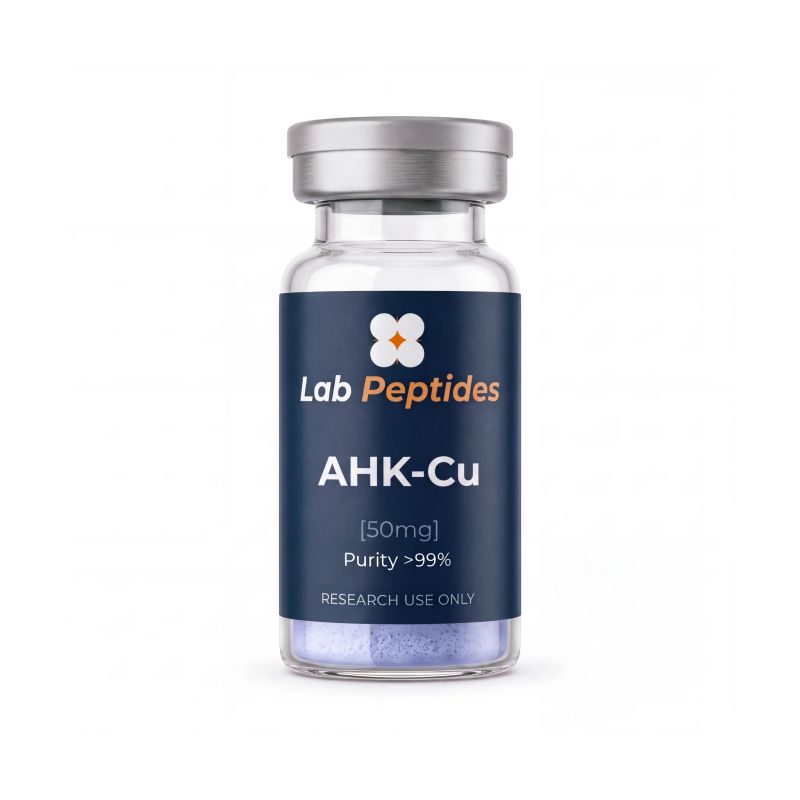
AHK-Cu 50mg Skin Tissues
The copper peptide for hair.
The follicle-side counterpart of GHK-Cu. AHK-Cu is the copper tripeptide Ala-His-Lys, studied in hair research on cultured follicles and dermal papilla cells. Blue lyophilised powder, to be reconstituted. Stocked in France. For research use only.
- In stock in France
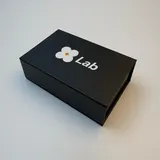 Ordered with its water: shipped in a magnetic box
10% off every deliveryPause, skip or cancel in 1 clickNo commitment, no hidden fees
No automatic charge: pay for each delivery by card, in Bitcoin (an extra 5% off), or by bank transfer from €100
Your complete kit
The vial alone cannot be used as is. Add what you need to prepare it:
Frequently bought together

Research Use Only (RUO) · Prohibited for human or veterinary use.
Key facts
AHK-Cu is the copper complex of the tripeptide alanine-histidine-lysine (Ala-His-Lys). It is a close relative of GHK-Cu: an alanine replaces the glycine in first position. This vial contains 50 mg of it, lyophilised. The powder is blue: that is the colour of copper bound to the peptide.
Where GHK-Cu is mostly studied on skin and the extracellular matrix, AHK-Cu is studied on the hair follicle. For laboratory research use only.
Protocol and preparation
| Water added | Concentration | Reading marker |
|---|---|---|
| 2 ml | 25 mg/ml | 10 UI = 2,5 mg |
| 3 ml | 16,67 mg/ml | 10 UI = 1,67 mg |
The volume of water does not change the product, only its concentration. Introduce the water slowly along the vial wall, never directly onto the lyophilisate, then swirl without shaking. Markers given on a 1 ml syringe graduated in 100 units.
Asepsis
Disinfect surfaces and stoppers (70% alcohol).
Solvent
Draw the required volume of bacteriostatic water.
Introduction
Inject gently against the vial wall (avoid direct jet on powder).
Solubilization
Roll the vial gently. Do not shake vigorously (degradation risk).
Solution storage Once reconstituted: 2-8°C (refrigerator).
Warning Theoretical tool for chemical handling. Does not constitute medical advice.
Open the dilution calculator- The amount of powder looks tiny. A lyophilisate takes up a few millimetres at the bottom of the vial, sometimes just a translucent film. The stated weight is there.
- The powder is compact, stuck to the wall or to the stopper. Transport moves the freeze-dried cake around. It changes nothing to reconstitution.
- The vial carries no individual label. That is our standard packaging, not a downgraded vial.
- After reconstitution, deposits or filaments appear. This is common, especially with small molecules. Let it settle and roll the vial between your palms, never shake it.
- The parcel is plain. Nothing on the outside indicates the contents or the brand name.
What is not normal: a cracked vial, an uncrimped cap or a stopper that moves, powder that has liquefied or changed colour. In those specific cases, write to us with a photo and we take the vial back.
Technical data
- Reconstitution
- 2 ml d'eau bactériostatique → 25 mg/ml.
- Peptide sequence
- Ala-His-Lys (complexe de cuivre)
- Molecular formula
- C15H24ClCuN6O4-
- Molecular weight
- 451.39 g/mol
- CAS number
- 682809-81-0
- Physical form
- Poudre lyophilisée
- Recommended solubility
- Eau bactériostatique, NaCl 0.9%, acide acétique 0.1%
- Storage conditions
- Au réfrigérateur (+2 à +8 °C), à l'abri de la lumière. En poudre, possible au congélateur pour une conservation longue. Une fois préparé : réfrigérateur, jamais au congélateur.
- Use
- Research reagent, in vitro only (RUO)
Storage & handling
Unreconstituted vial. Refrigerated, between +2 and +8 °C, protected from light. A freezer (-20 °C) is suitable for long-term storage.
After reconstitution. Refrigerator only, protected from light, never the freezer.
The 50 mg vial is reconstituted with 2 ml of bacteriostatic water, i.e. 25 mg/ml. The resulting solution is blue and clear.
Mechanism of action
The tripeptide binds a copper(II) ion notably through the terminal amine of the alanine and the imidazole ring of the histidine. The resulting complex is stable in aqueous solution and gives it its blue tint.
In cultured human dermal papilla cells, Pyo et al. (2007) observed with AHK-Cu a rise in the Bcl-2/Bax ratio and a fall in the cleaved forms of caspase-3 and PARP, two markers of programmed cell death. The dermal papilla is the group of cells, at the base of the follicle, that controls the hair cycle.
Studies and references
The reference study is that of Pyo et al. (Archives of Pharmacal Research, 2007): isolated human hair follicles and dermal papilla cells were cultured in the presence of AHK-Cu, and the authors report elongation of the follicles and increased cell proliferation.
These results were obtained in vitro and ex vivo. No clinical trial in humans has been published on AHK-Cu, and no dose is established: this page gives none. For GHK-Cu, see the work of Maquart et al. (FEBS Letters, 1988) on collagen synthesis by cultured fibroblasts.
Frequently asked questions
How does AHK-Cu differ from GHK-Cu?
Why is the powder blue?
Is there a reference dose for AHK-Cu?