How to store lyophilized peptides: a complete research storage guide

Why storage is critical in peptide research
A poorly stored peptide means a flawed experiment. Degradation may leave no visible sign: the vial looks identical, the powder keeps its appearance, but the active peptide has lost 30, 50, or 80 % of its integrity. Dose-response curves become inconsistent, apparent Kds drift batch to batch, and the scientific cost eventually far exceeds the storage savings. Understanding degradation mechanisms and applying suitable protocols is therefore a profitable investment.
Three storage forms and their relative stability
A peptide can exist in three physical states, each with its own stability profile.
The lyophilized form (amorphous powder obtained by sublimation of water under vacuum) is the most stable. Under inert atmosphere and at low temperature, it can retain activity for several years. The absence of water suppresses nearly all hydrolysis, deamidation, and Maillard reactions. It is the reference storage form for any research peptide.
The aqueous solution form (after reconstitution) is much more fragile. Water activates peptide bond hydrolysis, asparagine and glutamine deamidation, and methionine and cysteine oxidation. Chemical half-life in solution at 4 °C is measured in weeks, rarely months. At room temperature, it may drop to a few days for sensitive peptides.
The frozen solution form (aliquots at -20 °C or -80 °C) lies between the two. Freezing slows but does not completely stop chemical reactions, and repeated freeze-thaw cycles generate mechanical stresses that favor protein aggregation. It is a compromise to avoid daily manipulation of the lyophilized stock.
Recommended storage temperatures
Classical temperatures and their typical uses:
- -80 °C (ultra-freezer): reference long-term storage for rare, precious peptides, or those intended for multi-year use. Ideal for solution aliquots.
- -20 °C (laboratory freezer): standard for long-term storage of sealed lyophilized powders and monthly-use aliquots.
- +2 to +8 °C (refrigerator): for peptides in use over days to weeks after reconstitution. Limit to 2-4 weeks depending on peptide stability.
- Room temperature (20-25 °C): only for the time strictly necessary to transfer between two cold storages or to weigh. Never leave a peptide solution at room temperature more than a few hours.
The Arrhenius empirical rule applies: each 10 °C decrease divides degradation rate by two to three. A peptide stable 1 month at +4 °C will therefore be stable about 6 months at -20 °C and several years at -80 °C.
Choosing the right container: glass vs plastic
Vial material has a measurable impact on long-term stability, especially for low-concentration peptides.
Type I borosilicate glass (Schott vials or equivalents, commonly used by peptide suppliers) is the gold standard: chemically inert, hermetic, transparent for visual inspection. It resists temperature variations and freeze-thaw cycles.
Polypropylene (PP) is a good compromise for aliquots. It adsorbs peptides less than other plastics and withstands -80 °C. Prefer laboratory-grade tubes (Eppendorf LoBind Protein, Axygen MaxyClear, Sarstedt) over generic tubes.
Polystyrene (PS) and polycarbonate (PC) should be avoided for low-concentration peptides: significant wall adsorption that can "vanish" a non-negligible fraction of peptide onto tube walls.
For highly hydrophobic or very dilute peptides (< 1 μg/mL), adding a surfactant such as polysorbate 20 (Tween 20) at 0.01-0.05 % or bovine serum albumin (BSA) at 0.1 % significantly reduces wall adsorption.
Protecting against moisture, oxygen, and light
Three invisible enemies accelerate degradation of a poorly stored lyophilized peptide.
Moisture comes first: a hygroscopic lyophilized peptide absorbs ambient humidity as soon as the vial is opened at room temperature. This partial hydration triggers hydrolysis and deamidation even in an apparently "dry" powder. The absolute rule: always let the vial return fully to room temperature before opening (30-60 minutes after removal from the freezer) to avoid condensation on cold walls.
Oxygen oxidizes methionine, cysteine, and tryptophan. Serious suppliers package under nitrogen or argon atmosphere and use butyl-silicone stoppers that limit gas exchange. For long-term storage of an opened vial, consider re-sealing under vacuum or inert gas.
Light, especially UV, photo-oxidizes tryptophan, tyrosine, and cysteine. Amber vials provide adequate protection; otherwise store in darkness (opaque freezer, cardboard, aluminum wrapping).
Managing freeze-thaw cycles
Each freeze-thaw cycle generates local concentration gradients, osmotic shocks, and transient pH changes that promote precipitation, aggregation, and, in some cases, covalent fragmentation. The cumulative effect translates into progressive activity loss, sometimes abrupt after 5 to 10 cycles depending on the peptide.
The standard countermeasure is to prepare aliquots at the very first reconstitution, with a volume adapted to planned use (typically 50, 100, or 200 μL per tube), freeze each aliquot once, then thaw entirely just before use and use in full. Unused aliquots should be discarded, not refrozen.
For thawing, prefer gentle warming on ice (2-3 h at +4 °C) rather than a 37 °C water bath, which exposes to high local temperatures and promotes aggregation. After thawing, a brief vortex (not a prolonged shaker that generates foam) homogenizes the solution.
Warning signs of degradation
Several visual and experimental cues signal advanced degradation:
- Cloudiness or precipitate in solution after reconstitution: aggregation or precipitation. Never use as-is for quantitative tests.
- Color change (yellowing, amber tint): advanced oxidation, especially for tryptophan-containing peptides.
- Unexpected dissolution difficulty: aggregate formation that resists redissolution, requiring heating or sonication.
- Unusual unpleasant odor: microbial decomposition (contamination) or volatile degradation products. Discard.
- Unexplained loss of activity in a reproducible biological assay, with no other protocol change.
- HPLC profile change (appearance of secondary peaks, broadening of main peak) if analytical control is available.
When in doubt about a batch, better to order a new vial than to risk weeks of biased experiments.
Summary table by peptide category
Not all peptides behave the same. A few general benchmarks:
- Stable short peptides (BPC-157, GHK-Cu, TB-500, GHRP-6): lyophilized at -20 °C for 2-3 years. After reconstitution in bacteriostatic water at +4 °C: 4-8 weeks.
- Peptides with methionine or tryptophan (some GHRH variants, melanocortins): enhanced oxidation monitoring. Optional addition of an oxygen scavenger (free methionine in excess, 1-10 mM).
- Acylated GLP-1 analogs (semaglutide, tirzepatide, retatrutide): higher stability thanks to C-18 acylation that masks the N-terminus. Lyophilized at -20 °C: 2-4 years. Reconstituted at +4 °C: typically 4-6 weeks.
- Disulfide-bridge peptides (somatostatin, oxytocin, insulin): watch for S-S scrambling. Avoid pH > 8 and trace reducing agents.
- Cyclic peptides (cyclosporine, melanotan II): generally more stable than their linear counterparts.
Laboratory good practices to adopt systematically
To sustain stock quality:
- Label every vial and aliquot with name, batch, first-opening date, reconstitution date, concentration, solvent, initials.
- Keep a stock logbook (paper or electronic) with movement history, freeze-thaw cycles, estimated expiration dates.
- Respect the cold chain during transport (insulated coolers with dry ice or eutectic gel packs depending on duration).
- Periodically verify freezer temperature (connected temperature logger, high alarm).
- Never reconstitute more than needed: keep most of the product as lyophilized and reconstitute only the immediately useful aliquot.
- Briefly centrifuge (10-30 s at 2000 g) each vial before opening to collect powder at the bottom and avoid losing product when removing the stopper.
- Use new syringes and needles for each handling, and filter pipette tips to avoid cross-batch contamination.
Conclusion
Research peptide storage is not optional but a prerequisite for scientific reproducibility. Rules are simple: lyophilized at -20 °C or -80 °C for long term, reconstitution just before use in bacteriostatic water, single-use aliquots, protection from moisture, oxygen, and light, and regular visual and analytical monitoring. A rigorous protocol preserves both financial investment and the reliability of experimental results. On a months-to-years scale, the difference between well-run and neglected storage measures the success or failure of an entire research program.
Cold chain during transport: ensuring quality between supplier and laboratory
The quality of a delivered peptide depends as much on production as on transport. A perfect batch leaving the laboratory can arrive degraded if the cold chain was broken for 24 or 48 hours in a summer warehouse. Three transport configurations are common: protected ambient, refrigerated, and frozen on dry ice.
Ambient transport is acceptable for a stable lyophilized peptide (BPC-157, TB-500, GHK-Cu, most modern GLP-1 analogs) over short durations (2-5 days), provided that insulated packaging with preconditioned eutectic gel and a heat exposure indicator are used. It is the most economical and most common mode for research peptides.
Refrigerated transport (+2 to +8 °C) is required for more fragile or already reconstituted peptides. It needs calibrated quantities of eutectic gels (2-4 packs per 1-2 vials depending on duration) and temperature monitoring with a passive recorder (thermochromic stickers) or active data logger. Oversized thick-EPS insulated packaging limits excursions during 48-72 hours of international transit.
Frozen transport (-78 °C, dry ice) is reserved for very fragile batches, unmodified native peptides, or cellular preparations. Dry ice sublimates at -78 °C and requires ventilated packaging to avoid overpressure. It is costly and regulatorily constrained (DOT hazardous material transport in the United States, IATA equivalent for air freight).
Upon receipt, three systematic reflexes: check the visual state of vials (stopper integrity, visible unfused powder), record the unboxing temperature if a logger is present, and immediately place in the freezer for long-term storage or in the refrigerator for short-term use.
Realistic storage durations: what stability studies tell us
Supplier-listed durations vary from 12 months to 5 years. What are they really worth? Real stability studies (ICH Q1A, forced degradation, real-condition stability) published in the pharmaceutical and regulatory literature provide some robust orders of magnitude.
For a lyophilized peptide sealed under inert atmosphere, stored at -20 °C in borosilicate glass vials: typical stability of 3 to 5 years with activity loss below 5 %. At +4 °C, stability drops to 1-2 years for most peptides, with variations depending on composition. At +25 °C (climate-controlled room), stability reduces to 3-6 months for the most stable peptides and 1-2 months for sensitive ones.
For a peptide reconstituted in bacteriostatic water at +4 °C, studies suggest 4 to 8 weeks of chemical and microbiological stability under clean laboratory conditions, with 5-15 % activity decrease over this period depending on the peptide. Beyond that, without analytical revalidation (HPLC), it is reasonable to consider the batch as uncertain.
These durations do not replace periodic requalification: for a reference peptide used as a quantitative standard, semiannual or annual HPLC control remains the best guarantee of result consistency.
Reconstitution solvents: beyond bacteriostatic water
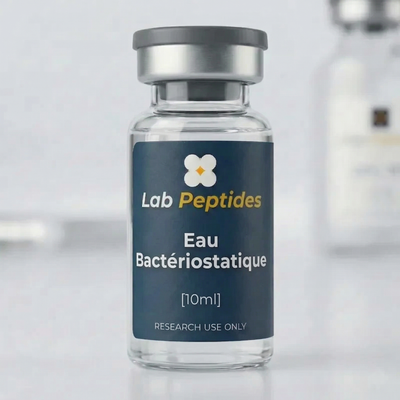
Bacteriostatic water (water for injection + 0.9 % benzyl alcohol) is the reference solvent for most water-soluble research peptides. Its benzyl alcohol inhibits bacterial growth during the use of a multi-dose solution. It suits short hydrophilic peptides (BPC-157, TB-500, GHK-Cu), modern GLP-1 analogs, and most GHRPs/GHRHs.
Some peptides require alternative solvents. Poorly water-soluble peptides benefit from reconstitution in a mixed solvent: 10 to 30 % aqueous acetic acid, or 0.1 % aqueous TFA, facilitate initial dissolution before dilution in the assay buffer. Concentrated DMSO can dissolve even highly hydrophobic peptides, provided it is diluted to < 1 % final in cellular assays to avoid solvent cytotoxicity.
For in vitro functional assays, a physiological buffer (PBS pH 7.4, HBSS, serum-free DMEM) is often preferable to pure bacteriostatic water because it stabilizes pH and provides ions essential to peptide conformation. For long-term stability studies, buffering to pH 5-6 (acetate, citrate) significantly slows asparagine deamidation relative to neutral pH.
Basic equipment for serious storage
A laboratory regularly handling research peptides should have at minimum:
- A dedicated -20 °C freezer, with high-temperature alarm and connected temperature logger. Ideally a laboratory-grade frost-free ventilated freezer, without automatic defrost that generates temperature cycles.
- A -80 °C ultra-freezer for strategic batches and long-use aliquots.
- A +2 to +8 °C laboratory refrigerator, distinct from the freezer, for peptides in current use.
- Organized racks with layout plan (drawers, labeled cryogenic boxes) to quickly locate a sample without prolonging freezer opening.
- A small benchtop centrifuge to gather powder at the bottom of vials and recover residual volumes.
- A gentle variable-speed vortex to homogenize without generating foam.
- A laboratory notebook or LIMS to trace batches, reconstitution dates, and freeze-thaw cycles.
This equipment represents a modest investment relative to the cumulative cost of peptides and research time they protect.
FAQ: lyophilized peptide storage
How long does a sealed lyophilized vial last at room temperature?
Several weeks to 2-3 months depending on the peptide and actual ambient temperature. Acceptable for postal transit or emergency storage, but not recommended for long term. As soon as possible, place at -20 °C or -80 °C.
Can a thawed peptide be refrozen?
Technically yes, but each freeze-thaw cycle damages the peptide. The professional rule: prepare aliquots at first reconstitution, thaw one aliquot for immediate use, discard excess. For a precious peptide, an accidental freeze-thaw cycle is not dramatic; five cycles are.
Should oxygen be removed from the vial after opening?
For short use (a few weeks), no, residual ambient air is not critical. For long-term storage of an opened vial, purging with nitrogen or argon before reclosure significantly prolongs stability, especially for methionine- or tryptophan-containing peptides.
Is in-house lyophilization an option?
Possible with a benchtop lyophilizer (fast freezing then sublimation under deep vacuum), but the equipment investment (€10 000-50 000) and required know-how (vacuum control, primary and secondary drying cycles, final residual humidity control < 1 %) far exceed the needs of most research laboratories. Purchasing an industrially lyophilized batch remains much more cost-effective.
How do you know if a peptide is still active after one year in solution?
Three approaches: (1) comparative HPLC against a recent reference batch to detect degradation peaks, (2) mass spectrometry to confirm molecular mass integrity, (3) functional biological test (binding, EC50) compared to the historical curve. In the absence of analytics, rely on reconstitution date and apply a conservative rule (4 to 8 weeks max at +4 °C).
Are acylated GLP-1 peptides more stable than non-acylated ones?
Yes, generally. C-18 acylation masks the N-terminus and reduces exopeptidase susceptibility. Published stability studies on semaglutide and tirzepatide show stability superior to most native peptides, with wider tolerance to temperature variations during transport.