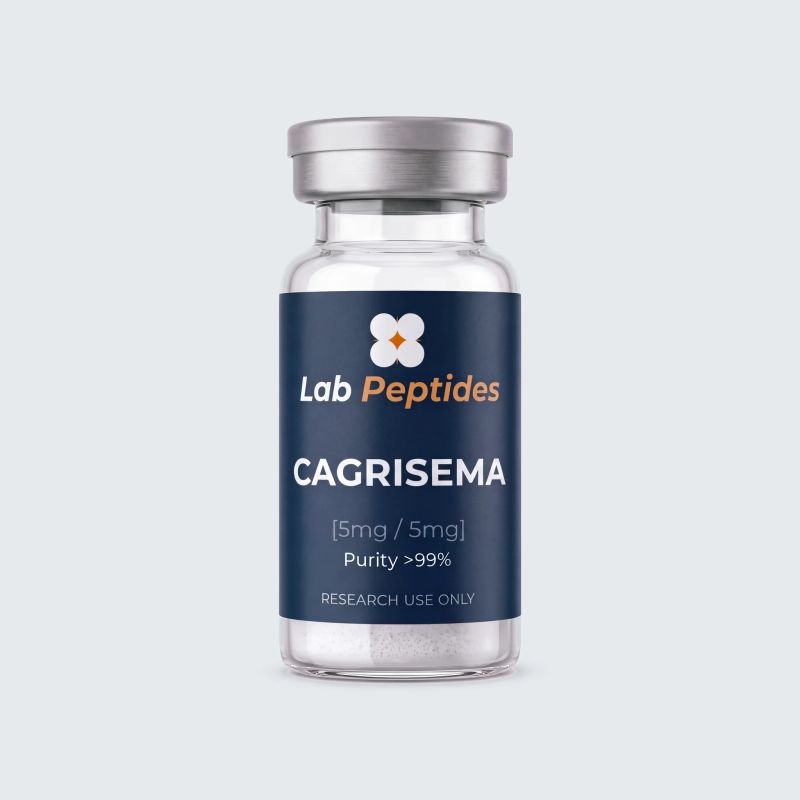
Cagrilintide + Semaglutide 5mg + 5mg Metabolism
Amylin + GLP-1, one vial.
Two research analogues in a single vial: 5 mg of cagrilintide, a long-acting acylated amylin analogue, and 5 mg of semaglutide, a GLP-1 analogue. Lyophilised powder, to be reconstituted. Stocked in France. For research use only.
Research protocols start at: 5 units, i.e. 0.25 mg of each peptide per week (vial prepared with 1 ml of water).
5 mg + 5 mg = what the vial contains, not the dose.See the preparation
- In stock in France
 Ordered with its water: shipped in a magnetic box
Your complete kit
The vial alone cannot be used as is. Add what you need to prepare it:
Research Use Only (RUO) · Prohibited for human or veterinary use.
Key facts
This vial combines two synthetic peptides studied together under the code name CagriSema: 5 mg of cagrilintide and 5 mg of semaglutide, lyophilised in the same vial. Cagrilintide is an acylated analogue of amylin, a peptide co-secreted with insulin by pancreatic beta cells. Semaglutide is an analogue of GLP-1 (glucagon-like peptide-1), an incretin of intestinal origin.
The two molecules act on distinct receptors. That complementarity is what research explores: two signalling pathways, one reagent. For laboratory research use only.
Protocol and preparation
| Water added | Concentration | Reading marker |
|---|---|---|
| 1 ml | 5 mg/ml | 40 UI = 2 mg |
| 2 ml | 2,5 mg/ml | 40 UI = 1 mg |
The volume of water does not change the product, only its concentration. Introduce the water slowly along the vial wall, never directly onto the lyophilisate, then swirl without shaking. Markers given on a 1 ml syringe graduated in 100 units.
Asepsis
Disinfect surfaces and stoppers (70% alcohol).
Solvent
Draw the required volume of bacteriostatic water.
Introduction
Inject gently against the vial wall (avoid direct jet on powder).
Solubilization
Roll the vial gently. Do not shake vigorously (degradation risk).
Solution storage Once reconstituted: 2-8°C (refrigerator).
Warning Theoretical tool for chemical handling. Does not constitute medical advice.
Open the dilution calculator- The amount of powder looks tiny. A lyophilisate takes up a few millimetres at the bottom of the vial, sometimes just a translucent film. The stated weight is there.
- The powder is compact, stuck to the wall or to the stopper. Transport moves the freeze-dried cake around. It changes nothing to reconstitution.
- The vial carries no individual label. That is our standard packaging, not a downgraded vial.
- After reconstitution, deposits or filaments appear. This is common, especially with small molecules. Let it settle and roll the vial between your palms, never shake it.
- The parcel is plain. Nothing on the outside indicates the contents or the brand name.
What is not normal: a cracked vial, an uncrimped cap or a stopper that moves, powder that has liquefied or changed colour. In those specific cases, write to us with a photo and we take the vial back.
Technical data
- Reconstitution
- 1 ml d'eau → 5 mg/ml de chaque peptide. 5 UI = 0,25 mg de chaque ; 10 UI = 0,5 mg de chaque.
- Peptide sequence
- Mélange : Cagrilintide (5 mg) + Sémaglutide (5 mg)
- Physical form
- Poudre lyophilisée blanche
- Recommended solubility
- Eau bactériostatique, NaCl 0.9%, acide acétique 0.1%
- Storage conditions
- Au réfrigérateur (+2 à +8 °C), à l'abri de la lumière. En poudre, possible au congélateur pour une conservation longue. Une fois préparé : réfrigérateur, jamais au congélateur.
- Use
- Research reagent, in vitro only (RUO)
Storage & handling
Unreconstituted vial. Refrigerated, between +2 and +8 °C, protected from light. A freezer (-20 °C) is suitable for long-term storage. Ambient-temperature transport is not an issue for a lyophilised powder.
After reconstitution. Refrigerator only, never the freezer: a freeze-thaw cycle degrades peptides in solution. Bacteriostatic water (0.9% benzyl alcohol) allows repeated draws from the same vial. Let the water run slowly down the inner wall, then swirl the vial gently until fully dissolved, without shaking it.
Mechanism of action
Cagrilintide. A 37-amino-acid amylin analogue carrying a C20 fatty diacid that binds it to albumin and extends its half-life. It activates the amylin receptors (AMY1 to AMY3) and the calcitonin receptor, G-protein-coupled receptors expressed notably in the brainstem.
Semaglutide. An analogue of human GLP-1 (94% sequence homology), stabilised by an α-aminoisobutyric acid at position 8 and acylated on lysine 26 with a C18 fatty diacid. It activates the GLP-1 receptor, also G-protein-coupled, and triggers the cyclic AMP pathway.
Both peptides rely on the same design principleA fatty-acid chain that extends their time in circulation. The literature reports a half-life of around one week for each.
Studies and references
The combination was evaluated in phase 3 in the REDEFINE programme. The REDEFINE 1 trial (Garvey et al., New England Journal of Medicine, 2025, NCT05567796) enrolled 3,417 adults for 68 weeks and compared the combination with each molecule alone and with placebo.
Before it, a phase 2 trial (Frias et al., The Lancet, 2023) had compared the combination with each of the two molecules over 32 weeks. Cagrilintide alone was the subject of a phase 2 trial (Lau et al., The Lancet, 2021).
This work belongs to the company developing the combination. The product sold here is a laboratory reagent, for research use only.
Frequently asked questions
What exactly does the vial contain?
How does it differ from the separate cagrilintide and semaglutide vials?