Molecular Structure of Peptides: From Sequence to Function
Understanding the relationship between amino acid sequence, three-dimensional structure and properties of synthetic peptides.
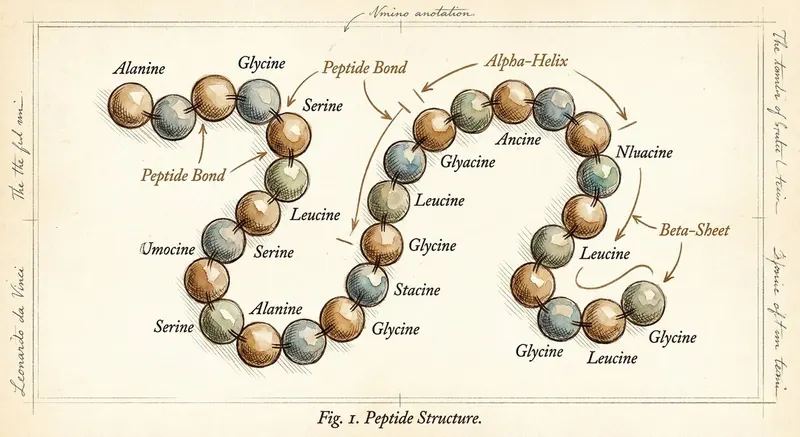
Basics of Peptide Structure
A peptide is a chain of amino acids linked by peptide (amide) bonds. The specific sequence determines the physicochemical and biological properties of the compound.
Structure Levels
Primary Structure
The linear sequence of amino acids, noted from N-terminus to C-terminus. Example for BPC-157:
Gly-Glu-Pro-Pro-Pro-Gly-Lys-Pro-Ala-Asp-Asp-Ala-Gly-Leu-Val
Secondary Structure
- α-helix: Coiling stabilized by H-bonds (i → i+4)
- β-sheet: Parallel or antiparallel strands
- Turns: Direction reversals (often Pro, Gly)
Tertiary Structure
Overall 3D folding, stabilized by:
- Disulfide bridges (Cys-Cys)
- Hydrophobic interactions
- Ionic bonds (Asp/Glu with Lys/Arg)
Key Properties
Molecular Weight
Sum of amino acid masses minus (n-1) water molecules. Expressed in Daltons (Da) or g/mol.
| Peptide | Molecular Weight | Number of AA |
|---|---|---|
| BPC-157 | 1419.53 Da | 15 |
| DSIP | 848.81 Da | 9 |
| Semaglutide | 4113.58 Da | 31 |
| TB-500 | 4963.44 Da | 43 |
Isoelectric Point (pI)
pH at which the peptide has zero net charge. Determines solubility and electrophoresis behavior.
Hydrophobicity
Influences solubility and membrane permeability. Hydrophobic peptides often require co-solvents (DMSO, acetic acid).
Common Modifications
- N-terminal acetylation: Protects against aminopeptidases
- C-terminal amidation: Increases stability and activity
- Cyclization: Improves resistance to proteolysis
- PEGylation: Increases circulating half-life
Research Impact
Knowledge of structure allows to:
- Predict stability and storage conditions
- Choose appropriate reconstitution solvent
- Understand interaction mechanisms
- Interpret analytical data (HPLC, MS)