How to read a peptide Certificate of Analysis (COA): the demanding researcher's complete guide
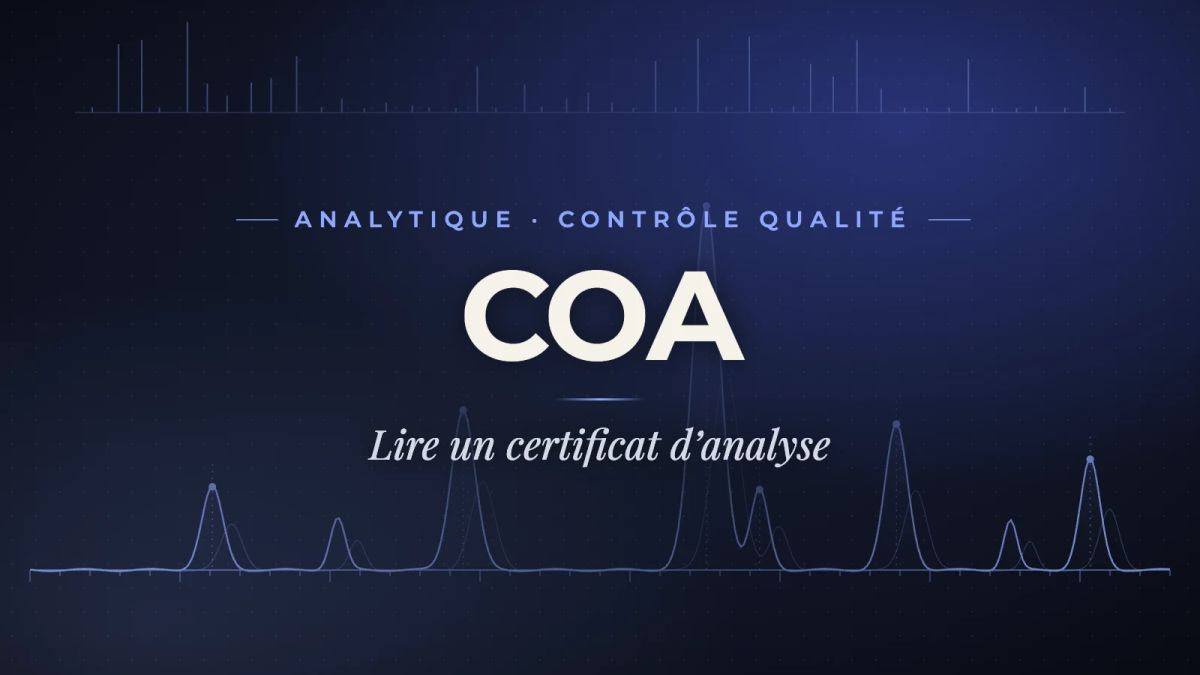
A Certificate of Analysis (COA) is the scientific document accompanying each batch of research peptide sold by a serious laboratory. It condenses the quality control results performed on the delivered molecule — chromatographic purity, mass identity, sterility, appearance, solubility — and stands as tangible proof that the product matches what is advertised. Knowing how to read a COA is not a luxury: it is the #1 filter to distinguish a rigorous supplier from an opaque vendor, and to avoid injecting parasitic data into a research project.
Why the COA is the most important document of your order
In Research Use Only (RUO) peptide research, experimental reproducibility directly depends on the analytical quality of the reagent. A peptide advertised at 99% purity but delivered at 85% introduces 15% unknown material into your protocol: deletion products, incomplete synthesis byproducts, residual trifluoroacetate, truncated peptides, epimers, aggregates.
These impurities can bias your results in multiple ways: biological activity reduced or amplified by an active metabolite, unexplained cellular toxicity, parasitic peaks in assays, inter-batch variability preventing publication. The COA is the tool that anticipates these risks before even reconstituting the vial.
A supplier refusing to provide a COA, sending a generic document without batch number, or delivering a blurry PDF with no attached chromatogram, is a disqualifying signal. Analytical transparency is the foundation of scientific trust.
Mandatory sections of a serious COA
1. Product and batch identification
The first section must unambiguously state: peptide commercial name, full chemical name (sequence in 1-letter or 3-letter code), CAS number if available, unique batch number, manufacturing date, analysis date, recommended expiry, storage conditions, physical appearance (lyophilized white powder, crystalline, etc.).
The batch number is critical: it traces any future anomaly and enables comparison of experimental results across different shipments. One unique batch = one unique COA. Be suspicious of COAs repeating identical data across shipments without variation in masses, purity or dates — that signals a copy-pasted document, not an actual analysis.
2. Chromatographic purity (analytical HPLC)
The heart of the COA. HPLC purity is expressed as percentage of area under curve (AUC), typically measured in reverse-phase C18, with UV detection at 214 nm (peptide bond absorption) or 220 nm. A quality research peptide typically shows ≥ 98% HPLC purity, sometimes ≥ 99% for premium products.
The raw chromatogram must be attached. Check: presence of a dominant main peak, absence of significant parasitic peaks (> 1%), stable baseline, main peak symmetry (high asymmetry = co-eluting impurities). The HPLC method must be described: column (brand, dimensions, particle size), mobile phase (typical acetonitrile/water gradient with 0.1% TFA), flow rate, temperature, duration, injection volume.
Watch the distinction crude vs net purity. Crude (as-is) purity includes residual water, salts and counter-ions. Net peptide content (measured by amino acid analysis or UV assay) quantifies only the active peptide. A peptide can be 99% HPLC pure but contain only 75% net peptide if TFA and water content is high. This data is crucial to calculate actual dosages in pharmacological research.
3. Mass spectrometry identification
Measured molecular mass must match the theoretical mass calculated from the sequence. Classic techniques are ESI-MS (electrospray, ideal for ionizable peptides) and MALDI-TOF (matrix-assisted laser desorption, fast and robust). Accepted tolerance is typically ± 0.5 Da for peptides under 3000 Da, ± 1-2 Da beyond.
A significant gap between measured and theoretical mass indicates either a sequence error (amino acid substitution), or an unintended modification (+16 Da oxidation on Met, +1 Da deamidation on Asn, loss of a side chain). The raw MS spectrum must be provided, not just the numeric value.
4. Complementary tests by use case
Sterility test: essential for peptides destined for cell culture. The fluid thioglycolate and soybean-casein broth test (USP <71>) detects bacteria and fungi after 14-day incubation. A rigorous COA states "sterile / no growth detected".
Endotoxin test (LAL, Limulus Amebocyte Lysate): quantifies residual bacterial lipopolysaccharides, typically expressed in EU/mg. Research threshold: < 1 EU/mg for sensitive in vitro assays, < 0.25 EU/mg for animal models.
Water content (Karl Fischer): typically 2-8% for lyophilized powder. Beyond, accelerated degradation likely.
Residual TFA content: trifluoroacetic acid is used in preparative HPLC; its presence (> 10%) can be cytotoxic. A serious COA specifies it.
Amino acid analysis (AAA): cross-validation of composition via total hydrolysis and residue quantification. Gold standard to confirm the sequence.
Common pitfalls and red flags
Generic COA without chromatogram. A COA lacking the raw HPLC chromatogram and MS spectrum PDFs is unusable. It's marketing, not science.
Advertised purity > 99.9%. Rare in practice for long peptides (> 20 aa). Be cautious if systematic across the whole catalog.
Missing batch number. Future issues cannot be traced. Disqualifying.
Dates inconsistent with shipment. A COA dated 3 years ago on a product delivered today suggests old stock, potentially degraded. Check analysis date vs shipment date.
HPLC method not detailed. "HPLC purity: 98%" without specifying column, gradient and detection is an incomplete COA. A real lab describes its method.
Crude purity confused with net purity. Some vendors advertise "99% pure" referring to crude HPLC purity while net peptide content is 70%. Always ask for the distinction.
No contact for batch-specific questions. A serious supplier accepts precision requests on a specific batch. Refusal = opacity.
How to use a COA in research practice
Step 1: systematic archiving. Each received COA is saved as PDF in a directory tracked by batch number and peptide. This registry becomes your audit trail for any publication or post-hoc analysis.
Step 2: corrected concentration calculation. For a peptide at 98% HPLC and 80% net peptide, a 5 mg vial actually contains 5 × 0.98 × 0.80 = 3.92 mg of active peptide. Adjust your dilutions accordingly, or your nominal concentrations will be overestimated by 20%.
Step 3: inter-batch consistency. Compare COAs of several successive shipments of the same peptide. Strong variance in purity (> 2%) or net content (> 5%) may explain inter-series experimental inconsistencies.
Step 4: complementary functional tests. A good COA attests to chemical quality but not always bioactivity. For critical studies, double-check with an internal functional test (binding, cell assay) on a sample of each batch.
Step 5: physical documentation retention. Some journals require COAs of batches used in Materials and Methods. Keep them accessible 5-10 years minimum, ideally indefinitely.
What to do with a doubtful COA
If a COA shows several red flags (suspiciously round purity, missing method, absent chromatogram, nonexistent batch number), the rational response is to contact the supplier with precise technical questions. A legitimate lab will respond by providing missing data, detailing the method and identifying minor chromatogram peaks.
A supplier who dodges, replies generically or refuses technical communication demonstrates lack of actual analytical competence. In that case, switch suppliers — regardless of the attractive price displayed. In research, a bad reagent costs infinitely more in lost time and repeated experiments than the initial saving.
The researcher's checklist to validate a COA before purchase
- Peptide name, sequence, CAS number present?
- Unique batch number and recent analysis date?
- HPLC purity ≥ 98%, chromatogram provided?
- Measured mass matches theoretical mass, MS spectrum attached?
- HPLC method detailed (column, gradient, detection)?
- Crude and net purity distinguished?
- Water, TFA, endotoxin content if relevant?
- Sterility test for cell culture use?
- Technical contact available for batch-specific questions?
- Automatic archiving on supplier side (retrieve a 2-year-old COA)?
If the answer is "yes" to all ten criteria, you are facing a supplier worthy of your trust. Three or more "no" answers, move on. Your research deserves better than an opaque reagent.
FAQ — your frequent questions about peptide COAs
Can I request a COA before purchase to verify quality?
Yes, a serious supplier accepts to send a template COA (without client batch number) on request. Refusal is a red flag.
What does "HPLC purity ≥ 98%" actually mean?
It means the main peak represents at least 98% of the total UV-HPLC detected area. The remaining 2% are chromatographically separated impurities but not individually identified.
Does a COA guarantee peptide bioactivity?
No. The COA attests chemical quality (purity, identity). Bioactivity also depends on folding, post-receipt stability and experimental conditions. A 99% pure but misfolded peptide may be biologically inactive.
Must a COA include a toxicity test?
No, in RUO use, no toxicological test is required or relevant. The COA documents chemistry, not human use. Any reference to "safety for human use" on a research peptide COA is a major legal alert.
What to do if two different batches give divergent experimental results?
Compare both COAs line by line. If a purity or net content discrepancy exists, correct concentrations. If COAs are identical but results diverge, suspect bioactivity or storage issues. Contact the supplier with both COAs and batch numbers.
Is there an ISO standard for research peptide COAs?
No universal mandatory standard for RUO use. Best practices inspired by ICH Q6A, USP <1057> and European Pharmacopoeia guidelines serve as reference, but their application remains voluntary. COA quality reflects the supplier's scientific culture more than regulatory compliance.
Summary
A COA is a research peptide's scientific passport. It documents identity, purity, mass, sterility and batch traceability of the delivered lot. Knowing how to read it — chromatogram, MS spectrum, detailed methods, crude/net distinction, complementary tests — is an essential skill for any researcher taking their experiments seriously. A transparent supplier systematically joins a complete COA with each batch; an opaque vendor dodges. Filter your suppliers on this criterion, and your protocols will gain reproducibility from the first shipment.
Historical evolution of the COA in peptide research
The Certificate of Analysis concept dates to the 1960s with the rise of American and European pharmacopoeias. Originally, it documented primarily identity and active ingredient content for classical pharmaceutical industry. The emergence of therapeutic peptides in the 1980s (recombinant insulin, calcitonin) mandated integration of high-resolution HPLC and mass spectrometry analyses.
With the explosion of RUO research in the 2010s, the peptide COA standardized around three indispensable pillars: HPLC chromatography, mass identification, sterility/endotoxin testing for cellular use. The most advanced suppliers today add tandem mass spectrometry (MS/MS) sequence analysis, amino acid analysis (AAA), and Good Laboratory Practice (GLP) compliance checks.
Pharma COA vs RUO research COA: the real differences
A pharmaceutical COA meets strict regulatory requirements (ICH Q6A, FDA 21 CFR Part 211, EMA). It must include accelerated stability studies, forced degradation studies, analytical method validation per ICH Q2(R1), catalyst residues, identified and quantified impurity profiles. Generation cost: often tens of thousands of euros per batch.
An RUO research COA remains scientifically rigorous but pragmatic. It documents critical parameters for experimental reproducibility without imposing pharma regulatory burden. A serious RUO COA nonetheless contains: HPLC purity with chromatogram, MS mass with spectrum, sterility if relevant, confirmed identity, traceable batch number.
Confusing the two levels creates symmetric risks: demanding a pharma COA from an RUO supplier (prohibitive costs, biased selection toward big players) or accepting an ultra-light COA without chromatogram under RUO pretext (unverifiable quality). The right cursor is a complete, transparent RUO COA with all raw documents attached.
Practical zoom: decoding the COA of a popular peptide
BPC-157 — what the COA must display
Sequence: Gly-Glu-Pro-Pro-Pro-Gly-Lys-Pro-Ala-Asp-Asp-Ala-Gly-Leu-Val (15 aa). Theoretical molecular mass: 1419.53 Da. A serious COA states HPLC purity ≥ 98%, measured mass within 1419.0-1420.0 Da in ESI-MS, water content ≤ 6%, negative sterility test. The main HPLC peak typically elutes around 8-10 minutes in standard C18 gradient.
BPC-157-specific red flag: missing mention of the stabilized form (free vs arginate). Buyers must know whether the vial contains the free form or the arginate form (more stable), as theoretical mass differs.
Semaglutide — the complexity of lipidated analogs
Semaglutide (31 aa, C18 lipid modifications via γ-Glu-2xOEG linker) has theoretical mass 4113.58 Da and demands a more detailed COA: confirmation of lipidation by MS/MS, purity ≥ 98% with resolution of non-lipidated forms (critical impurity), net peptide content corrected for lipid content, stability verified at 2-8 °C.
A semaglutide COA that does not indicate the lipidated mass (4113.58 Da) but only the native peptide mass (3270.70 Da) is a COA of non-compliant or poor quality product. This vigilance also applies to liraglutide, tirzepatide, retatrutide.
TB-500 fragment — the short peptide case
The form sold is typically the acetylated thymosin β4 fragment 17-23, i.e. Ac-Leu-Lys-Lys-Thr-Glu-Thr-Gln-OH (7 aa, theoretical mass 889.01 Da). A COA must clarify whether it is the fragment or the full TB-500 (43 aa, 4963 Da). This commercial confusion is the #1 source of purchase error in peptide research.
Emerging analytical technologies changing the game
HRMS (High-Resolution Mass Spectrometry): Orbitrap or Q-TOF instruments achieve resolution > 100,000 and mass accuracy < 5 ppm, enabling unambiguous identification of modified peptides (phosphorylation, oxidation, deamidation) invisible to low-resolution MS. A high-end COA now mentions the MS resolution used.
2D-LC (two-dimensional liquid chromatography): combines two separation modes (e.g. ion exchange × reverse phase) to resolve ultra-complex mixtures. Relevant for long peptides with impurities co-eluting in 1D HPLC.
Ion Mobility MS (IM-MS): separates ions by collision cross-section, useful to detect conformers and structural isomers invisible to MS alone.
SEC-MALS (Size Exclusion Chromatography - Multi-Angle Light Scattering): quantifies high-mass aggregates, critical for long or concentrated peptides.
These technologies are not mandatory in an RUO COA, but their mention signals a supplier invested in analytical excellence. At equivalent HPLC quality, this criterion may distinguish two suppliers.