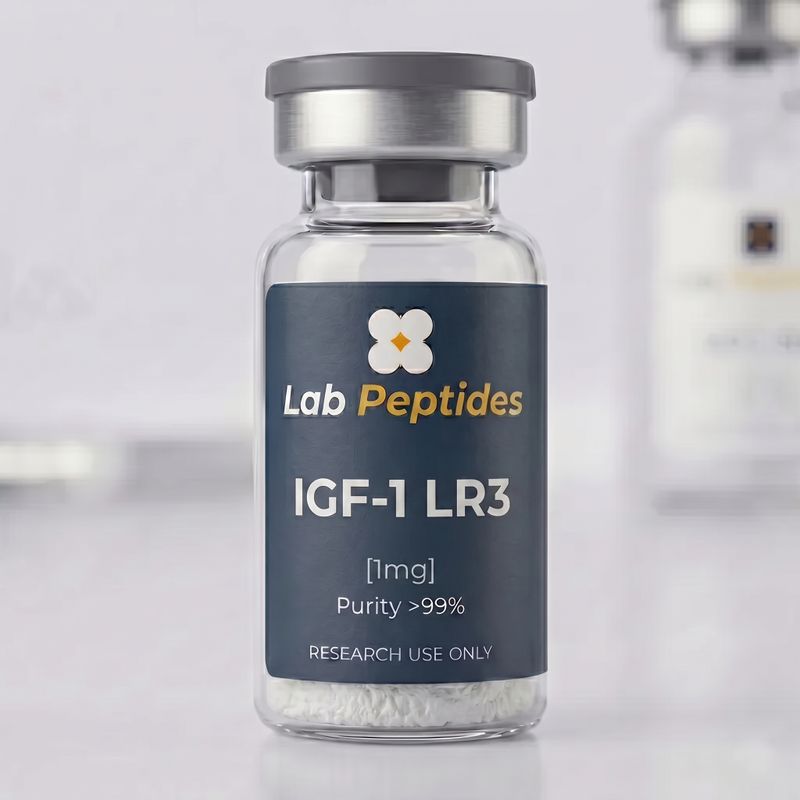
IGF-1 LR3 1mg Crecimiento Muscular
La forma de larga duración del IGF-1. Análogo de 83 aminoácidos cuya extensión N-terminal y sustitución Arg3 reducen la afinidad por las proteínas de transporte: allí donde el IGF-1 nativo queda neutralizado en unos minutos, este sigue activo durante horas. Pureza HPLC ≥98 %, vial de 1 mg. Producto destinado a la investigación.
- Stock en Francia
-10 % de por vida en cada cicloPause, salte o cancele en 1 clicSin compromiso, sin gastos ocultos
Tu kit completo
- Vial 1mgIncluido
- Agua bacteriostáticaAñadir
- Jeringas de 1 mlAñadir
El vial por sí solo no puede usarse tal cual. Un vial sellado de IGF-1 LR3 1mg, liofilizado, sin etiquetado individual.
No olvide lo imprescindible
Se compran juntos a menudo


Información del producto
IGF-1 LR3 (Long R3 Insulin-like Growth Factor 1) is a synthetic analogue of human IGF-1, with 83 amino acids against 70 for the native molecule. Two modifications set it apart: a 13-amino-acid N-terminal extension and the substitution of glutamic acid at position 3 with arginine (hence "R3").
Both changes target the same thing: affinity for the IGFBPs, the six binding proteins that sequester circulating IGF-1. Native IGF-1 is over 95% bound and its free plasma half-life is measured in minutes. The LR3 analogue binds them weakly and stays available far longer — that is the entire rationale for this research version.
This vial delivers 1 mg of IGF-1 LR3 at HPLC purity of at least 98%, lyophilised in type I borosilicate glass. For research use only.
01Mecanismo de acción
IGF-1 acts on the IGF-1R receptor, a transmembrane tyrosine kinase of the insulin receptor family. Binding triggers receptor autophosphorylation and then two main cascades: the PI3K/Akt/mTOR pathway, associated in the literature with protein synthesis and cell survival, and the MAPK/ERK pathway, associated with proliferation.
What sets LR3 apart is not mechanistic but pharmacokinetic. The IGFBPs, particularly IGFBP-3, form a ternary complex with native IGF-1 that extends its circulating presence while making it unavailable. By reducing that binding, the LR3 analogue increases the free fraction — the amount of molecule actually able to reach the receptor.
Worth noting, as it is a common confusion: reduced IGFBP affinity does not mean increased receptor affinity. LR3 binds IGF-1R with comparable, if slightly lower, affinity than native IGF-1.
Péptidos similares
Against native IGF-1 (mecasermin). Same receptor, same cascade, but incomparable availability: native IGF-1 is over 95% sequestered by IGFBPs, LR3 largely escapes them. That is the only difference that matters in practice, and it is pharmacokinetic.
Against secretagogues (Ipamorelin, CJC-1295, Tesamorelin). The difference is one of level. Secretagogues act upstream: they stimulate the pituitary to release growth hormone, which then drives hepatic IGF-1 production. They therefore preserve physiological pulsatility and feedback loops. IGF-1 LR3 bypasses that chain and acts downstream, directly on the receptor. The two approaches are not interchangeable and are not documented in the same way.
Against MGF and PEG-MGF. MGF is a splice isoform of IGF-1, with a different E domain and local action; its pegylated form seeks to extend a naturally very short half-life. These are neighbouring but distinct molecules, with separate literatures.