Oral peptides in research: bioavailability changes the game
The oral bioavailability wall
For years, one rule structured peptide research: a peptide is handled via the injectable route. The reason is biochemical. Most peptides are fragile amino-acid chains, degraded within minutes by digestive proteases and hepatic first-pass metabolism. A swallowed molecule rarely reaches circulation intact: its oral bioavailability collapses to a few percent, when it is not zero.
Recent medicinal chemistry has begun to work around that wall. Two strategies dominate: structural stabilization (modifications that resist proteases) on one side, and small non-peptide agonists that mimic a peptide's action without its fragility on the other. The research catalog is therefore opening to a new format: the tablet.
Four molecules, four oral logics
Oral semaglutide: the peptide that broke through
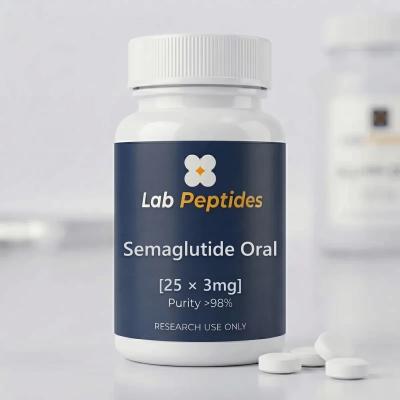
Semaglutide is the first GLP-1 agonist to prove that a peptide could work orally at industrial scale. The key: co-formulation with an absorption enhancer (SNAC) creating a localized pH window in the stomach, transiently protecting the molecule during passage. The research 25 x 3mg format reproduces this daily fractioned-dose logic, where the injectable version concentrates the dose into a weekly administration.
Oral BPC-157: gastric stability as the argument
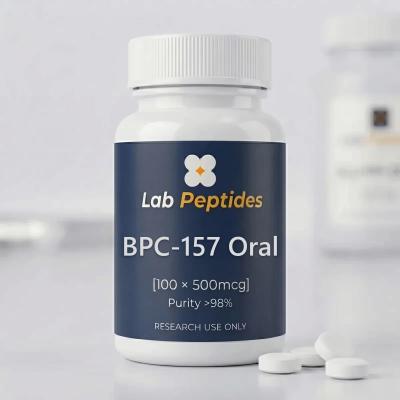
BPC-157 is a special case. This peptide derived from a gastric protein shows unusual resistance in acidic conditions, which has fueled interest in studying it orally. The 100 x 500mcg format translates this approach into precise dosing units, suited to research protocols exploring the digestive rather than systemic route.
Oral KPV: the compact tripeptide
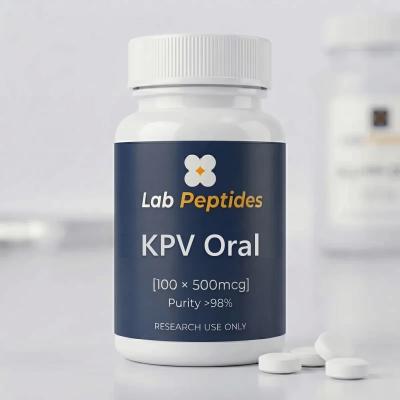
KPV is a short fragment (three amino acids) derived from alpha-MSH. Its small size is mechanically an asset for the oral route: fewer bonds to hydrolyze, less surface exposed to proteases. The 100 x 500mcg format makes it a candidate for studies documenting the interest of orally administered tripeptides.
SLU-PP-332: the non-peptide agonist
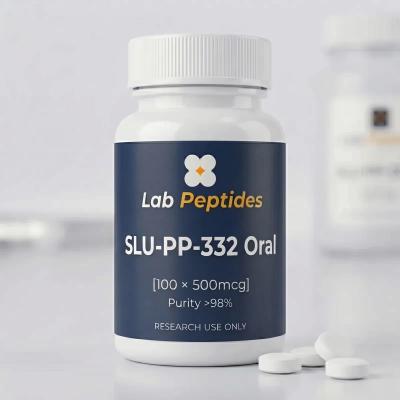
SLU-PP-332 illustrates the second strategy. It is not a stabilized peptide but a small molecule ERR receptor agonist, designed from the start for the oral route. This class entirely escapes the protease problem: it has no peptide bond to protect. Available in 100 x 250mcg and 100 x 500mcg formats, it represents the frontier where peptide research meets small-molecule chemistry.
What the oral route concretely changes in the lab
Beyond biochemistry, the oral format changes daily handling:
- No reconstitution. A dosed tablet is ready to use: no more bacteriostatic water, no dilution math, no opened vial to keep cold.
- Discrete, reproducible dosing. One unit = one dose. Syringe-draw variability disappears, serving protocol reproducibility.
- Simplified storage. A dry solid is more stable than a reconstituted solution, which imposes a strict cold chain and a short use window.
- Zero needle. For handling that does not require the injectable route, removing the injection step reduces materials and associated risks.
Limits to keep in mind
The oral format is no magic wand. Three caveats matter:
- Bioavailability stays below injectable. Even stabilized, an oral peptide delivers a fraction of the dose to circulation. Dose equivalences between oral and injectable are not linear and depend on each molecule.
- Inter-individual variability is higher. Digestive absorption depends on pH, gastric content, transit: variables the injectable route bypasses.
- Not every molecule qualifies. A long, fragile peptide with no dedicated stabilization strategy does not become oral just by pressing it into a tablet. The oral format concerns molecules chosen for compatibility.
Injectable or oral: a protocol choice, not a fashion
The arrival of orals does not cancel the injectable: it widens the toolbox. The injectable route keeps the advantage of maximal bioavailability and precise systemic dose control. The oral route wins on practicality, storage and needle removal. The right format depends on the protocol, the molecule and the research question, not on an absolute hierarchy.
For a laboratory, having both routes on the same molecule — now the case for semaglutide, BPC-157 and KPV — opens direct comparisons that were impossible when injectable was the only option.
Products intended exclusively for laboratory research. Not for human or animal consumption.