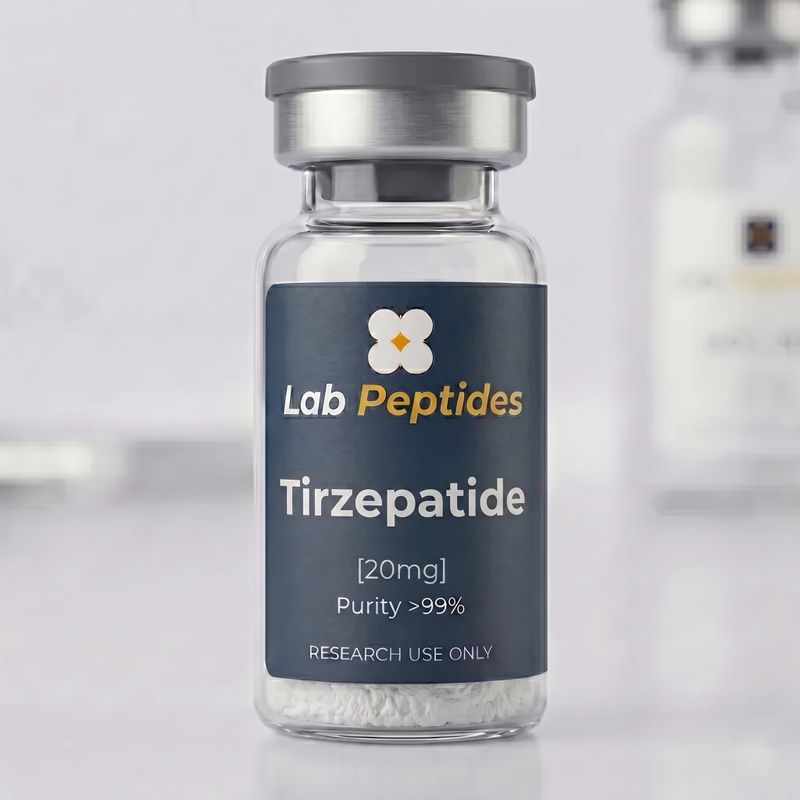
Tirzepatide 20mg Perte de poids
Le double agoniste de dernière génération. GIP + GLP-1 réunis — stimulation hormonale combinée pour une perte de poids documentée à -22% en 72 semaines (SURMOUNT-1). Surclasse Semaglutide en efficacité directe. La nouvelle référence FDA. Le futur de la perte de poids ciblée.

Product information
Tirzepatide 20mg is the format for the intermediate steps (5 to 10mg per week), giving access to the GLP-1/GIP dual agonism documented by SURPASS and SURMOUNT without heavy volumetric commitment. This vial is sized for titration phases and short exploratory research cycles, typically 4-8 weeks after reconstitution. For researchers discovering the molecule or calibrating a first protocol, the 10mg format (start at 2.5mg) validates individual tolerance, adjusts titration to subject physiology, and measures early metabolic markers (fasting glucose, HbA1c, body mass, waist circumference, lipids) before committing to a long cycle. Its compact format also minimizes financial risk if discontinuation is decided early in the cycle.
Range positioning: 20mg covers the 5 to 10mg steps, between the 10mg (start at 2.5mg) and the 15mg (standard SURMOUNT-1 target dose), 30mg (3-month long-cycle), or 60mg (6-month mega-cycle). The 20mg vial, reconstituted with 2 mL bacteriostatic water, delivers 10 mg/mL: 25 units = 2.5 mg; 50 units = 5 mg; 75 units = 7.5 mg. Caution: twice as concentrated as the 10mg vial (5 mg/mL), do not reuse its markings. At target dose 10mg/week (SURMOUNT-1 plateau week 13-16), one vial covers exactly 2 full weeks; at 5mg/week (plateau week 5-8) it covers 4 weeks. To start at 2.5mg, the 10mg vial is the right format: within 28 days after reconstitution the 20mg would not be finished. The format thus suits both calibration and short-segment validation equally.
01Mechanism of action
Tirzepatide is the first marketed dual incretin-mimetic agonist. Its 39-residue sequence derives from native human GIP (Glucose-dependent Insulinotropic Polypeptide), with engineered modifications that confer simultaneous high affinity at two G-protein-coupled receptors: GLP-1R and GIPR. Coskun and colleagues (Mol Metab 2018) described the rational design: Aib substitutions at positions 2 and 20 blocking DPP-4 cleavage, and a C20 diacid fatty-acyl chain attached to Lys20 via a gamma-glutamate linker that anchors the molecule to serum albumin and extends the half-life to roughly 117 hours in humans.
Tirzepatide biology is not simply the sum of GLP-1 plus GIP activity. The GIPR-biased sequence (picomolar-range EC50 at GIPR, sub-nanomolar at GLP-1R) creates a qualitatively distinct signaling signature. Willard et al. (JCI Insight 2020) demonstrated that tirzepatide recruits beta-arrestin less strongly at GLP-1R than native GLP-1, producing a bias toward Galpha-s / cAMP signaling that may limit receptor desensitization. At GIPR, conversely, tirzepatide behaves as a full agonist. This signaling architecture partly explains the clinical metabolic superiority observed over single GLP-1 agonists.
The GIP arm adds mechanisms absent from single agonists. In adipose tissue, GIPR activation stimulates postprandial lipogenesis and triglyceride clearance while improving insulin sensitivity in subcutaneous adipocytes. In the central nervous system, GIPR neurons in the arcuate and paraventricular nuclei modulate appetite additively with GLP-1R neurons. Preclinical models (GIPR-KO mice, obese rats) suggest that GIP/GLP-1 co-activation increases thermogenic energy expenditure through brown adipose tissue, contributing to weight loss beyond caloric restriction.
At the pancreatic level, the incretin effect is potentiated synergistically: tirzepatide administration in type 2 diabetic subjects triggers glucose-dependent insulin secretion exceeding a reference GLP-1 mono-agonist, without clinical hypoglycemia (Heise 2022 Diabetes Care). GLP-1 glucagonostatic action stabilizes fasting glycemia. Gastric emptying is also slowed, contributing to satiety but demanding attention to drug interactions and gastrointestinal discomfort during rapid titrations.
Pharmacokinetics justify the weekly regimen. Cmax is reached 24-72 hours post-injection depending on dose, terminal half-life 117 hours, steady-state achieved within 4 weeks on a fixed weekly dose. Clearance is essentially proteolytic (no significant CYP450 biotransformation), limiting pharmacokinetic interactions. In research contexts this pharmacokinetic window is precious: weekly administration produces near-stationary plasma concentrations, facilitating protocol standardization and reproducibility of cohort measurements.
Similar peptides
Versus semaglutide (GLP-1 mono-agonist): head-to-head superiority demonstrated in SURPASS-2 (Frias 2021 NEJM). Tirzepatide 15mg beats semaglutide 1mg by +0.44% additional HbA1c and +5.5 kg additional weight loss. The GIP arm contributes measurably to visceral fat and energy expenditure. Limit: slower titration (5 steps to 15mg) and stricter gastrointestinal tolerance in the first weeks.
Versus retatrutide (GLP-1/GIP/GCGR triple agonist): retatrutide adds a glucagon arm that stimulates hepatic thermogenesis and lipolysis. Phase II data (Jastreboff 2023 NEJM) show -24.2% at 12mg/48w vs -20.9% for tirzepatide 15mg/72w, a notable gap. But retatrutide is newer, with fewer long-term data, and the GCGR component demands heightened vigilance on hepatic function. Tirzepatide retains the advantage of clinical maturity (>400 publications) and better-mapped tolerance profile.
Versus liraglutide 3mg (Saxenda): liraglutide is a daily GLP-1 mono-agonist with -8% weight loss over 56 weeks (Pi-Sunyer 2015 NEJM SCALE). Tirzepatide 15mg weekly produces -20.9% over 72 weeks, an absolute gain of >12 percentage points. The posology advantage (1 weekly injection vs 1 daily) and 2.5x superior efficacy make liraglutide obsolete as first-line weight loss agent.
Versus dulaglutide (Trulicity): dulaglutide is a weekly GLP-1 agonist with modest weight loss (-3 to -4 kg at 1.5mg). Tirzepatide is 4-5x superior on weight outcomes. Direct comparison awaits SURPASS-CVOT (2025-2026 results) for cardiovascular events.
Versus basal insulin: SURPASS-3 and SURPASS-5 show that adding tirzepatide to antidiabetic therapy outperforms titrating basal insulin, without weight gain or hypoglycemia. Insulin remains essential in type 1 diabetes and acute type 2 decompensation, but as a type 2 intensification agent, tirzepatide is superior.
Versus bariatric surgery (sleeve, bypass): surgery remains the absolute efficacy reference (-25 to -30% at 1 year for Roux-en-Y bypass), but tirzepatide 15mg approaches it (-20.9% at 72 weeks) without invasive intervention, without post-operative nutritional deficiencies, and with a reversible profile. SURMOUNT-4 data remind us however that discontinuation triggers rapid weight regain, unlike post-surgery states.
Versus bupropion-naltrexone (Contrave/Mysimba), orlistat (Xenical), phentermine-topiramate (Qsymia): these agents produce 3-10% weight loss and are eclipsed by tirzepatide (2-7x more effective by comparison). Their residual advantages: oral form, much lower cost, no injection requirement.
Research positioning: tirzepatide is today's peptide of choice for exploratory protocols combining maximal metabolic efficacy and documented tolerance profile. Its data maturity surpasses retatrutide's and rivals semaglutide's, while offering a higher intensity of effect than the mono-agonist.