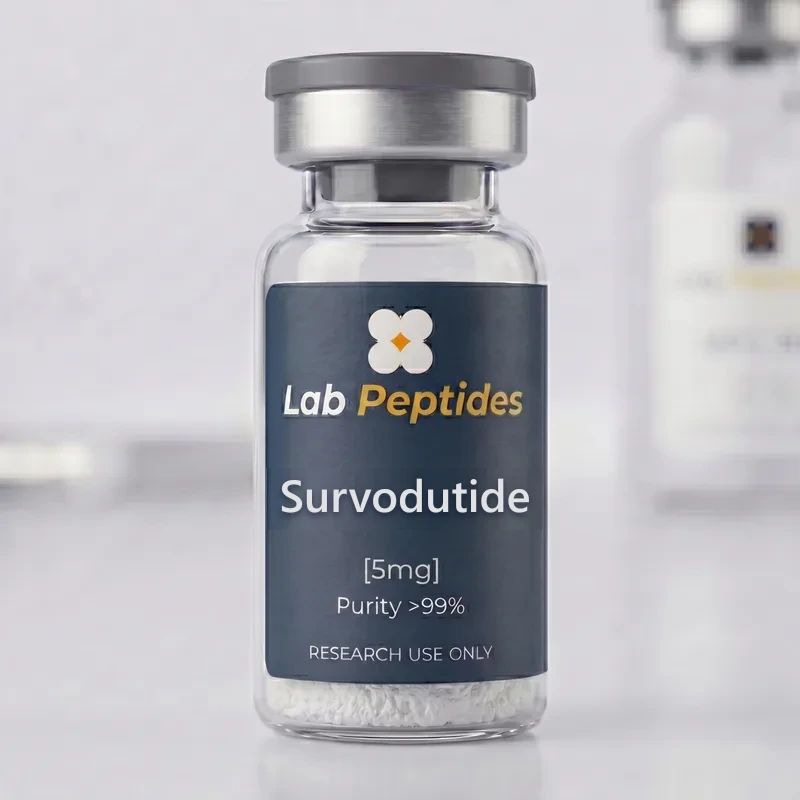
The next generation of GLP-1s. Survodutide hits TWO receptors at once, glucagon and GLP-1, where classic molecules target only one. The molecule 2026 metabolic research is talking about. HPLC >= 98%, third-party COA, EU stock.
The next generation of GLP-1s. Survodutide hits TWO receptors at once, glucagon and GLP-1, where classic molecules target only one. The molecule 2026 metabolic research is talking about. HPLC >= 98%, third-party COA, EU stock.
No references yet for this peptide — search PubMed for associated scientific literature.
The listed studies are provided for documentation and research purposes only. They do not constitute a therapeutic indication nor a recommendation for human use. This product is strictly for laboratory use only (RUO).
Reconstitution for this format (5 mg)Standard volumes used in laboratory settings
Water added
Concentration
Reading marker
1 ml
5 mg/ml
40 UI = 2 mg
2 ml
2,5 mg/ml
40 UI = 1 mg
The volume of water does not change the product, only its concentration. Introduce the water slowly along the vial wall, never directly onto the lyophilisate, then swirl without shaking. Markers given on a 1 ml syringe graduated in 100 units.
1
Asepsis
Disinfect surfaces and stoppers (70% alcohol).
2
Solvent
Draw the required volume of bacteriostatic water.
3
Introduction
Inject gently against the vial wall (avoid direct jet on powder).
4
Solubilization
Roll the vial gently. Do not shake vigorously (degradation risk).
What is normal on arrivalThe observations that worry customers, and are not defects
The amount of powder looks tiny. A lyophilisate takes up a few millimetres at the bottom of the vial, sometimes just a translucent film. The stated weight is there.
The powder is compact, stuck to the wall or to the stopper. Transport moves the freeze-dried cake around. It changes nothing to reconstitution.
The vial carries no individual label. That is our standard packaging, not a downgraded vial.
After reconstitution, deposits or filaments appear. This is common, especially with small molecules. Let it settle and roll the vial between your palms, never shake it.
The parcel is plain. Nothing on the outside indicates the contents or the brand name.
What is not normal: a cracked vial, an uncrimped cap or a stopper that moves, powder that has liquefied or changed colour. In those specific cases, write to us with a photo and we take the vial back.
01What is the purity of Survodutide?
Survodutide meets an HPLC specification of ≥ 98%, and its certificate of analysis is published on this page: check it before you order.
02How should Survodutide be stored?
Before reconstitution, lyophilized Survodutide is stable for several weeks at room temperature, and for several months in the fridge or freezer. Shipping does not degrade it. Once reconstituted, keep the solution between +2°C and +8°C, away from light, and do not freeze it.
03How do I reconstitute Survodutide 5mg?
To reconstitute Survodutide, use bacteriostatic water or sterile 0.9% NaCl. Inject the solvent gently along the wall of the vial, then roll it slowly (do not shake). See our reconstitution guide for dosage calculations.
04Is a certificate of analysis (COA) available?
Yes: the certificate of analysis for Survodutide is published on this page and can be checked before you order. It shows the results measured by the laboratory.
05Is Survodutide intended for human consumption?
No. Survodutide is intended exclusively for in vitro and in vivo scientific research (Research Use Only - RUO). It is not approved for human or veterinary use. Its purchase is reserved for laboratories, researchers and scientific institutions.
06What are the research applications of Survodutide?
Survodutide is part of our Weight Loss range. It is used in scientific research for in vitro and in vivo studies. Specific applications depend on the research protocol. See the scientific literature (PubMed) for publications on this peptide.