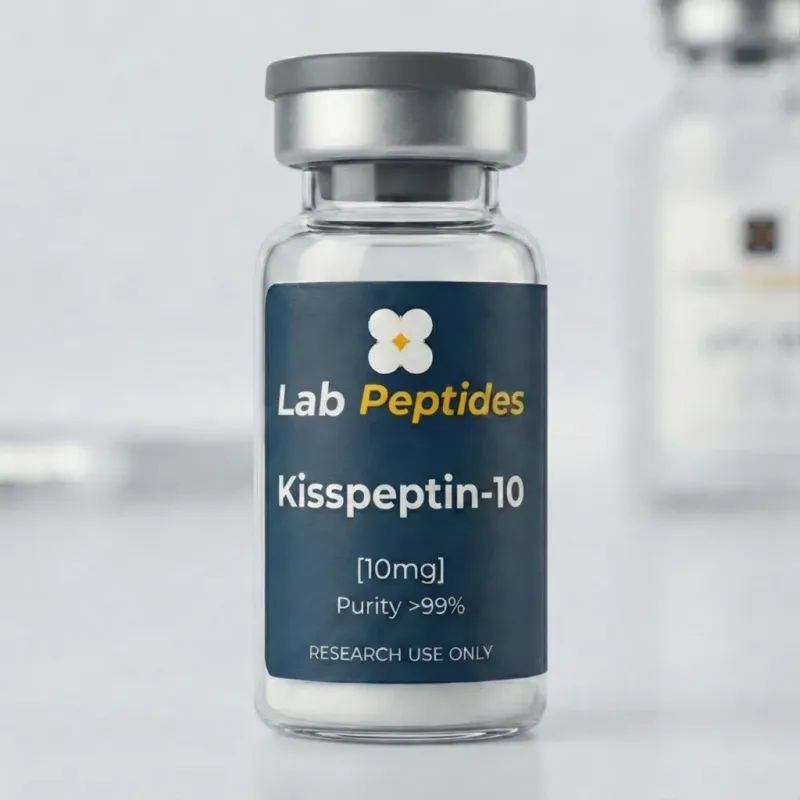
Kisspeptine-10 10mg Hormonal Balance
Hypothalamic decapeptide. The central trigger of the gonadotropic axis, discovered in the 2000s and which reshaped the understanding of puberty.
The master regulator of the hormonal axis. Kisspeptin fires the upstream hypothalamic LH/FSH cascade — the source of your testosterone and fertility. Regulation at the root, not a patch. The peptide rewriting the modern hormonal approach.

Product information
Kisspeptin-10 10mg (KP-10, Metastin 45-54) is a decapeptide with the sequence Tyr-Asn-Trp-Asn-Ser-Phe-Gly-Leu-Arg-Phe-NH2, corresponding to the bioactive C-terminal fragment of native kisspeptin-54 encoded by the human KISS1 gene on chromosome 1q32. With a molecular weight of approximately 1302 Da, this synthetic decapeptide binds to the G protein-coupled receptor GPR54 (renamed KISS1R) with nanomolar affinity and constitutes today one of the most precise pharmacological tools to study the human hypothalamic-pituitary-gonadal axis.
KP-10 occupies an absolutely central position in reproductive endocrinology. Kisspeptinergic neurons in the arcuate (ARC) and anteroventral periventricular (AVPV) hypothalamic nuclei control pulsatile release of gonadotropin-releasing hormone (GnRH), which itself commands pituitary LH and FSH secretion, and ultimately gonadal function. Seminal work by Seminara and colleagues (2003, New England Journal of Medicine) and de Roux and colleagues (2003, PNAS) demonstrated that inactivating GPR54 mutations cause congenital hypogonadotropic hypogonadism with absent puberty, while activating mutations cause central precocious puberty. These discoveries established kisspeptin as the molecular gatekeeper of puberty and reproductive function.
The name's history is singular. Kisspeptin was initially discovered in 1996 by Jung-Hoon Lee and colleagues (Journal of the National Cancer Institute) as a metastatic suppressor of cancer, in the city of Hershey, Pennsylvania, hence the nod to Hershey's Kisses chocolates and the name "kisspeptin". It was only in 2001-2003 that its endocrine and reproductive role was revealed through discovery of its endogenous receptor GPR54 and first human studies.
In exploratory research, KP-10 distinguishes itself by unique pharmacological specificity: it selectively activates GPR54 without cross activity on other peptide receptors, generating clean and reproducible stimulation of the GnRH-LH-FSH axis. Each Atlas Lab vial ships lyophilized, with an HPLC specification of at least 98% purity. The short plasma half-life (approximately 4 minutes for KP-10 versus 27 minutes for native KP-54) imposes an IV bolus or SC administration protocol with frequent rotations, typical of clinical endocrinology explorations.
01Mechanism of action
Kisspeptin-10 mechanism of action articulates a hierarchical neuroendocrine cascade of rare elegance, where activation of a single hypothalamic GPR54 receptor triggers the entire human reproductive axis within minutes.
First stage, GPR54 activation on GnRH neurons. GPR54 (KISS1R) is a Class A G protein-coupled receptor, predominantly expressed on GnRH neurons of the preoptic hypothalamus. KP-10 binding activates the Gq/11 -> phospholipase C beta -> IP3 production -> calcium release from reticular stores pathway. This intraneuronal calcium elevation triggers synaptic vesicle fusion containing GnRH and pulsatile release of the neuropeptide into the hypothalamic-pituitary portal system. The effect is rapid: GnRH release is detectable within 5 minutes after KP-10 IV administration, with peak at 15-30 minutes.
Second stage, pituitary stimulation. Released GnRH activates GnRH-R receptors on anterior pituitary gonadotropes, triggering secretion of the gonadotropins LH (luteinizing hormone) and FSH (follicle-stimulating hormone). In healthy adult men, a single 0.3 mcg/kg IV dose of KP-10 produces robust and reproducible serum LH elevation of 3 to 8 times baseline within 30 minutes, with more modest and prolonged FSH elevation (Dhillo and colleagues 2005, JCEM).
Third stage, gonadal action. LH elevation stimulates testicular Leydig cells producing testosterone and activates ovarian thecal cells involved in steroidogenesis. FSH elevation supports spermatogenesis in men and follicular maturation in women. The testosterone effect in men is measurable 4 to 6 hours after single administration, with 20-to-50-percent increase in serum testosterone in healthy subjects.
Fourth axis, duality of kisspeptinergic neuronal populations. Kisspeptin neurons of the arcuate nucleus (ARC) co-express neurokinin B and dynorphin (KNDy population) and are responsible for baseline GnRH pulsatility in both sexes. AVPV neurons predominate in females and mediate the preovulatory LH surge in response to estrogen positive feedback. This duality explains why KP-10 can be used both to study baseline GnRH pulsatility and to trigger ovulation (Abbara 2015 JCEM).
Fifth dimension, extra-hypothalamic action. KP-10 also exerts documented extra-gonadal axis effects. At the limbic brain level, Comninos and colleagues (2017, Journal of Clinical Investigation) showed by fMRI that KP-10 activates regions responsible for sexual emotional processing (insula, anterior cingulate gyrus, amygdala, hippocampus) in healthy men, with correlated improvement of sexual motivation parameters. Thurston and colleagues (2022, JAMA Network Open) extended these observations to men with HSDD. KP-10 also activates kisspeptin receptors expressed in placenta, trophoblastic vessels, and several cancers, but these actions fall outside the direct reproductive framework.
Similar peptides
Kisspeptin-10 positioning in the reproductive endocrinology space clarifies through systematic comparison with four major alternatives: Kisspeptin-54, GnRH analogs (gonadorelins), exogenous gonadotropins (hCG, hMG), and indirect gonadal axis modulators (clomiphene, anastrozole, enclomiphene).
Versus Kisspeptin-54 (KP-54, Metastin 68-121), KP-10 presents a different pharmacokinetic profile that influences use choice. KP-54 is a 54-amino-acid peptide with plasma half-life of approximately 27 minutes, markedly superior to KP-10's 4 minutes. This difference makes KP-54 more suited to clinical protocols requiring prolonged stimulation (ovulatory induction in IVF, treatment of hypothalamic amenorrhea over several weeks), while KP-10 is preferable for occasional endocrine tests (LH/FSH profile after single bolus) and brief explorations. Intrinsic GPR54 potency is comparable between the two forms, but synthesis cost and accessibility favor KP-10 for non-clinical exploratory research.
Versus GnRH analogs (gonadorelin, leuprorelin, goserelin), KP-10 acts one stage upstream in the neuroendocrine cascade. Exogenous GnRH directly stimulates pituitary gonadotropes, short-circuiting the hypothalamic step. This difference has a capital consequence: KP-10 only works in subjects whose hypothalamic GnRH axis is functional or reactivatable, while exogenous GnRH bypasses a potential hypothalamic lesion. Conversely, GnRH antagonists can theoretically block the pituitary effect of KP-10 without preventing hypothalamic GnRH release, providing a pharmacological dissection tool for the axis. GnRH agonists in continuous administration also produce pituitary desensitization sought in oncology, a profile that KP-10 may also present at repeated high doses.
Versus exogenous gonadotropins (hCG, hMG, recombinant FSH), KP-10 acts even further upstream and requires intact hypothalamic-pituitary-gonadal function. Exogenous gonadotropins directly stimulate gonads, bypassing the entire central axis, and are indispensable in cases of pituitary insufficiency or severe anovulation. KP-10 conversely offers the advantage of a more physiological hormonal profile, with maintenance of natural pulsatility and lower risk of iatrogenic hyperstimulation (OHSS in assisted reproductive medicine).
Versus indirect modulators like clomiphene (anti-estrogen hypothalamic agonist SERMs), enclomiphene (active stereoisomer), or anastrozole (aromatase inhibitor), KP-10 presents a fundamentally different mechanism. Clomiphene blocks hypothalamic estrogen receptors and thus lifts negative feedback, indirectly increasing endogenous GnRH secretion. KP-10 directly stimulates GnRH release without passing through this detour. The potential advantage of KP-10 is more reproducible action less dependent on sex and estrogenic status of the subject, but its short half-life and parenteral administration route limit its routine use versus oral SERMs.
The verdict: Kisspeptin-10 is the most direct tool to switch on the GnRH-LH-FSH axis, backed by solid published literature (Seminara NEJM 2003, Dhillo JCEM 2005, Comninos JCI 2017). HPLC specification of at least 98%. Plan biological monitoring (LH, FSH, testosterone, estradiol) and rule it out with a history of hormone-dependent cancer or during pregnancy.