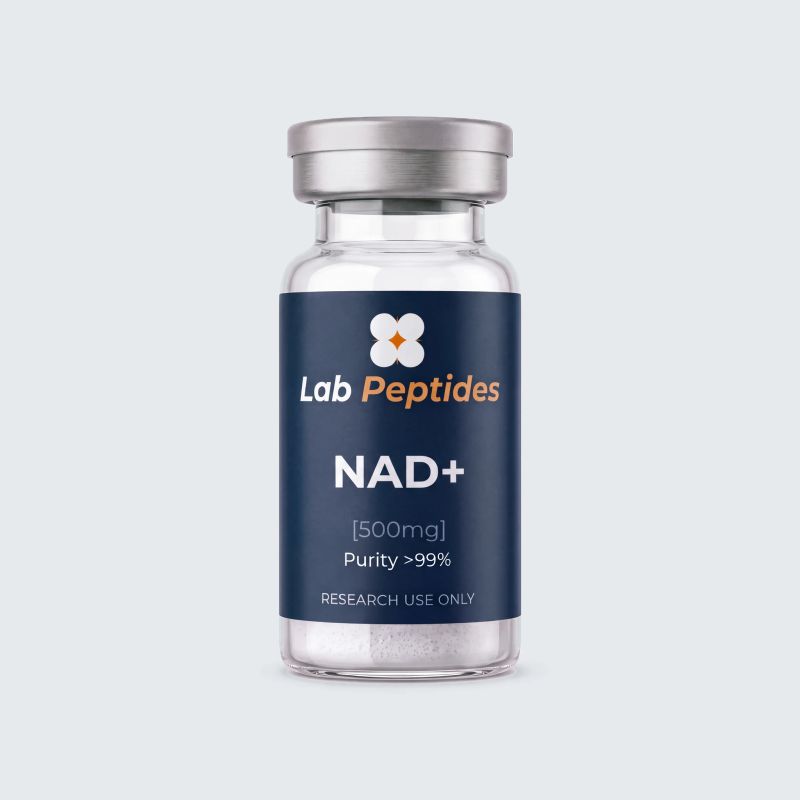
NAD+ 500mg Longevidad
El carburante de sus células.
El carburante celular que declina con la edad. Los niveles de NAD+ caen un 50% entre los 30 y los 60 años → fatiga, envejecimiento, declive cognitivo. Restauración directa por inyección: energía celular disparada, mitocondrias reparadas, ADN protegido. El rejuvenecimiento en la fuente.
- Certificado de análisis
- Stock en Francia
 Pedido con su agua: enviado en estuche imantado
-10 % en cada envíoPause, salte o cancele en 1 clicSin compromiso, sin gastos ocultos
Sin cargo automático: pague cada envío con tarjeta, en Bitcoin (-5 % adicional) o por transferencia desde 100 €
Tu kit completo
El vial por sí solo no puede usarse tal cual. Añada lo necesario para prepararlo:
Se compran juntos a menudo


Uso exclusivo en investigación (RUO) · Prohibido para uso humano o veterinario.
Lo esencial
NAD+ (Nicotinamide Adenine Dinucleotide, MW 663.43 Da) is not strictly a peptide: it is a dinucleotide coenzyme present in every living cell, the obligatory catalyst of more than 500 enzymatic reactions linking energy metabolism, DNA repair, calcium signalling and epigenetics. It is also one of the best-documented biological markers of ageing: intracellular NAD+ levels drop by roughly 50 % between ages 20 and 60 in human tissues, and this erosion correlates directly with loss of mitochondrial function, insulin resistance, cognitive decline and frailty in older subjects.
En detalle
NAD+ research exploded after 2013, when Shin-ichiro Imai, David Sinclair and their teams crystallised the NAD+/sirtuin hypothesis: restoring the NAD+ pool reactivates SIRT1-SIRT7, NAD+-dependent enzymes that deacetylate substrates as critical as PGC-1alpha, FOXO3, p53 and histone H3K9. Three supplementation strategies now coexist: oral precursors (NR nicotinamide riboside, NMN nicotinamide mononucleotide), direct subcutaneous injection of NAD+, and long clinical IV infusions (250-1000 mg over 2-8 hours). Subcutaneous injection of pure NAD+ offers a compromise between the limited bioavailability of oral forms (major hepatic first-pass effect) and the logistical burden of IV protocols.
This vial delivers 500 mg of high-purity NAD+ (>98 %, HPLC), type I glass, fluorinated butyl stopper, inert seal. Lyophilisation protects the molecule from hydrolysis: as anhydrous solid at -20 C, stability exceeds 24 months. After reconstitution in bacteriostatic water, the solution remains usable for 14 days refrigerated at 4-8 C, provided warming-cooling cycles and light exposure are minimised. In accordance with European regulations, this product is intended exclusively for in vitro research and preclinical studies on non-human models: it is neither a medicinal product, a food supplement, nor a medical device.
Protocolo y preparación
| Agua añadida | Concentración | Marca de lectura |
|---|---|---|
| 2 ml | 250 mg/ml | 10 UI = 25 mg |
| 2,5 ml | 200 mg/ml | 10 UI = 20 mg |
El volumen de agua no cambia el producto, solo su concentración. Introduzca el agua despacio por la pared del vial, nunca directamente sobre el liofilizado, y luego gírelo suavemente sin agitar. Las marcas se dan sobre una jeringa de 1 ml graduada en 100 unidades.
Asepsia
Desinfecte las superficies y los tapones (alcohol al 70%).
Disolvente
Extraiga el volumen necesario de agua bacteriostática.
Introducción
Inyecte suavemente contra la pared del vial (evite el chorro directo sobre el polvo).
Solubilización
Haga rodar el vial suavemente. No lo agite con fuerza (riesgo de degradación).
Conservación de la solución Una vez reconstituido: 2-8°C (nevera).
Advertencia Herramienta teórica para manipulación química. No constituye un consejo médico.
Abrir la calculadora de dilución- La cantidad de polvo parece mínima. Un liofilizado ocupa unos pocos milímetros en el fondo del vial, a veces solo una película translúcida. El peso indicado está ahí.
- El polvo está compacto, pegado a la pared o al tapón. El transporte desplaza la torta liofilizada. No cambia nada en la reconstitución.
- El vial no lleva etiqueta individual. Es nuestro embalaje estándar, no un vial de menor calidad.
- Tras la reconstitución aparecen depósitos o filamentos. Es habitual, sobre todo con moléculas pequeñas. Deje que se asiente y haga rodar el vial entre las palmas, nunca lo agite.
- El paquete es neutro. Nada en el exterior indica el contenido ni el nombre de la marca.
Lo que no es normal: un vial agrietado, una cápsula sin engastar o un tapón que se mueve, polvo que se ha licuado o cambiado de color. En esos casos concretos, escríbanos con una foto y recuperamos el vial.
Standard reconstitutionSlowly inject 2.5 ml of bacteriostatic water into the 500 mg vial, creating a 200 mg/ml solution. Gently roll the vial between palms, never shake (NAD+ is sensitive to mechanical shear). The reconstituted solution must be clear, pale yellow to colourless; any opacity, precipitate or brown coloration indicates degradation (oxidation to ADP-ribose).
- Low dose (maintenance): 50 mg = 0.25 ml (25 units)
- Medium dose (short protocol): 100 mg = 0.5 ml (50 units)
- High dose (withdrawal/clinical protocol): 200-250 mg = 1.0-1.25 ml
- Clinical IV dose: 500 mg = 2.5 ml (diluted in 250 ml 0.9 % NaCl over 2-4 hours)
Typical frequency in research models2 to 5 times per week for maintenance protocols, daily for 5-10 days for intensive short protocols (withdrawal, post-stress recovery).
- Injection site pain: concentrated NAD+ is notoriously painful on SC or rapid IV injection. Inject VERY SLOWLY (1 ml over 2-3 minutes). Dilution in 0.9 % NaCl reduces pain.
- Flush and chest sensation: rapid IV infusions trigger facial warmth, chest tightness and transient dyspnoea. Slow the flow rate.
- Nausea: frequent at high doses (>200 mg), mitigated by dividing the dose or injecting after a light meal.
- Maintain cold chain: reconstituted solution must stay at 4 C, never at prolonged room temperature.
Documented research synergiesProtocols combining oral precursors (NMN/NR 500-1000 mg/day) and SC NAD+ injections 2-3x/week are most used in specialised clinics, with the hypothesis that oral maintains baseline tone and injection creates tissue peaks. Combinations with SS-31 (mitochondrial health) or MOTS-c (insulin sensitivity) are explored but interaction data are limited.
This product is not intended for human use. The protocols described are examples drawn from scientific literature and documented clinical practices, provided strictly for informational purposes for research work on non-human models.
Datos técnicos
- Reconstitución
- 2,5 ml d'eau → 200 mg/ml. 25 UI = 50 mg.
- Fórmula molecular
- C21H27N7O14P2
- Peso molecular
- 663.4 g/mol
- Número CAS
- 53-84-9
- Forma física
- Poudre lyophilisée
- Solubilidad recomendada
- Eau bactériostatique, NaCl 0,9%
- Condiciones de conservación
- Au réfrigérateur (+2 à +8 °C), à l'abri de la lumière. En poudre, possible au congélateur pour une conservation longue. Une fois préparé : réfrigérateur, jamais au congélateur.
- Uso
- Reactivo de investigación, solo in vitro (RUO)
Conservación y manipulación
Sealed unreconstituted vialStorage in the fridge (+2 to +8 °C); a -20 °C freezer is an option for long-term storage (over 3 months). At room temperature (20-25 C), do not store beyond 30 days; beyond, NAD+ oxidation to ADP-ribose accelerates.
- 4-8 C (standard laboratory refrigerator): optimal stability 14 days, acceptable up to 21 days if the vial has not been repeatedly taken out and returned.
- -20 C (freezing): NOT RECOMMENDED for NAD+ in solution. Unlike short peptides, NAD+ is a dinucleotide sensitive to freeze-thaw cycles, which cause crystallisation and partial hydrolysis.
- Light: keep protected from light in an opaque box or wrapped in aluminium. NAD+ absorbs in UV (maximum 260 nm) and degrades under prolonged UV exposure.
- pH: the reconstituted solution has a natural pH around 5.5-7.5. Avoid any contact with strongly alkaline solutions (pH >9), which accelerate pyrophosphate bond hydrolysis.
- Colour: shift from pale yellow to amber brown = advanced oxidation.
- Opacity or precipitate: formation of insoluble aggregates = structural degradation.
- Odour: appearance of ammonia smell = release of free nicotinamide (hydrolysis).
If in doubt, discard the vial. The cost of a reconstituted vial is negligible compared to research time lost on data corrupted by degraded product. Rigorously document reconstitution date, lot, draws performed and storage conditions in a laboratory logbook.
Mecanismo de acción
NAD+ participates in four major families of enzymatic reactions. First, as a redox coenzyme: glycolysis, the Krebs cycle and beta-oxidation convert NAD+ into NADH, whose reducing equivalents feed the mitochondrial respiratory chain (complex I) to generate ATP. The cytoplasmic and mitochondrial NAD+/NADH ratio is a real-time metabolic sensor: a high ratio signals efficient energy status, a low ratio indicates metabolic saturation or relative hypoxia.
Second, NAD+ is the obligatory substrate of sirtuins (SIRT1 to SIRT7), deacetylases and ADP-ribosyltransferases described by Shin-ichiro Imai in 2000 (Nature). SIRT1 deacetylates PGC-1alpha (mitochondrial biogenesis), FOXO3 (longevity, autophagy), p53 (senescence) and numerous histones. SIRT3 is the major mitochondrial sirtuin: it deacetylates SOD2 (antioxidant defence), the respiratory chain and several Krebs cycle enzymes. When NAD+ falls, sirtuin activity collapses in cascade, accelerating the epigenetic and metabolic drift associated with ageing.
Third, NAD+ is consumed by PARPs (Poly-ADP-Ribose Polymerases) during DNA break repair. PARP1 can consume up to 100 NAD+ molecules per second during massive genotoxic stress, literally depleting the cellular pool. The PARP/sirtuin competition for NAD+ explains why chronic inflammatory states or radiation exposure accelerate NAD+ decline.
Fourth, NAD+ is hydrolysed by CD38, an ectonucleotidase expressed on immune cells and senescent tissues. CD38 increases with age (Camacho-Pereira 2016 Cell Metabolism), to the point of becoming the main driver of NAD+ decline in older subjects. CD38 inhibitors (apigenin, 78c) are studied as complementary strategies to NAD+ precursors.
After subcutaneous injection, NAD+ does not cross the cell membrane directly: it is hydrolysed into nicotinamide riboside (NR) and AMP by extracellular CD73/CD38, then precursors re-enter the cell via ENT/SLC transporters and are reconverted into intracellular NAD+ through the salvage pathway (NAMPT, NMNAT1-3). This indirect pharmacokinetics explains why plasma NAD+ rise is modest but tissue rise can be significant depending on the model.
Estudios y referencias
The NAD+ and precursors literature exceeds 15,000 PubMed-indexed publications. Pivotal studies have established three data layers: NAD+ decline with age, precursor efficacy, and human clinical trials.
Massudi 2012 PLoS One first quantified human tissue NAD+ decline: skin biopsies from 30 subjects aged 20-60, mean 50 % drop, negative correlation r = -0.65 with age. Zhu 2015 PNAS showed by in vivo 31P MRS that brain NAD+ falls with age in healthy humans.
Gomes 2013 Cell (Sinclair lab) described the nuclear pseudohypoxia mechanism: the age-related NAD+ drop deactivates SIRT1, which stabilises HIF1alpha, which represses nucleus-encoded mitochondrial transcription, uncoupling mtDNA/nDNA. NMN administration (500 mg/kg IP 7 days) in aged mice restored NAD+ and mitochondrial function to young-mouse levels.
Mills 2016 Cell Metabolism conducted the most comprehensive long-term safety study: oral NMN 100-300 mg/kg/day for 12 months in mice, improved insulin sensitivity, bone density, ocular and muscle function, without detectable toxicity. Yoshino 2021 Science conducted the first human randomised trial: 250 mg/day oral NMN for 10 weeks in 25 prediabetic postmenopausal women, improved muscle insulin sensitivity (hyperinsulinemic clamp, +25 %).
Martens 2018 Nature CommunicationsRandomised crossover trial, 1000 mg/day oral NR for 6 weeks in 30 healthy adults aged 55-79, blood NAD+ elevation of 60 %, systolic blood pressure decrease (-8 mmHg average in mildly hypertensive subjects). Trammell 2016 Nature Communications characterised human NR pharmacokinetics: plasma half-life 2.7 hours, bioavailability superior to nicotinamide, dose-dependent blood NAD+ rise.
Airhart 2017 PLoS One followed 8 heart failure patients on NR 1000 mg/day 9 weeks: blood NAD+ elevation, reduction of NLRP3 activation and pro-inflammatory cytokines. Elhassan 2019 Cell Reports: oral NR 500 mg/day 3 weeks in older men, muscle NAD+ elevation, drop in circulating inflammatory markers (IL-6, TNF-alpha, IL-2).
Regarding subcutaneous injection, human data come mainly from specialised clinics (Springfield Wellness Center, Paterick 2017): 100-500 mg IV or SC protocols in addiction withdrawal programmes, with reports of better mood, sleep and cognitive clarity from non-randomised cohorts. Preclinical studies on direct NAD+ SC injection are limited; most research focuses on oral NR/NMN precursors, whose bioavailability is better documented.
Critical limitationLong-term human trials on precursors remain short (3-12 weeks), cohorts small (<100 subjects), and data on pure NAD+ SC injection essentially observational. Generalisations to global anti-ageing indications are speculative.
- 1VieillissementNAD+ in aging, metabolism, and neurodegeneration
- 2
- 3
Péptidos similares
Injectable NAD+ differs radically from oral precursors and other metabolic strategies. Versus oral NR (Nicotinamide Riboside): NR 500-1000 mg/day is very well documented (Trammell 2016, Martens 2018, Elhassan 2019) but undergoes partial hepatic conversion and intracellular bioavailability depends on ENT transporters. NR is the most studied form in human clinical trials but requires 3-6 weeks to significantly elevate tissue NAD+.
Versus oral NMN (Nicotinamide Mononucleotide)NMN 250-500 mg/day has shown clinical effects (Yoshino 2021 Science) but its absorption pathway is still debated (Slc12a8 transporter proposed by Grozio 2019, controversial). NMN is increasingly available as a dietary supplement in the USA (after the FDA removed it from NDI category in 2022).
Versus direct NAD+ injectionSC NAD+ bypasses hepatic first-pass metabolism, but NAD+ does not directly cross the cell membrane and must be hydrolysed into precursors by extracellular CD38/CD73. Plasma rise is rapid and robust but tissue uptake depends on the same salvage pathways as oral precursors. The main injection advantage is guaranteed systemic bioavailability and high plasma peaks.
Versus caloric restriction and intermittent fastingThese interventions physiologically increase NAD+ and activate sirtuins without supplementation. NAD+ precursors are often described as partial mimetics of caloric restriction, without reproducing all its benefits (autophagy, ketones, mTOR signalling).
Versus the mitochondrial trilogy (SS-31, MOTS-c, Urolithin A): NAD+ acts at the redox coenzyme pool and sirtuin level. SS-31 protects mitochondrial membranes via cardiolipin. MOTS-c activates AMPK and metabolic signalling. Urolithin A induces mitophagy. These four strategies are not redundant: they target distinct nodes of mitochondrial biology. Experimental protocols combining NAD+ + MOTS-c + SS-31 are empirically documented but not yet validated in randomised trials.
Final limitationNo NAD+ precursor (nor direct NAD+) has demonstrated in randomised human trials prolongation of lifespan, prevention of major chronic diseases, or reversal of biological ageing markers over durations >12 months. Data are promising but preliminary.
Preguntas frecuentes
Is NAD+ a peptide?
Why inject NAD+ rather than take oral NR or NMN?
Why is NAD+ injection painful?
Can the reconstituted solution be frozen?
Does injectable NAD+ extend lifespan?
What are the reported side effects?
Can injectable NAD+ be combined with SS-31 or MOTS-c?
Should NAD+ be cycled?
 Lee antes de pedirPéptidos y longevidad en investigación: epitalón, humanina y mecanismos de senescencia celularEpitalón, humanina, FOXO4-DRI, MOTS-c: panorama de los péptidos explorados en investigación sobre senescencia celular, mantenimiento de telómeros y vías mitocondriales implicadas en el envejecimiento.Leer el artículo