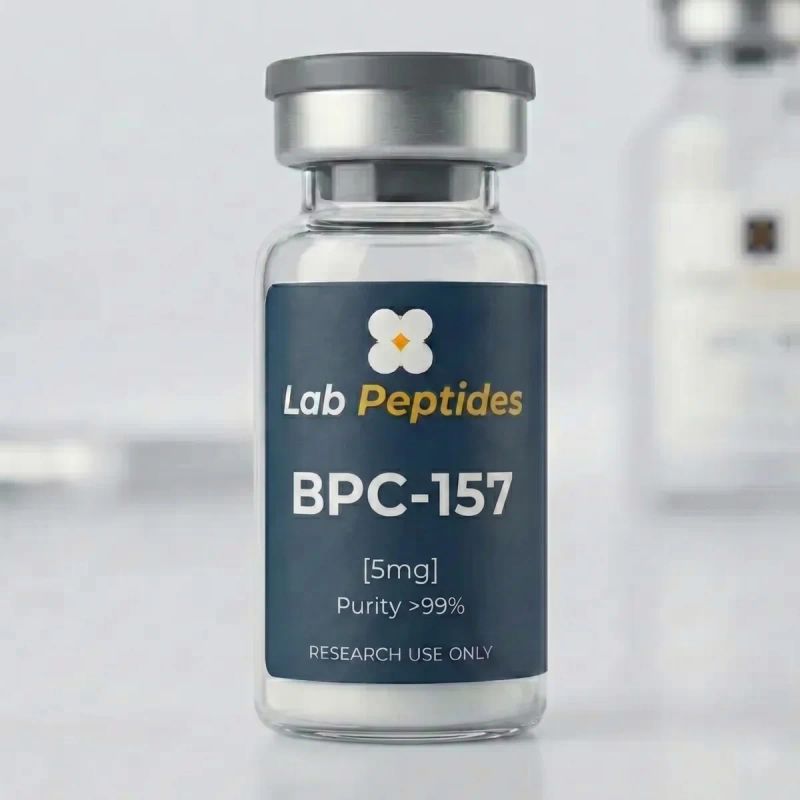
BPC-157 5mg Recuperación
Recuperación relámpago. 30 años de investigación.
La referencia absoluta de la recuperación. Un pentadecapéptido gástrico estudiado en investigación preclínica desde hace más de 30 años. Tendones, articulaciones, intestinos, mucosas — BPC-157 acelera la cicatrización tisular a un nivel nunca visto. El arma secreta de los atletas de alto nivel. Formato de protocolo flexible.
Este producto contiene BPC-157. Los trabajos publicados abordan la angiogénesis, la formación de nuevos vasos sanguíneos. Ningún ensayo clínico humano aleatorizado ha caracterizado las contraindicaciones.
Las alertas teóricas descritas en los trabajos preclínicos afectan a los antecedentes de cáncer, en particular tumores sólidos muy vascularizados, al embarazo y la lactancia, y a las retinopatías proliferativas.

Información del producto
Our BPC-157 5 mg vial is the ideal entry format for researchers wishing to initiate a first exploratory protocol without committing to large stock. With 5 mg of lyophilized peptide per vial at HPLC purity ≥98 %, this format suits short research cycles (2 to 3 weeks) and preliminary validations before moving to a more extended format. The certificate of analysis is published on this page, viewable before you order. BPC-157 5 mg is intended for independent researchers, experimental sports medicine clinics, and laboratories prioritizing maximum supply flexibility. Why choose the 5 mg format? Reduced initial investment, reconstitution flexibility (1 ml = 5 mg/ml or 2 ml = 2.5 mg/ml for fine dosing), typical autonomy 2-3 weeks at 250 mcg/day. The perfect pilot format to document a first phase before escalation.
01Mecanismo de acción
BPC-157 (Body Protection Compound-157) is a synthetic 15-amino-acid pentadecapeptide (Gly-Glu-Pro-Pro-Pro-Gly-Lys-Pro-Ala-Asp-Asp-Ala-Gly-Leu-Val), derived from a body-protection sequence originally identified in human gastric juice. Its unusual stability in acidic environments sets it apart from conventional peptides: the literature has reported a meaningful half-life at pH 2 and resistance to digestive proteases, making it a unique subject of study within the regenerative research peptide class.
At the molecular level, preclinical models have suggested a multimodal mechanism. BPC-157 modulates the nitric oxide (NO) system via an eNOS / neuronal NOS axis, which according to published observations influences local vasodilation and tissue perfusion. Complementary work has documented activation of the VEGFR2 (Vascular Endothelial Growth Factor Receptor 2) pathway, involved in angiogenesis, along with upregulation of early growth response genes (Egr-1) and the FAK-paxillin transcription factor in studied endothelial cells.
The peptide has also been reported to interact with central dopaminergic and serotonergic axes: rodent behavioral studies describe effects on neuroplasticity, GABAergic tone, and stress response. On the gastrointestinal front, literature has described mucosal barrier protection via modulation of endogenous prostaglandin (PGE2) and heat shock proteins (HSP70/90). These converging mechanisms position BPC-157 as a research peptide of particular interest in tissue-repair models (tendons, ligaments, skeletal muscle), traumatic brain injury (TBI) models, and experimental gastropathy.
It is critical to recall that all of this data comes from preclinical models (rodent, porcine, in vitro) and limited case studies. No marketing authorization exists for therapeutic human use: BPC-157 remains strictly a peptide for exploratory research.
Structurally, BPC-157 (Body Protection Compound 157) is a synthetic 15-amino-acid pentadecapeptide (sequence Gly-Glu-Pro-Pro-Pro-Gly-Lys-Pro-Ala-Asp-Asp-Ala-Gly-Leu-Val, mass 1419.6 Da) derived from a protective sequence identified by Sikiric and colleagues (University of Zagreb) from a stable fragment of human gastric juice, pepsin-resistant (Sikirić et al., em">Eur J Pharmacol 1991, J Physiol Paris 1997). Its stability in gastric acid radically distinguishes BPC-157 from most naturally occurring proteolysis-sensitive peptides. Molecular pathways documented in preclinical research include: (1) activation of nitric oxide (NO) synthesis via L-arginine/eNOS pathway, (2) transcriptional upregulation of VEGF-A and FGF-2 favouring angiogenesis, (3) modulation of the Egr-1 early transcription factor involved in fibroblast proliferation, (4) interaction with 5-HT2A and dopaminergic receptors in some behavioural models, (5) stabilisation of endothelial function via eNOS modulation and reduction of oxidative stress (8-OH-dG, MDA).
Péptidos similares
BPC-157 occupies a unique position within the regenerative research peptide class. Unlike TB-500 (Thymosin Beta-4 fragment), which acts primarily via G-actin sequestration and endothelial progenitor cell mobilization, BPC-157 exerts its action via an NO-dependent pathway and VEGFR2 modulation — two distinct but potentially complementary mechanisms, which is why research protocols sometimes combine both peptides (synergy documented in animal tendon repair models).
Compared to classical growth factors such as IGF-1 or GH (Growth Hormone), BPC-157 is distinguished by its local specificity and absence of marked endocrine systemic effects in studied models. GH and IGF-1 operate via generalized anabolic stimulation and mitogenesis, whereas BPC-157 appears to favor modulation of the tissue microenvironment (local angiogenesis, controlled inflammation, endothelial stabilization).
Compared to anti-inflammatory peptides such as LL-37 or cathelicidins, BPC-157 does not display direct antimicrobial activity but modulates the immune-vascular axis in a more refined manner. Compared to classical gastroprotective peptides such as sucralfate or proton pump inhibitors (PPIs), it acts via a completely different pathway: restoration of mucosal microcirculation rather than acid reduction or formation of a mechanical protective layer.
In our shop, BPC-157 is the most ordered recovery peptide, and one of the most documented in preclinical literature. Commercialization for human therapeutic use remains prohibited in France, Europe, and the United States, hence the importance of sourcing strictly intended for in vitro and ex vivo research.
Compared to other regenerative research peptides, BPC-157 sits in a specific segment: multi-organ systemic action with exceptional acid stability and versatility (documented PO, IP, SC, IM). TB-500 (synthetic thymosin β-4 fragment, LKKTETQ, 889 Da) shares tissue-healing indications but acts through a different mechanism (G-actin sequestration, Ac-SDKP anti-fibrosis). The BPC-157 + TB-500 combination is proposed in grey literature as complementary in preclinical tendon protocols. Compared to GHK-Cu (340 Da tripeptide), BPC-157 preferentially targets deep tissues and visceral healing, while GHK-Cu focuses on skin and dermal collagen production. Compared to PRP (platelet-rich plasma), BPC-157 offers the advantage of a standardised precisely-dosed formulation, unlike autologous PRP inherent variability. Compared to IGF-1 LR3, BPC-157 does not directly stimulate cell proliferation via IGF-1R but acts indirectly via NO/VEGF pathways — distinct use profile.