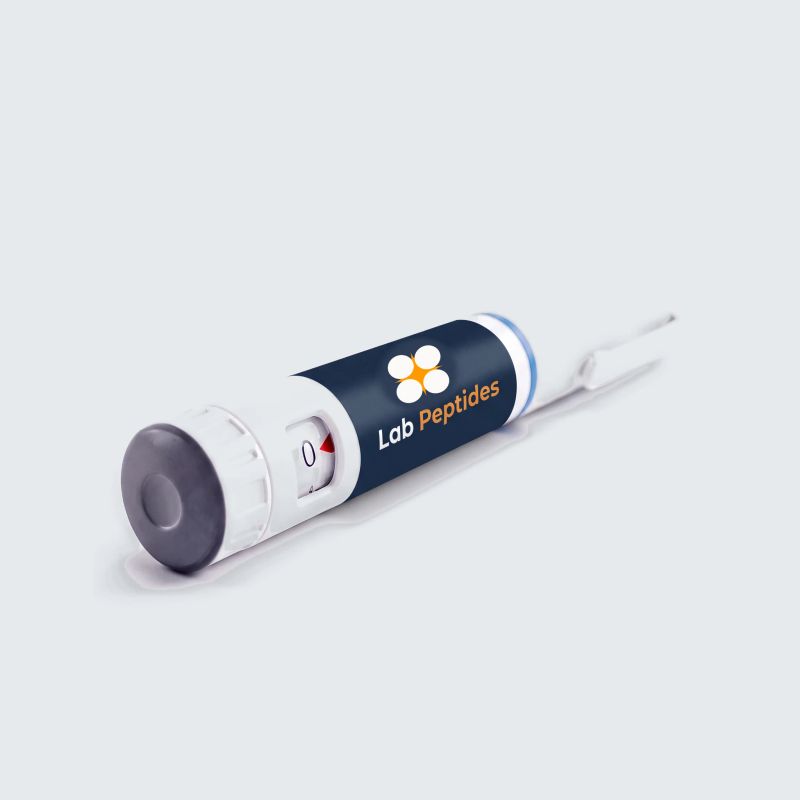
Retatrutide Pluma Precargada 20mg Metabolismo
El formato XL, listo para usar.
El mayor volumen de nuestra gama en pluma, para quien ya ha encontrado su ritmo. Triple agonista GLP-1, GIP y glucagón, entregado listo para usar: nada que reconstituir, nada que comprar aparte, la dosis se ajusta con la rueda. A igual volumen, es la pluma que sale más barata por miligramo, y la que le ahorra más pedidos al año. Se incluyen cuatro agujas: inyecta desde la recepción, sin pasar por la farmacia. Producto destinado a la investigación.
Inicio de los protocolos de investigación: 4 unidades en el dial, es decir 0,27 mg por semana.
20 mg = el contenido del bolígrafo, no la dosis.Ver la preparación
Uso exclusivo en investigación (RUO) · Prohibido para uso humano o veterinario.
Lo esencial
The largest volume in our pen range. Retatrutide is a triple agonist of the GLP-1, GIP and glucagon receptors; this ready-to-use format removes reconstitution and dose calculation, and offers the lowest cost per milligram among our pens. It suits those who have already settled into a routine.
Protocolo y preparación
Advertencia Herramienta teórica para manipulación química. No constituye un consejo médico.
Abrir las instrucciones ilustradas de la pluma- El bolígrafo lleva un marcado a mano: las iniciales del producto y la dosis. Es nuestra referencia de dosis en el cuerpo del bolígrafo. Compruebe que coincide con su pedido.
- Las agujas vienen en la caja, no puestas en el bolígrafo. Cuatro agujas de rosca, una nueva en cada inyección.
- El líquido es transparente e incoloro, a veces con una pequeña burbuja de aire. Es el aspecto esperado. El cebado, antes de la primera inyección, elimina la burbuja.
- El paquete es neutro. Nada en el exterior indica el contenido ni el nombre de la marca.
Lo que no es normal: un líquido turbio, coloreado o con partículas, un bolígrafo agrietado o un dial que no gira. En esos casos concretos, escríbanos con una foto y recuperamos el bolígrafo.
A pre-filled pen requires no reconstitution. The solution is ready to use: no powder to dissolve, no bacteriostatic water to add, no volume to calculate. That is the essential difference from a vial.
Before first use. Take the pen out of the fridge ten to fifteen minutes beforehand: a cold solution is more uncomfortable to inject, and this is the most common cause of discomfort. Check that the liquid is clear and colourless. A cloudy appearance or visible particles means it should not be used.
Attaching the needle. Remove the cap, screw on one of the needles supplied with the pen, then remove both needle covers. Use a new needle for every injection, never reuse one.
Priming. Before the very first injection from a new pen, set the dial to the smallest graduation and press the button until a droplet appears at the tip. This clears air from the cartridge and ensures the following dose is complete. It is not repeated for subsequent injections.
Setting the dose and injecting. Turn the dial to the desired figure. Pinch the skin lightly, insert the needle at ninety degrees, press the button fully and hold for ten seconds before withdrawing: this ensures the full dose has been delivered. Withdrawing too early is the most common mistake.
Afterwards. Remove the needle, dispose of it in a sharps container, replace the cap and return the pen to the fridge. Rotate the injection site each time.
Datos técnicos
- Reconstitución
- Prêt à l'emploi, aucune reconstitution. Molette graduée de 1 à 60 unités : 1 unité = 66,7 mcg, 30 unités = 2 mg, 60 unités = 4 mg. Le stylo contient 3 ml, soit 300 unités au total. Le liquide est de l'eau bactériostatique : rien à ajouter, rien à mélanger.
- Secuencia peptídica
- YXQGTFTSDYSILLDKKAQXAFIEYLLEGGPSSGAPPPS-NH2 (X = Aib ; lysine acylée)
- Fórmula molecular
- C221H342N46O68
- Peso molecular
- 4731.34 g/mol
- Número CAS
- 2381089-83-2
- Forma física
- Stylo pré-rempli, solution prête à l'emploi
- Solubilidad recomendada
- Aucune reconstitution : la solution est prête, la dose se règle à la molette
- Condiciones de conservación
- +2°C à +8°C, ne pas congeler, à l'abri de la lumière. Se conserve 1 an.
- Uso
- Reactivo de investigación, solo in vitro (RUO)
Conservación y manipulación
Store the pen between +2 °C and +8 °C, refrigerated and away from light. This is an important difference from lyophilised powder, which tolerates room temperature: a pen contains an already-reconstituted solution and therefore requires continuous refrigeration.
Never freeze it. A solution that has been frozen and thawed should be discarded, even if it looks normal.
Take the pen out a few minutes before injectingThis noticeably reduces discomfort without breaking the cold chain.
It tolerates a few hours out of the fridge during transport, between the delivery point and home. Return it to the cold as soon as you receive it.
Mecanismo de acción
Retatrutide acts simultaneously on three receptorsGLP-1, GIP and glucagon. This triple action distinguishes it from GLP-1-only agonists such as semaglutide, and from dual GLP-1/GIP agonists such as tirzepatide. Published work covers glycaemic regulation, gastric emptying and energy expenditure. This is a research compound: available data come from ongoing clinical studies and do not constitute a therapeutic indication.
Estudios y referencias
Clinical data on retatrutide are still recent but spectacular. The pivotal phase II obesity trial Jastreboff 2023 NEJM (Retatrutide Phase 2 Obesity Trial) tested 1/4/8/12mg weekly in 338 obese non-diabetic adults over 48 weeks. Mean weight loss: -8.7% (1mg), -17.1% (4mg), -22.8% (8mg), -24.2% (12mg) vs -2.1% placebo. At 12mg, 92% of participants lost >= 5%, 75% >= 15%, 56% >= 20%, and 26% lost >= 25%.
Phase II diabetes study Rosenstock 2023 Lancet281 T2D patients over 36 weeks with doses 0.5/4/8/12mg. HbA1c: -2.02% at 12mg vs -0.01% placebo; weight loss -16.94% vs -3.0% placebo at 12mg. Retatrutide demonstrated an effect equivalent or superior to the best GLP-1 mono-agonists on diabetes while producing markedly stronger weight loss.
Phase II hepatic steatosis study Sanyal 2024 LancetRetatrutide 5-10mg weekly in 98 patients with MASLD and obesity, over 48 weeks. Hepatic fat fraction reduction: -57.0% (5mg), -81.4% (10mg) vs -0.3% placebo. At 10mg, 85% of patients reached hepatic fat fraction < 5% (resolution threshold), 74% had >= 30% reduction. These results exceed those of any other pharmacological agent tested on MASLD, including tirzepatide in SYNERGY-NASH.
Phase III TRIUMPH trials are ongoing. TRIUMPH-1 (adult obesity, n=2250), TRIUMPH-2 (obesity with comorbidities), TRIUMPH-3 (type 2 diabetes + obesity), TRIUMPH-4 (MASH with fibrosis), TRIUMPH-6 (sleep/OSA): results expected 2025-2027. The program was designed to demonstrate broad superiority vs tirzepatide (direct comparator in certain arms) on weight loss, metabolic improvement, hepatic steatosis, and sleep apnea.
Tolerance profileIn phase II trials, gastrointestinal adverse events (nausea, vomiting, diarrhea, constipation) are frequent but mostly mild-to-moderate and concentrated in the early titration weeks. Adverse-event discontinuation rate was 6-16% depending on dose. Two signals deserve vigilance: mean heart rate increase of 3-7 bpm (similar to tirzepatide, likely linked to the GLP-1 arm), and modest ALT elevation in some patients (likely linked to GCGR-induced hepatic lipolysis). Retatrutide did not produce significant hypoglycemia in non-diabetics, confirming that the glucagon arm is properly balanced by the incretin arm.
In research these references structure protocols. The standard phase II titration was: 2mg W1-4, 4mg W5-8, 8mg W9-12, 12mg W13+ (progression by 4mg steps every 4 weeks). Researchers seeking to reproduce Jastreboff 2023 conditions use this schema as reference. Phase III trials test extended plateaus up to 16mg in certain arms, reflecting the possibility of an unsaturated dose-response even at 12mg.
- 1
- 2
¿Bolígrafo o vial?
Pen or vial? The contents are identical molecule for molecule. What changes is everything around it.
With a vial, you buy the powder, then bacteriostatic water, then insulin syringes. You reconstitute it yourself, work out your concentration, and convert your dose into syringe units. The vial costs less per milligram and lets you choose the concentration.
With a pen, there is nothing else to buy, needles are included, nothing to prepare and nothing to calculate: the dose is read off a dial. In exchange, the concentration is fixed and the pen must be kept refrigerated.
The vial suits those already comfortable with the process who want to optimise cost. The pen suits those coming from a pen-based treatment, those starting out, or anyone who would rather not handle a syringe.
Preguntas frecuentes
Do I need to add bacteriostatic water?
Are needles included with the pen?
How many doses does a pen contain?
What if the pen has been left out of the fridge?
Why hold for ten seconds after pressing?
Is the content the same as in your vials?
Can a pen be shared between several people?
 La guía completaRetatrutida (LY3437943): guía completa del triple agonistaEstructura, mecanismo de triple agonista, farmacocinética, programa TRIUMPH (1-4, Obesity, HFpEF, MASH), comparación con semaglutida y tirzepatida, protocolos de reconstitución solo para investigación, estabilidad y perspectivas regulatorias. La referencia científica sobre la retatrutida.Leer la guía
Lee también:Retatrutide: la página dedicada