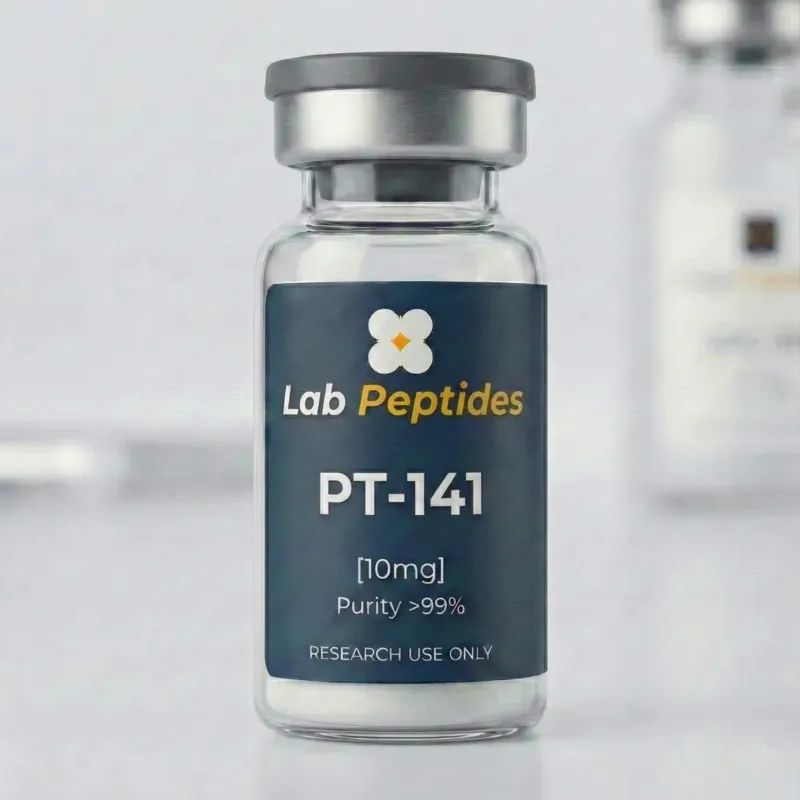
PT-141 10mg Bienestar
Deseo disparado. Acción central.
El único péptido que actúa directamente sobre el deseo. Bremelanotide activa la vía central MC4R — mecanismo totalmente distinto del de Viagra/Cialis. Eficacia documentada sobre la libido femenina Y masculina. Aprobado por la FDA para el HSDD. La molécula del Vyleesi, en vial de investigación.
- Certificado de análisis del lote
- Stock en Francia
-10 % de por vida en cada cicloPause, salte o cancele en 1 clicSin compromiso, sin gastos ocultos
Tu kit completo
- Vial 10mgIncluido
- Agua bacteriostáticaAñadir
- Jeringas de 1 mlAñadir
El vial por sí solo no puede usarse tal cual. Un vial sellado de PT-141 10mg, liofilizado, sin etiquetado individual.
No olvide lo imprescindible
Se compran juntos a menudo



Información del producto
PT-141, or bremelanotide, is a synthetic cyclic heptapeptide Ac-Nle-cyclic[Asp-His-D-Phe-Arg-Trp-Lys]-OH of molecular weight 1025 Da, derived from alpha-MSH (melanotropic hormone) through successive structural modifications of Melanotan II. It is the result of a research programme initiated in the 1990s at the University of Arizona, then industrialised by Palatin Technologies. In 2019, the US FDA approved bremelanotide under the commercial name Vyleesi for the treatment of hypoactive sexual desire disorder (HSDD) in premenopausal women, following two randomised phase 3 trials (RECONNECT) totalling more than 1247 patients.
Its pharmacological originality is profound: unlike PDE5 inhibitors (sildenafil, tadalafil) which act peripherally on penile or clitoral vessels, PT-141 acts centrally on the central nervous system, at the melanocortin MC3R and especially MC4R receptors located in the hypothalamus. It thus activates desire itself, upstream of the vascular cascade, and also works in non-responders to PDE5 (diabetic neuropathy, post-prostatectomy nerve injury, psychogenic dysfunction).
This vial delivers 10 mg of high-purity PT-141 (>98 %, HPLC) in lyophilised form, type I borosilicate glass, fluorinated butyl stopper, argon atmosphere. The standard documented dose (1.75 mg SC as a single dose) allows approximately 5-6 uses per vial. Destined exclusively for in vitro research and preclinical studies on non-human models, in accordance with European regulations; no human, dietary or medical use.
01Mecanismo de acción
The PT-141 mechanism is central and articulates primarily around melanocortin receptors. Five subtypes MC1R-MC5R exist in humans: MC1R (skin/hair pigmentation), MC2R (adrenal cortex, cortisol), MC3R and MC4R (central nervous system, food intake, sexual function), MC5R (exocrine glands). PT-141 is a preferential MC3R/MC4R agonist with reduced affinity for MC1R (key difference with Melanotan II, which minimises pigmentation).
MC4R activation in the paraventricular nucleus of the hypothalamus triggers a neuroendocrine cascade: oxytocin release from magnocellular neurons, dopamine increase in the ventral tegmental area and nucleus accumbens (reward circuits), spinal parasympathetic activation (sacral parasympathetic nucleus). These three effects converge towards facilitation of sexual arousal: oxytocin modulates motivation and attachment, dopamine creates anticipatory desire, and parasympathetic activation potentiates the peripheral vascular response (tumescence).
Unlike PDE5 inhibitors, PT-141 does not act directly on guanylate cyclase or vascular nitric oxide. It cannot therefore cause prolonged erection of the priapism type by blocking the detumescence inhibitor system. The erection or lubrication obtained under PT-141 remains controlled by normal physiological mechanisms, simply potentiated by activated central desire.
Pharmacokinetics: after subcutaneous injection of 1.75 mg, plasma peak in 1 hour, half-life 2-2.7 hours, urinary elimination. Biological effect (desire and arousal) peaks at 1-2 hours, perceptible duration 4-10 hours depending on subjects. Metabolisation is minimal, the peptide is excreted intact or slightly hydrolysed.
Central collateral effect: MC4R hypothalamic stimulation also affects appetite (transient reduction 20-40 %), anxiety (variability between subjects: mild anxiolysis for some, activation for others) and thermoregulation. Residual MC1R activation can cause discreet tanning at repeated doses.
The most frequent side effect is nausea (~40 % of subjects in RECONNECT trials), mediated by MC4R activation central and peripheral at the chemoreceptor vomiting zone. This nausea is moderate, dose-dependent and attenuated by injection after light meal, preventive antiemetic, or dose fractionation.
Péptidos similares
PT-141 differs radically from other sexual sphere agents through its central mechanism and activity spectrum.
Versus PDE5 inhibitors (sildenafil, tadalafil, vardenafil): PDE5 inhibitors act peripherally on genital vasodilation by preventing cGMP degradation. PT-141 acts centrally on desire. Mechanisms are complementary, non-competitive. PDE5 are ineffective if central activation is lacking (absent desire, ineffective stimulation), PT-141 is effective even in PDE5 non-responders. In combination, effects may be additive but increase the risk of flush and hypotension (both modulate blood pressure differently).
Versus testosterone (male or female replacement therapy): testosterone corrects an underlying hormonal deficit with effects over several weeks-months. PT-141 acts acutely over a few hours. In hypogonadic patients, testosterone must be corrected before evaluating PT-141. In women with testosterone-normal HSDD, PT-141 is a non-hormonal option.
Versus flibanserin (Addyi, serotonergic for female HSDD, FDA approved 2015): flibanserin is a 5HT1A agonist/5HT2A antagonist in daily intake (nightly to limit drowsiness), with modest effect and major alcohol interaction (alcohol prohibition required). PT-141 is PRN (as needed), without such severe alcohol restriction, with faster effect. Different side effect profiles (flibanserin: drowsiness, hypotension; PT-141: nausea, flush).
Versus Melanotan II (pharmacological precursor): MT-II is the ancestor of PT-141, non-selective MC1R/MC3R/MC4R/MC5R agonist. It causes marked pigmentation (MC1R) and sexual effect recognised as side effect in early users. PT-141 was designed to minimise MC1R and maximise MC4R: improved selectivity, pigmentation almost absent at usual doses.
Versus apomorphine (dopamine D2 agonist, former ED treatment): central dopaminergic mechanism. Moderate tolerance, frequent nausea. Withdrawn from the US market in 2003. PT-141 has a non-dopaminergic melanocortin profile, complementary.
Versus cognitive-behavioural and couple therapies: PT-141 does not replace the psycho-relational approach. In RECONNECT, the placebo effect was 20-25 %, underlining the important psychogenic component of HSDD. An integrated approach (peptide + therapy + hormones if deficit) is often superior to each isolated component.
Versus other research catalogue peptides (Kisspeptin-10 gonadotropic, intranasal Oxytocin, DSIP for sleep): different neuroendocrine targets. Kisspeptin modulates the GnRH axis (endogenous LH/FSH production), oxytocin acts directly on attachment/trust system, DSIP on sleep. PT-141 is the only catalogue peptide oriented directly towards central sexual desire.
Unique positioning: the only research catalogue peptide with FDA approval in a female sexual indication, innovative central mechanism, substantial clinical corpus in women, documented off-label use in male PDE5 non-responder. It is a specific tool not to be trivialised but whose place in the research peptide arsenal is clear.