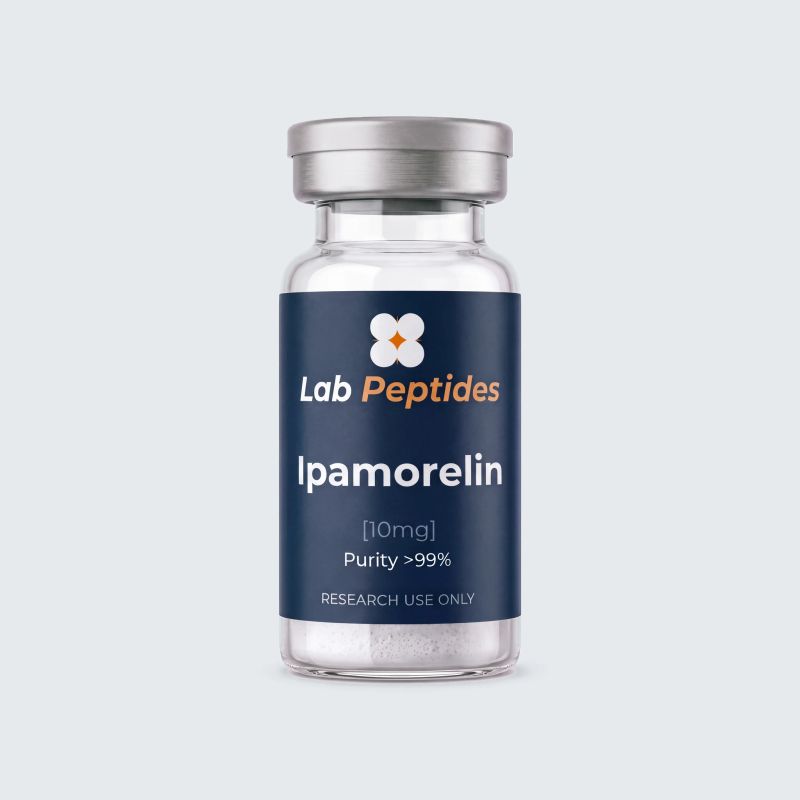
Ipamorelin 10mg Factores de crecimiento
El secretagogo más limpio.
El secretagogo más limpio del mercado. Selectividad total sobre los receptores de grelina → sin cortisol, sin prolactina, sin efecto apetito indeseado. Estimulación pura y dirigida del eje GH. La elección premium para los protocolos a largo plazo con cero efectos secundarios.
- Stock en Francia
 Pedido con su agua: enviado en estuche imantado
-10 % en cada envíoPause, salte o cancele en 1 clicSin compromiso, sin gastos ocultos
Sin cargo automático: pague cada envío con tarjeta, en Bitcoin (-5 % adicional) o por transferencia desde 100 €
Tu kit completo
El vial por sí solo no puede usarse tal cual. Añada lo necesario para prepararlo:
Se compran juntos a menudo


Uso exclusivo en investigación (RUO) · Prohibido para uso humano o veterinario.
Lo esencial
Our Ipamorelin 10 mg vial is the most selective GHRP (Growth Hormone Releasing Peptide) available in peptide research. Initially developed by Novo Nordisk in the 1990s, Ipamorelin is a pentapeptide (Aib-His-D-2-Nal-D-Phe-Lys-NH2) selective agonist of the GHS-R1a receptor (ghrelin receptor), responsible for stimulating pulsatile growth hormone secretion without the cross-side effects characteristic of non-selective GHRPs. With 10 mg of lyophilized peptide per vial at HPLC purity ≥98 %, this format covers approximately 20 to 40 days of protocol at the typical 250-500 mcg/day dose.
En detalle
Ipamorelin is the reference GHRP for research protocols seeking to avoid the undesirable increases in cortisol, prolactin, or ACTH reported with GHRP-6 or Hexarelin. It is systematically associated with CJC-1295 DAC in secretagogue literature to explore the GHRH + GHRP synergy on GH pulsatility. The flexible pilot format to document a first secretagogue response.
Protocolo y preparación
| Agua añadida | Concentración | Marca de lectura |
|---|---|---|
| 1 ml | 10 mg/ml | 10 UI = 1 mg |
| 2 ml | 5 mg/ml | 40 UI = 2 mg |
El volumen de agua no cambia el producto, solo su concentración. Introduzca el agua despacio por la pared del vial, nunca directamente sobre el liofilizado, y luego gírelo suavemente sin agitar. Las marcas se dan sobre una jeringa de 1 ml graduada en 100 unidades.
Asepsia
Desinfecte las superficies y los tapones (alcohol al 70%).
Disolvente
Extraiga el volumen necesario de agua bacteriostática.
Introducción
Inyecte suavemente contra la pared del vial (evite el chorro directo sobre el polvo).
Solubilización
Haga rodar el vial suavemente. No lo agite con fuerza (riesgo de degradación).
Conservación de la solución Una vez reconstituido: 2-8°C (nevera).
Advertencia Herramienta teórica para manipulación química. No constituye un consejo médico.
Abrir la calculadora de dilución- La cantidad de polvo parece mínima. Un liofilizado ocupa unos pocos milímetros en el fondo del vial, a veces solo una película translúcida. El peso indicado está ahí.
- El polvo está compacto, pegado a la pared o al tapón. El transporte desplaza la torta liofilizada. No cambia nada en la reconstitución.
- El vial no lleva etiqueta individual. Es nuestro embalaje estándar, no un vial de menor calidad.
- Tras la reconstitución aparecen depósitos o filamentos. Es habitual, sobre todo con moléculas pequeñas. Deje que se asiente y haga rodar el vial entre las palmas, nunca lo agite.
- El paquete es neutro. Nada en el exterior indica el contenido ni el nombre de la marca.
Lo que no es normal: un vial agrietado, una cápsula sin engastar o un tapón que se mueve, polvo que se ha licuado o cambiado de color. En esos casos concretos, escríbanos con una foto y recuperamos el vial.
Recommended reconstitution: 2 ml bacteriostatic water for injection → final concentration 5 mg/ml. Procedure: 1) let vial and diluent reach room temperature (15 minutes); 2) disinfect stopper with 70% alcohol; 3) draw bacteriostatic water into sterile syringe; 4) inject slowly along inner wall of vial; 5) gently swirl until dissolution — no vigorous shaking. Dosages reported in literature: exploratory human research protocols (outside authorized therapeutic framework) typically mention 200 to 300 mcg per injection, 2 to 3 times daily subcutaneously, or 400-900 mcg/day total. Some protocols explore higher doses (500 mcg x 3/day = 1500 mcg/day). At 5 mg/ml concentration, 200 mcg corresponds to 0.04 ml (4 units on 100 IU syringe), 300 mcg to 0.06 ml (6 units), and 500 mcg to 0.1 ml (10 units). Documented optimal timing: injections are typically placed away from meals (2 hours before or after a carbohydrate- or lipid-rich meal that may attenuate GH response). Classic moments are: morning fasted, pre-workout, before bedtime. Autonomy: 10 mg allows approximately 11 days at 300 mcg x 3/day (~900 mcg/day), or a pilot cycle of about ten days. For an extended 6-8 week protocol at this regimen, plan for 4 to 5 vials. Documented synergy with CJC-1295 DAC: the CJC-1295 DAC (1 mg/week) + Ipamorelin (200-300 mcg x 2-3/day) combination is the most studied secretagogue protocol, exploiting the GHRH-R + GHS-R1a synergy to amplify GH pulsatility without cortisol/prolactin effects. Post-reconstitution storage: refrigerator 2-8 degrees Celsius, 28-day usage window with bacteriostatic.
Datos técnicos
- Reconstitución
- 2 ml d'eau → 5 mg/ml. 4 UI = 200 mcg ; 6 UI = 300 mcg.
- Secuencia peptídica
- Aib-His-D-2-Nal-D-Phe-Lys-NH2
- Fórmula molecular
- C38H49N9O5
- Peso molecular
- 711.9 g/mol
- Número CAS
- 170851-70-4
- Forma física
- Poudre lyophilisée blanche
- Solubilidad recomendada
- Eau bactériostatique, NaCl 0.9%, acide acétique 0.1%
- Condiciones de conservación
- Au réfrigérateur (+2 à +8 °C), à l'abri de la lumière. En poudre, possible au congélateur pour une conservation longue. Une fois préparé : réfrigérateur, jamais au congélateur.
- Uso
- Reactivo de investigación, solo in vitro (RUO)
Conservación y manipulación
Lyophilized unreconstituted Ipamorelin is stored in the fridge (+2 to +8 °C) in its original sealed packaging, protected from light and humidity; for long-term storage (over 3 months), a -20 °C freezer keeps it for up to 24 months. At refrigerated temperature (2-8 degrees Celsius), documented stability covers a minimum of 12 months. At room temperature (below 25 degrees Celsius), recommended duration for transport or temporary storage: 3 weeks maximum. Once reconstituted with bacteriostatic water, Ipamorelin must be stored between 2 and 8 degrees Celsius. Documented post-reconstitution stability: 28 days with bacteriostatic (benzyl alcohol 0.9%), 7 days with preservative-free sterile water. Specific sensitivities: like all short pentapeptides, Ipamorelin is sensitive to repeated freeze-thaw cycles (limit to a maximum of three), histidine oxidation (avoid contact with non-inert metals), and prolonged acidic or basic hydrolysis. Avoid direct UV exposure and thermal shocks. Lyophilised Ipamorelin shows excellent stability at -20°C under desiccation (> 24 months with no measurable RP-HPLC purity loss). In reconstituted solution (0.9% benzyl alcohol bacteriostatic water, 1-5 mg/mL), documented 28-day stability at 2-8°C in amber vial. Optimal pH is 5.5-7.0: avoid highly acidic (pH < 4) or basic (pH > 8) solutions favouring deamidation of C-terminal Lys-NH2 residue and hydrolysis of D-Phe-Lys amide bonds. N-terminal Aib confers superior exopeptidase resistance but remains sensitive to oxidative conditions: strictly protect from UV light and avoid exposure to residual hydrogen peroxide in diluents. Unlike more complex peptides, Ipamorelin contains no Cys (no disulfide dimer risk) nor Met (no oxidation), simplifying storage logistics. Repeated freeze/thaw cycles must be avoided as they generate aggregates detectable by SEC-HPLC.
Mecanismo de acción
Ipamorelin is a synthetic pentapeptide with sequence Aib-His-D-2-Nal-D-Phe-Lys-NH2 (amino-isobutyric acid - histidine - D-naphthylalanine - D-phenylalanine - amidated lysine), molecular weight 711.85 Da. The sequence integrates non-natural residues (Aib, D-2-Nal, D-Phe) conferring increased metabolic stability and optimizing affinity for the target receptor.
At the molecular level, Ipamorelin is a selective agonist of the GHS-R1a receptor (Growth Hormone Secretagogue Receptor 1a), also known as the ghrelin receptor. This Gq/11-coupled receptor is expressed primarily in somatotropic cells of the anterior pituitary and in certain hypothalamic areas (arcuate nucleus, paraventricular nucleus). Receptor activation triggers a PLC-IP3-Ca2+ cascade leading to rapid pulsatile release of GH stored in secretion granules.
The distinctive characteristic of Ipamorelin is its exceptional SELECTIVITY: unlike other GHRPs (GHRP-6, GHRP-2, Hexarelin), Ipamorelin does NOT induce significant increases in prolactin, cortisol, ACTH, or aldosterone at studied therapeutic doses. This selectivity was documented in the foundational Raun et al. study (1998) and confirmed by subsequent independent work. It makes Ipamorelin the preferred GHRP for research protocols where GH effect specificity is a priority.
Pharmacokinetically, Ipamorelin presents a short plasma half-life of approximately 2 hours, with a GH peak observed 30-45 minutes after subcutaneous injection. This rapid kinetics requires multi-daily administrations (2-3 times per day) to maintain chronic stimulation, typically in synergy with an extended-duration GHRH analog such as CJC-1295 DAC.
Preclinical and exploratory human studies have documented GH increases of 5 to 15 times baseline after injection, with return to baseline values in 3-4 hours. IGF-1 increases 1.5 to 2 times baseline after 1-2 weeks of regular protocol. Ipamorelin is not approved for human therapeutic use and remains an exploratory research tool.
Structurally, Ipamorelin is a synthetic pentapeptide (Aib-His-D-2-Nal-D-Phe-Lys-NH2, 711.9 Da) designed by NovoNordisk in collaboration with Ferring in the mid-1990s as a selective tool for the GHS-R1a receptor (Growth Hormone Secretagogue Receptor type 1a). Two key structural features distinguish it from other GHRPs: (1) incorporation of an α-aminoisobutyric residue (Aib) at position 1 replacing the histidine of classical GHRPs, stabilising the β-turn conformation required for receptor activation, (2) presence of a D-2-naphthyl-alanine (D-2-Nal) at position 3 replacing the D-isomer tryptophan, increasing GHS-R1a selectivity over related receptors. Pharmacologically this yields a highly selective GHS-R1a agonist which, in classical rodent studies (Raun et al., Eur J Endocrinol 1998), does not significantly elevate cortisolemia, ACTH, prolactin or FSH/LH at effective doses, unlike GHRP-2 and GHRP-6. This "clean" selectivity makes Ipamorelin the reference tool to specifically isolate the ghrelin-like effect on the somatotropic axis. Signalling activates PLC-β → DAG + IP3 → intracellular Ca²⁺ + PKC (via Gαq) plus Gαs-cAMP-PKA, with a balanced profile neither Gαs- nor β-arrestin-biased in recent cryo-EM and BRET studies (2020-2023).
Estudios y referencias
The scientific corpus on Ipamorelin primarily comes from the founding work of the Raun group (Novo Nordisk) in the 1990s, then from European and American academic teams studying the selective GHRP class.
Raun et al. (European Journal of Endocrinology 1998; DOI 10.1530/eje.0.1390552) published the foundational study on Ipamorelin, documenting in rat and dog a dose-dependent GH stimulation without significant increase in prolactin, cortisol, or ACTH — unlike GHRP-6 and GHRP-2 studied in the same protocol. This study established Ipamorelin as the first GHRP with pure GH selectivity.
Gobburu et al. (Journal of Clinical Pharmacology 1999) conducted the first pharmacokinetic studies in healthy humans, documenting biphasic kinetics, subcutaneous bioavailability, and absence of significant adverse effects after single injection. The 2h half-life and 30-45 min GH peak were confirmed.
Gonzalez-Lopez et al. (Growth Hormone & IGF Research 2000) explored the chronic response of the somatotropic axis under Ipamorelin administered 2-3 times daily for 4 weeks in adult rats, documenting a sustained IGF-1 increase without notable GHS-R1a receptor desensitization.
Beck et al. (Hormone Research 2001) studied the Ipamorelin + GHRH 1-29 combination in dogs, providing the first data on GHRP + GHRH synergy that would later be explored with CJC-1295 DAC. GH increase was significantly superior to the sum of individual effects.
Several human phase 2 clinical trials (indicationsPost-operative ileus, cachexia, elderly undernutrition) were conducted between 2000 and 2010 by various sponsors. Results showed good tolerance but mixed clinical efficacies, leading to discontinuation of most commercial programs. Helixmith/Bachem currently holds rights on certain research indications.
Corpus limitationsHuman studies are essentially phase 1-2 with cohorts <100 subjects, long-term data (>6 months) are rare, and no marketing authorization has been obtained. Ipamorelin remains strictly an exploratory research peptide outside validated clinical protocols.
Ipamorelin preclinical models cover acute GH stimulation, lean mass preservation in cachexia and post-operative healing. In young Sprague-Dawley rats, SC bolus 5-50 µg/kg: plasma GH peak reaching 100-300 ng/mL at 10-15 min, return to baseline at 60-90 min, without significant elevation of cortisol, ACTH, prolactin or FSH/LH at rodent therapeutic doses (Raun 1998). In ovariectomised (OVX) rats: chronic administration 4-6 weeks preserves trabecular bone mineral density (µCT) and femoral mechanical strength (3-point bending). In C26 tumor cachexia model in BALB/c mice: partial preservation of lean mass quantified by DEXA and reduced weight loss vs untreated control. In postoperative ileus model in dogs and pigs (Helsinn Therapeutics studies leading to subsequent clinical trials — phase III program discontinued): Ipamorelin favours digestive motility recovery via central GHS-R1a action and peripheral action on myenteric plexuses. In aged rat model (18-24 months): plasma IGF-1 elevation partially restoring juvenile levels over 4-8 weeks, notably in co-administration with CJC-1295 (DAC or non-DAC). All these data are preclinical (RUO), no therapeutic human use authorised.
Péptidos similares
Ipamorelin occupies a unique position in the GHRP (Growth Hormone Releasing Peptides) class thanks to its exceptional selectivity on the GHS-R1a receptor without undesirable effects on corticotropic, lactotropic, or mineralocorticoid axes.
Compared to GHRP-6 (the first widely used GHRP), Ipamorelin offers a significantly cleaner profile: GHRP-6 substantially increases prolactin, cortisol, and stimulates hunger via its central orexigenic effect. Ipamorelin preserves the adjacent hormonal profile while providing comparable GH stimulation at equipotent dose.
Compared to GHRP-2 (improved GHRP-6 evolution), Ipamorelin remains more selective: GHRP-2 still produces a slight prolactin increase and modest cortisol stimulation. GH response amplitude is similar between the two peptides.
Compared to Hexarelin (historically the most potent GHRP), Ipamorelin avoids the rapid desensitization and marked cortisol and prolactin increases reported with Hexarelin in prolonged use. Hexarelin retains its interest in short protocols where potency outweighs selectivity.
Compared to MK-677 (Ibutamoren, non-peptide oral secretagogue), Ipamorelin presents a more physiological pulsatile kinetics (peak-return-peak) versus MK-677 which produces a sustained non-pulsatile elevation that may desensitize the receptor long-term. Ipamorelin however requires daily injections, against a single oral dose for MK-677.
In synergy with CJC-1295 DAC (extended-duration GHRH analog), Ipamorelin forms the most studied secretagogue duo in literature, exploiting the two independent GHRH-R + GHS-R1a pathways to maximize physiological GH pulsatility. This combined protocol remains the gold standard in secretagogue research.
In our shop, Ipamorelin is the most ordered GHRP, thanks to its selectivity profile. Its commercialization for human therapeutic use remains prohibited in France, Europe, and the United States — strict research use.
Ipamorelin stands out from other GHRPs by its exceptionally selective activity profile. Compared to GHRP-2 (D-Ala-D-β-Nal-Ala-Trp-D-Phe-Lys-NH2, 817 Da): Ipamorelin induces similar GH release but without detectable cortisol, ACTH or prolactin elevation at effective doses, while GHRP-2 modestly elevates these hormones at high doses. Compared to GHRP-6 (His-D-Trp-Ala-Trp-D-Phe-Lys-NH2, 872 Da): Ipamorelin has no significant orexigenic effect (GHRP-6 strongly activates food intake via hypothalamic POMC/NPY). Compared to Hexarelin (His-D-2-MeTrp-Ala-Trp-D-Phe-Lys-NH2, 887 Da): Ipamorelin does not activate the CD36 receptor expressed on cardiomyocytes, while hexarelin shows a CD36-mediated cardiotropic effect in rodent ischaemia models. Compared to MK-677 (ibutamoren): Ipamorelin is peptide and SC injectable with acute kinetics (~90 min), MK-677 is oral with 24h chronic kinetics — complementary pharmacological tools. Compared to GHRH analogues (sermorelin, CJC-1295 with or without DAC, tesamorelin): different mechanism (GHS-R1a Gαq/Gαs vs GHRHR Gαs), systematically documented supra-additive synergy in co-administration. In research protocols, Ipamorelin + CJC-1295 (non-DAC) is the preferred combination for reconstituted physiological GH pulsatility studies.
Preguntas frecuentes
Why is Ipamorelin the most selective GHRP?
How do I reconstitute Ipamorelin 10 mg?
Why combine Ipamorelin with CJC-1295 DAC in research?
Which biological markers are tracked in Ipamorelin protocols?
Is your Ipamorelin authentic?
What is the delivery lead time in Europe?
What is the documented tolerance profile?
How long does a 10 mg vial cover in protocol?
Why is Ipamorelin considered the 'cleanest' GHRP?
What is Ipamorelin's plasma half-life in rodents?
Ipamorelin + CJC-1295: which combination to recommend in research?
 La guía completaCJC-1295: guía completa DAC vs no DAC (Mod GRF 1-29) en investigaciónCJC-1295 con o sin DAC: estructura, semivida (8 días frente a 30 minutos), pulsatilidad de la GH, ensayos de Teichman e Ionescu 2006, asociación con ipamorelina, comparación con sermorelina y tesamorelina, y reconstitución.Leer la guía
Lee también:Ipamorelina: guía completa del GHRP selectivo (estudios, dosis, estatus)